
Why Did Broadcom's Stock Price Plummet Despite Strong Earnings? — The Beginning of AI Layer Rotation
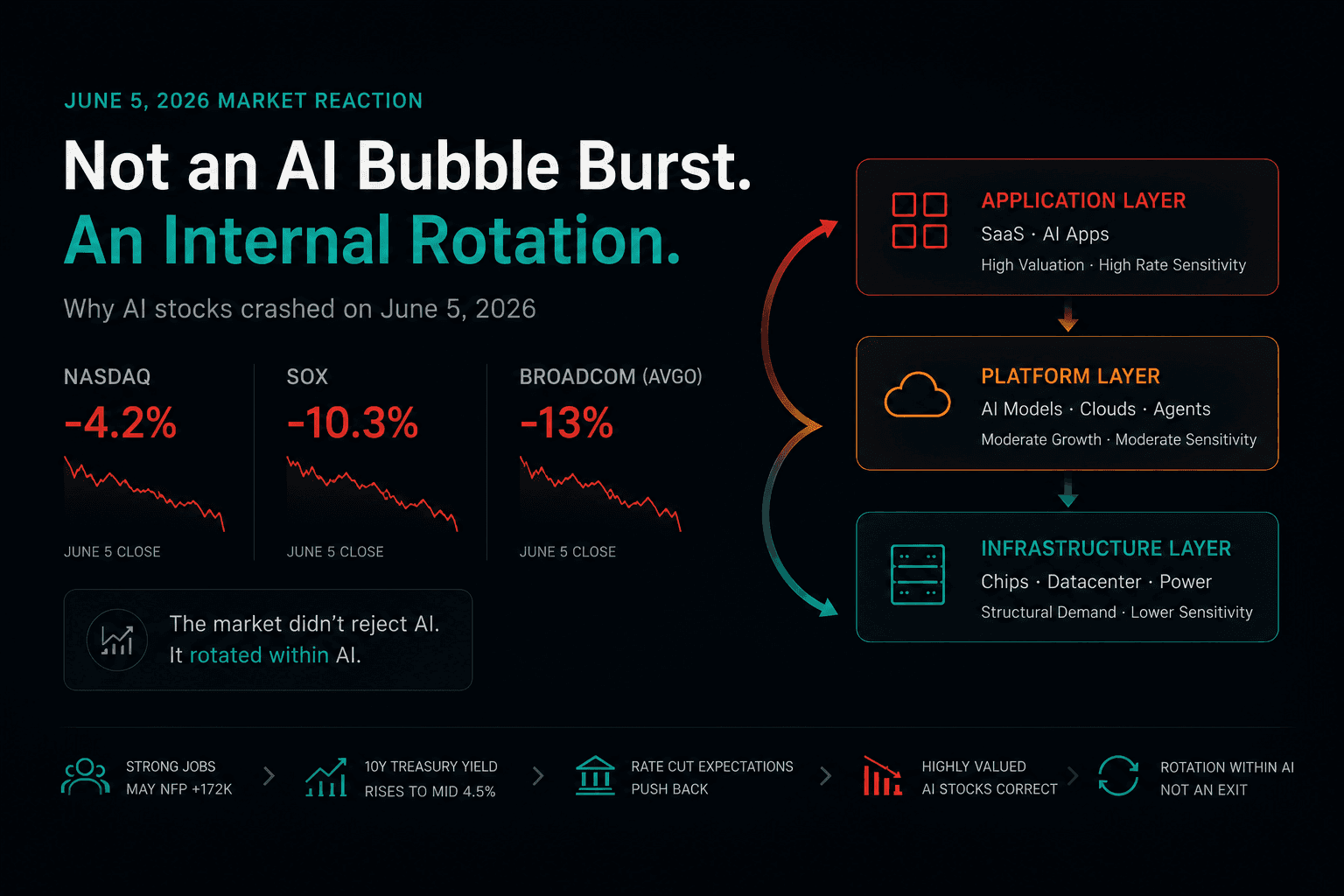
The Nasdaq fell 4.2% in a single day. The semiconductor index plummeted 10.3%. Many headlines told the same story: “The AI bubble has started to burst.” However, at that very moment, Broadcom’s AI business was growing 140% year-over-year. It was not that demand had declined. Broadcom was not the starting point of this correction, and it was not the entire AI sector that collapsed. If you interpret June 5th in this way, what you need to look for in your portfolio changes.
1 The reason the stock price plummeted despite good earnings
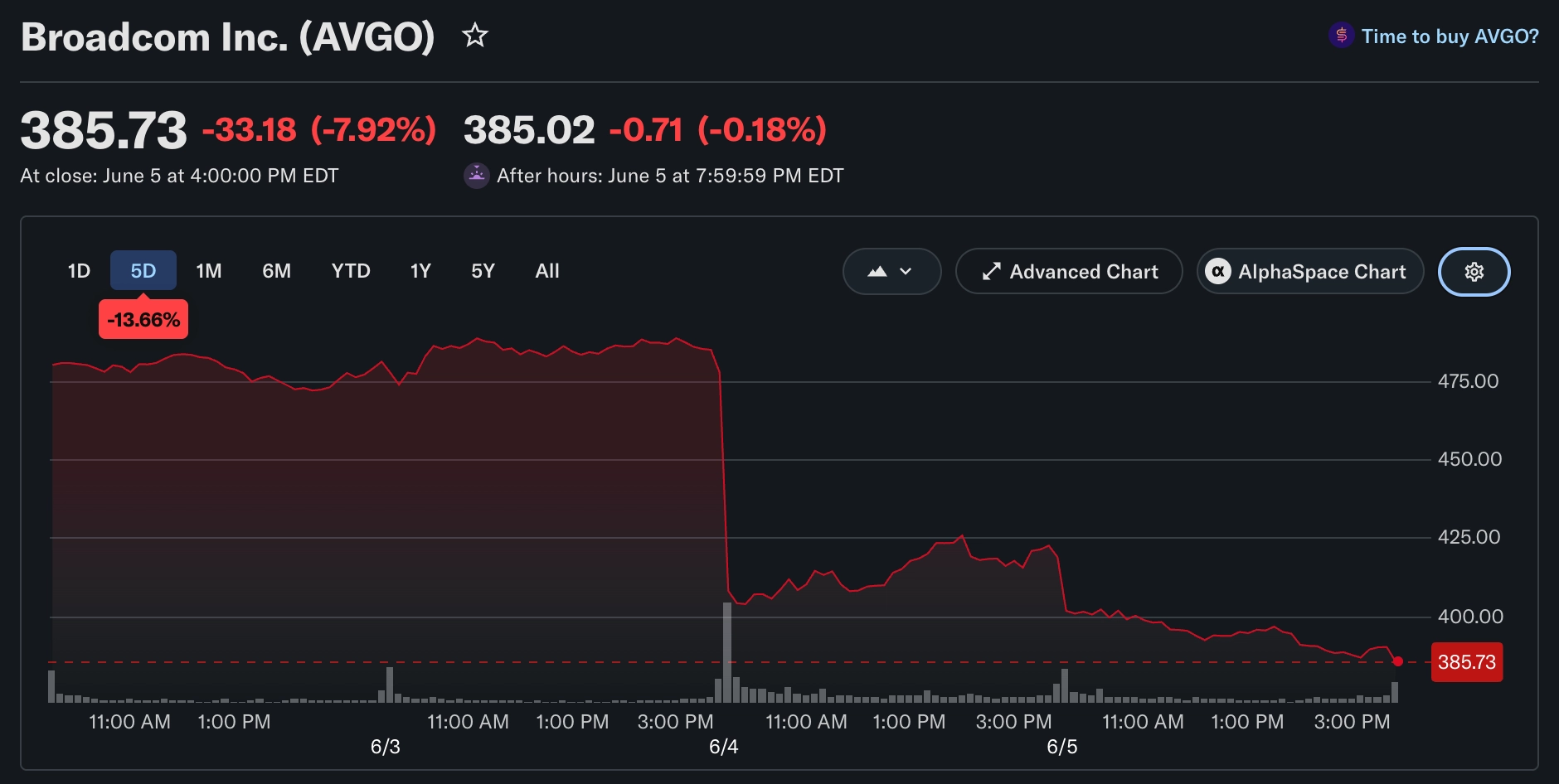
Broadcom announced its earnings on June 3. Both EPS and revenue exceeded consensus estimates. Quarterly revenue from the AI chip business was $10.7 billion , up 140% year-over-year. The CEO maintained the 2027 AI revenue target of $100 billion .
However, the stock price plummeted 13% after the earnings announcement.
The factor of disappointment was the lack of an upward revision in guidance. The market was waiting for an upward adjustment. The problem was that expectations were greater than those for Broadcom. However, this alone is insufficient to explain the correction on June 5.
What actually shook the market was the May NFP announced two days later. The forecast was 80,000 , but the actual figure was 172,000, significantly exceeding expectations. If employment remains this robust, the justification for the Fed to rush to lower interest rates weakens. As the U.S. 10-year Treasury yield rose to the mid-4.5% range , AI growth stocks across the board wavered.
The shock was felt first and more severely in the stocks where expectations were most reflected.
2Three things that happened on the same day
When Aleph lowered its Macro Pulse to 56.1 “Caution” in “The Fed’s Rate Freeze Is Not a Safety Signal,” it viewed interest rates as a more dangerous variable than the AI bubble. Four days later, that assessment was reflected in NFP data.
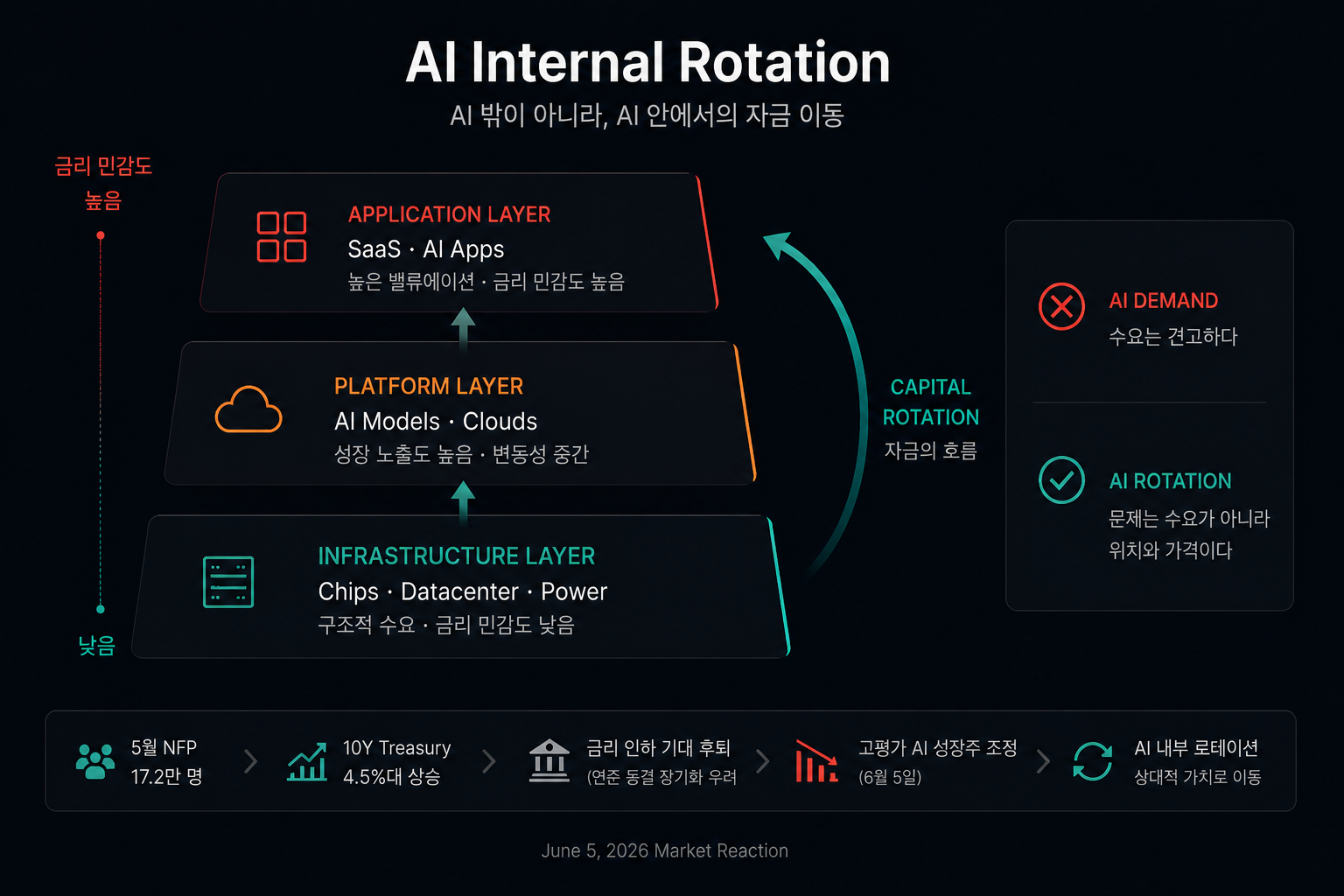
On the same day, the energy, REITs, and defense sectors showed relatively solid performance. Even within AI-related stocks, the infrastructure sector experienced a smaller decline than the application sector. This did not mean that money was flowing out of the AI sector; rather, a trend was observed within the AI sector shifting toward layers with relatively lower price pressures.
This correction is likely an internal rotation of AI, not an escape from AI.
The topic of the SpaceX IPO also came up. There was a frame suggesting that “investment capital is shifting from AI to space,” but this interpretation is somewhat simplistic. SpaceX is not just a space company. Starlink is already one of the world’s largest low-orbit communication networks and is expanding its role as the data transmission infrastructure necessary for the era of AI agents . As discussed in the article “OpenAI, Anthropic, and SpaceX IPO Investment Strategies,” it is more natural to interpret SpaceX as an expansion of the AI infrastructure layer rather than viewing it as an investment theme separate from AI.
This trend is also confirmed from the perspective of research institutions. Around the same time, Morningstar recommended a rebalancing from growth to value, noting that there are hardly any AI-related stocks currently trading at a discount, while simultaneously ranking Micron (MU) among the top performers in the past year. This does not mean selling AI stocks; rather, it suggests identifying sectors within the AI market where expectations have not yet been excessively priced in.
The interesting thing is that these three signals appeared at almost the same time.
If you read it using 3 layer grammar
I covered this structure in "Global Government Bond Seizure, SaaS Collapse — Why Layer Selection Is Everything in AI Investment ." June 5th was the day that demonstrated that structure in real time.
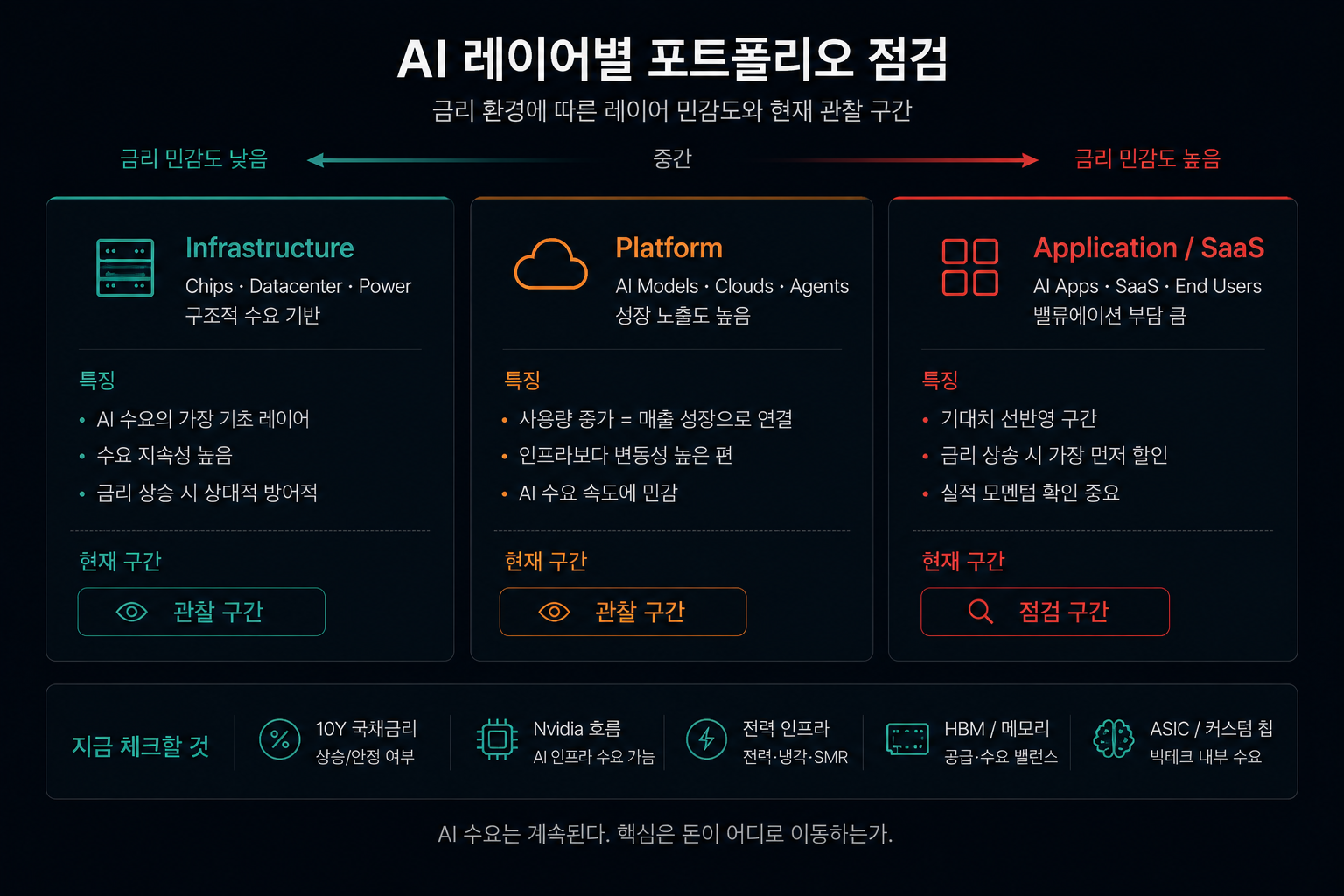
The infrastructure layer remains the area where the most structural demand is confirmed. The combined AI Capex forecast for the Big 4 tech companies is actually increasing. Regardless of which AI service survives, data centers , semiconductors, and power infrastructure are necessary to handle that traffic. If Nvidia has risen significantly, identifying areas within the Nvidia value chain where price pressure is still less burdensome is a meaningful approach during this observation phase. In "Things Missed When Viewing AI Infrastructure Through AI Alone," we covered power, cooling, REITs, and SMR, and prices in these areas tend to reflect changes more slowly than in semiconductors.
The Application/SaaS layer should be viewed differently. Much expectation is already reflected in the valuations of software companies utilizing AI. If interest rates rise further, this is the layer that will be discounted first. If this sector accounts for a large portion of your portfolio, now is the time to review your holdings. This does not mean you should sell everything, but rather that it is better to establish criteria in advance regarding the weighting you will hold.
The platform layer lies somewhere in between. Companies like Anthropic , Google, and OpenAI, which operate agents directly, have a structure where token revenue increases directly as usage grows. While it is more volatile than infrastructure, the slope of its growth becomes steeper as the pace of AI adoption accelerates. For this layer, the speed of AI demand is a more critical variable than interest rates.
4Ultimately, interest rates determine the timing
Frankly, explaining the relationship between interest rates and growth stocks always leads to the discussion of DCF, but to put it realistically, it is this: when long-term interest rates rise, the expected returns on bonds also increase. If the earnings of AI companies are mostly concentrated 5 to 10 years ahead, investors will evaluate those future earnings using a higher discount rate. If the discount rate assumption changes, the fair price also changes.
The 172,000 NFPs in May gave the Fed justification to maintain interest rates. If next month's data comes out similarly, this structure will continue. Conversely, if employment cools or prices decline, expectations for rate cuts will revive, and money will flow back into growth stocks. Now is the time to watch where that turning point lies.
The direction of AI is clear. However, when that is reflected in stock prices is largely determined by the interest rate environment. Distinguishing between these two factors seems to be the most practical approach in the current market.
If the core of this correction was a change in interest rate expectations rather than slowing AI demand, the next variable is the June CPI. The market is likely to react more sensitively to how the CPI affects the future interest rate path than to prices themselves.
If the CPI turns out higher than expected, the recent upward pressure on interest rates could intensify again. Conversely, if signs of a slowdown in inflation are confirmed, the market's interpretation of this correction could change. What matters is not the CPI figure itself, but how it alters interest rate expectations.
5Frequently Asked Questions
| question | answer |
|---|---|
| Should I sell everything now? | This correction is not a signal of the end of the AI era. Broadcom's AI business was actually performing well, up +140% YoY. Differentiating between layers is what should be done before selling off all holdings. |
| Should I participate in the SpaceX IPO? | The risk of overvaluation is generally high immediately after an IPO. It is a better time to make an assessment after the price stabilizes following listing and earnings indicators begin to emerge, rather than at the offering price. I believe the assessment that SpaceX belongs to the AI infrastructure layer remains valid from a mid-to-long-term perspective. |
| Nvidia has already risen a lot; should I buy it now? | Much expectation is already reflected in current prices. In the current observation phase, it is a meaningful approach to look for areas with relatively lower price burdens among companies that sell to Nvidia—in the fields of HBM , power infrastructure , and ASIC design—rather than Nvidia itself. |
| What happens if interest rates rise further? | The demand for AI itself continues. Big Tech's AI Capex is not decreasing. However, the valuation multiples of AI growth stocks are compressing. The infrastructure layer is relatively more defensive than platforms, and platforms are relatively more defensive than applications. |
| How much AI-related stock is appropriate to hold? | Layer composition comes before the weighting itself. Identifying whether your AI position is in infrastructure, platform, or application must precede determining the weighting. |
| How should one view those holding AI ETFs? | The name "AI ETF" alone is not enough. Interest rate sensitivity can vary significantly depending on whether it is an infrastructure-focused, platform-focused, or SaaS- focused ETF. The first step is to examine the constituent stocks of your holdings based on their layers. |
Conclusion — It is a section of observation, not a section of judgment.
Reading June 5th as the beginning of the AI bubble collapse misses too much. Broadcom's AI business was running smoothly even on that day. SpaceX is also being re-evaluated from the perspective of AI infrastructure. What collapsed were the things that had risen the highest.
This correction demonstrated that the framework of layer differentiation can be valid in the actual market. In reality, where one stands within the current AI ecosystem is a more important variable than which AI wins.
The direction of interest rates remains open. The interpretation could change completely with the next NFP. Therefore, this is a period of observation rather than judgment. The most practical thing to do right now is to differentiate the layers and see which side moves first.
All figures and analyses in this article are for informational purposes only and do not constitute investment advice. The market data mentioned is based on the time of writing and is subject to change. You bear full responsibility for your own investment decisions regarding the companies mentioned, such as Broadcom, SpaceX, and Nvidia. Consulting with a professional financial advisor before making any significant decisions is recommended.
📌 Was this analysis helpful?
In the next post, we plan to cover “Next Observation Points of the AI Infrastructure Layer — HBM, Power, and ASIC Sectors.”
Continuously track layer rotations and interest rate variables within the AI. Receive notifications so you don't miss anything.
How this content was produced
Aleph's research AI agent assisted with collecting and analyzing public data, creating charts and visuals, and structuring the draft. Davar personally reviewed and edited the sources, figures, reasoning, and final conclusions.
This content is for informational purposes only and is not personalized investment advice or an individual stock recommendation. Read the full disclaimer

Davar
Davar builds and operates Aleph's research AI agent and writes and reviews analysis on macroeconomic developments and AI industry trends.

© Aleph. All rights reserved.