
AI Strategy
Anthropic
OpenAI
Technology investment
Professional Engineer pattern
2026.04.30
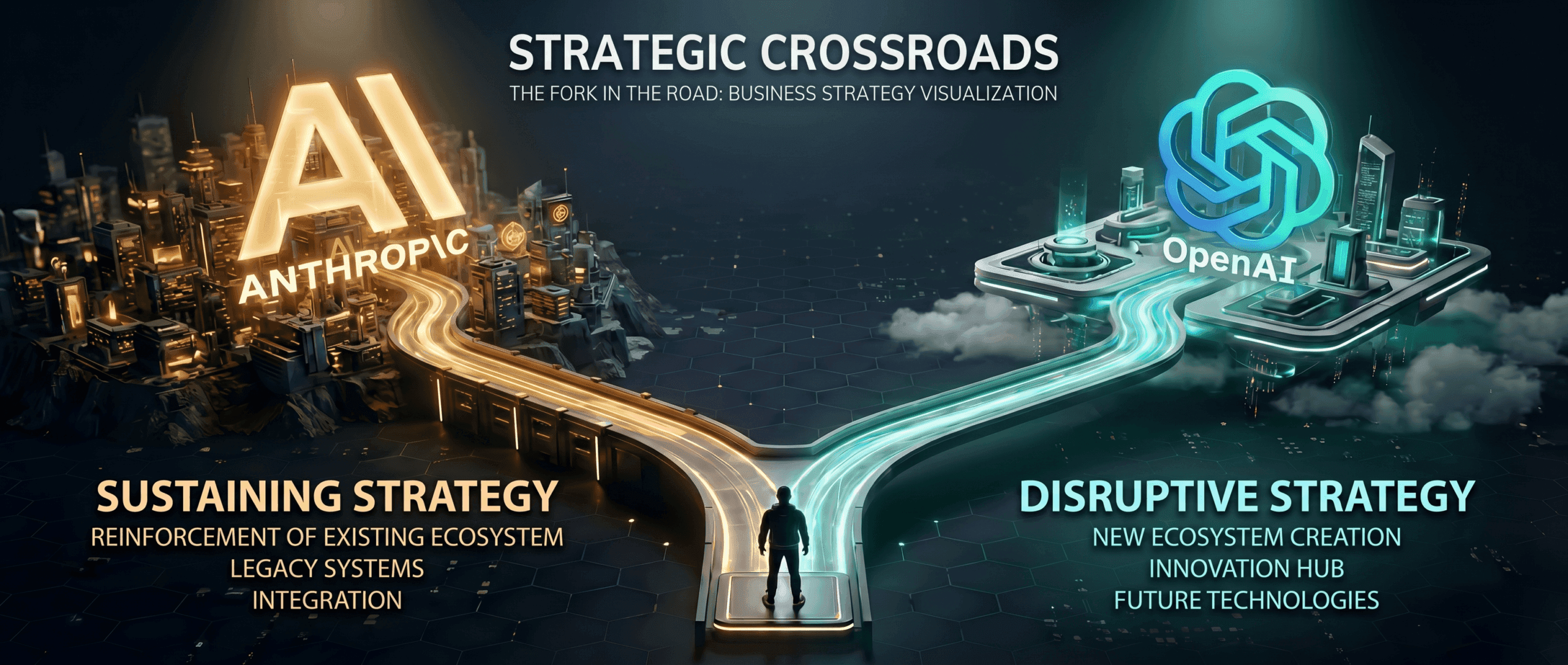
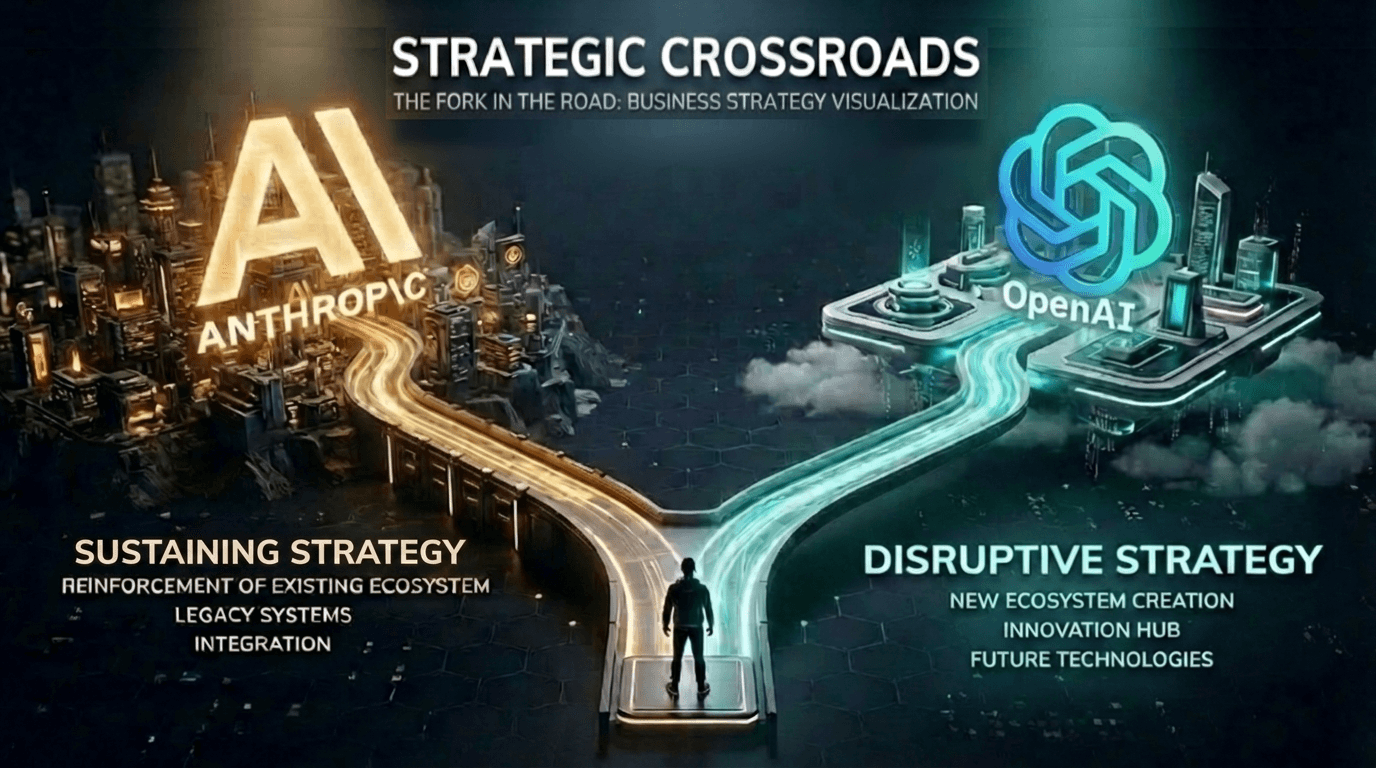
On April 28, 2026, Anthropic and OpenAI unveiled their respective strategies on the same day. Anthropic launched connectors for nine creative software programs, including Blender, Adobe, and Ableton, while OpenAI deployed GPT-5.5, Codex, and Managed Agents to Amazon Bedrock. On the surface, these appear to be similar news regarding "AI expansion," but these two moves have declared a completely different war. And we have already seen this pattern many times in the history of technology.
1 The name of this pattern — Two strategies repeated in professional engineering
Throughout the history of technology, whenever a new technology emerged, companies have chosen one of two paths: the "Sustaining" approach, which strengthens existing ecosystems , and the "Disruptive" approach, which creates new ecosystems themselves . This distinction, theorized by Clayton Christensen, remains valid even decades later. It is impossible to definitively say which approach is correct, as the results vary depending on the conditions.
From an investor's perspective, there is only one reason why this pattern is important: the strategy chosen determines the nature of the company's moat . The reinforcement type relies on a partner ecosystem, while the creation type establishes dependence on independent infrastructure. Long-term investors should observe how this difference is reflected in the valuation five years from now.
2History Has Already Answered — Three Cases
Professional engineers have already provided ample examples of the consequences when these two strategies conflict. Let us examine three cases.
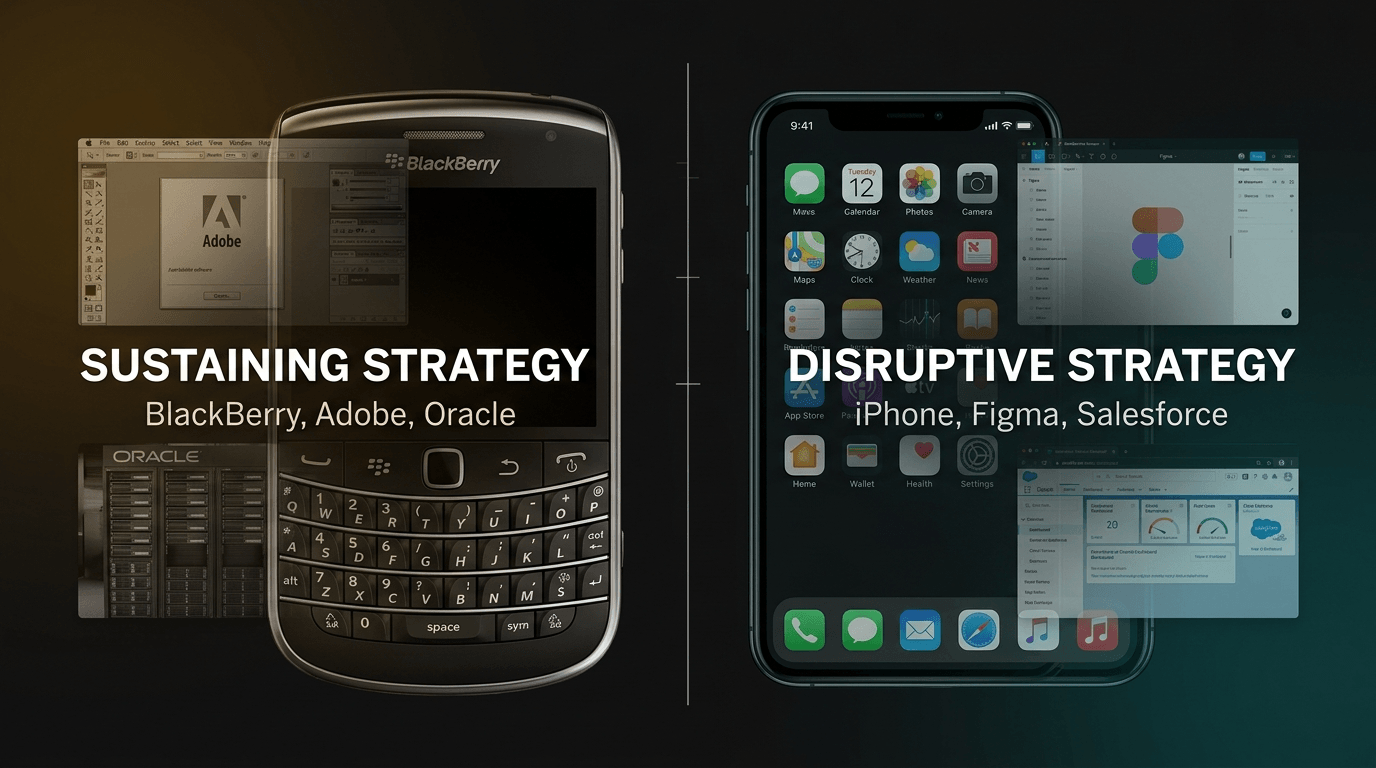
| times | Reinforced type | Creative type | result |
|---|---|---|---|
| 2007 smartphone | BlackBerry — Enterprise Email, Security, and Keyboard Integration. Maximizing Existing Work Productivity | Apple iPhone — Creating a completely new software ecosystem called the App Store | A landslide victory for the creative type. BlackBerry virtually disappeared from the market after 2013. |
| 2010s Design tools | Adobe — Enhance Photoshop and Illustrator with Creative Cloud. Switch Subscriptions | Figma — Browser-based, real-time collaboration, no installation required. A completely new collaboration layer. | Creative dominance. Adobe attempted to acquire for $20 billion → Failed due to EU regulations (2022–2023) |
| 1999~ Enterprise SW | Oracle · SAP — Strengthening On-Premise ERP & Databases. Deeply Integrated into Enterprise IT | Salesforce — The “No Software” SaaS Model. A Completely New Delivery Ecosystem | Creative dominance. Salesforce dominates the CRM market, with SaaS becoming the industry standard. |
In all three cases, the creative type won. Does that mean the creative type always wins? Not necessarily. The situation is different when looking at Microsoft 365 vs. Google Workspace . Although Google created a cloud-based collaboration ecosystem, Microsoft 365 remains dominant in the enterprise market. This is because switching costs are extremely high, and Google has not been able to completely replace the functional depth of Excel and PowerPoint even after 20 years. Conditions for the enhancement type to survive certainly exist.
3 April 28, 2026 — AI Version Branch
Anthropic’s Creative Connector strategy is a textbook example of reinforcement . Anthropic’s official statement made this clear: “Claude can’t replace taste or imagination, but it can open up new ways of working.” (Anthropic, April 28, 2026) Users simply need to continue using Blender. Claude simply analyzes scenes, writes scripts, and handles batch processing within Blender via the Python API. The same applies to over 50 tools in Adobe Creative Cloud. It is a strategy of integrating into existing workflows rather than replacing them.
In contrast, OpenAI's AWS Bedrock strategy is closer to a creative approach . The very next day after Microsoft Azure's exclusivity ended, they deployed GPT-5.5, Codex, and Managed Agents to Bedrock. This is not merely a model deployment; it is an penetration into the enterprise IT procurement structure. By utilizing OpenAI models within AWS's security, governance, and compliance framework, the process is structurally identical to how Oracle became integrated into enterprise ERP systems. OpenAI's official announcement described this as "a clear single path from experimentation to production." (OpenAI, April 28, 2026)
4 Four Conditions That Determine Who Wins
Analyzing historical cases reveals that the conditions determining the outcome between reinforcement and creation converge into four factors. Applying these conditions to the current situation of Anthropic and OpenAI yields an interesting conclusion.
| condition | Advantage for reinforced type | Advantageous for the creative type | Current AI Market Assessment |
|---|---|---|---|
| Switching costs | The higher the level, the more enhanced the survival | The lower the level, the more creative infiltration | Low creative tool transition costs → Easy creative penetration. High enterprise IT transition costs → Enables reinforced defense. |
| purchasing decision | The corporate IT manager decides | Decided by the end user | Anthropic Target (Creator) is determined by the individual → Advantageous for creative types. OpenAI Target (Enterprise) is determined by the IT manager → Enhanced defense possible. |
| Network effect | Reinforced safety as it weakens | The stronger, the more creative explosion | Strong network effects within the AWS enterprise ecosystem → A favorable foundation for OpenAI's creative strategy |
| Changes in technology architecture | If it is gradual improvement, reinforced glass | If the architecture itself changes, creative glass | AI agents represent an architectural shift that changes the very way software is used → structurally advantageous for creative types. |
This table implies one thing: while Anthropic’s enhancement model may lead in adoption speed in the short term, OpenAI’s creation model is likely to have a deeper long-term moat. However, there is an important variable. Since MCP is an open standard, competitors can utilize Anthropic’s Blender connector in the same way. The very fact that Anthropic acknowledged this and publicly disclosed it reveals that this strategy places more emphasis on building ecosystem trust than on short-term adoption.
5 3 Buckets Investors Must Watch
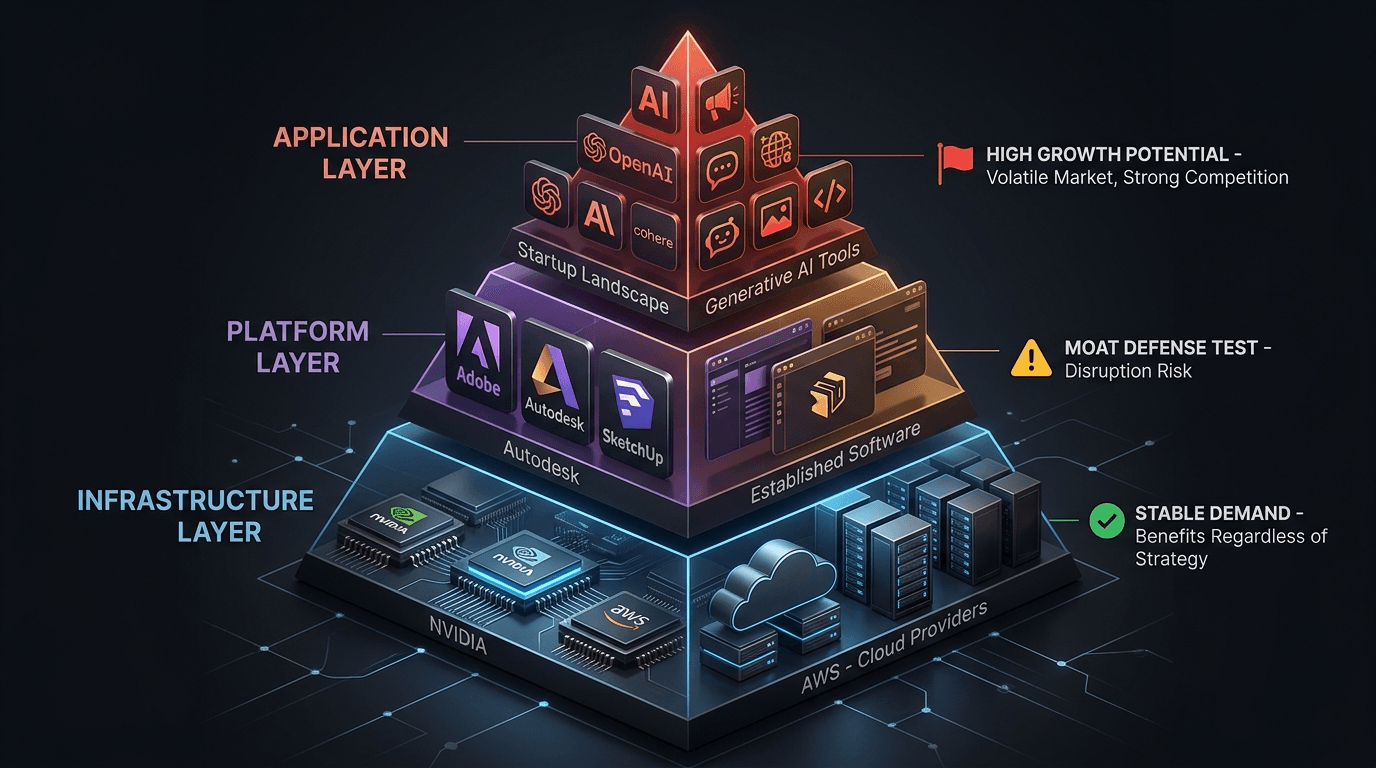
When translated into an investment perspective, this pattern can be classified into three buckets. Please read this from the standpoint of pattern analysis rather than investment advice.
Infrastructure Layer — “Pipes Sell No Matter Who Wins”
Whether the enhancement type wins or the creation type wins, GPUs and cloud infrastructure will continue to sell. Historically, in the Gold Rush, it was not the gold miners who made money steadily, but the shovels. OpenAI's multi-cloud expansion leads to a direct increase in demand for infrastructure layers such as AWS and NVIDIA. This bucket has a clear direction, regardless of strategic outcomes.
Testing Existing Ecosystem Defense — “Time to Verify If the Moat Is Real”
There are companies facing direct pressure from Anthropic's connector strategy. Adobe is a prime example. If Claude becomes a structure where "AI operates" 50 Creative Cloud tools on behalf of users, the motivation for users to learn Adobe directly diminishes. This dilutes the "learning curve," which is one of Adobe's barriers to entry. Autodesk and SketchUp are in the same vein. We must watch to see whether these companies turn connector partnerships into defensive tools or perceive them as a threat.
Middle Layer AI SaaS — “The Bucket Requiring the Most Care”
Companies that layer AI capabilities on top of specific apps and sell them as B2B SaaS are the most vulnerable. If Anthropic releases its own Blender and Adobe connectors, or if OpenAI launches Managed Agents, the rationale for this middle layer's existence weakens. This is similar to how Salesforce pushed most of the CRM middleware built on top of Oracle out of the market. If you have invested in this sector, it is time to re-examine the company's differentiating points.
6Frequently Asked Questions
| question | answer |
|---|---|
| Can't one company handle both the reinforcing and the creative types? | It is possible, but conflicts arise in resource allocation. Microsoft is a prime example of a success story. They pursued both Azure (creative) and Office 365 (enhancement) in parallel, but this was possible because the two strategies targeted different objectives (infrastructure vs. productivity) that did not conflict. Using both strategies simultaneously on the same target leads to internal cannibalization. |
| Is Anthropic's connector strategy disadvantageous in the long run? | That is not necessarily the case. The hardened approach is advantageous for adoption speed and building user trust. It could also be viewed as a two-stage strategy where Anthropic first secures ecosystem trust through the MCP open standard, and then builds its own moat ( Claude Design, Claude Code , etc.). The judgment should be based on the situation two to three years from now. |
| Did BlackBerry lose because of strategy or technology? | It is both. However, the decisive factor was strategy. Corporate IT managers supported BlackBerry, but the end users—the employees—chose the iPhone. The decision-makers and the actual users were different, and ultimately, the users won. Even in the AI era, tools chosen by developers and creators themselves tend to dominate the ecosystem more quickly than those adopted by corporate IT. |
| Where can this pattern be applied from the perspective of domestic investors? | It is useful for classifying the strategies of domestic AI SaaS companies. Identifying whether they are pursuing an enhancement strategy of integrating AI into existing ERP and groupware, or a creation strategy of building entirely new AI-native workflows, and examining the market's switching costs and purchasing decision structures together helps in assessing long-term competitiveness. |
Conclusion — The difference in strategy is the difference in moats.
The strategies released by Anthropic and OpenAI on the same day, April 28, 2026, are superficially “AI expansion,” but are essentially heading toward a completely different future. Anthropic chose speed of adoption and ecosystem trust by adopting a strategy of integrating into existing tools, while OpenAI chose long-term dependency by adopting a strategy of being embedded within enterprise infrastructure.
This pattern has been repeated throughout the history of technology. BlackBerry lost to the App Store ecosystem while trying to make corporate email more efficient, and Oracle was pushed aside by the SaaS delivery model while trying to make its ERP more powerful. On the other hand, Microsoft succeeded in pursuing both strategies in parallel by strengthening Office while simultaneously deploying a new infrastructure called Azure. History teaches us one lesson: what matters is not which strategy is right, but whether that strategy aligns with the switching costs and purchasing decision structure of the relevant market.
When selecting stocks in the AI era, first ask yourself, “Is this company an enhancing type or a creative type?” Then, verify whether that choice aligns with the conditions of the market you are currently targeting. Reading the strategic direction behind the news headlines—this is how you stay ahead of the timing in tech investing.
All analyses in this article are for pattern analysis and informational purposes only and do not constitute investment advice. The interpretations regarding the mentioned companies and strategies are the author's own analysis and do not guarantee actual investment results. Historical patterns do not guarantee future performance, and all investment decisions and responsibilities rest with the individual. Consulting with a professional financial advisor before making any significant investment decisions is recommended.
📌 Was this analysis helpful?
In the next post, we plan to cover “Reinforcement vs. Creation — Classification of Beneficiary and Cautionary Stocks in the AI Era.” We will apply this pattern analysis directly to actual stocks.
We continue to publish analyses that translate technology strategies into investment language. Subscribe to our notifications so you don't miss out.
How this content was produced
Aleph's research AI agent assisted with collecting and analyzing public data, creating charts and visuals, and structuring the draft. Davar personally reviewed and edited the sources, figures, reasoning, and final conclusions.
This content is for informational purposes only and is not personalized investment advice or an individual stock recommendation. Read the full disclaimer

Davar
Davar builds and operates Aleph's research AI agent and writes and reviews analysis on macroeconomic developments and AI industry trends.
© Aleph. All rights reserved.