
Jensen Huang declared “$1 trillion in revenue by 2027” on stage on March 16. Everyone must have been waiting with their Samsung Electronics windows open.
However, the real benefits came from elsewhere.
Simultaneously with the announcement of NVIDIA's Rubin architecture, Wall Street funds poured into three companies with unfamiliar names.
Everyone knows about HBM, but no one talks about the companies that cool the GPUs to prevent them from melting, the companies that supply power, or the socket companies that inspect every chip as it comes out. I will tell you about them now.
1GTC 2026, Understanding in 3 Lines
For those who find reading the news a hassle, here is a summary of the key points first.
① NVIDIA officially unveiled the next-generation GPU 'Vera Rubin' architecture, and
② Inference performance has increased 3 to 5 times compared to the existing Blackwell , and
③ The power and cooling infrastructure required to run this chip has emerged as a new bottleneck.
Simply put, it is a situation where Nvidia has created a faster engine, but the road (infrastructure) cannot keep up.
The companies building that 'road' are the protagonists of today's story.
Throughout 2025, cloud companies unanimously stated that “the biggest bottleneck in AI expansion is not chip supply, but securing power .”
One rack of Rubin chips consumes up to 150kW of power—that is the amount used by 50 households simultaneously.
Without the companies that supply this electricity, cool the generated heat, and inspect every chip that comes out, there would be no $1 trillion in revenue for Nvidia.

2 Beneficiary Stock #1 — Vertiv Holdings (Vertiv, VRT) 🇺🇸
You can think of it as a company that cools down GPUs so they don't melt.
It was once a quiet industrial cooling equipment company, but at some point, Wall Street began calling it the “Silicon Sovereign.”
Stock prices up +190% in 2024, an additional +43% in 2025… They have already risen significantly, so why should we still pay attention?
Rubin chips consume 120 to 150 kW per rack. This is a level that is physically impossible to cool with conventional air cooling.
Vertiv's CoolChip Fluid Network uses a method of flowing coolant directly to the CPU and GPU,
This technology is being applied to NVIDIA's official Blackwell and Rubin designs.
Although there is a competitor, Schneider Electric, Wall Street assesses that Vertiv is a step ahead in the speed of AI specialization.
$13.2 to $13.8 billion
$15 billion (all-time high)
Confirmed on March 23
$305
28 or more people
Strong Buy advantage
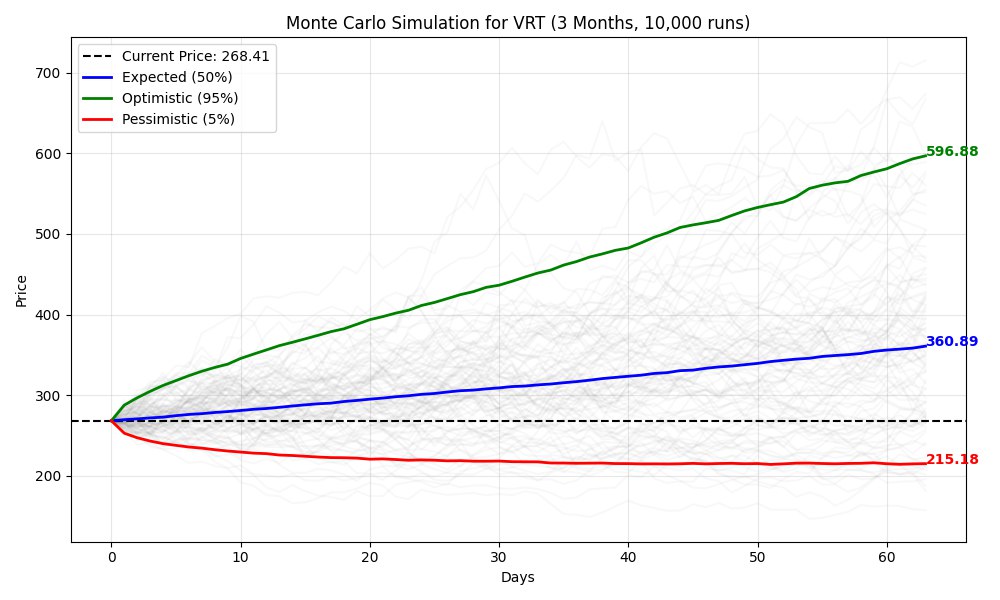
We ran 10,000 simulations based on historical volatility, starting from the current price of $268.41 .
• Expected Rate of Return (Median 50%): +34.5% → Target Price $360.89
• Optimistic Scenario (Top 5%): Potential rise to $596.88
• Pessimistic Scenario (Bottom 5%): Potential drop to as low as $215.18
A wide distribution means that the variability is that much greater.
Simulations also confirm that while it has the highest expected return among the three stocks, it is a high-risk, high-return investment with the greatest downside risk.
The optimistic scenario ($596.88) represents a +122% increase from the current price—there is room for an explosive rise if combined with supply and demand from S&P 500 inclusion.
📋 VRT Outlook by Scenario (Simulation-Based)
| scenario | Probability | trigger | The 3-month goal | react |
|---|---|---|---|---|
| Optimistic | Top 5% | Rubin Order Surge + Supply and Demand from S&P Inclusion | $596.88 (+122%) | Continued retention |
| Expected | Median 50% | AI infrastructure investment proceeding as scheduled | $360.89 (+34.5%) | Maintain split buying |
| Pessimistic | bottom 5% | Tariff and Supply Chain Shocks | $215.18 (-19.8%) | Set stop-loss at $242 |
Inclusion in the S&P 500 on March 23 implies a forced purchase of the index fund. Short-term supply and demand momentum is expected, and a strategy of staggered entry during the stabilization phase following the inclusion is also valid. While the simulated expected return of +34.5% is the highest among the three stocks, it is a double-edged sword capable of falling as low as -19.8% ($215) . Please limit the weighting to
5~8% 이내 of your total portfolio.3 Beneficiary Stock #2 — Eaton (Eaton, ETN) 🇺🇸
If Vertiv is the “company that cools GPUs so they don’t melt,” then Eaton is the “company that supplies electricity to turn on GPUs.”
On March 16, Eaton appeared in person as Jensen Huang's partner on the keynote stage.
Why is this important? Because they are not just a simple parts supplier, but a co-design partner that NVIDIA has directly involved in the design process.
Beam Rubin DSX , announced jointly by Eaton and NVIDIA at GTC 2026, is a modular data center platform co-designed to fit the Rubin NVL72 rack.
The key is the 800V DC power grid . It is a technology that significantly reduces energy conversion losses compared to existing methods and enables megawatt-scale deployment.
This does not mean a supply contract, but rather that Eaton technology is included as the 'default' in NVIDIA's reference designs.
Rapidly expanding
S&P and Moody's upgrades
2027~
March 2026
The only one in the industry
9 consecutive years
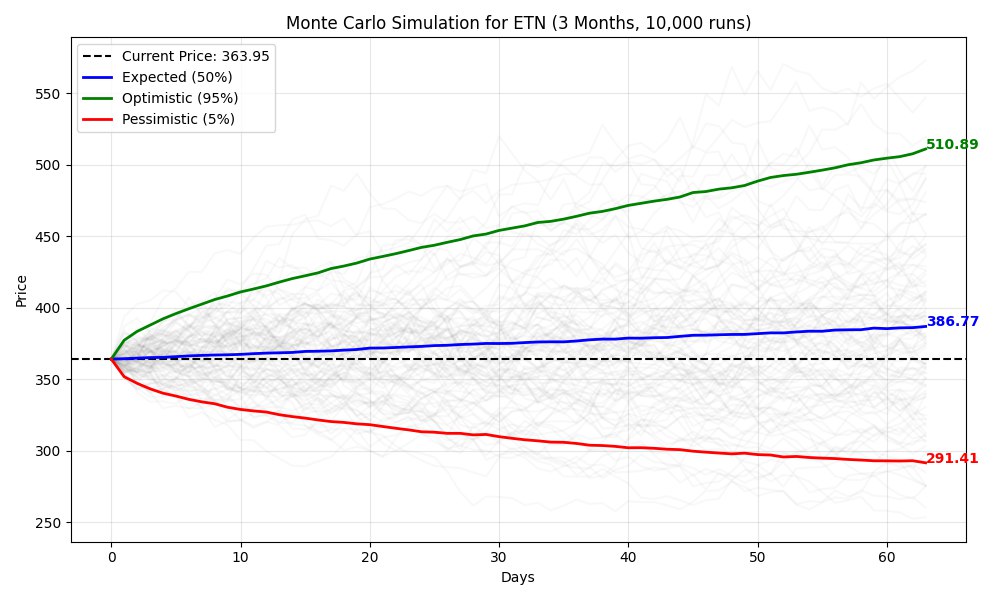
We conducted 10,000 simulations based on the current price of $363.95 .
• Expected Rate of Return (Median 50%): +6.3% → Target Price $386.77
• Optimistic Scenario (Top 5%): Potential rise to $510.89
• Pessimistic Scenario (Bottom 5%): Potential drop to as low as $291.41
Among the three stocks, it has the lowest expected return, but the distribution is the most balanced.
The downside ($291) is limited, and the optimism ($510) is also within a realistic range.
The 'stable growth stock' profile, best suited for investors who dislike volatility, is proven by numbers.
📋 ETN Outlook by Scenario (Simulation-Based)
| scenario | Probability | trigger | The 3-month goal | react |
|---|---|---|---|---|
| Optimistic | Top 5% | 800VDC early demand switching | $510.89 (+40.4%) | Continued retention |
| Expected | Median 50% | Beam Rubin DSX Order Proceeding Normally | $386.77 (+6.3%) | Maintain split buying |
| Pessimistic | bottom 5% | Economic recession and delays in power investment | $291.41 (-19.9%) | Set stop-loss at $327 |
Their roles are different. VRT is for cooling (thermal management) , and ETN is for power (energy supply) . AI data centers cannot function without both.
If Vertiv is a more aggressive growth stock, Eaton is closer to a defensive growth stock that combines dividends and growth.
If you are sensitive to volatility, it is recommended to take a position with ETNs, and if you are aggressive, combine them by increasing the weight of VRT.
Aim for
합산 비중 10~15% for the two stocks. 
4 Beneficiary Stock #3 — Reno Industrial (058470) 🇰🇷
“What is a test socket?” — This single sentence captures the appeal of this sector.
For new AI chips (Blackwell, Rubin, etc.) to be mass-produced, they must undergo 100% full inspection .
The company that manufactures the pins (sockets) connecting the inspection equipment and the chip is Rino Industrial.
New chip launch = Increase in Reno Industrial orders — this equation has almost never been broken.
Lino Industrial's Pogo-pin test sockets are used in the R&D phase . They are not for mass production.
In other words, whenever fabless companies like Qualcomm, Apple, and MediaTek design a new chip, a new custom socket is required, and
The socket is supplied virtually exclusively by Rino Industrial. Rino Pin ranks first with a global market share in the 70% range.
As the process moves toward 2nm, the precision requirements for sockets increase, and the ASP (Average Selling Price) also rises.
It is a structure where the more difficult it gets, the more money you make.
~350~360 billion won (+29%)
~410~450 billion won (+17~25%)
Almost debt-free
200 billion won
Full-scale launch in 2026
Many North American and Taiwanese fabless companies
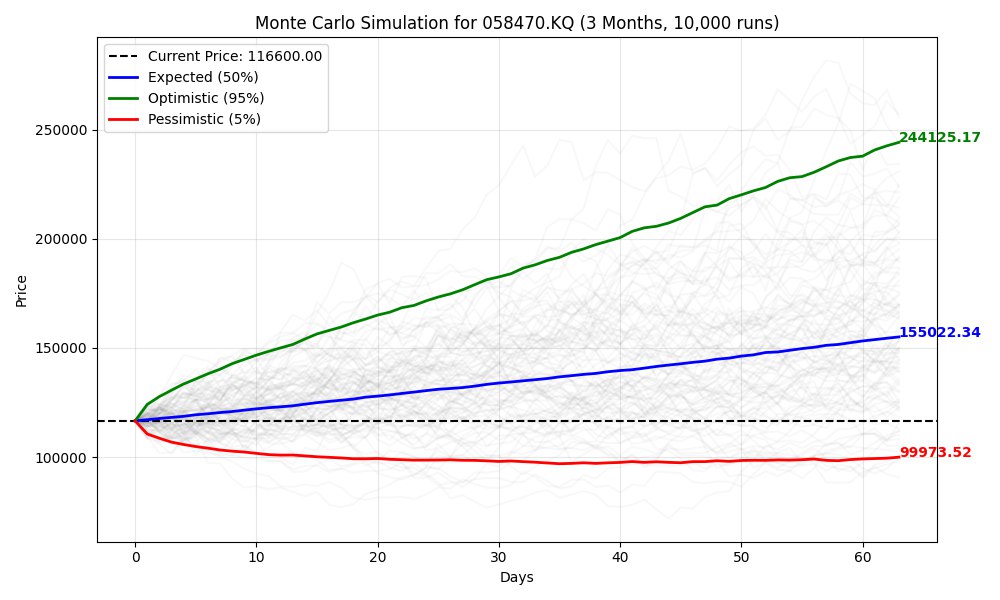
We conducted 10,000 simulations based on the current price of 116,600 won .
• Expected Rate of Return (Median 50%): +32.9% → Target Price 155,022 KRW
• Optimistic Scenario (Top 5%): Potential rise to up to 244,125 KRW
• Pessimistic Scenario (Bottom 5%): Potential drop to 99,974 won
The expected return of +32.9% is comparable to VRT (+34.5%), representing a much stronger upside than expected.
The optimistic scenario figure of 244,125 won far exceeds the 52-week high (172,300 won) .
However, it should be noted that the downside of the pessimistic scenario (~100,000 won) is just above the psychological support level of 100,000 won.
The current stock price (116,600 won) is about 32% lower than the 52-week high (172,300 won). However, this does not mean that “undervalued = buy immediately.”
It is highly volatile depending on the global macro environment (interest rates, tariffs), the semiconductor industry cycle, and order visibility.
Due to the nature of KOSDAQ mid-cap stocks, they are sensitive to changes in foreign investor supply and demand.
We recommend taking a medium-to-long-term (12–24 months) approach and allocating within 3–5% of the total portfolio .
📋 Reno Industrial Outlook by Scenario (Simulation-Based)
| scenario | Probability | trigger | The 3-month goal | react |
|---|---|---|---|---|
| Optimistic | Top 5% | Early Realization of New Factory Orders | 244,125 won (+109%) | Continued retention |
| Expected | Median 50% | 2nm demand returns to normal | 155,022 won (+32.9%) | Maintain split buying |
| Pessimistic | bottom 5% | Sharp cooling of business conditions and foreign investor exodus | 99,974 won (-14.3%) | Set stop-loss at 105,000 won |
5 How to Include 3 Stocks in a Portfolio?
Since the three stocks have different characteristics, you should not blindly buy them with equal weight.
Looking at the simulation results, the risk and return profiles of each stock are distinctly different.
You need to understand this difference and position yourself within your portfolio.
※ The figures above are the median (50%) of 10,000 Monte Carlo simulations based on historical volatility. Future returns are not guaranteed.
| event | personality | offensive type (30s · Surplus Funds) | Neutral type (40s · Family) | stable type (50s and older) |
|---|---|---|---|---|
| 🇺🇸 VRT (Vertiv) | Aggressive growth stocks | 6~8% | 3~5% | 1~2% |
| 🇺🇸 ETN (Eaton) | defensive growth stocks | 5~7% | 4~6% | 2~4% |
| 🇰🇷 Rino Industrial (058470) | Domestic small and medium-sized growth stocks | 3~5% | 2~3% | 0~1% |
All three stocks have the potential for a short-term surge immediately after the GTC announcement. Absolutely do not buy them all at once.
Volatility is expected for VRT around the time of its inclusion in the S&P 500 on March 23. A strategy of entering with a small amount before inclusion and buying more during corrections after inclusion is valid.
For ETNs, waiting for the earnings season (late April) to verify the figures before entering is also a strategy.
It is safer to enter the market for Reno Industrial after confirming
신공장 가동 전 실적 가시화(2026년 3분기) .6 3 Things to Do Right Now
The analysis is already complete. Now, I will narrow it down to just three things that actually need to be done.
Add VRT, ETN, and Reno Industrial to your watchlist — Right now
I'm not telling you to buy it right away. Observe first.
If you buy during the overheated phase immediately after the GTC announcement, there is a high probability of loss.
Observe the stock price trend for at least 2 to 3 weeks, and consider your first purchase when a correction of more than 10% from the peak occurs.
Opportunities come not just once, but many times.
Position yourself as having a 'hedge relationship' with Samsung and Hynix.
The three stocks introduced today are independent of HBM (High Bandwidth Memory) demand.
Even if NVIDIA increases the proportion of Groq's SRAM-based chips and HBM demand decreases,
The demand for cooling, power, and testing actually increases.
If you are an existing holder of Samsung or Hynix, these three stocks serve as a risk hedge .
Adjust the weight of dollar assets (VRT/ETN) when the exchange rate is in the 1,500 won range.
When the won-dollar exchange rate is 1,500 won or higher, buying U.S. stocks increases the risk of exchange rate loss.
It is reasonable to increase the proportion of dollar assets by targeting the range where the exchange rate falls to the 1,430–1,450 won range .
Conversely, Reno Industrial (a domestic stock) faces relatively less buying pressure during periods of high exchange rates.
The GTC 2026 beneficiary theme is not short-term momentum, but a structural change spanning 3 to 5 years .
The most frequently repeated mistake is the pattern of cutting losses due to selling pressure after a short-term surge.
Do not be swayed by short-term volatility as long as the logic behind why I bought this stock—Rubin architecture, power infrastructure bottlenecks, and the transition to the 2nm process—remains intact.
Sticking to logic rather than being greedy for higher returns is the answer to long-term investment.
Conclusion — When everyone is looking at the front door, look at the back door.
NVIDIA GTC serves as a compass for the AI industry every year.
However, paradoxically, the biggest profits do not come from Nvidia stock.
During the Gold Rush, the people who made real money were not the miners who mined gold, but the people who sold pickaxes and jeans.
Vertiv cools the GPU so it doesn't melt, and
Eaton supplies electricity to turn on the GPU, and
Reno Industrial inspects every new GPU without fail whenever it is released.
Without these three companies, there is no $1 trillion dream for Nvidia.
Do you currently have any of these three stocks in your portfolio? If not, add them to your watchlist starting today.
The market gives opportunities to those who know and are prepared. Always.
📌 Was this analysis helpful?
Please let me know in the comments which GTC 2026 beneficiary stocks you are watching.
How this content was produced
Aleph's research AI agent assisted with collecting and analyzing public data, creating charts and visuals, and structuring the draft. Davar personally reviewed and edited the sources, figures, reasoning, and final conclusions.
This content is for informational purposes only and is not personalized investment advice or an individual stock recommendation. Read the full disclaimer

Davar
Davar builds and operates Aleph's research AI agent and writes and reviews analysis on macroeconomic developments and AI industry trends.

© Aleph. All rights reserved.