
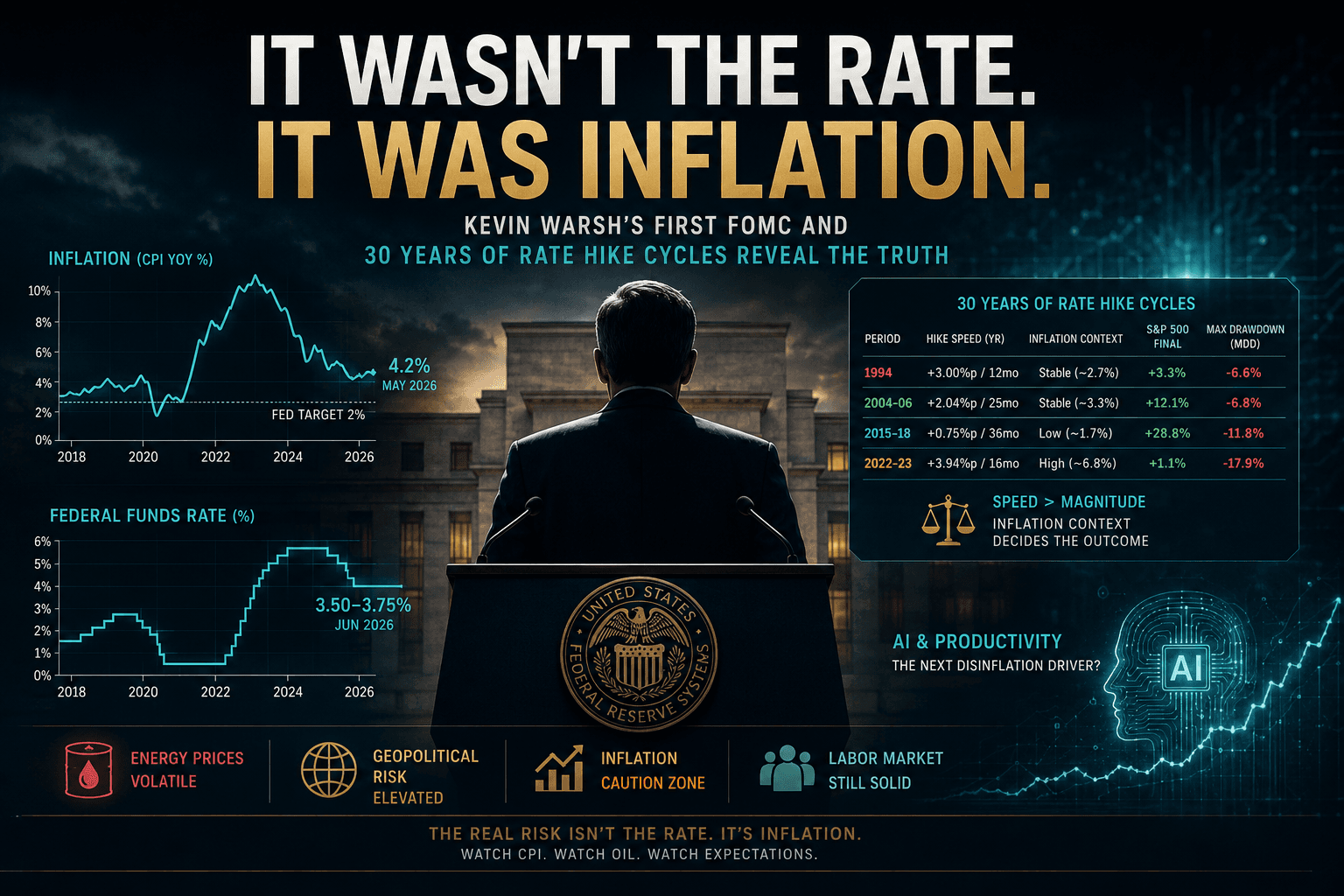
What Kevin Warsh’s First FOMC and the 30-Year Rate Hike Cycle Showed — Inflation Series Part 3
inflation
Interest rate cycle
AI productivity
macroeconomic
US stocks
KOSPI
2026.06.18
Immediately after the FOMC meeting, similar questions always come up. This time was no exception; they poured in without fail. “The Fed took a hawkish stance; will stocks fall?” It is a natural question, given how we have been taught for so long. When interest rates rise, stock prices fall. However, the problem was not the interest rates. To be precise, the inflation that drove those rates was more important than the rates themselves.
Over the past 30 years, there have been four interest rate hike cycles. Surprisingly, the stock market ended in a rise during all of these cycles. However, the processes were completely different. Let’s explore together why the 1994 and 2022 periods differed, despite both involving interest rate hikes, by analyzing Wash’s first FOMC remarks.
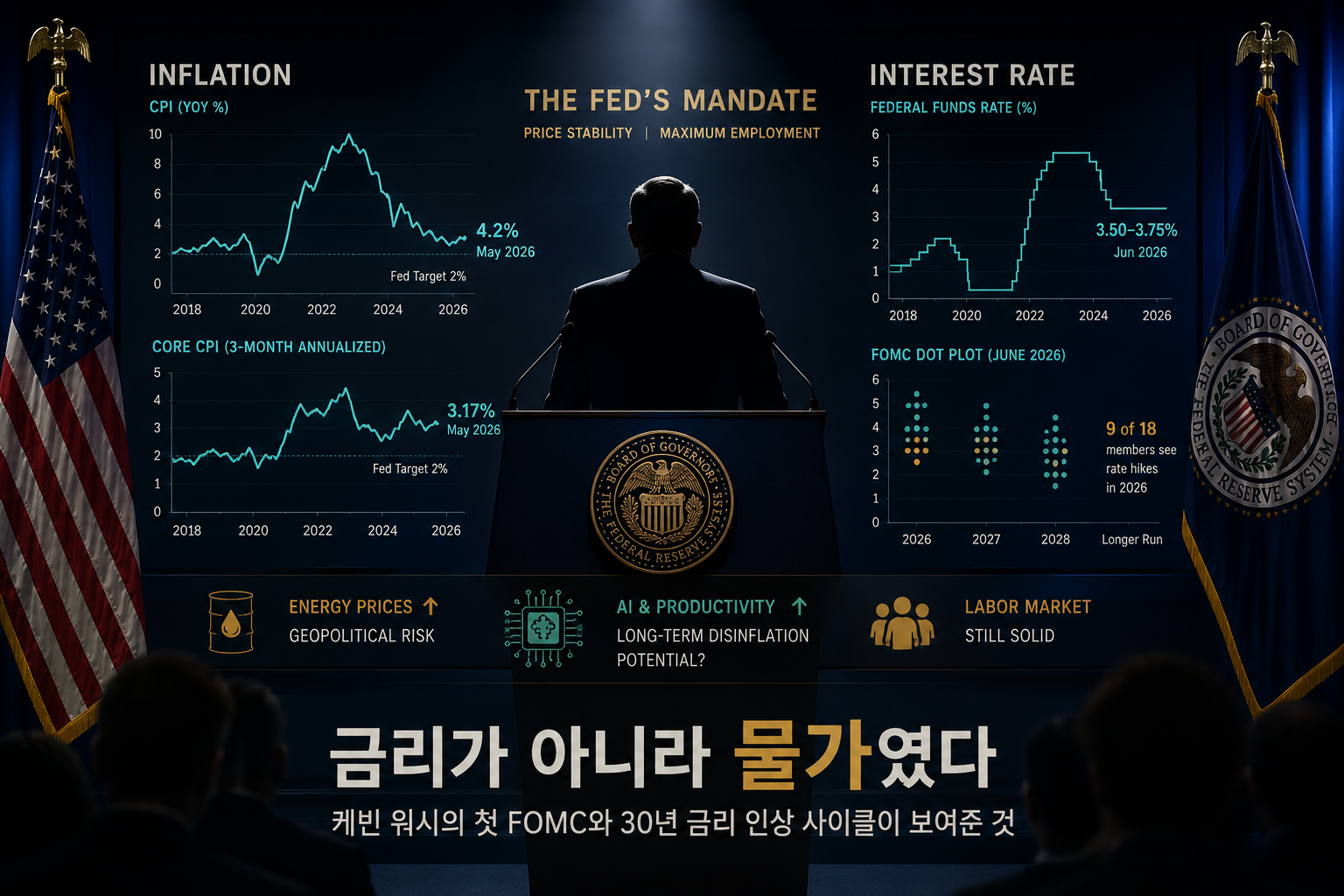
1Interest Rate Hike Cycle, Looking at Actual Data
First, let's look at 30 years of data to see how the stock market reacted when interest rates were raised. Surprisingly, the results differ somewhat from our common sense.
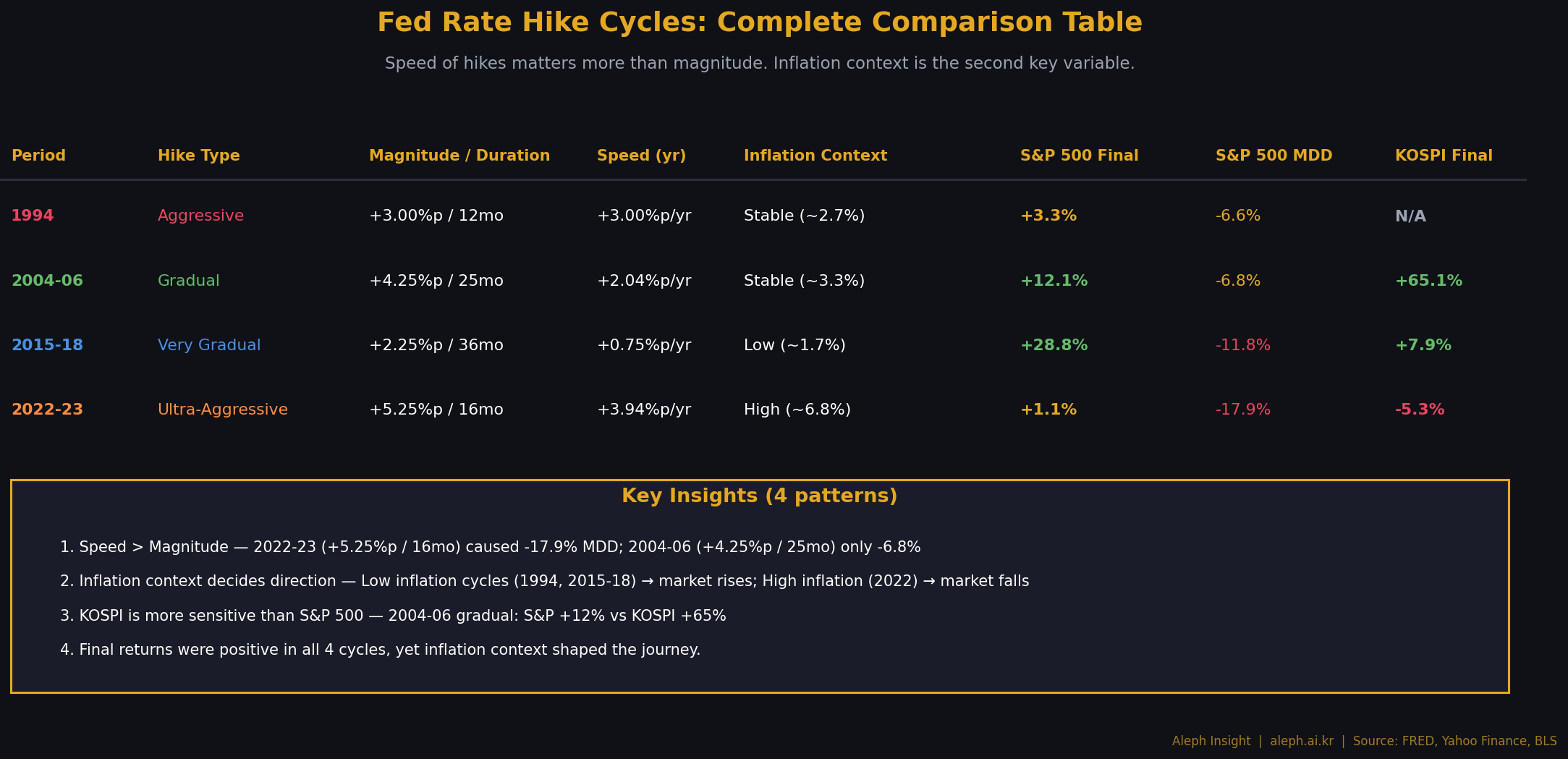
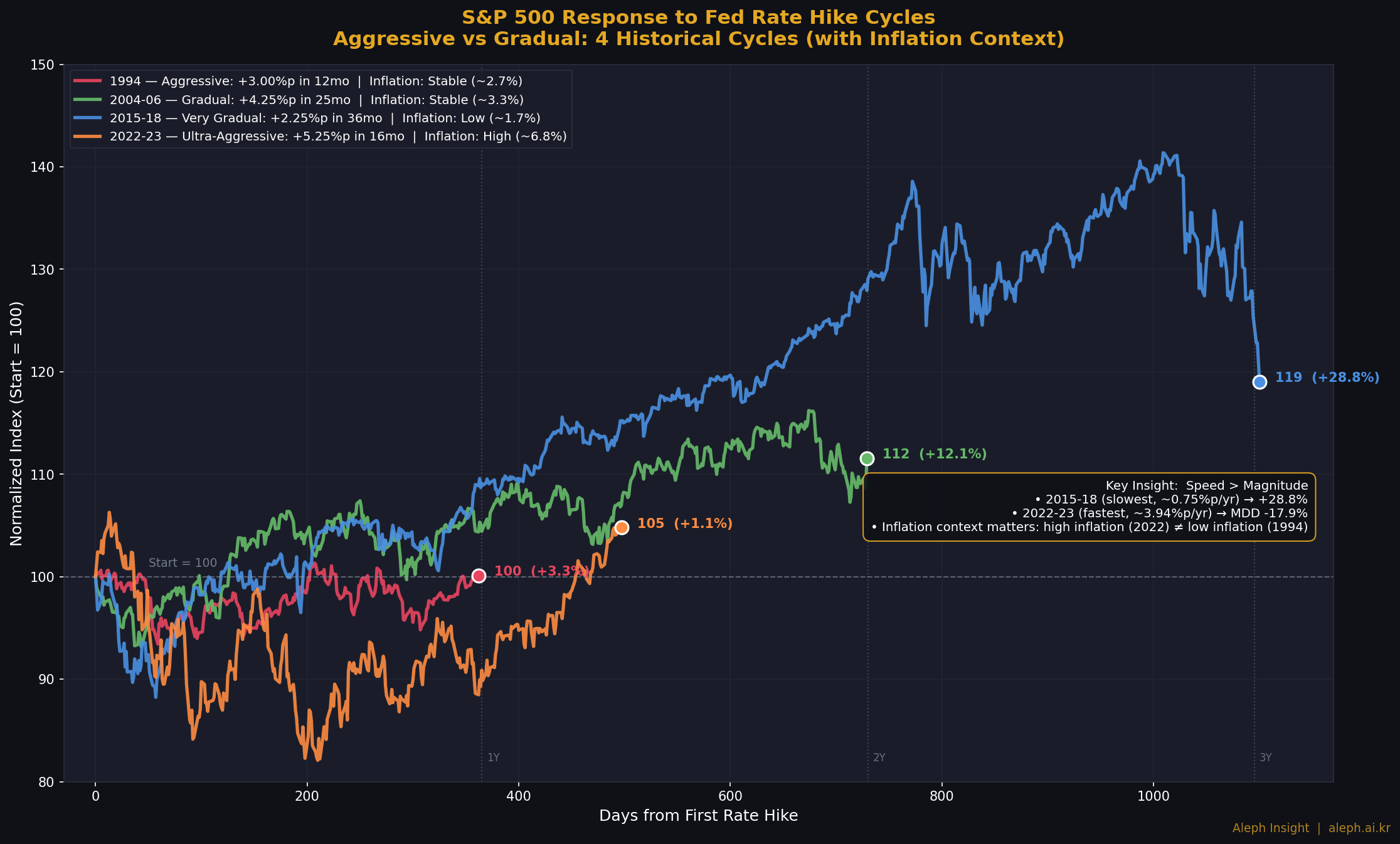
As shown in the table, the final returns were positive in all four interest rate hike cycles. However, the processes were very different. From 2015 to 2018, the S&P 500 rose 28.8% while interest rates were being raised. Although the 2022–2023 cycle ultimately ended with a slight positive gain, the decline midway through the cycle reached approximately -17.9%. Even though the final returns appeared similar, the processes were completely different. Why were the processes in 2015 and 2022 so different?
2Interest rates are a prescription, not a disease
The Fed does not raise interest rates without a reason. It raises rates only when prices are rising too rapidly. Therefore, what needs to be looked at is not the interest rate itself, but the inflation that prompted the rate hike.
Interest rates are not a disease. They are a prescription. What the market feared was not the prescription itself, but the situation in which a prescription became necessary.
The 2022–2023 cycle is a prime example. At that time, the U.S. CPI exceeded 9%, and the Federal Reserve raised interest rates at one of the fastest rates in history—an annual increase of 3.9 percentage points. In contrast, the rate from 2015 to 2018 was 0.75 percentage points per year. What the market feared was not the interest rate itself rising to 5.25%, but the inflation that necessitated such a drastic hike.
Raising interest rates when prices are low is interpreted as a signal that growth is robust. Raising interest rates when prices are high increases corporate costs and dampens consumption. Even the same prescription can have completely different meanings depending on the state of the illness.
3What the war left behind was ultimately prices
So where is the current inflation coming from? The variable the market has focused on most recently was energy prices following the Iran war.
The May CPI recorded 4.2% , the highest figure since April 2023. One might argue that it is lower than in 2022. However, the direction is the issue. When the trend of the Core CPI over the past three months is annualized, it has risen to 3.17% . The gap with the Fed's 2% target is widening again.
The problem is that inflation indicators react with a lag even after oil prices fall. Currently, Brent crude is trading at $78.40 per barrel. It has dropped from its peak as concerns about a war with Iran have partially subsided. However, the Core CPI is still lagging. The transition process, in which oil prices move first and inflation follows, has not yet fully concluded. Just because oil prices have fallen does not mean that inflationary pressure disappears immediately. The war has left us with the risk of inflation.
4Worsh’s First FOMC — What the Hawkish Freeze Left Behind
On June 17, the FOMC unanimously decided to keep interest rates unchanged, maintaining the benchmark rate at 3.5–3.75%. However, the market did not interpret this as a dovish signal. The S&P 500 fell 1.21% , and the 2-year yield jumped 16 basis points.
What the market reacted to was not the interest rate decision, but the dot plot. Nine out of 18 members believed that an interest rate hike was necessary within the year. Immediately after the FOMC meeting, the market reflected a significantly higher probability of a September hike. Although rates were frozen, it was a day when expectations for a hike grew much larger.
What stood out was the change in the statement. Based on media reports, it was reduced from 341 words to 130 words. This was interpreted as a signal to reduce reliance on forward guidance. It effectively means there is a lack of information for the market to predict the next move. Wash himself did not even submit figures in the dot plot. He stated that it “does not help with policy implementation.”
In other words, Wash effectively sent a message to the market that now is not the time to discuss interest rate cuts. Then, out of the blue, he brought up the long-term variable of AI productivity in a public forum.
5 Why the Fed Talked About AI
Wash mentioned AI and productivity improvements as important variables at a press conference. This was during a discussion about inflation. It sounds a bit strange at first. Why would AI be brought up in an interest rate meeting?
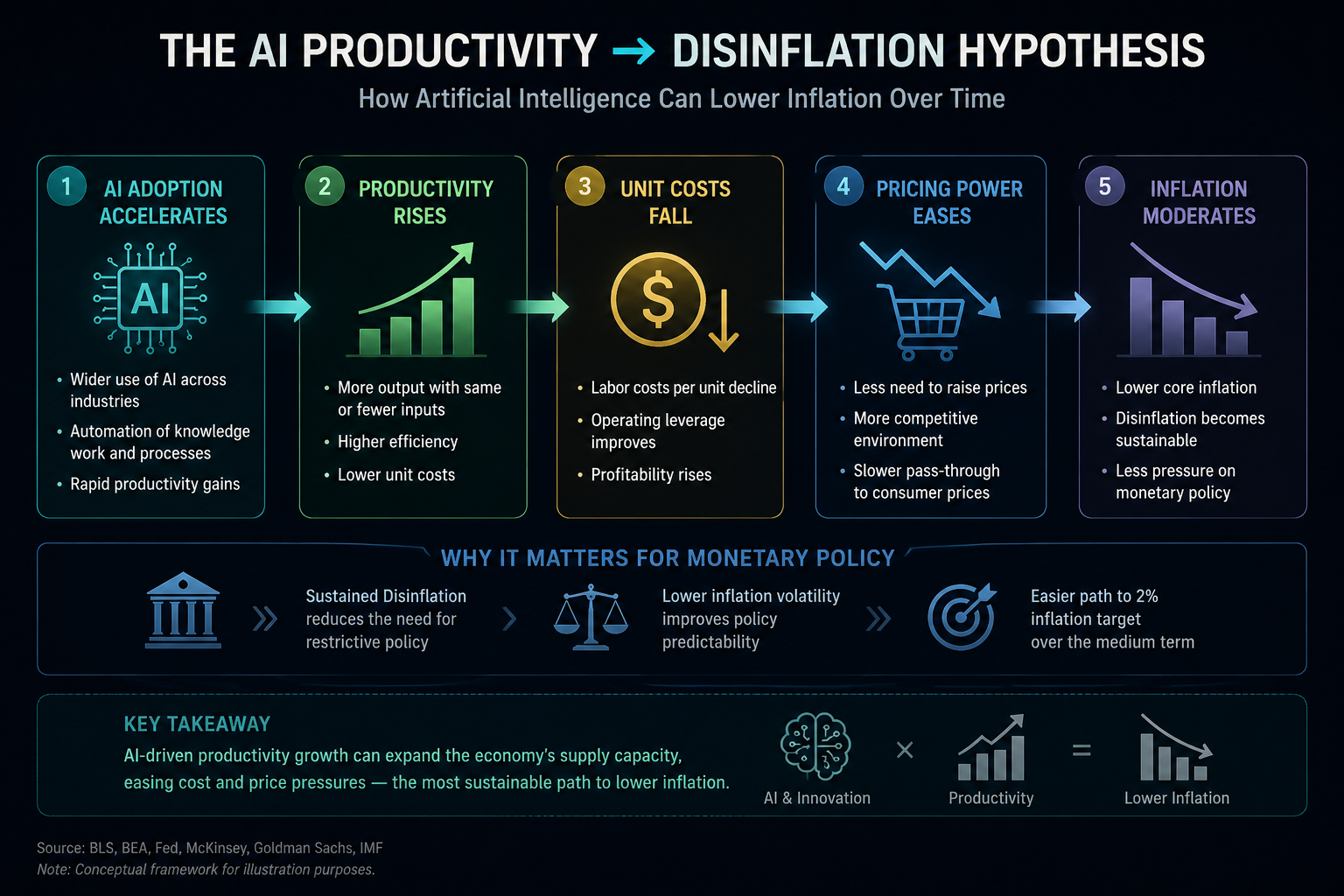
From a macroeconomic perspective, there is a connection. AI is a matter of productivity. As productivity increases, it becomes possible to produce more at the same cost. In the long run, this can lower price pressure. Wash has described AI as “the most powerful wave of productivity improvement in a lifetime.” This is not technological optimism, but rather a disinflation hypothesis. The logic is that supply-side shock inflation resolves over time, and if AI changes the long-term productivity trajectory, it can lower price expectations.
However, this aspect is not yet fully verified. Some studies are yielding results indicating that the productivity effects of AI are smaller than expected or difficult to measure. This suggests that while AI works powerfully in specific job functions, its spread across the entire economy may be slower than anticipated. This discussion was first covered in the previous article , "Why Is the Market So Obsessed with AI?"
Nevertheless, it is worth noting that the current Fed Chair has repeatedly brought up this hypothesis in public remarks. This implies that just as the market has begun to view AI as a macroeconomic variable rather than tech news, the Fed is moving in the same direction. This has not yet been verified by data, so I intend to look for actual data in the next installment.
6Frequently Asked Questions
| question | answer |
|---|---|
| Is Wash a hawk or a dove? | It is difficult to categorize this simply. In the short term, it showed a firm hawkish stance on price stability and attempted to reduce reliance on forward guidance by shortening its statements to 130 words according to media reporting standards. However, it also trusts the productivity effects of AI and maintains the position that supply-shovel inflation should be viewed from a long-term perspective. While the current stance is a hawkish freeze, the position could change as data accumulates showing that AI is actually lowering prices. |
| Isn't a Core CPI YoY of 2.9% not bad? | A year-on-year growth of 2.9% appears low. However, when the trend over the past three months is annualized, it stands at 3.17%. The direction is heading upward again. At this point, the direction is more important than the level. The fact that the Core CPI is lagging despite oil prices having already fallen means that the transition process is still underway. |
| What is the likelihood of interest rates rising in September? | Immediately following the FOMC meeting, the market assessed a 49% probability of a rate hike in September. The key variables are the trend of the Core CPI over the next two months and oil prices. If Brent crude rises above $85 again or the three-month annualized Core CPI exceeds 3.5%, the market could lean toward a hike. Currently, it is difficult to be certain about either outcome. |
| Should I reduce my stock position now? | It is appropriate to view this as a period for observing key indicators rather than aggressively increasing position weight. The direction of the Core CPI and whether oil prices rebound are key variables. A gradual approach is more suitable than a full liquidation. Based on Aleph, it falls into a CAUTION zone, having crossed the warning threshold but not yet reached the threshold signaling an immediate sell. |
| Can AI actually lower prices? | This is not yet a hypothesis confirmed by data. Some studies even suggest that the productivity benefits of AI are smaller than expected. However, the fact that the Fed Chair has repeatedly mentioned this in public remarks signals that it has begun to be incorporated into policy decisions. In the next installment, I intend to look for traces of this using actual data. |
Conclusion — Ultimately, what the market sees is prices
The 30-year interest rate hike cycle examined in this article demonstrates one fact: the market was more influenced by the direction of prices than by interest rates themselves.
War raises energy prices, and energy prices stimulate inflation. And inflation, in turn, drives the Fed's interest rate decisions. Therefore, what was important at this FOMC meeting was not the interest rate freeze itself, but the Fed's perspective on inflation.
This is also why Wash has repeatedly mentioned AI productivity. If AI can increase productivity and alleviate cost pressures, inflationary pressures could be lower than they are now. If that happens, the Fed's interest rate path is also likely to become much flatter.
In that case, the market could experience a path closer to 1994 or 2015 than a shocking tightening cycle like 2022.
Conversely, if the productivity benefits of AI fall short of expectations and prices rise again, the story changes. The Fed will have to consider stronger tightening, and the market may once again have to go through a rough process.
Ultimately, there is only one question that will determine the future market.
Is AI really beating inflation?
In the previous post, we examined why investment in AI infrastructure continues to increase. In the next installment, we intend to use data to verify whether that investment is leading to actual productivity improvements and how it is impacting prices.
The analysis and figures in this article are for informational purposes only and do not constitute investment advice. The CAUTION status, observation period, and risk period mentioned in this article are based on general market analysis and may vary depending on individual investment circumstances. The FOMC results and dot plot are based on official Federal Reserve announcements and are subject to change. Consulting with a professional financial advisor before making any significant decisions is recommended.
📌 Was this analysis helpful?
In the next installment, we plan to cover “Is AI Actually Beating Prices? — Inflation Series Part 4.”
We continue to track the intersection of macroeconomics and AI. Subscribe to notifications so you don't miss out.
How this content was produced
Aleph's research AI agent assisted with collecting and analyzing public data, creating charts and visuals, and structuring the draft. Davar personally reviewed and edited the sources, figures, reasoning, and final conclusions.
This content is for informational purposes only and is not personalized investment advice or an individual stock recommendation. Read the full disclaimer

Davar
Davar builds and operates Aleph's research AI agent and writes and reviews analysis on macroeconomic developments and AI industry trends.
© Aleph. All rights reserved.