
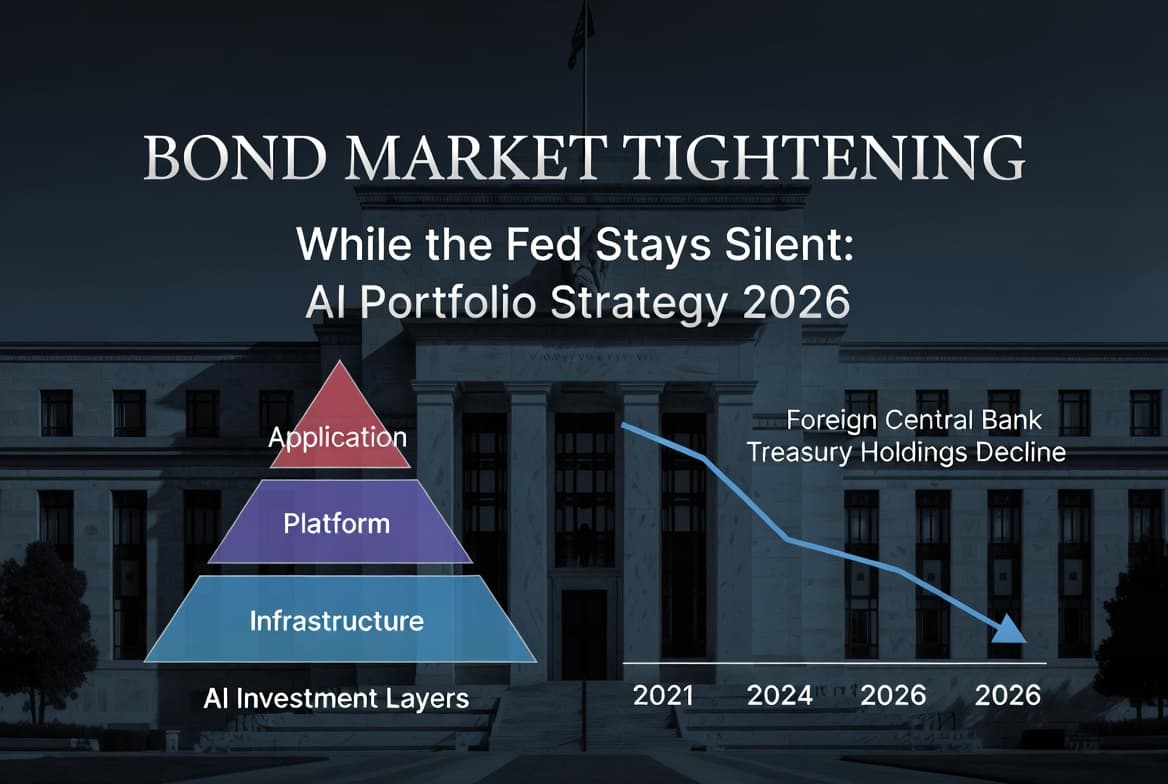
Now that the bond market is tightening instead of the Fed, how should AI portfolios change?
Bond interest rates
AI Portfolio
Government bond dumping
inflation
Risk Management
2026.05.22
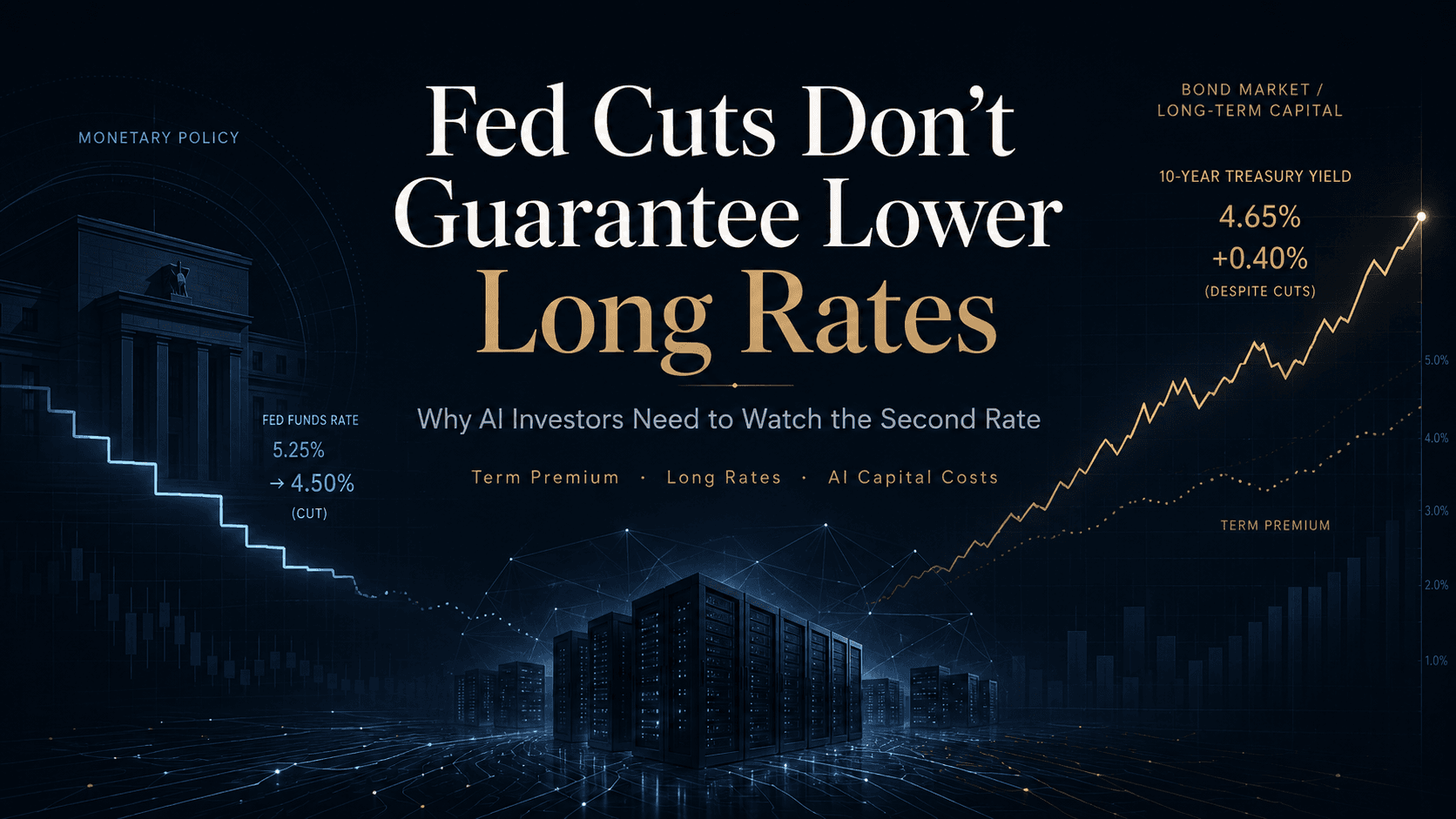
The Federal Reserve maintained the benchmark interest rate at 3.50–3.75% at the FOMC meeting on April 29. However, bond yields are rising, and Turkey sold 89% of its U.S. Treasury holdings in just one month. Market interest rates move even when the Fed does not—this is the current structure. This direction was already foreshadowed in the March OECD report , and the trend is continuing into May.
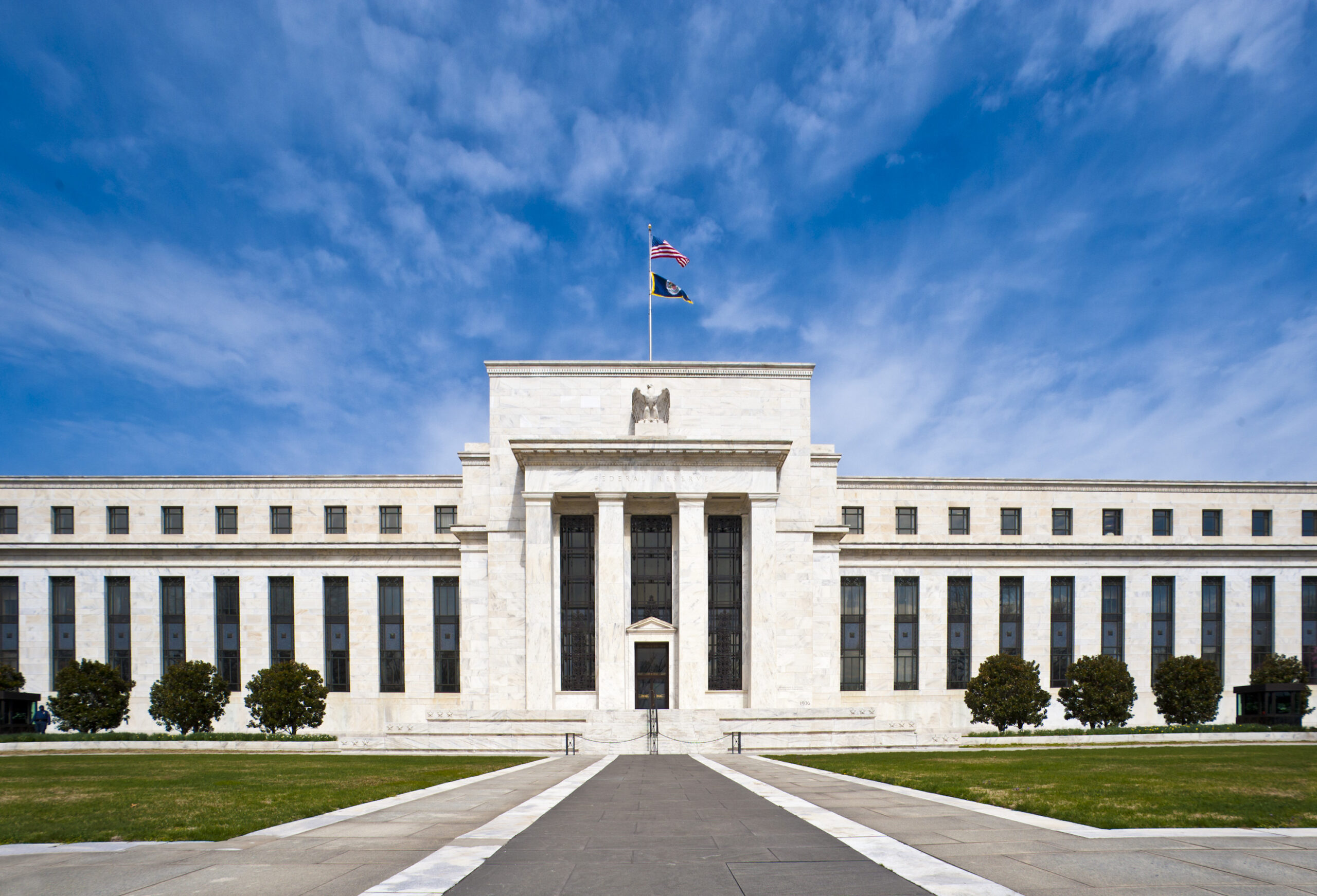
1 The number speaks first
At the beginning of the year, the market expected two to three interest rate cuts. Now, CME FedWatch places the probability of a cut this year at less than 10% . Expectations have shifted in this direction in less than half a year.
The problem is not the base interest rate. The problem is the interest rate the market demands.
According to a survey of 200 global fund managers conducted by BofA in May, the proportion of those citing inflation as the biggest tail risk jumped from 26% in April to 40% in May in just one month. The proportion of those citing a surge in bond yields as the biggest risk also doubled from 9% to 18%. Furthermore, in the same survey, the proportion of excess stock holdings reached 50%, while cash accounted for only 3.9%. With everyone clustered in the same direction, risk perception is shifting rapidly.
The outlooks of Wall Street institutions are divided. Goldman Sachs forecasts a 25 basis point cut in December. Morgan Stanley predicts no cuts this year. JP Morgan goes a step further, believing the next move could be a hike rather than a cut. Barclays has pushed back the timing of its first cut to March 2027.
When outlooks are divided like this, the market typically prices in the most hawkish scenario first. That is why bond yields are currently rising even without any action from the Fed.
2Freezing is not safety
Even if the Fed does not touch the benchmark rate, the result is the same if market rates rise. Corporate financing costs increase, and stock discount rates rise. Currently, that path is open in three directions simultaneously.
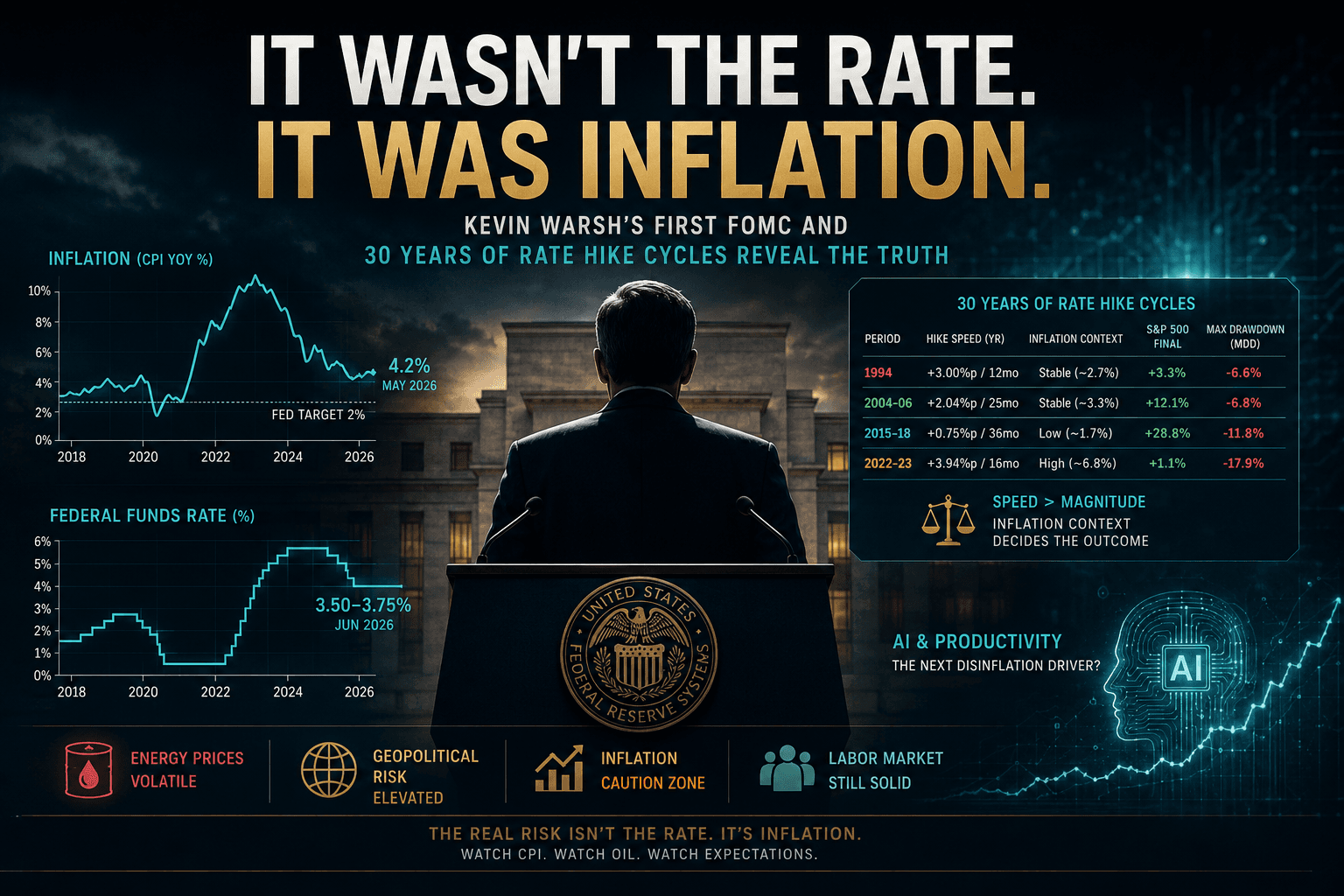
Inflation is a known issue. The April CPI rose to 3.8%. Gundlach predicted that "the next headline CPI will start in the 4% range." On top of this, energy-related pressure is mounting as Brent oil prices approach $100 per barrel due to the war with Iran. The IMF also warned that monetary policy normalization could be delayed, anticipating that U.S. inflation will exceed its target.
However, what the market is more concerned about is the possibility of a hike. Expectations for a rate cut within the year are being overturned by the possibility of a hike. At the end of March, the probability of a hike in the futures market even briefly rose to 52%. While the Fed remains silent, the market is finding its own answer.
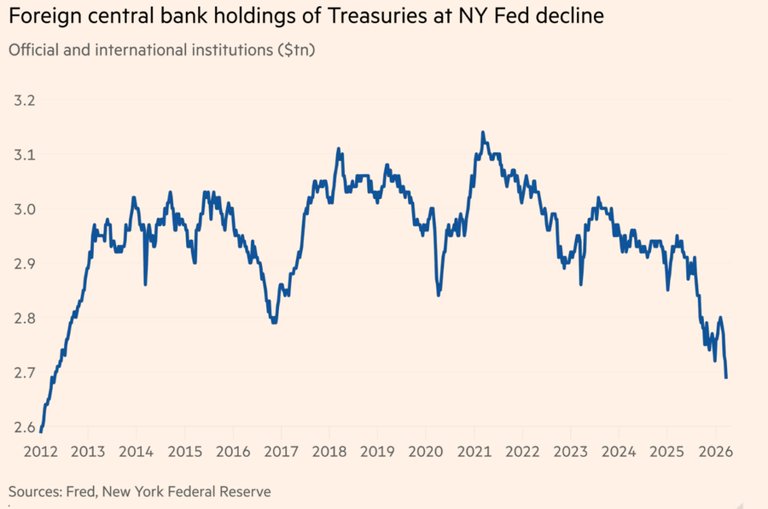
And there is one more thing most people are missing. Global central banks are selling U.S. Treasury bonds. Turkey liquidated its holdings by 89% in just the month of March, dropping from $16 billion to $1.8 billion. As oil prices surged due to the war with Iran, the country needed dollars to defend the lira, and it raised the funds by selling government bonds. China's holdings also stood at $652.3 billion, the lowest level since September 2008. Japan also sold $47 billion. Across all foreign institutions, $240 billion has disappeared compared to February.
It is an exaggeration to interpret this as the collapse of dollar hegemony. It is a process in which countries procure dollars to defend their domestic currencies. However, the result is the same. When the supply of government bonds increases, prices fall and interest rates rise.
While the Fed remains silent, the bond market is at work. I have separately outlined the path this structure takes to SaaS valuations and the private credit rift .
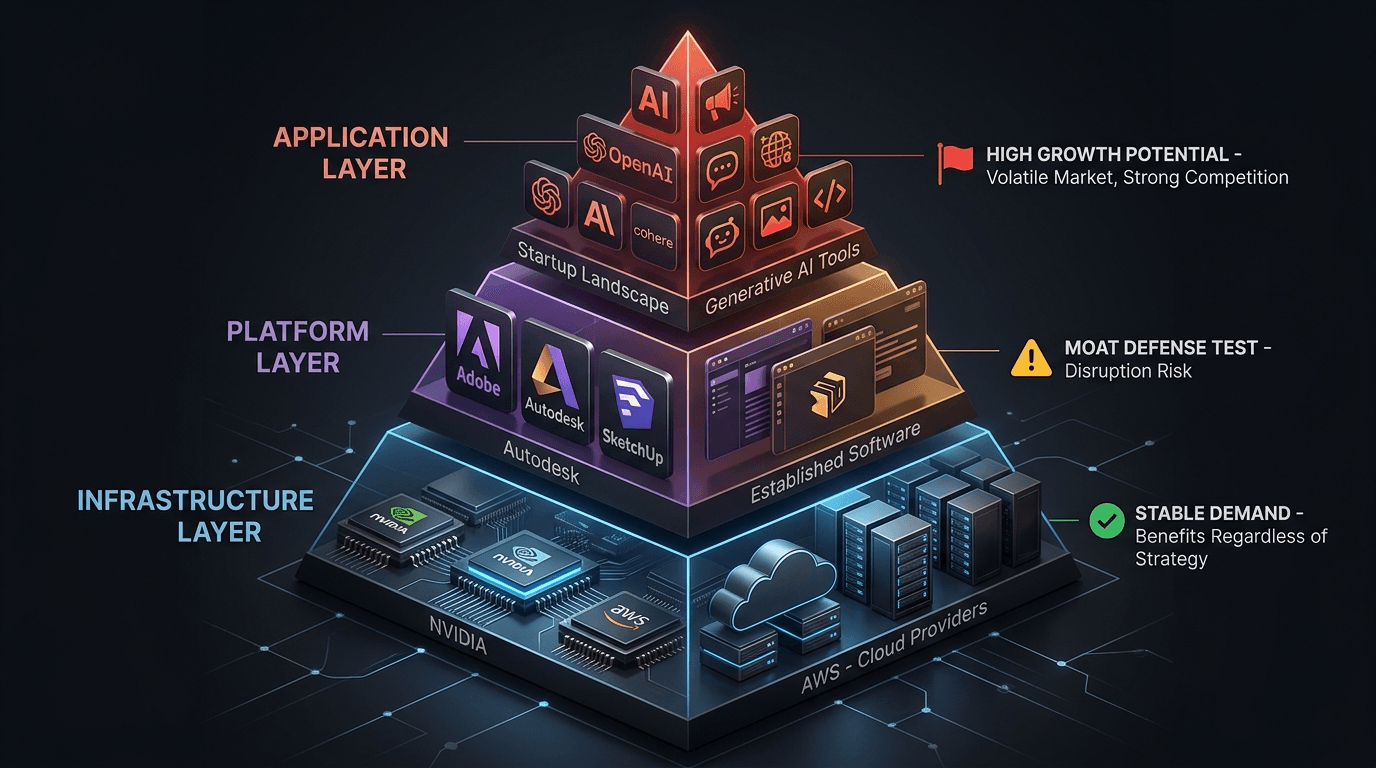
Even within 3AI, the question is where it is.
There is one most important question in the market right now. It is not “Do you have AI?” but “Where do you stand within AI?”
Infrastructure layers such as power, semiconductors, and data centers react to interest rates in a completely different way than the AI app and SaaS layers. For AI apps and software, prices are determined by expectations for the distant future. It is structured so that if the discount rate rises, the present value of those expectations decreases. This is a direct blow. Infrastructure, on the other hand, is different. The capital expenditure forecast for 2026 by AI hyperscalers has now been revised upward to $755 billion . This is not a story; it is actual orders.
In 2000, people asked the same question.
Is the internet real?
The Internet was real. What was wrong was the belief that companies like Pets.com would survive on it. The fiber optic cables laid by Cisco remained. Even when Nokia collapsed, the base stations remained. And on that infrastructure, Google and Amazon grew. This pattern, which technological revolutions have repeated, seems to hold true once again.
However, this does not mean that the infrastructure layer is completely safe. If interest rates rise rapidly, a short-term correction is difficult to avoid. There is only one difference: whether or not there is a basis for recovery. I have separately outlined the specific allocation logic for the infrastructure layer, which is indicated by the simultaneous demand for interest rates, energy, and AI .
4 Things to Keep in Mind for Each Scenario
The most likely scenario right now is a trend where bond yields continue to rise while the market freeze is maintained. In this scenario, it is necessary to keep in mind the possibility that volatility will increase, starting with the AI app and software layer, which faces the greatest valuation burden. This is a period where a strategy of securing some cash becomes meaningful again. With the BofA survey showing an overholding of stocks reaching 50% and cash holdings amounting to only 3.9%, the lack of cash to absorb the sell-off once it begins is also a structural vulnerability.
There is also a view, similar to JP Morgan, that leaves open the possibility of a rate hike. This is the scenario for which the market consensus is least prepared. In this case, while the infrastructure layer would also find it difficult to avoid a short-term correction, it can be approached differently from the app layer due to the basis for recovery in real demand.
There are also views, like those of Goldman Sachs, that forecast a rate cut in December. If this scenario materializes, the layer currently most suppressed is likely to rebound the fastest. However, rather than betting all at once, it seems more appropriate to approach the situation step by step while confirming signals.
The bigger problem is that the market has started to believe that interest rates are unlikely to fall again, rather than the fact that they are high.
5 3 Signs to Watch Out for Right Now
The next CPI announcement is the first. Whether the figure Gundlach predicted would “start in the 4% range” actually materializes is the fastest trigger to change market sentiment.
The second factor is whether the 10-year Treasury yield breaks through the 5% mark. Historically, crossing this threshold has triggered a full-scale shift of funds between stocks and bonds. We must also consider the fact that 62% of respondents in a BofA survey expect the 30-year yield to be above 6%.
The third factor is the tone of Federal Reserve Chair Kevin Warsh's remarks. Whether he places more weight on the Trump administration's pressure to cut interest rates or on actual inflation data will determine the direction for the second half of the year. The timing of his first public statement is crucial.
6Frequently Asked Questions
| question | answer |
|---|---|
| Doesn't the infrastructure layer also get hit if interest rates rise? | Short-term corrections are difficult to avoid. However, the difference lies in the basis for recovery. With AI hyperscaler CapEx revised upward to $755 billion, real demand proceeds regardless of interest rate fluctuations. Even during the dot-com bubble, fiber optic cables remained. |
| Should I sell it right now? | It seems appropriate to check for three signals first: the CPI entering the 4% range, the 10-year Treasury yield breaking through 5%, and the tone of the Fed Chair's remarks. Selling off all at once before these signals overlap carries the risk of missing the rebound. |
| Isn't global government bond dumping a sign of a structural crisis in the U.S. economy? | This sale does not constitute a rejection of U.S. Treasury bonds. It is a process in which countries procure dollars as demand for the dollar surges due to the war with Iran. It is closer to a temporary phenomenon caused by geopolitical shocks than a structural crisis. However, the outcome—upward pressure on bond yields—remains the same. |
| If the probability of a rate cut within the year is less than 10%, when can we expect a pivot? | Goldman Sachs looks ahead to December, while Barclays looks ahead to March 2027. The structure is such that the Fed can only act if both inflation slowdown and employment deterioration are confirmed simultaneously. I will discuss in detail which layer moves first on the day of the pivot in the next post. |
Conclusion — While the Fed remains silent
The bond market is taking the lead where the Fed has stepped back. Inflation, expectations of hikes, and global government bond sell-offs are simultaneously pushing bond yields up. As long as the freeze continues, this pressure will not easily dissipate.
To be honest, the most dangerous aspect of this structure is the complacency that "it is fine because I hold AI stocks." Even within the same AI theme, the outcome varies completely depending on where you are positioned. Apps and software take a direct hit from rising discount rates, while infrastructure is supported by real-world demand. Personally, I believe that simply examining the weight of AI apps and software in your current portfolio is a sufficiently meaningful step.
The next bull market is highly likely to differentiate the performance of those who bought a specific layer, rather than those who bought AI.
All content in this article is for informational purposes only and does not constitute investment advice. The scenarios and figures mentioned do not guarantee specific investment outcomes, and market conditions are subject to change at any time. You bear all investment decisions and responsibilities, and we recommend consulting a professional financial advisor before making any important decisions.
📌 Was this analysis helpful?
In the next post, we plan to cover “How Korean AI infrastructure stocks react differently in this scenario.” We will examine, layer by layer, how the global interest rate structure affects SK Hynix , the three major power equipment manufacturers, and Korean data center -related stocks.
We continue to track Fed pivot signals and AI investment strategies. Receive notifications so you don't miss out.
How this content was produced
Aleph's research AI agent assisted with collecting and analyzing public data, creating charts and visuals, and structuring the draft. Davar personally reviewed and edited the sources, figures, reasoning, and final conclusions.
This content is for informational purposes only and is not personalized investment advice or an individual stock recommendation. Read the full disclaimer

Davar
Davar builds and operates Aleph's research AI agent and writes and reviews analysis on macroeconomic developments and AI industry trends.
© Aleph. All rights reserved.