
AI Investment Strategy
wealth inequality
BlackRock
2026.03.25
Larry Fink, CEO of BlackRock, the world's largest asset management firm, issued a shocking warning in his annual letter on March 23. He stated, "AI will repeat wealth inequality on a larger scale." These are the words of someone managing $14 trillion. However, what was more significant was the remark that followed the warning: "If you do not invest, you will only watch economic growth from the sidelines." Forty percent of Americans are still outside the stock market, and in Korea, 75% of retirement pensions are tied up in principal-guaranteed products. A study conducted by Aleph through 1,000 Monte Carlo simulations confirmed that the asset gap between AI investors and non-investors would be 3.5 times after 10 years.
1What Larry Fink Said — 3 Key Warning Lines
Every March, there is a letter that Wall Street pays close attention to. It is the Annual Chairman's Letter from BlackRock CEO Larry Fink. In 17 pages, he reveals how the man managing $14 trillion—an amount equivalent to approximately eight times South Korea's GDP—views the world. The title of this year's letter is "Growing with Your Country."
Pink conveyed three key messages in the letter.
① “The old model of global capitalism is collapsing”
“The old model of global capitalism is fracturing. Countries are spending enormous sums to become self-reliant—in energy, in defense, in technology.”
② “AI will repeat wealth inequality on a larger scale”
“Now AI threatens to repeat that pattern at an even larger scale—concentrating wealth among the companies and investors positioned to capture it.”
③ “If you do not invest, you become a tenant who just watches from the sidelines”
“Billions watch their economies grow from the outside, as renters rather than owners—putting their savings in bank accounts that earn little, rather than investing to share in the growth around them.”
Source: BlackRock 2026 Chairman's Letter Original Text (PDF)
In particular, the metaphor used by Pink , “renters rather than owners,” is striking. It means that if you only keep your money in a savings account, you cannot share in the fruits of economic growth even if the economy grows. Just as people who pay monthly rent do not receive the benefits of rising housing prices.
2“K-shaped Economy” — People going up, people going down
The AI-induced wealth inequality warned about by Pink is already unfolding in reality. Economists call this the "K-shaped economy." It is an economic structure that splits like the letter K, with one side rising and the other falling.
The example Pink cited directly in his letter is striking: “Walmart reached its highest-ever valuation, two weeks after Saks went bankrupt.” — Walmart hit its all-time high market capitalization exactly two weeks after the luxury retailer Saks went bankrupt. Although they are both in the retail industry, the results are the exact opposite. The gap between companies that have succeeded in efficiency using AI and those that have not is widening to such an extreme degree.
| characteristic | The top of K ↗️ | The bottom of K ↘️ |
|---|---|---|
| Market capitalization | The Magnificent 7 contributes approximately 40% to S&P 500 earnings | Saks Bankruptcy Accelerates Weeding Out of SMEs |
| AI investment | Hyperscaler capex $380B→$650B (+70%) | Legacy software companies lose price competitiveness |
| Stock ownership rate (USA) | Households with an income of $100K+: 87% ownership | Households with income under $50,000: Only 28% own |
| Flow of wealth | Asset owners → Benefit from rising asset prices | Wage earners → Stagnation of real purchasing power |
Source: Gallup 2024-2025 Survey / CAA Analysis / Evercore ISI / Yahoo Finance
Eric Winograd, Chief Economist at Alliance Bernstein, accurately pointed out this structure. “The benefits of AI accrue primarily to those who have invested in financial markets. On the other hand, AI is increasing productivity by penalizing labor.” The gap between investors and non-investors is widening faster and more significantly due to AI.
While 87% of households with an income of over $100,000 own stocks, only 28% of households with an income of under $50,000 do (Gallup 2024-2025). It is a structure where, living in the same country, one side fully enjoys the rise of the asset market while the other enjoys none at all. The gap is also stark by race — only 70% of Whites, 53% of Blacks, and 38% of Hispanics own stocks.
3 Pink’s Prescription — “Democratize Investment”
Pink did not stop at just issuing a warning. He presented three specific prescriptions.
Maintain long-term investment
“Over the past two decades, every dollar invested in the S&P 500 grew more than eightfold. Miss just the ten best days, and you would have earned less than half.” — Over the past 20 years, $1 invested in the S&P 500 has grown to over $8, but missing just the ten best days can reduce returns to less than half. The key is not to try to time the market, but to stay in the market.
Reform Social Security
Fink supported a proposal jointly introduced by U.S. Senators Bill Cassidy (Republican) and Tim Kaine (Democrat). The proposal suggests creating a $1.5 trillion diversified investment fund separate from the existing Social Security Trust Fund, investing in a diversified manner across stocks and bonds, and managing it for 75 years. The aim is not to privatize or replace Social Security, but to increase returns through parallel management.
Create new jobs for the AI era
Pink quoted Nvidia CEO Jensen Huang: “Everybody should be able to make a great living. You don’t need a PhD in computer science to do so.” — This conveys the message that skilled technical jobs building AI infrastructure, such as data centers , power systems , and electric grids, represent new high-income employment opportunities. To this end, BlackRock announced the launch of its $100 million 'Future Builders' program, stating that it will train 50,000 technical professionals over five years.
4Korea is more serious — 75% of retirement pensions are dormant
Pink's warning may sound like a story about the United States. However, the reality in Korea is actually more serious.
| characteristic | 🇺🇸 USA | 🇰🇷 Korea | Implications |
|---|---|---|---|
| Stock market participation rate | 62% (Gallup 2025) | Approximately 35% (by the end of 2024) | Korea is half the level of the U.S. |
| Retirement pension investment proportion | 401(k) equity allocation 60%+ | Performance-based dividend 24.8%, principal and interest guaranteed 75.2% | Most of Korea's retirement pensions are dormant. |
| Maximum investor age group | Ages 55–64 (Retirement preparation generation) | 40s (23%) · 30s (20.8%) · 50s (20%) | In Korea, those in their 40s lead, while those 50 and older are lacking. |
Sources: Gallup 2025 / Korea Capital Market Institute (KCMI) 2026 / Korea Securities Depository 2025 / Yonhap News
Of Korea's retirement pension reserves of 496.8 trillion won , 75.2% (373.6 trillion won) is tied up in principal-guaranteed funds (KCMI, as of the end of 2025). The average annual return for principal-guaranteed funds is merely in the 2–3% range. Compared to the S&P 500's average annual return exceeding 10% during the same period, Korea's retirement pension system is effectively a "structure that does not participate in growth ." Larry Fink's concept of "renters rather than owners" exists in Korea in the form of retirement pensions.
Only about 35% of Korean adults own stocks, while 65% are outside the market. Compared to the United States (62%), this means nearly twice as many people are excluded from the growth of the capital market. With even retirement pensions locked into principal-guaranteed products, Koreans are structurally more vulnerable to the "wealth inequality of the AI era" mentioned by Pink.
5This Is How the Gap Widens If You Don't Invest — Results of 1,000 Simulations
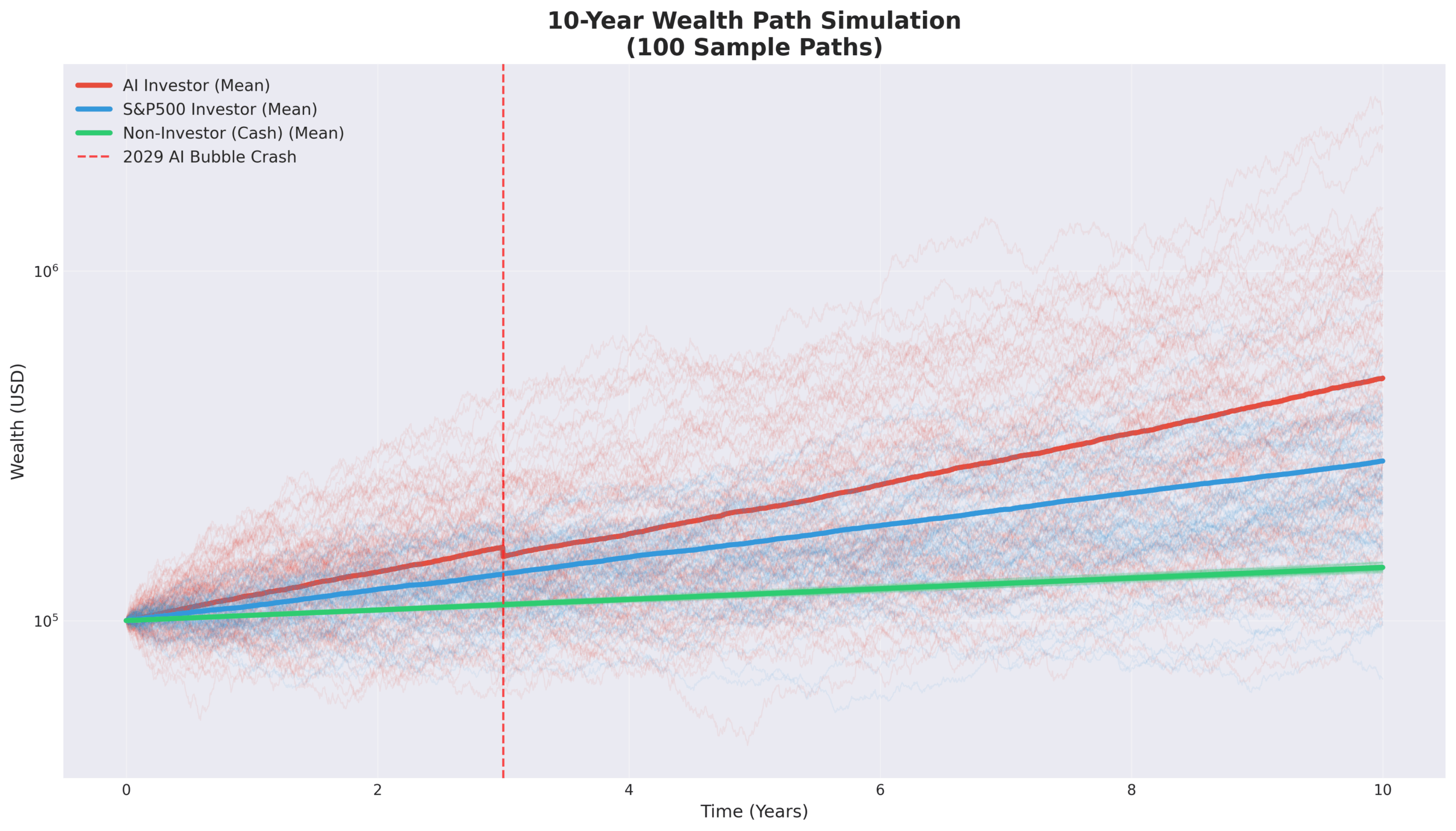
Larry Fink said, “If you don’t invest, you will be left out,” but specifically, just how left out will you be? Aleph verified this through 1,000 Monte Carlo simulations.
Simulation Design: Initial assets $100,000. Period 10 years (2026–2036). 1,000 simulations. Reflects an AI bubble collapse scenario (30% shock in Year 3, 50% probability). Three investment strategies were compared.
| scenario | Average after 10 years | median | bottom 5% | Top 95% | Compared to non-investors |
|---|---|---|---|---|---|
| 🤖 Option A — AI Investor AI ETF 70% + Cash 30% | $493,767 | $345,765 | $96,609 | $1,278,697 | +250% |
| 📈 Option B — S&P 500 Investors S&P 500 ETF 70% + Cash 30% | $286,068 | $255,444 | $122,776 | $560,474 | +103% |
| 💰 Plan C — Non-investors Deposits/MMF 100% (3.5% per annum) | $141,060 | $141,060 | $141,060 | $141,060 | base line |
⚠️ Simulations are statistical estimates based on historical data and do not guarantee actual returns. This is for informational purposes only and is not an investment recommendation.
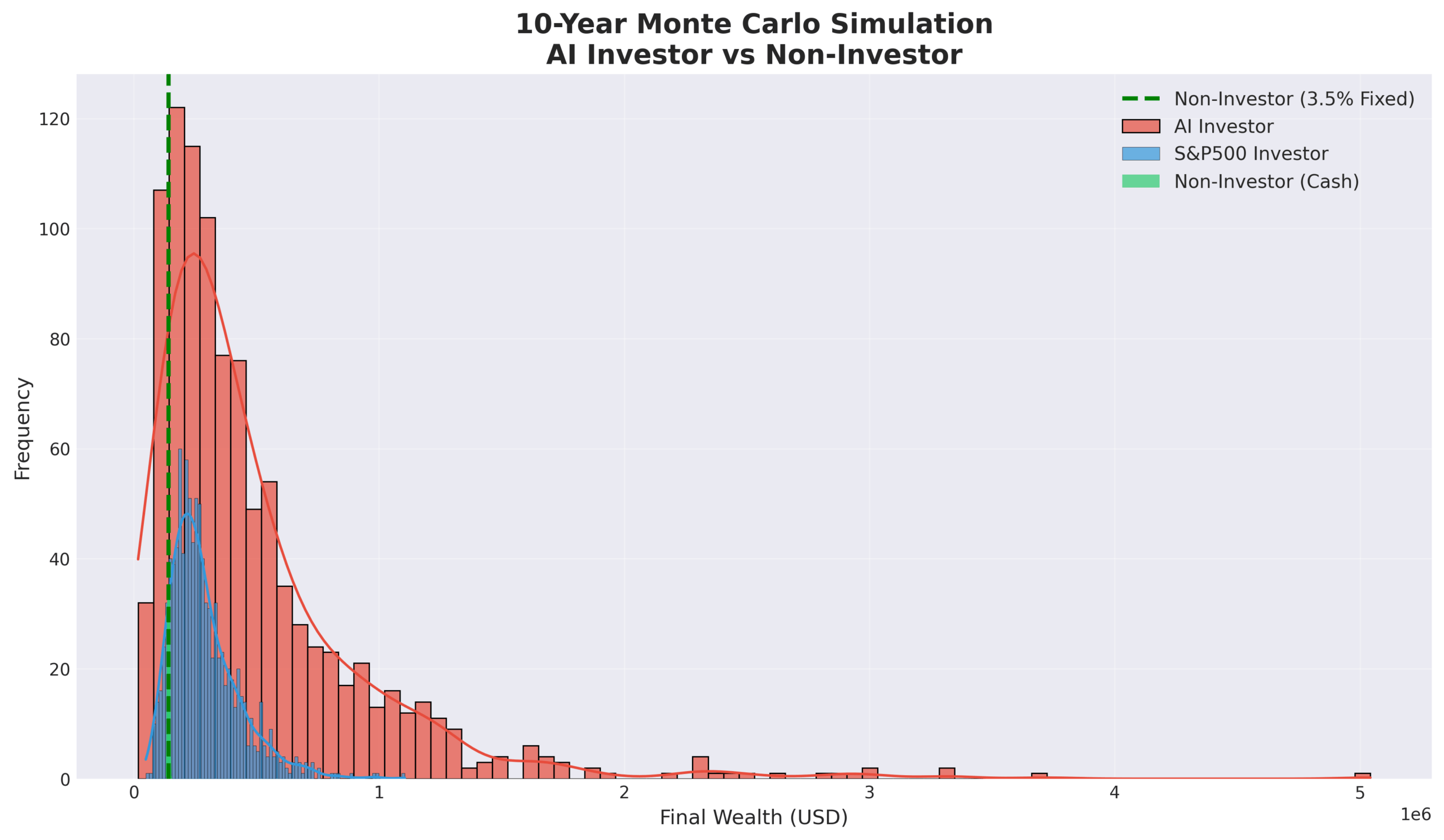
① Average gap after 10 years : AI investors ($493,767) vs. non-investors ($141,060) = $352,707 difference . Approximately 3.5 times.
② Top Scenario Gap : The top 95% of AI investors earn $1,278,697, which is nine times that of non-investors.
③ Even considering only the S&P 500 : The average is $286,068, which is double that of non-investors. Market participation itself is important, even if you do not necessarily invest heavily in AI.
④ Even after reflecting the AI bubble collapse : Even with the -30% shock in the third year, the long-term position is overwhelmingly favorable for investors.
Conclusion: Larry Fink’s statement that “if you don’t invest, you’ll be left out” is not an emotional appeal, but a mathematical fact.
6But Can We Trust Pink 100%?
A balanced perspective is required here. Larry Fink is the CEO of the world's largest asset management firm. His argument that "more people should invest" aligns with BlackRock's business interests . You must read this with this in mind.
| Pink's claim | Validity ✅ | Points to watch out for ⚠️ |
|---|---|---|
| Long-term investment is more important than timing | Supported by historical data (S&P 500 20-year 8x) | Past performance does not guarantee the future |
| More people need to invest | Substantial effect on alleviating wealth inequality | BlackRock AUM increase = Fee revenue increase |
| It is okay to overinvest in AI infrastructure | Possibility of long-term demand catching up (Pink's argument) | Morgan Stanley: 50/50 probability of meeting expectations |
| "AI company bankruptcy is also capitalism" | Creative destruction is part of innovation | Bankruptcy damage could be concentrated on individual investors |
Pink himself spoke frankly at the BlackRock Infrastructure Summit on March 13. “We’re going to have some huge successes, and we’re going to have a couple of failures. That’s capitalism.” — He predicted that there would be both massive successes and bankruptcies among AI companies. However, the important part is the next sentence: “Their return on equity is still better than mine, and I have a pretty good return on equity.” — This means that Big Tech’s profitability is still higher than BlackRock's.
While acknowledging Pink's interests, the direction of its core message is valid. The advice to "participate in investing" is a universal principle agreed upon by most economists and financial experts. However, judgment regarding "where, how much, and how" is required based on individual circumstances. This does not mean you should buy BlackRock products.
7 3 Things People in Their 40s and 50s Should Do Now in the AI Era
Theory and warnings are enough. Now it is time for the real thing. Here are three specific action items that Korean investors in their 40s and 50s should take away from Larry Fink's letter.
Check your retirement pension management status immediately.
If your retirement pension is 100% tied up in principal-guaranteed funds, check your fund manager's app right now. If you are a DC or IRP subscriber, switching just 20–30% to performance-based funds (including TDFs) can make a significant difference in long-term returns. The proportion of performance-based funds projected for 2025 has increased by 7.4 percentage points compared to the previous year — more people are already taking action.
This Month — Start Building Diversified Portfolios for the AI Era
This is not about putting all your eggs in one basket. What Pink emphasized is "market participation." It is fine to start with just one S&P 500 ETF (e.g., SPY , TIGER US S&P 500). If you have the means, consider incorporating 10–20% into AI infrastructure-related ETFs (e.g., BOTZ, KODEX US AI Tech TOP 10). The key is "getting started."
Quarterly — Risk Management through Rebalancing
Once you start investing, quarterly rebalancing is key. Because the AI sector is highly volatile, if your weighting in AI ETFs becomes too large, move a portion to the S&P 500 or bonds. As Morgan Stanley stated, "the probability of AI investment meeting expectations is 50/50," going all-in on AI is risky, but not participating at all is even riskier.
If you have little investment experience, try starting with this weighting.
📈 S&P 500 ETF : 50% (Global Diversification) · 🤖 AI/Semiconductor ETF : 15% (Growth Participation) · 🥇 Gold ETF : 10% (Hedge) · 💵 Cash/Short-term Bonds : 25% (Safety Net)
Domestic Access:
TIGER 미국S&P500 · KODEX 미국AI테크TOP10 · KODEX 골드선물(H) · TIGER CD금리투자KIS(합성)Conclusion — Will you live as a “tenant” or become an “owner”?
Larry Fink's 2026 Letter ultimately boils down to a single question: Will you participate in the growth of wealth created by AI, or will you simply watch from the sidelines?
40% of Americans are outside the capital market, and 65% of Koreans do not participate in the stock market. Of the 496.8 trillion won in retirement pensions, 75% is dormant in principal-guaranteed products yielding 2–3% per year. Meanwhile, AI companies are investing $650 billion in infrastructure this year alone, and Nvidia's market capitalization has reached $4.3 trillion.
1,000 Monte Carlo simulations clearly demonstrate that after 10 years, the asset gap between AI investors and non-investors is 3.5 times on average . The result remains the same even when accounting for the collapse of the AI bubble. This effectively proves, in numbers, what Pink called “renters rather than owners.”
Of course, there is no need to blindly trust Fink's words. He is the CEO of the world's largest asset management firm, and greater investment participation aligns with his business interests. However, the direction of the advice to "participate in the market" is a fact that history has repeatedly proven . The figures cited by Fink—the S&P 500 20-year 8x—are market facts, not BlackRock's opinions.
The important thing is to start now . Review your retirement pension. Start with at least one ETF. Participate as an “owner” in the growth of wealth in the AI era. Both this crisis and this opportunity ultimately belong to those who are prepared.
All figures and analyses in this article are for informational purposes only and do not constitute investment advice . Monte Carlo simulations are statistical estimates based on historical data and do not guarantee actual returns. AI investment involves various risks, including bubble collapses, technological changes, and regulatory risks. All investment decisions and responsibilities rest with the individual, and consulting with a professional financial advisor before making any important decisions is recommended.
📌 Was this analysis helpful?
In the next post, we plan to cover “Complete Guide to AI ETFs — QQQ vs BOTZ vs SOXX , Comparative Analysis for Korean Investors.”
If you are curious about the original text of Larry Fink's letter, you can view the full PDF here .
How this content was produced
Aleph's research AI agent assisted with collecting and analyzing public data, creating charts and visuals, and structuring the draft. Davar personally reviewed and edited the sources, figures, reasoning, and final conclusions.
This content is for informational purposes only and is not personalized investment advice or an individual stock recommendation. Read the full disclaimer

Davar
Davar builds and operates Aleph's research AI agent and writes and reviews analysis on macroeconomic developments and AI industry trends.
© Aleph. All rights reserved.