
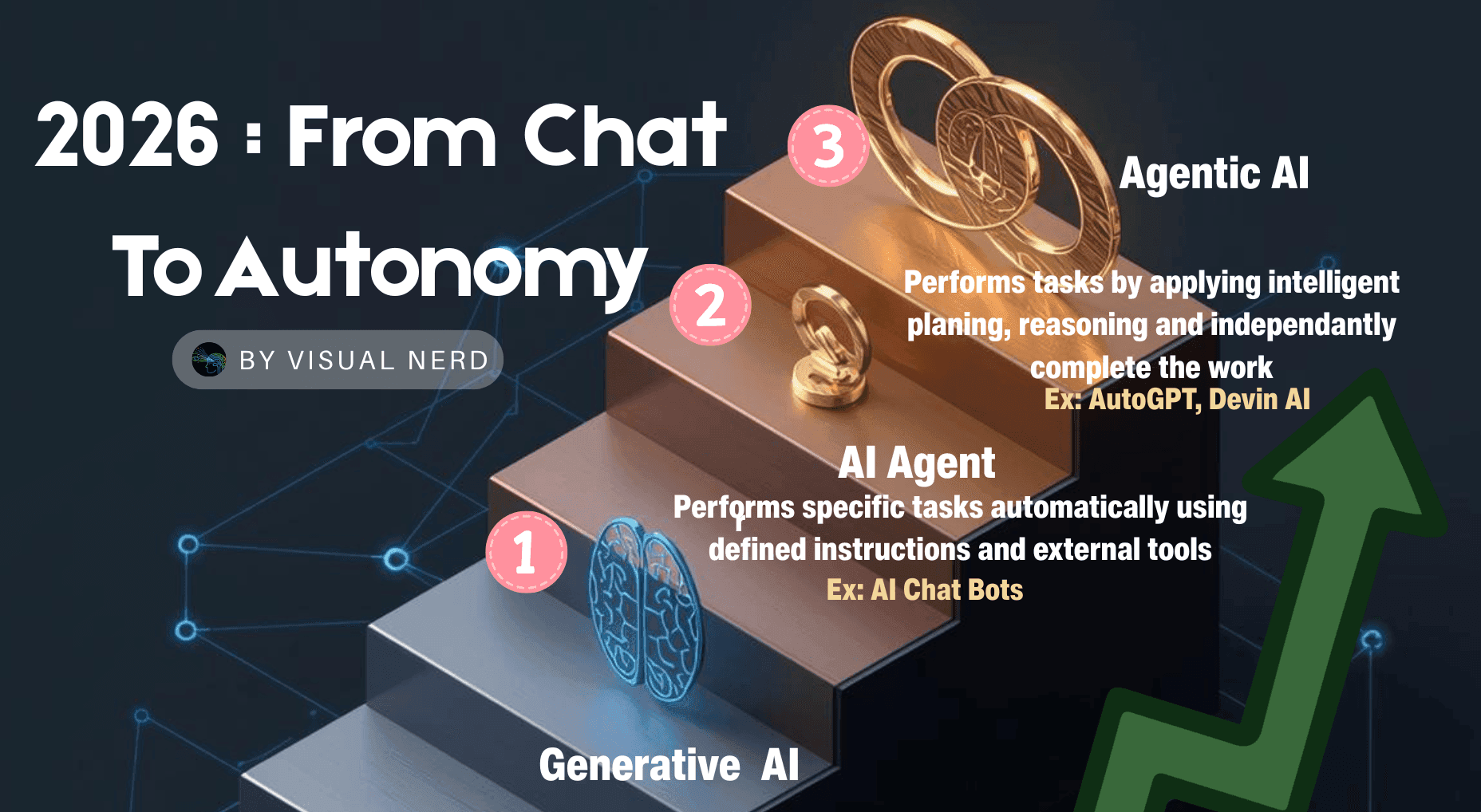
AI Agent
Jensen Huang
semiconductor
Investment Strategy
2026.03.23
You hear the term “AI agent” a lot these days, don’t you? From GTC presentations and podcasts to brokerage reports. However, it is difficult to find articles that clearly explain how they differ from chatbots. To start with the conclusion— chatbots answer questions, while agents handle tasks. Why this single difference drives computing demand by millions of times, and what does it mean for your portfolio? Aleph will explain it all in one go, for everyone from newcomers to investors.
1 What is an AI Agent — How is it different from a chatbot?
Let's start by clarifying the concepts. On the surface, AI agents and chatbots like ChatGPT both appear to be "conversing with AI," but they are completely different when you look inside.
| division | Existing AI (chatbot) | AI Agent |
|---|---|---|
| How it works | Answering the question | Receive a goal and plan and execute it yourself |
| Using tools | Conversation only possible | Utilizing tools such as file reading, code execution, and web search |
| memory | Remember only within the conversation | Long-term memory and file system access |
| computing consumption | Consume a small amount of tokens | Repeated reasoning at every step → Explosive increase in tokens |
| Representative Cases | ChatGPT, Gemini | Claude Code, OpenClaw , Devin |
The key lies in the frequency of computing consumption. Chatbots perform one inference per question and that's it. Agents are different. Like “reading files → writing code → testing → fixing errors → retrying,” they repeat inference dozens to hundreds of times until the job is done. The tokens used in this process amount to hundreds to thousands of times that of a chatbot. Now you suddenly understand why Jensen Huang said in his GTC 2026 keynote speech , “computing demand has grown a millionfold over the past two years,” right?
A chatbot is a translator who answers the request, “Translate this sentence into English.” An agent is an intern who handles tasks independently, such as “Analyzing this contract, identifying risk clauses, and even drafting an email for the legal team.” Hiring an intern increases the workload, and increased workload requires more computer resources.
2 What Jensen Huang Said Himself — Check the Original Text
We have selected only verified statements made directly by Hwang at the GTC 2026 keynote speech (March 16) and the All-In podcast (March 19). These are the original texts, not summaries.
Regarding computing demand, he said: “Inference demand has grown about 10,000x since ChatGPT launched — and computing demand overall has grown a millionfold over the past two years.” This means that since the release of ChatGPT, inference demand alone has increased 10,000-fold, and overall computing demand has grown 1 million-fold. Of course, one must take into account that these remarks were made by the CEO of a company that sells NVIDIA GPUs.
The evolution of AI was summarized as follows: “AI has evolved from perception to generation, to reasoning, and now it can truly get things done.” Perception → Generation → Reasoning → Execution. The final “get things done” refers precisely to the era of agents.
He added that the scale of AI infrastructure investment in 2027 will be “at least a trillion dollars,” and that actual demand will be much larger than that.
GTC 2026 Keynote: March 16, 2026 / All-In Podcast: March 19, 2026
Episode Title: “Jensen Huang: Nvidia's Future, Physical AI , Rise of the Agent, Inference Explosion”
Full Podcast Summary → Aleph All-In Complete Explanation
3Why Agents “Explode” Computing Demand
It may not be immediately clear just by looking at the numbers. It becomes clearer why agents generate this level of computing demand when viewed through the structure. In his GTC keynote speech, Huang summarized the evolution of AI into four stages.
| generation | The role of AI | Representative technology | computing consumption |
|---|---|---|---|
| 1st Generation: Perception | Image and audio classification | Early CNN, speech recognition | lowness |
| 2nd Generation: Generation | Text and image generation | ChatGPT, Midjourney | middle |
| 3rd Generation: Reasoning | Step-by-step analysis of complex problems | o1, Claude 3.5 | height |
| 4th Generation: Execution (Agentic) | If given a goal, they plan and execute on their own. | Claude Code , OpenClaw | explosive |
Here are three reasons why computing demand is exploding at the agent level.
① Iterative Inference. Agents do not stop reasoning until the task is finished. Even when writing a single piece of code, they repeat the process of “write → test → fix errors → retry” dozens of times. The difference in token consumption between a single chatbot conversation and a single agent task is hundreds to thousands of times.
② Multi-Agent Collaboration. In actual corporate settings, a single agent does not work alone. Research agents, coding agents, and verification agents collaborate simultaneously. It is essentially like an entire team taking over the space previously occupied by a single employee.
③ Always-On. In fact, this is the biggest change. The chatbot only turns on when I ask a question. The agent runs in the background 24 hours a day, monitoring and processing. It is like having a non-stop employee. Naturally, computing resources do not rest either.
Hwang personally stated regarding OpenClaw, an open-source agent framework , “This is as big of a deal as HTML. This is as big of a deal as Linux.” It is aiming to take the place of the operating system (OS) of the agent era, rather than merely serving as a development tool. If this becomes a reality, it will lead to computing demand that far exceeds current predictions.
4 Investor Perspective — Benefit Structure of the Agent Era
You have likely understood the concept. Now, the most important question from an investor's perspective is, "So, who makes money?"
The beneficiary structure consists of three main tiers. Tier 1 (chips and hardware) is the most direct. This includes NVIDIA, which supplies the GPUs used to create tokens; SK Hynix , which supplies the HBM memory attached to those GPUs; and Broadcom, which holds data center networking chips. The structure is such that demand in this tier increases as agents use tokens. Tier 2 (cloud infrastructure) provides a slightly more stable benefit. This is because the agents actually run in the cloud. Microsoft Azure and AWS fall into this category; however, it is important to note that both companies are currently developing their own chips, meaning they are moving toward reducing their dependence on NVIDIA in the long term.
| hierarchy | event | Agent Benefit Logic | Risk |
|---|---|---|---|
| Layer 3: Applications · SaaS | Salesforce, ServiceNow | Transition from SaaS to AaaS (Agent-as-a-Service) | Uncertainty regarding switching costs and speed |
| Domestic linkage | SK Hynix | HBM4 = Bottleneck resource for agent inference | Memory cycle risk |
| Domestic linkage | Naver | HyperCLOVA X Agentization + 5 Trillion Won Data Center Investment | Scale limitations compared to the global |
While Hwang's remarks are strong, there are counterarguments that must be considered before making an investment decision.
① Possibility of exaggerated demand forecast — The “1 million times” figure is a CEO statement aligned with the company’s interests. While it has been cross-verified by OpenAI and Anthropic, it is ultimately a statement made within the NVIDIA ecosystem.
② Uncertainty regarding agent commercialization speed — Enterprise field deployment may be slower than expected due to security, regulatory, and trust issues.
③ Efficiency Paradox — If the cost of the same operation is lowered due to improved chip performance, the effect of increased demand may be partially offset.
5 How to Reflect the Agent Era in Existing Portfolios
If we re-examine the Balanced Portfolio (Overseas 55% / Domestic 35% / Hedge 10%) from Aleph's previously discussed 2026 AI Stock Portfolio Analysis from the perspective of the agent era, the overall framework is maintained, but two key points are added. If you haven't read it yet, it will be more helpful to read it along with this article.
| Portfolio Items | Existing proportion | Directions for Adjusting Perspectives on the Agent Era |
|---|---|---|
| 🇺🇸 NVIDIA (NVDA) | 12% | Maintain or slightly expand — Agent infrastructure is the biggest beneficiary |
| 🇺🇸 Microsoft (MSFT) | 15% | Maintenance — Copilot agentization in progress, stable position |
| 🇺🇸 TSMC (TSM) | 10% | Maintenance — Monopoly on agent chip production, geopolitical risk constant |
| 🇰🇷 SK Hynix (000660) | 20% | Key takeaway — HBM4 is an agent inference bottleneck → Directly linked to demand |
| 🇰🇷 Samsung Electronics (005930) | 18% | Maintain — Recovery of HBM market share is the upside key |
| 🇺🇸 Broadcom (AVGO) | 5% | Growing Interest — Agent Data Center Networking Core Chip Supply |
“As the number of agents increases, tokens increase, and as tokens increase, chips are needed.” Deploy your assets along this chain. The intensity of benefits varies in the order of Chips (NVDA·SK Hynix) → Memory (SK Hynix·Samsung) → Infrastructure (MSFT·AMZN) → Networking (AVGO). If agent commercialization is faster than expected, demand for chips responds first; if it is slower, cloud infrastructure is more stable.
6 2 Things to Do Right Now
Read the full explanation of the Jensen Huang All-In podcast first.
If you grasp the full context of what Hwang said on the podcast—from Physical AI and token annual salaries to OpenClo—the investment implications of this article appear much more multifaceted. If you do not have time to watch the video yourself, you can start with the Aleph summary.
Check agent exposure in your current portfolio
If your portfolio is concentrated in only one layer among chips, memory, infrastructure, and networking, it is time to consider rebalancing. If your portfolio does not include SK Hynix, you may want to gauge the entry timing based on the HBM4 mass production schedule (scheduled for the second half of 2026). In this sector, split buying (at least three times) is not an option, but a principle.
Conclusion — Agents are not the next chapter of AI, but a completely different book.
Hwang’s “million-fold” figure is also a CEO statement that aligns with the company’s interests. Even taking that into account, it is difficult to deny the direction itself, as both OpenAI and Anthropic are moving toward agents. If generative AI was the era of chatbots, agents represent an era where corporate infrastructure is completely transformed.
There is only one thing that is certain. As agents work, tokens are consumed, and as tokens are consumed, chips are required. Check right now to see where your assets are located on this chain.
The speed of agent commercialization, the efficiency paradox, and the regulatory environment remain variables. Therefore, a structurally advantageous position takes precedence over short-term momentum.
All figures and analyses in this article are for informational purposes only and do not constitute investment advice . Jensen Huang's remarks included here are based solely on verified content from his GTC 2026 keynote speech and the All-In Podcast (March 19, 2026). All investment decisions and responsibilities rest with the individual, and consulting with a professional financial advisor before making any significant decisions is recommended.
📌 Was this analysis helpful?
In the next post, we plan to cover “HBM4 — Why SK Hynix Becomes a Key Component in the Agent Era.”
Please leave your investment concerns for the AI agent era in the comments.
How this content was produced
Aleph's research AI agent assisted with collecting and analyzing public data, creating charts and visuals, and structuring the draft. Davar personally reviewed and edited the sources, figures, reasoning, and final conclusions.
This content is for informational purposes only and is not personalized investment advice or an individual stock recommendation. Read the full disclaimer

Davar
Davar builds and operates Aleph's research AI agent and writes and reviews analysis on macroeconomic developments and AI industry trends.

© Aleph. All rights reserved.