
SpaceX · Cursor
AI Coding War
Platform Strategy
Musk
2026.04.24
On April 21, 2026, news broke that a rocket company had “acquired” an AI coding startup for $60 billion. That is how it appears if you only read the headline. The reality is different. SpaceX actually paid $10 billion , and the $60 billion is a call option to “buy it back” later. All of Musk’s calculations are contained within this single sentence difference. Let’s delve into the fierce battleground of the AI coding war.
1 The Deal We Misread — The Truth Behind the “$60 Billion Acquisition”
The headline "$60 billion acquisition" is only half right. The actual deal structure, as confirmed by Reuters and Bloomberg, is as follows: SpaceX made an upfront payment of $10 billion and, in return, acquired a call option to acquire Cursor later for $60 billion . The $60 billion was not exchanged right now.
What is even more interesting is the situation just before the deal. According to TechCrunch, Cursor was in the middle of a $2 billion funding round based on an enterprise valuation of $50 billion. They turned that money down and chose the SpaceX deal instead. The reason lies in a statement from Cursor cited by the NYT: “A lack of computing power was the bottleneck to growth.” This means that infrastructure was more urgent than money. It is a prime example illustrating the moment when access to computing became more important than funding in the age of AI.
Ultimately, the essence of this deal is not an acquisition, but a preemption . It is a structure where Cursor is locked in for $10 billion, and once its value rises sufficiently, it will be acquired for $60 billion. From Musk's perspective, the $10 billion is not the acquisition price, but a ticket to the next platform war.
2Why Coding of All Things? — 5 Reasons Why It Became an AI Battleground
Coding AI has become a key battleground in the AI war not simply because it is "profitable." There are structural reasons.
First, coding is the only domain where AI can immediately determine if it is incorrect. While the quality of essays or marketing copy is subjective, code yields an immediate answer upon execution. This verifiability dramatically increases its value as training data for AI models.
Second, software is the operating system of every industry. Mastering coding AI is mastering entire software development productivity. According to Shiftmag data, 92.6% of U.S. developers are already using AI coding tools.
Third, the execution language of the agent era is code. With Google unveiling the Gemini Enterprise Agent Platform at Cloud Next 2026 and all big tech companies touting AI agents, the way agents communicate with the world is ultimately through code. Coding AI is the infrastructure of the agent era itself.
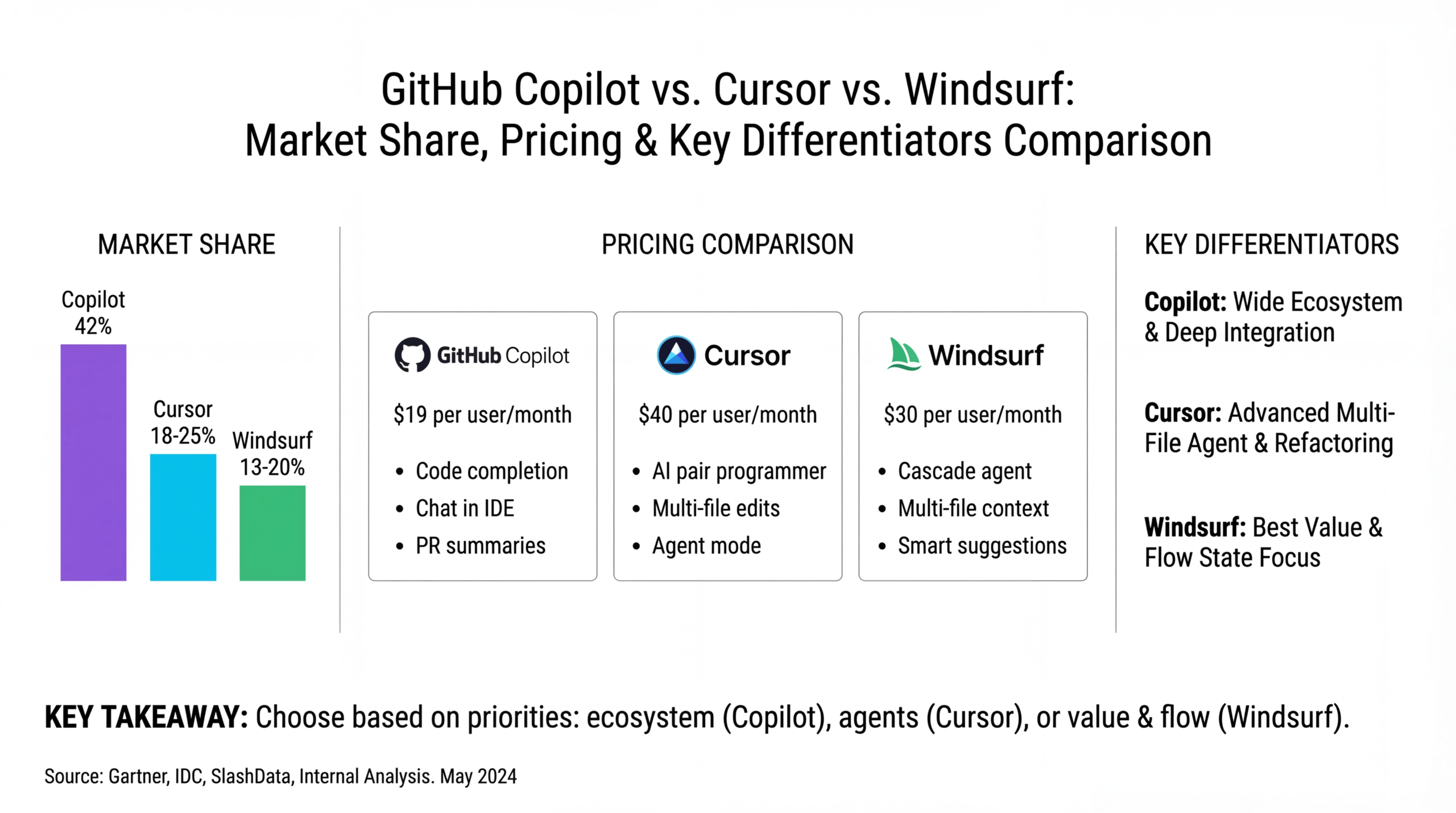
Fourth, whoever captures developers captures the platform. Microsoft, which acquired GitHub for $7.5 billion, has already proven this. Three players—Cursor, GitHub Copilot, and Windsurf—currently occupy about 80% of the AI coding tool market (Rework.com — see Direction).
Fifth, history repeats itself. The player who first dominated the tools developers use every day stood at the starting line of the next platform war. From Heroku to GitHub, through Slack, and up to Cursor—the same logic has been repeating for 16 years. And every time, when people first saw the deal, they asked, “Why that at that price?”
The History of Platform Wars Repeats Itself — Developer Ecosystem M&A Timeline
| year | acquirer | Target | amount | meaning |
|---|---|---|---|---|
| 2010 | Salesforce | Heroku | $210 million | Originator of cloud development infrastructure |
| 2016 | Amazon | Cloud9 IDE | private | Attempt to dominate browser IDEs |
| 2018 | Microsoft | GitHub | $7.5 billion | Takeover of the entire code repository → Copilot launch pad |
| 2021 | Salesforce | Slack | $27.7 billion | Dominating the developer collaboration ecosystem |
| 2021 | Prosus | Stack Overflow | $1.8 billion | Mastering the developer knowledge infrastructure |
| 2024 | Adobe | Figma ❌ | $20 billion | Crashed by Regulation — Signal to Check Platform Monopoly |
| 2025 | OpenAI | Windsurf ❌ | $3 billion | Deal Collapses, Key Personnel Leave for Google |
| 2025 | Windsurf Technology & Personnel | $2.4 billion | Indirect acquisition (License + Recruitment) | |
| 2026 | SpaceX | Cursor (Option) | $10 billion + $60 billion | Preempting the Era of AI Coding Agents |
❌ indicates a failed deal or a roundabout acquisition. Each transaction amount is based on press releases at the time and includes some undisclosed items.
3 Musk's 4 Calculations
Musk gains more than one thing from this deal. At least four layers operate simultaneously.
Solving the killer app problem of the xAI supercomputer
In February 2026, Musk announced that SpaceX had acquired xAI in an all-stock deal (Forbes). SpaceX now possesses the xAI supercomputer in Memphis. The problem was that there was no killer app to fully utilize those massive computing resources (Forbes analysis). The moment Cursor's AI model is trained on the xAI supercomputer, the lack of infrastructure is resolved (PCMag, AP).
Coding data exclusivity
Cursor possesses real-world coding data with over 1 million paid users and accounts for 60% of corporate revenue (see Gradually AI — Direction). This data is the scarcer and most valuable type for training AI models. In a situation where xAI was assessed as lagging behind in the coding AI competition (The Information), Cursor’s data and user base are the fastest means to bridge the gap.
Blocking competitors — Microsoft reviewed it first
According to an exclusive report by CNBC , Microsoft had previously considered acquiring Cursor prior to the SpaceX deal but ultimately abandoned the plan . The moment Musk finalized the deal, Microsoft's further access was blocked. Furthermore, as Cursor transitions from relying on OpenAI and Anthropic APIs to an xAI infrastructure, the API revenue base of its competitors will also be simultaneously weakened (PCMag).
SpaceX IPO AI Premium
CNBC reported the possibility of SpaceX going public by 2026. The moment a rocket and satellite company is redefined as a company possessing an AI coding platform, the valuation framework itself changes. $10 billion is the most efficient investment to secure an AI narrative prior to an IPO.
4Market Reaction — Who Is the Real Loser?
The real losers of this deal rarely appear in the headlines. If you break it down by player, the dynamics become clear.
| player | The meaning of this deal | influence | source |
|---|---|---|---|
| Microsoft | Abandoned after reviewing acquisition → Was preempted by SpaceX | Stock price up 3.6% over two days (April 20–22) ($418→$432) — Market actually views it positively. | CNBC, Microsoft IR |
| OpenAI | Cursor's Major API Providers → Direct Revenue Impact upon xAI Transition | Possibility of Declining API Revenue Share — Mid-to-Long-Term Risk | PCMag |
| Anthropic | Likewise, impact when switching from Cursor API provider to xAI | Potential Decrease in Demand for Claude API Coding — Mid-to-Long-Term Risks | PCMag |
| Cursor early investors | $10 Billion Deal Instead of a New $2 Billion Round — Cash Inflow Without Equity Dilution | NYT: “Will be silent if successful” — Dissatisfied but waiting for results | NYT DealBook |
It is paradoxical that Microsoft's stock price rose. The market may actually have felt relieved by the news that Microsoft failed to acquire Cursor. This is interpreted as meaning the company can focus on GitHub Copilot without the burden of a $60 billion acquisition. It is an example demonstrating how the same news can be read as a completely different signal depending on the perspective.
5What Should Investors Look At Right Now?
This deal is meaningful to investors not only because of SpaceX or Cursor itself, but because of the structural changes it signals.
| Layer | Approach direction | Key Points to Note |
|---|---|---|
| Layer 1 — AI Coding Infrastructure | Cloud and semiconductor sectors benefiting from running coding AI | NVIDIA (GPU), AWS·Azure (cloud infrastructure) — Direct beneficiaries of the increasing demand for AI coding |
| Layer 2 — Indirect Access to SpaceX IPO | Exploring Methods of Indirect Exposure Before SpaceX IPO | Seeking Funds to Hold SpaceX Equity or Participate in Offering if IPO Confirmed — 2026 Possibility, CNBC Report |
| Layer 3 — Next M&A Target | Attention on remaining players in the AI coding three-way battle | Unlisted AI Coding Startups Like Windsurf — Potential for Big Tech Interest to Rise (Including Current Speculation) |
① Whether SpaceX exercises the call option — The speed at which Cursor ARR reaches $6 billion is the de facto trigger
② Cursor's xAI Model Transition Speed — A Leading Indicator of OpenAI & Anthropic API Revenue Impact
③ Timing of the official SpaceX IPO announcement — The moment the AI premium valuation is validated by the market
6Frequently Asked Questions
| question | answer |
|---|---|
| Is SpaceX really acquiring Cursor for $60 billion? | It is not confirmed yet. The $60 billion is a call option, and the actual payment is $10 billion. Whether SpaceX exercises the option later depends on Cursor's growth trajectory and market conditions. |
| Why did Cursor reject $2 billion in funding and choose SpaceX? | According to the NYT, a lack of computing power was a bottleneck to growth. This means that access to xAI supercomputers was more urgent than money. It is a prime example of an era where securing AI infrastructure has become more important than funding. |
| Is there actually a blow to OpenAI and Anthropic? | Since Cursor currently relies heavily on APIs from two companies, switching to xAI will have a direct impact on API revenue. This is a medium-to-long-term risk rather than a short-term one, and official figures have not yet been confirmed. |
| How do you approach this from the perspective of Korean investors? | Direct investment in SpaceX is difficult as it is privately held. An indirect approach through stocks benefiting from AI coding infrastructure (cloud and semiconductors) is more realistic. A direct investment path could open up once a SpaceX IPO materializes (CNBC reported this possibility in 2026). |
| Who is the next AI coding M&A target? | Windsurf (formerly Codeium) is frequently mentioned. With Cursor now tied to SpaceX in the three-way competition for AI coding, there is a possibility that interest in the remaining big tech players will increase. However, who the next target is is currently just speculation. |
Conclusion — $10 billion is not the acquisition price, but the ticket.
If you read this deal solely as a "$60 billion acquisition," you are only seeing half the story. The $10 billion SpaceX paid was not the money to buy Cursor. It is a ticket to the war on AI coding platforms. And the reason this war is important is that coding AI is the execution infrastructure for the agent era.
Musk solved four problems at once: an xAI supercomputer killer app, coding data, a competitor containment, and an IPO narrative. If he secured all four of these simultaneously with $10 billion, the numbers aren't bad, at least.
The next AI superstar could emerge not from the place that builds the biggest models, but from the place with the agents that handle code best . That game is being set right now.
All figures in this article are for informational purposes only and do not constitute investment advice. Figures regarding deal structure (from Reuters, Bloomberg, TechCrunch, etc.) are based on the date of publication and are subject to change. ★☆☆ Reliability indicators (corporate code AI weighting, ARR forecast, market share, etc.) should be used for directional reference purposes only. You bear all investment decisions and responsibilities, and we recommend consulting a professional financial advisor before making any significant decisions.
📌 Was this analysis helpful?
In the next post, we plan to cover “The Next Target of the AI Coding War — Windsurf and GitHub Copilot, Who Will Be Next on the M&A Plate?”
We continue to translate the trends of the platform war from an investment perspective. Subscribe to our notifications so you don't miss out.
How this content was produced
Aleph's research AI agent assisted with collecting and analyzing public data, creating charts and visuals, and structuring the draft. Davar personally reviewed and edited the sources, figures, reasoning, and final conclusions.
This content is for informational purposes only and is not personalized investment advice or an individual stock recommendation. Read the full disclaimer

Davar
Davar builds and operates Aleph's research AI agent and writes and reviews analysis on macroeconomic developments and AI industry trends.


© Aleph. All rights reserved.