
US-Iran War
AI Industry Impact
Energy costs
Supply chain risk
2026.04.10
You might ask what a war between the U.S. and Iran has to do with the AI industry? It is much more direct than you might think. Today, AI operates on data centers , electricity, cooling, semiconductors , and massive capital. The moment a geopolitical shock originating from the Middle East hits energy prices, the ripples connect directly to AI training costs and cloud pricing. You might think this is a story about technology, but it turns out to be about oil prices, and ultimately, electricity rates and semiconductor procurement.
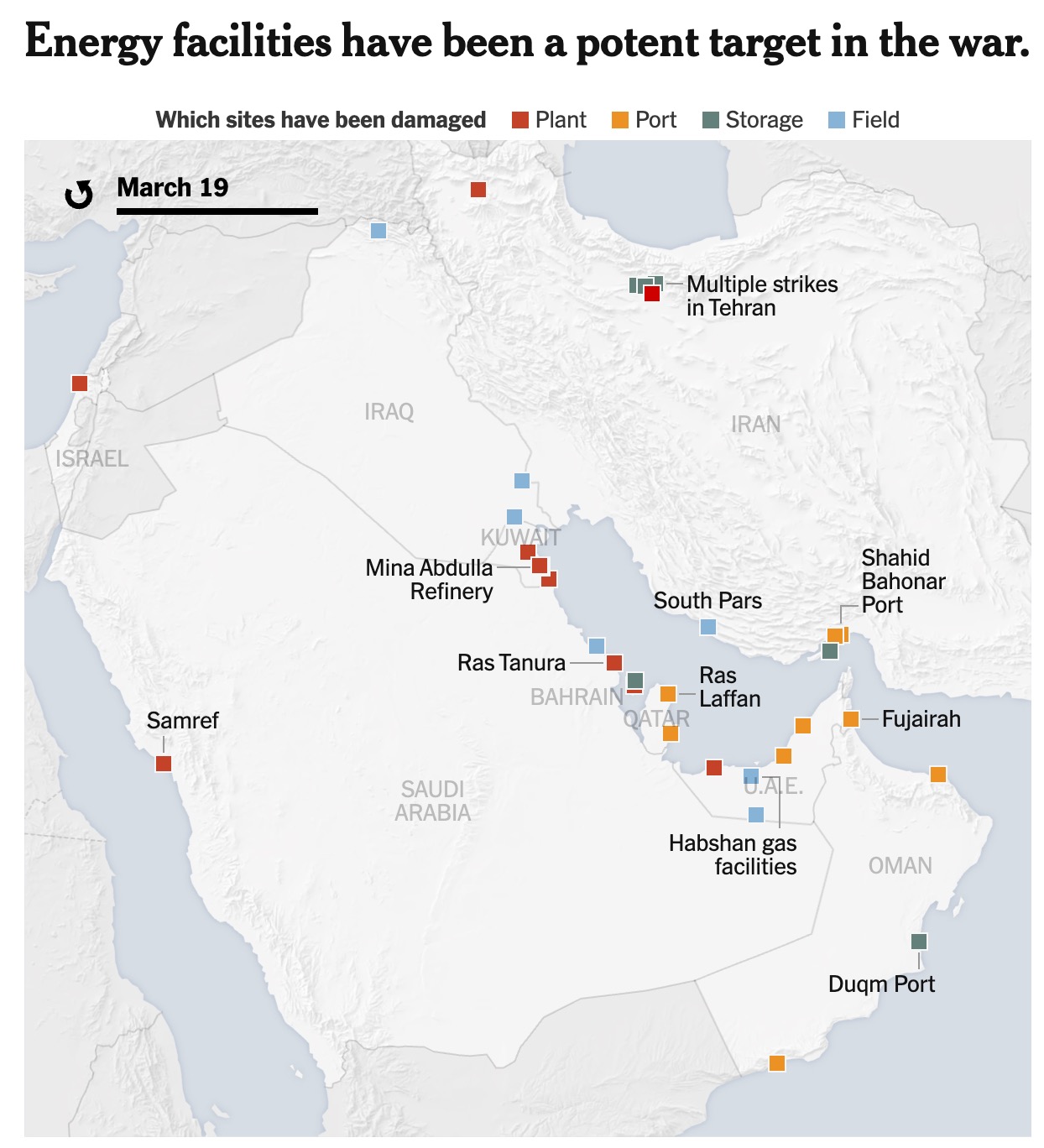
The Path of War Affecting the AI Industry — Shorter Than You Think
There are three key pathways through which geopolitical risks impact the AI industry: rising energy prices → increased data center operating costs , supply chain disruptions → higher semiconductor costs , and weakened investor sentiment → financial pressure on AI startups . When these three pathways operate simultaneously, the growth of the AI industry does not halt; instead, it creates a structure where players capable of growth are selected.
The energy market reacted quickly after the war began. Al Jazeera reported that global oil prices rose by more than 25% , and The Guardian reported that crude oil prices surpassed $110 per barrel . While these figures may seem unrelated to AI, they represent a direct cost variable for AI data centers that consume large amounts of electricity.
2 Shock Transmission Pathways — At a Glance with Sankey Diagrams
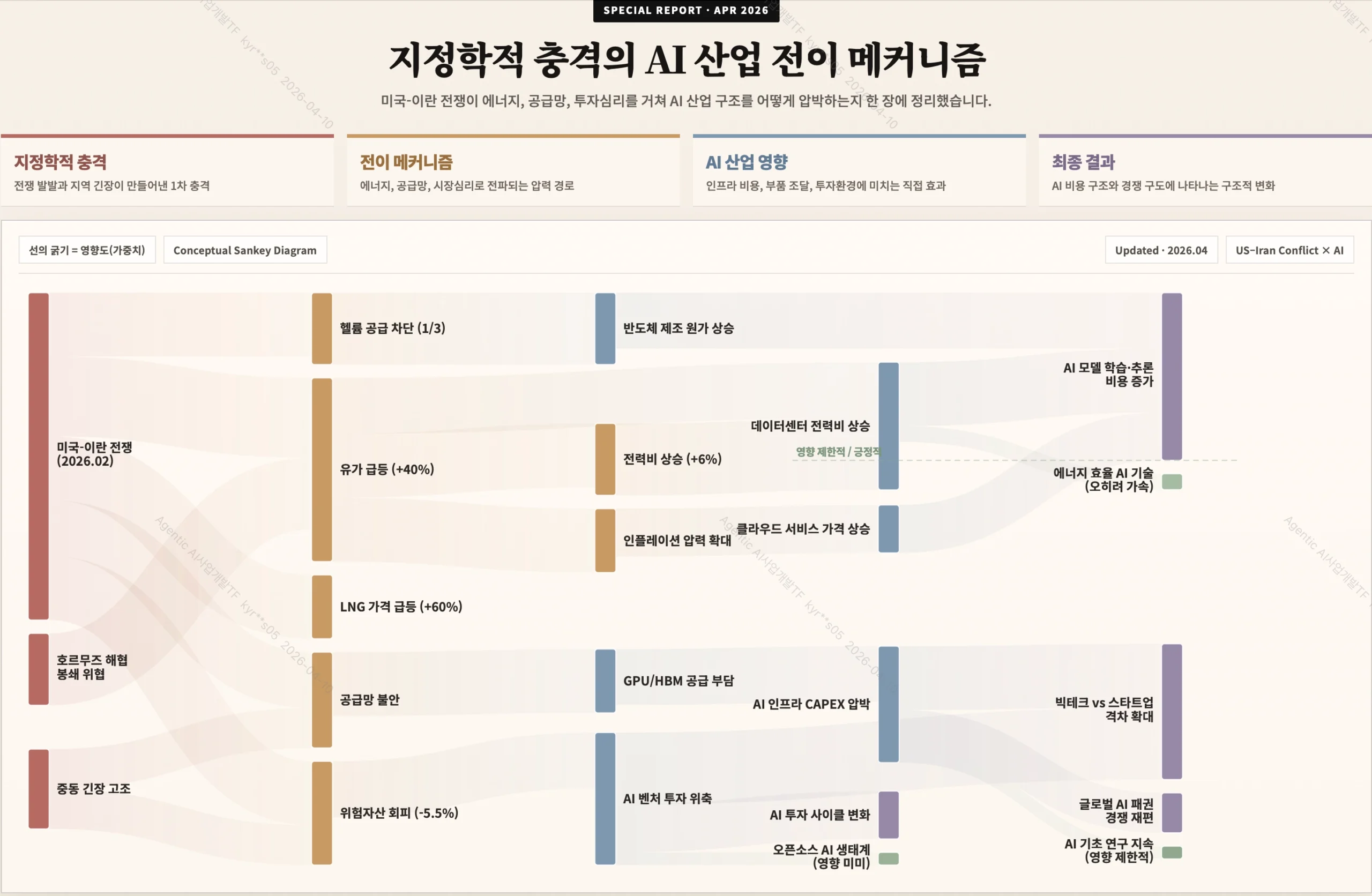
The diagram below illustrates the entire process of geopolitical shocks transferring to the cost structure of the AI industry. The thickness of the lines indicates the degree of impact, and hovering your mouse over each node displays a description.
Looking at the thickest flows in the diagram, three facts stand out. First, the path leading from soaring oil prices → rising electricity costs → increased data center operating costs is the thickest. Second, there is an unexpected bottleneck : the cutoff of helium supply → rising semiconductor manufacturing costs . Third, the nodes marked in green at the bottom right—namely, energy-efficient AI technologies and the open-source ecosystem—may have a limited impact or even accelerate it.
3 Helium Affects GPUs? — The Identity of the Hidden Bottleneck
Among supply chain shocks, helium is the easiest to overlook. The New York Times reported that production disruptions in Qatar have cut off about one-third of the global helium supply. Helium is used as an inert cooling gas in semiconductor manufacturing processes and is a material with no substitutes. With helium making up only 0.0005% of the air and global production concentrated in just three locations—the United States, Qatar, and Russia—the system is structurally vulnerable to geopolitical shocks. In particular, since high-purity helium is essential for cleaning the internal optical systems of EUV lithography equipment, accumulated supply disruptions directly impact the procurement costs of GPUs and HBMs.
According to industry analysis, with HBM demand expected to increase by 70% year-over-year by 2026, prices for some memory types are already rising by 30–40% . Since these are industry analysis figures rather than official statistics, it is appropriate to interpret them as a general trend rather than precise numbers.
4 Big Tech is Getting Stronger — The Paradox of Capital Power
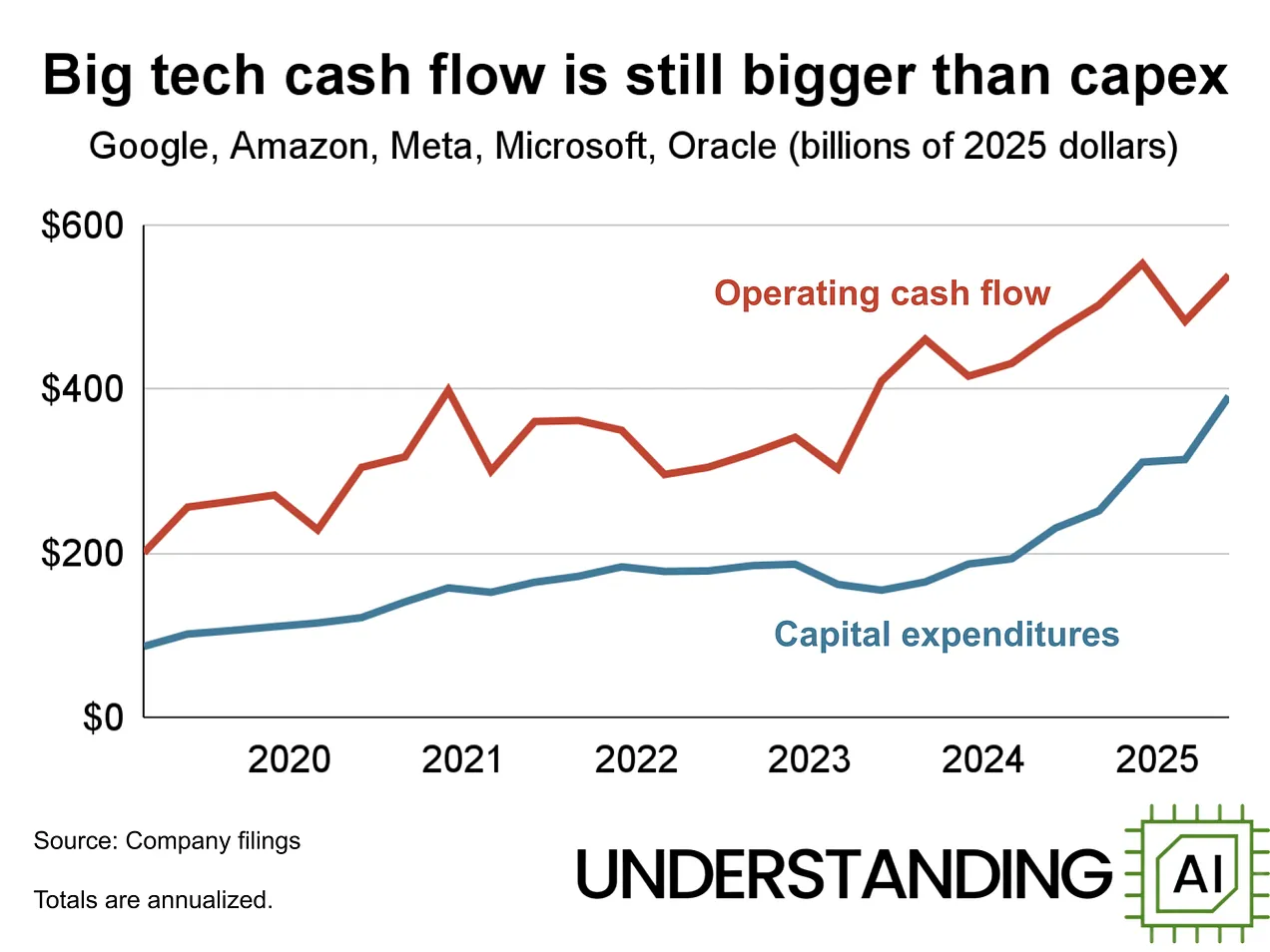
War does not stop AI innovation; it merely makes the conditions for who can continue to innovate more stringent. According to Reuters, Alphabet, Amazon, Meta, and Microsoft are projected to invest approximately $650 billion in AI infrastructure by 2026. As oil prices, electricity costs, transportation costs, and semiconductor procurement costs rise simultaneously, this capital gap takes on greater significance.
| Influencing factors | Big Tech | AI startup | source |
|---|---|---|---|
| Increase in electricity costs (+6%) | Partially hedged through self-generation and PPA contracts | Direct passing on of cloud costs | CNBC |
| Oil prices surge (+25%) | Long-term energy contracts buffer short-term shocks | Immediate increase in cooling and operating costs | Al Jazeera |
| Helium supply -1/3 | Secure inventory and alternative supply lines in advance | GPU procurement delays and rising costs | NYT |
| Weakened investment sentiment | Continue investing with internal cash flow | Sharp decline in Series B and lower funding | Reuters |
5Opportunity in Crisis — Energy-Efficient AI Accelerates
Not all areas of AI are taking the hit equally. Rather, this environment can accelerate innovation in specific directions.
Lightweight AI Models — Cost Pressure Drives Innovation
As power consumption and GPU costs rise, the value of models that deliver the same performance with fewer computations increases. While research to achieve GPT-4-level performance on an Llama scale has been active since before the war, cost pressures are driving this direction even more strongly. We are living in an era where efficiency is becoming the new measure of technological superiority .
Open Source AI Ecosystem — A Relative Safe Zone
Developers and startups utilizing open-source models can mitigate the impact of rising cloud API costs by operating their own servers. As the practicality of open-source models like Llama, Mistral, and Gemma increases, strategies to reduce dependence on large cloud services become more effective.
AI Basic Research — Limited Impact
University research institutes and non-profit AI research organizations are outside the direct impact zone of short-term energy cost shocks. Rather, the demand for research on energy-efficient algorithms and new learning paradigms may increase.
6Frequently Asked Questions
| question | answer |
|---|---|
| Does war actually affect the price of AI services? | Although not direct, the indirect path is clear. It follows the sequence of rising oil prices → rising electricity costs → increased data center operating costs → cloud service price adjustments, and there is typically a time lag of 6 to 18 months for this chain to take effect. |
| Why are helium supply disruptions important for semiconductors? | Helium is an irreplaceable cooling and cleaning gas in the semiconductor manufacturing process. Dependence on it is particularly high in state-of-the-art processes. A one-third reduction in supply leads to increased wafer production costs and results in price pressure for GPUs and HBMs. |
| How should we view AI investments right now? | The environment is relatively favorable for energy-efficient AI companies, Big Tech firms with their own infrastructure, and on-premises solutions capable of reducing cloud dependency. The key variables are whether the war ends and the speed of energy market stabilization. |
| What impact will this have on domestic AI and semiconductor companies? | While SK Hynix and Samsung Electronics benefit from the surge in demand for HBM, they are also facing upward pressure from the costs of helium and specialty gases. As long as a supplier-dominated market is maintained, price increases can be passed on, but the risk of production disruptions persists. |
Conclusion — To understand AI, you must look at electricity rates and geopolitics together.
The biggest impact of a U.S.-Iran war on the AI industry is not the technology itself, but issues of cost structure and capital allocation . AI will continue to grow. However, who benefits from that growth is determined collectively by energy prices, supply chain stability, and the investment environment.
There are also things that this crisis is paradoxically accelerating. These include energy-efficient AI technology, lightweight models, and the open-source ecosystem . As costs rise, technologies that solve the problem of being “cheaper and more efficient” shine even brighter. The next AI superstar may emerge not from the largest models, but from the places that create the most efficient models.
It is time to add another lens through which to view AI. We need a perspective that looks beyond just model performance benchmarks to encompass the electricity rates, logistics, and semiconductor supply chains that power those models, as well as geopolitics .
All figures in this article are for informational purposes only and do not constitute investment advice. Geopolitical situations can change rapidly, and energy and semiconductor price data is based on data as of April 2026. All investment decisions and responsibilities rest with the individual, and consulting with a professional financial advisor before making any significant decisions is recommended.
📌 Was this analysis helpful?
In the next post, we plan to cover “Winners of Energy Efficiency AI — Lightweight Models and Companies to Watch in the Era of Power Crisis.”
We continue to track the impact of geopolitical risks on AI investment strategies. Subscribe to alerts so you don't miss out.
How this content was produced
Aleph's research AI agent assisted with collecting and analyzing public data, creating charts and visuals, and structuring the draft. Davar personally reviewed and edited the sources, figures, reasoning, and final conclusions.
This content is for informational purposes only and is not personalized investment advice or an individual stock recommendation. Read the full disclaimer

Davar
Davar builds and operates Aleph's research AI agent and writes and reviews analysis on macroeconomic developments and AI industry trends.

© Aleph. All rights reserved.