
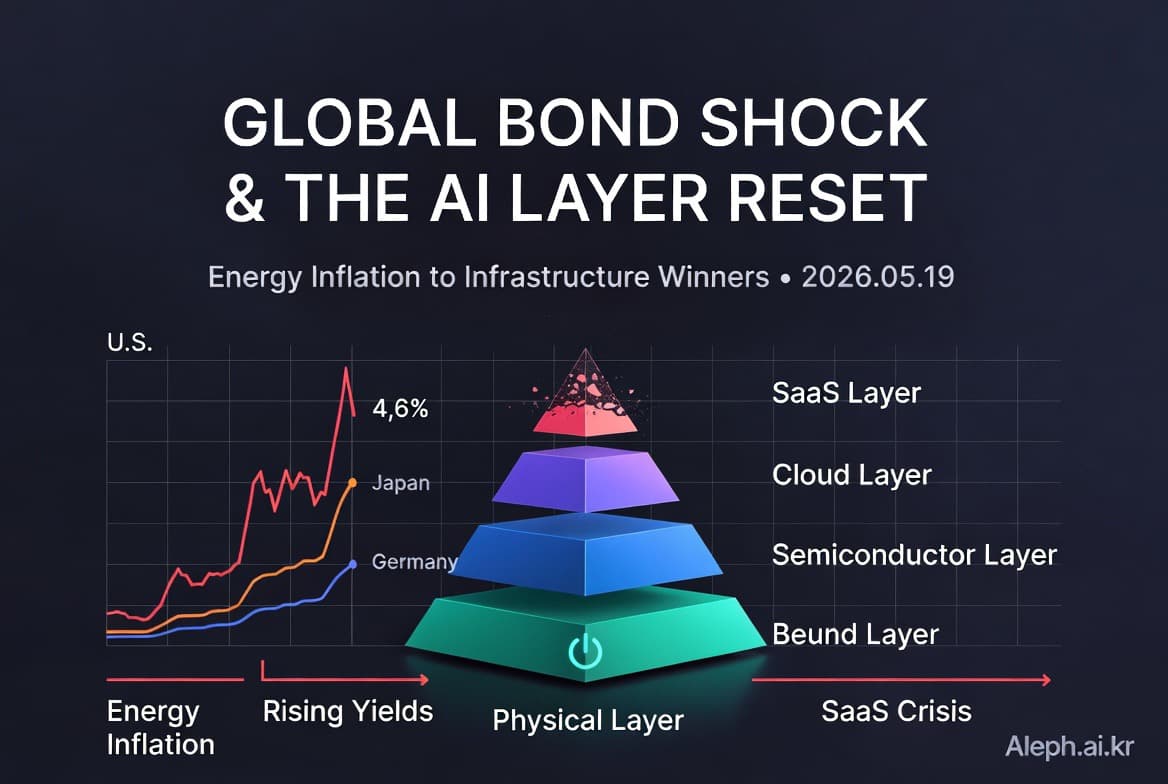
Energy inflation → Soaring interest rates → SaaS collapse — The current correction indicates a problem of layers.
Government bond yields rise
AI Investment Strategy
SaaS crisis
Layer Investment
2026.05.19
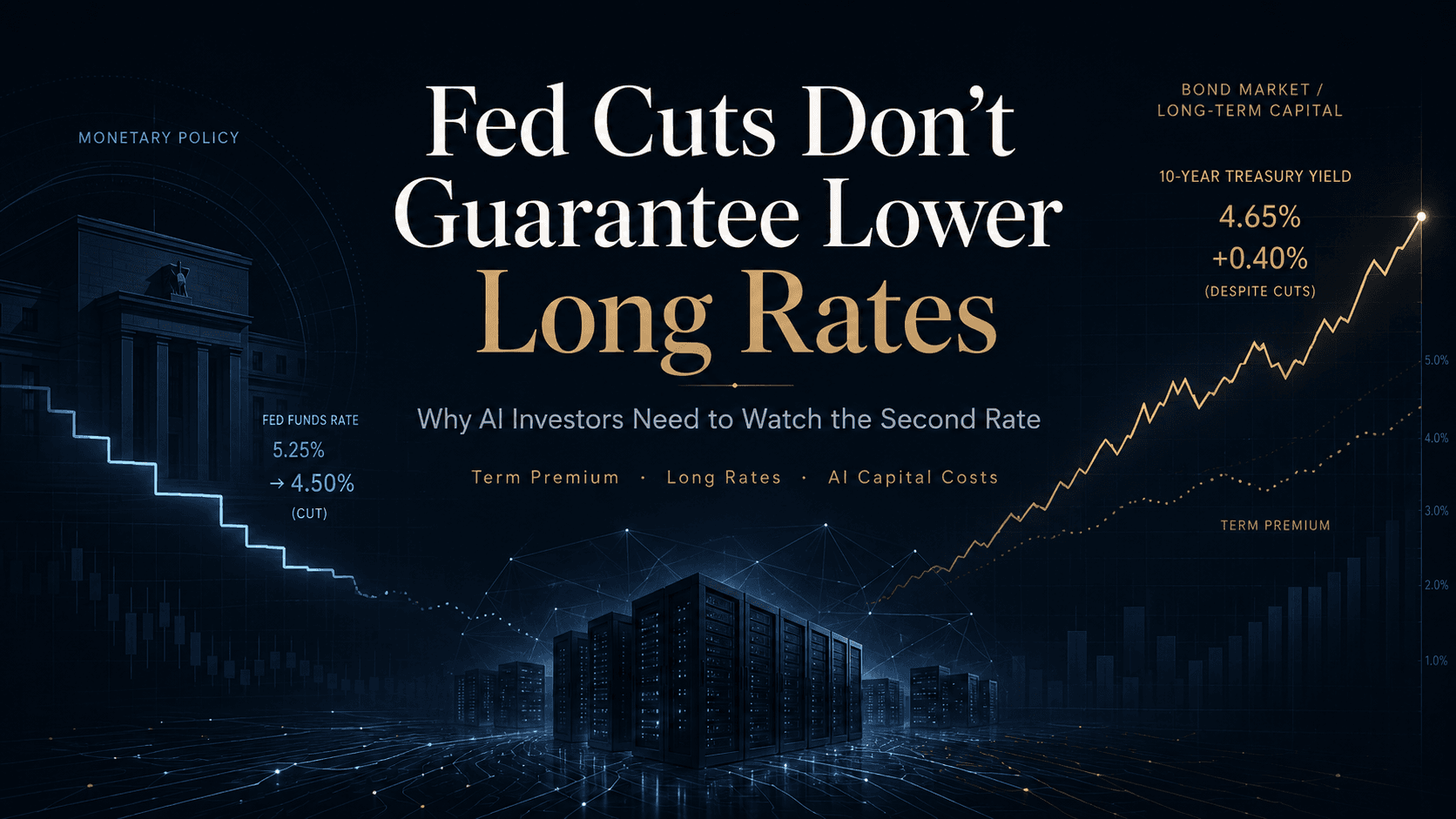
Two factors are cited as the cause of today's stock market correction: the simultaneous surge in government bond yields across the U.S., Japan, and Germany, and the instability of AI private credit. However, these two are not separate events. They form a domino effect: energy inflation dampens expectations for interest rate cuts, rising rates raise the discount rate for growth stocks, and the collapse of SaaS valuations casts doubt on the book value of private credit. However, this does not mark the end of AI investment as a whole. What this correction is asking is not "whether to buy AI or not," but which layer of AI to invest in .
1 The Identity of Adjustment — A Single Shock Transmission Structure, Not Two Events
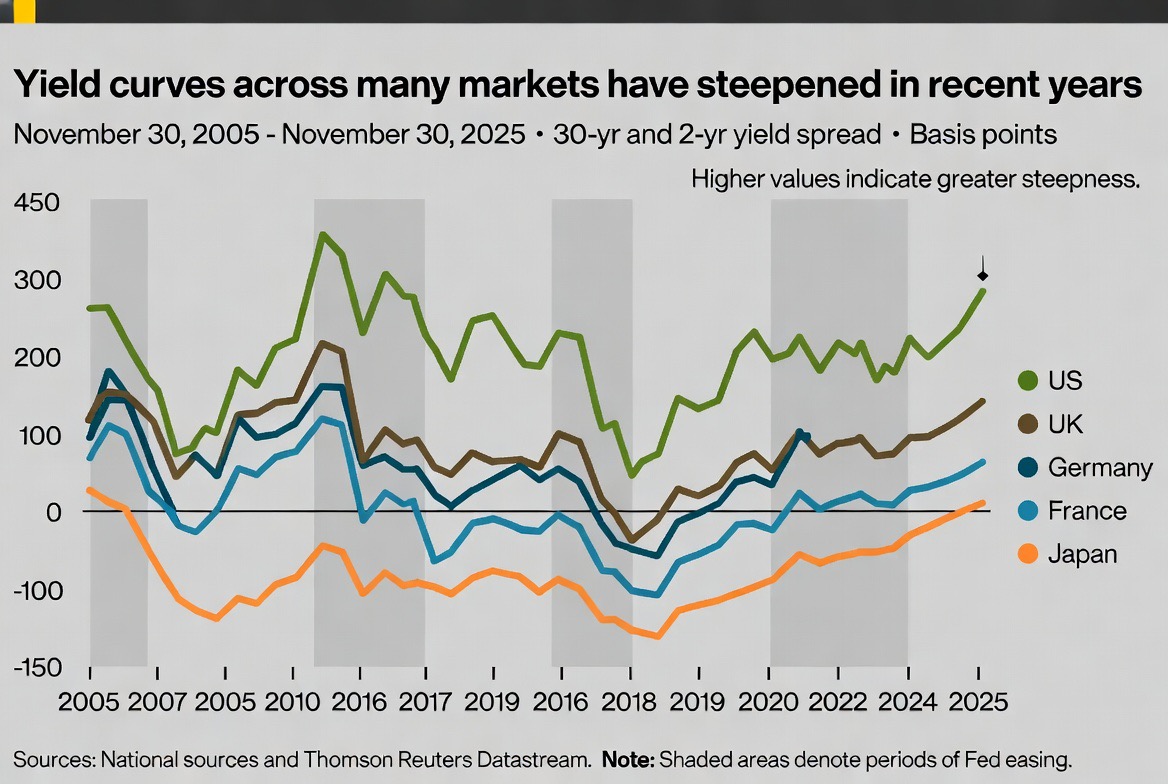
On the surface, it appears that two factors are shaking the market right now: a surge in global bond yields and cracks in software private credit. However, analyzing these two separately leads to a miscalculation. As energy prices rose following the war in Iran and inflation remained unchecked, central banks lost their justification for lowering interest rates. Rising long-term interest rates eroded the value of future cash flows in growth stocks, and this impact weighed down SaaS multiples. As SaaS multiples collapsed, suspicion spread to the book value of private credit lenders providing funds to SaaS companies, and this suspicion escalated into a risk aversion sentiment across all risk assets. Energy prices pulled the trigger, and that shock is now sequentially impacting the next layers.
The numbers show the path. The yield on U.S. 10-year Treasuries hit a 15-month high of 4.60% , while the Japanese 10-year JGB stood at 2.75% , marking a 29-year high. The Japanese 30-year yield reached 4.19% , the first time it has climbed since its issuance in 1999. Bloomberg reported that the weekly rise in U.S. Treasury yields last week was the largest since the shock of Trump's tariffs in April 2025. During the same period, software ETFs have plummeted by more than 20% year-to-date, while the average for semiconductors and hardware is rising by 69% to 92%. This is how the landscape diverged within the same AI theme.
What matters is the direction, not the absolute level. The bigger problem is that the market has started to believe that interest rates are unlikely to fall again, rather than the fact that they are high. Unless that belief changes, the discount rate pressure on growth stocks will continue.
2 Energy prices were the trigger — the starting point of the bond panic
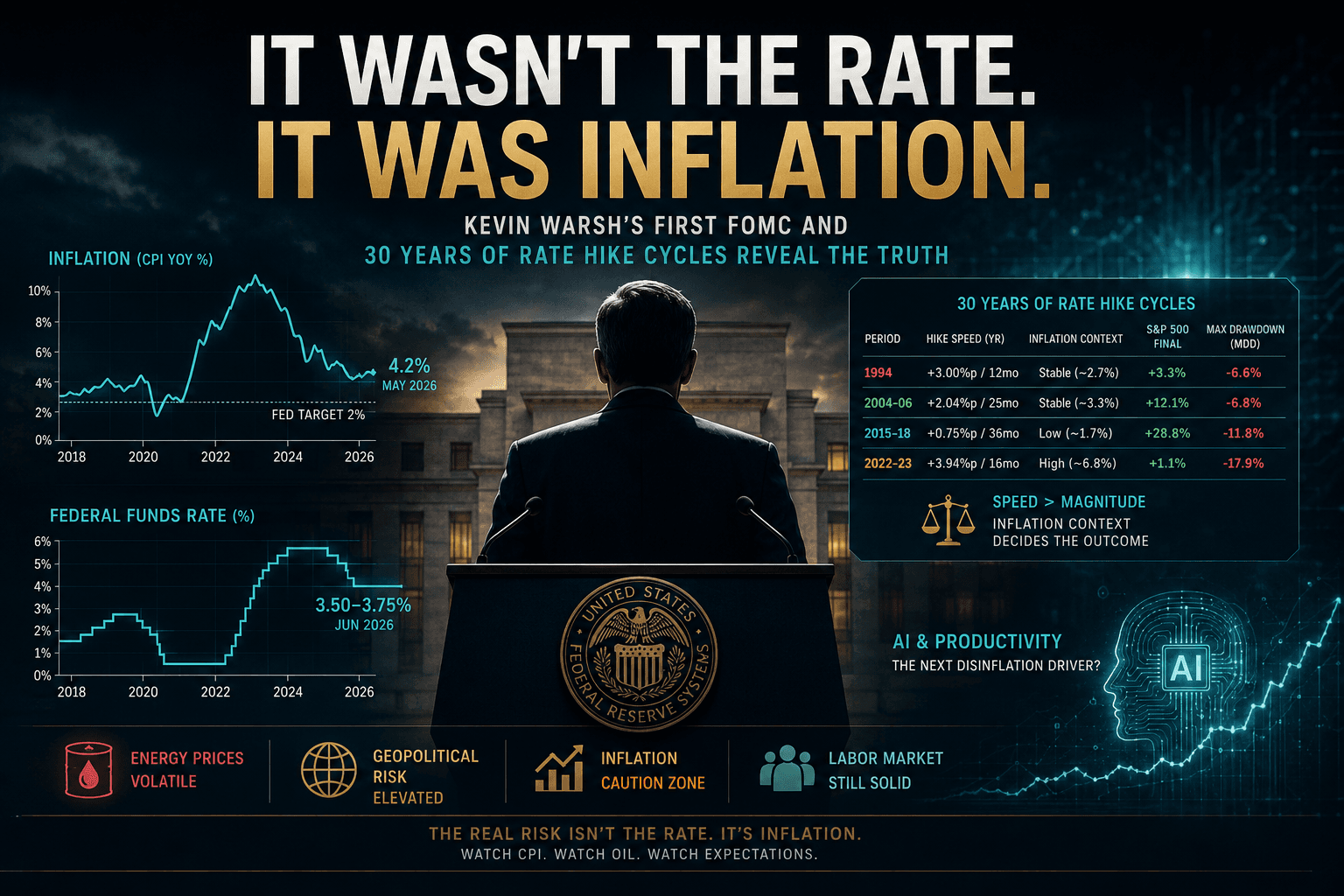
The reason global bond yields have become so synchronized is energy inflation. As oil prices rose following the war in Iran, inflationary pressures accumulated, and central banks cannot lower interest rates unless inflation is brought under control. This structure becomes clearer when examining why the Fed's rate freeze is not a safety signal for the market . ECB President Christine Lagarde’s statement that she is “always concerned” about bond market volatility is also in the same context. The situation, where no central bank is willing to readily signal a pivot, keeps long-term interest rates high.
The reason this particular shock is so severe is synchronization . Not only in the U.S., but also in Japan, 30-year bonds have hit all-time highs since 1999, and German Bund yields are at their highest level since 2011. This means that the energy shock has spread from being a problem for a single country into global inflation expectations. We first addressed this trend in the "OECD 2026 Growth Outlook and Commodity Shock Scenarios ." Since March, Aleph has been tracking the pathway through which a war with Iran directly impacts the cost structure of the AI industry via energy costs. The spillover mechanism by which geopolitical shocks lead to AI infrastructure costs was covered in this article , while an urgent analysis from the perspective of Korean investors was first addressed inthis analysis .
3 The Cracks in SaaS Private Credit — People Who Read the Cause Backwards
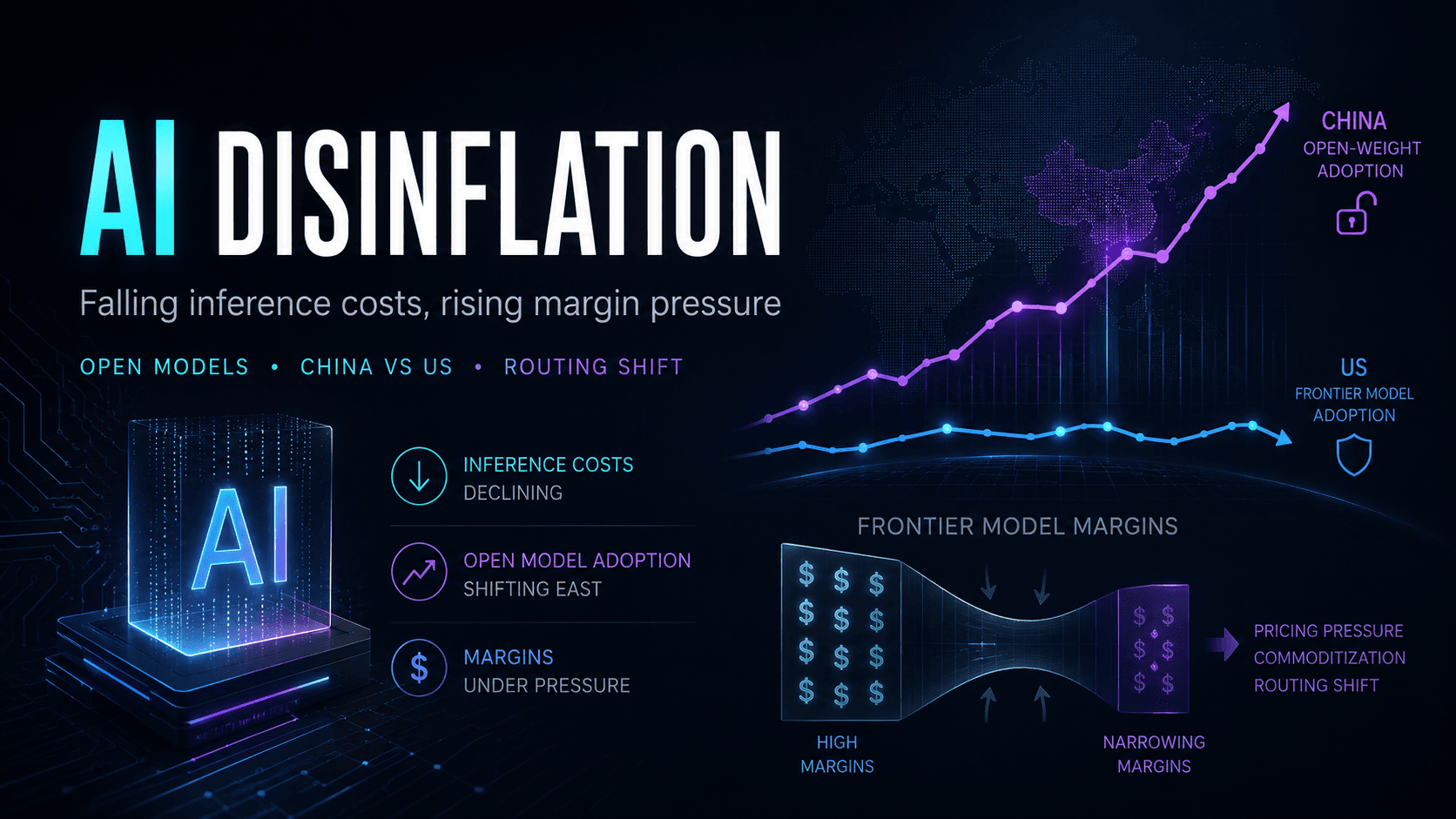
The saying "AI is shaking private credit" is circulating in the market. This statement is half right and half wrong. It is not AI that is shaking it, but the private credit that lent money to legacy SaaS businesses being devoured by AI. The problem is that the market has started to view these two events as the same thing. AI is not directly destroying private credit. The sequence is that AI destroys legacy SaaS business models, and the ripple effects then spread to the loan ledgers.
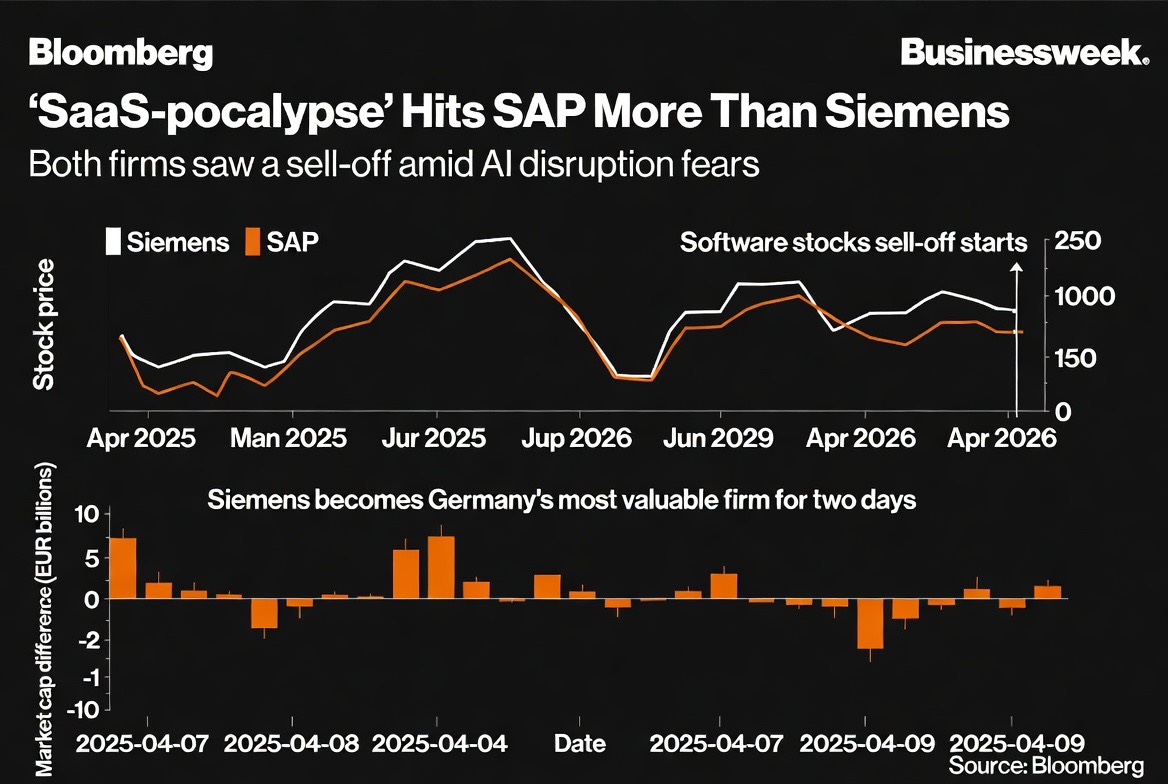
According to the BIS quarterly report, software company stock prices plummeted by approximately 30% between October 2025 and February 2026, with BDCs with high SaaS exposure falling about 5 percentage points further than those with lower exposure . Morgan Stanley’s credit strategy team projected that the direct loan default rate could rise from the current 5.6% to as high as 8%. Blackstone BCRED posted a monthly loss in February 2026 for the first time in three years, and Golub Capital cut its dividend by 15%. Based on Morningstar data, more than 75% of the 86 software companies are declining this year, with an average loss of -23.9%.
Then the question changes. It is not AI that is collapsing, but rather a side that is collapsing at the hands of AI. It is a structure where the attacker (AI infrastructure) thrives while the attacked (legacy SaaS) collapses. The story of Anthropic ARR doubling in just four months represents the opposite of this structure. Which side you belonged to determined this year's returns.
4The Second Industrial Revolution — But the railroad company went bankrupt
Even in the 1840s, people said the same thing.
The railroad will change the world.
That statement was correct. What was wrong was the belief that everyone would make money by buying railroad stocks. Investors poured money into railroad companies one after another, and “Railroad King” George Hudson became a hero of the era. When the bubble burst, Hudson went bankrupt, and dozens of railroad companies collapsed one after another.
The ones who truly made money in that era were someone else entirely. They were the ironworks that produced the rails laid on the tracks, the coal mines that operated the locomotives, and the construction companies that built the bridges. The fruits of the railroad revolution went more to those who supplied the infrastructure than to the shareholders of the railroad companies.
That structure is clearly visible in the current AI industry. The companies laying the rails are semiconductor, memory, and power infrastructure firms, while the railroad companies operating on borrowing are legacy SaaS companies. Morningstar data confirms this. Only 7% of hardware stocks have recorded losses this year. SanDisk is up 511%, Intel 225%, and Seagate 194%. In contrast, more than 75% of software stocks are declining, with an average of -23.9%.
However, even during the railroad boom, investors who jumped in at the last minute suffered losses. The fact that SanDisk has risen +511% is not a signal that it is safe to enter now. Valuation issues manifest in the same way in AI IPOs — how should we view SpaceX's PSR of 130x and OpenAI's $14 billion deficit ? Choosing a layer and deciding when and at what price to enter within that layer are separate questions.
5 4 AI Layers — Where Is the Opportunity Left?
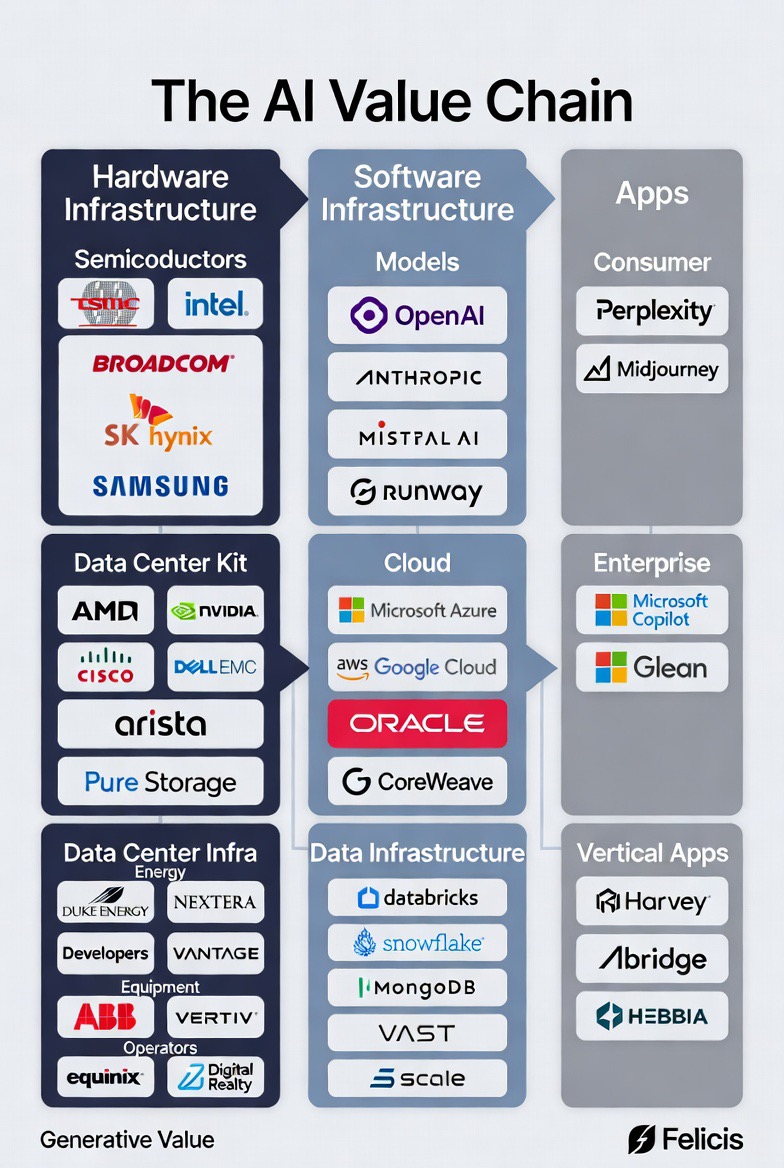
If you break down the AI stack into layers, you can see what is happening right now.
The physical layer (power, cooling, and data center REITs) is currently the most undervalued sector. Goldman Sachs forecasts that global data center power demand will increase by 220% by 2030 compared to 2023. It is already a common industry consensus that the biggest bottleneck in AI infrastructure is electricity, not GPUs. A significant portion of the $650 billion that the top five hyperscalers plan to pour into AI infrastructure by 2026 will flow into this layer. Since stock price appreciation has not yet been as high as that of semiconductors, valuation pressure is low. Representative companies include GE Vernova, Vertiv , Eaton, Equinix , and Digital Realty, and I have separately summarized portfolio allocation for this layer, which is indicated by the simultaneous demand for interest rates, energy, and AI .
The semiconductor and memory layers have already risen significantly. Gartner forecasts that semiconductor industry revenue will grow 64% year-over-year in 2026 to reach $1.32 trillion. Demand for HBM is structurally strong. However, entering the market for the short term at a level that has already risen by 69% to 92% entails accepting volatility. While it remains valid if the plan is to hold for the long term, it is advisable to wait for a correction phase for short-term trading.
The cloud hyperscaler layer takes a defensive position. It absorbs the impact of rising energy costs through in-house generation, long-term PPAs, and GPU pre-purchases. It contributes to portfolio stabilization rather than aggressive growth.
The legacy SaaS layer is currently in the most precarious position. Structural business model disruption by AI is underway, compounded by pressure from private credit. While short-term rebound trading is possible, the rationale for holding in the medium to long term is weak. However, the divergence between companies that have actively internalized AI to strengthen their defenses and those that have not has already begun. Not all SaaS is the same.
For specific stock composition and weighting strategies by layer, please refer to the 2026 AI Stock Portfolio Analysis .
6Frequently Asked Questions
| question | answer |
|---|---|
| How dangerous is the current rise in government bond yields for AI stocks? | It varies by layer. Growth-oriented SaaS companies that rely on long-term cash flow take a direct hit from rising interest rates. On the other hand, semiconductor, memory, and infrastructure companies, which are currently experiencing skyrocketing revenue and profits, are structured so that earnings, rather than interest rates, drive their stock prices. Therefore, the blanket judgment that "AI stocks are risky" is incorrect. |
| Should I buy SaaS stocks now? | Not all SaaS is the same. They are divided into companies that have embedded AI into the core of their products and those that rely on legacy functions. However, the current structural headwinds are too strong to incorporate them without verification. Rising default rates, pressure on multiples, and the repercussions of private credit are all occurring simultaneously. |
| Why are Japanese and German interest rates important to Korean investors? | When the yields on safe assets, which serve as the global benchmark for asset allocation, rise simultaneously, the relative attractiveness of all risky assets decreases. Japan's 30-year bond hitting a historical high signals that "safe bond yields are this high," accelerating the shift of funds from growth stocks to bonds. |
| What is the basis for claiming that the physical layer (power and cooling) is better than semiconductors? | There is a valuation burden. Semiconductors have already risen 69% to 92% this year. While the demand structure for the physical layer remains equally strong, stock price reflection has been slow. It is relatively attractive in terms of expected returns relative to short-term volatility. |
Conclusion — Choosing the right layer is everything, but you also need to consider the price.
The current stock market correction is not the end of AI investment. Energy prices pulled the trigger, and that shock is manifesting in today's market through interest rates and SaaS valuations. The proposition that AI is the second industrial revolution remains valid. However, just as Carnegie Steel profited during the railroad boom, the layer supplying tools will benefit first. Physical (power and cooling) and semiconductors and memory occupy that position.
To be honest, watching this correction, I realized once again how practical the framework of "layering" is. It is no coincidence that power and cooling infrastructure companies held their ground relatively well during the same period when software ETFs plummeted by 20%. Personally, I believe this gap is likely to widen further in the future. This is because as the demand for AI increases, electricity is needed first, and that demand accumulates structurally regardless of interest rate environments.
Perhaps the market has begun to re-evaluate AI not as a simple theme, but as a complex structure where interest rates, energy, and growth overlap. The starting point for portfolio review right now is not simply saying, “I bought AI stocks ,” but rather which layer you bought.
All figures and analyses in this article are for informational purposes only and do not constitute investment advice. Interest rates and energy prices are subject to rapid change, and data is current as of May 19, 2026. All investment decisions and responsibilities rest with the individual, and consulting with a professional financial advisor before making any significant decisions is recommended.
📌 Was this analysis helpful?
In the next post, we plan to cover “Winners of the Physical Layer — Stocks and ETFs to Watch in Power and Cooling Infrastructure.”
We continue to track global interest rate spikes and AI layer investment strategies. Receive notifications so you don't miss out.
How this content was produced
Aleph's research AI agent assisted with collecting and analyzing public data, creating charts and visuals, and structuring the draft. Davar personally reviewed and edited the sources, figures, reasoning, and final conclusions.
This content is for informational purposes only and is not personalized investment advice or an individual stock recommendation. Read the full disclaimer

Davar
Davar builds and operates Aleph's research AI agent and writes and reviews analysis on macroeconomic developments and AI industry trends.
© Aleph. All rights reserved.