

US Stock Market Outlook 2026 — Analysis of Market Structure Simultaneously Shaked by Broadcom Earnings, Employment Indicators, and Long-term Interest Rates
US long-term interest rates
Broadcom earnings
AI semiconductors
Market Structure Analysis
Employment indicators
2026.06.01
This week for the U.S. stock market is not merely a week of indicators. From remarks by Federal Reserve officials on Monday to Broadcom's earnings on Wednesday and the May National Employment Plan (NFP) on Friday—on the surface, it appears to be a series of big events, but what the market is truly trying to verify is something else entirely. It is not about whether AI is progressing well. It is about how much current interest rate levels can support the growth of AI. In the face of that question, the very structure of the market is changing.
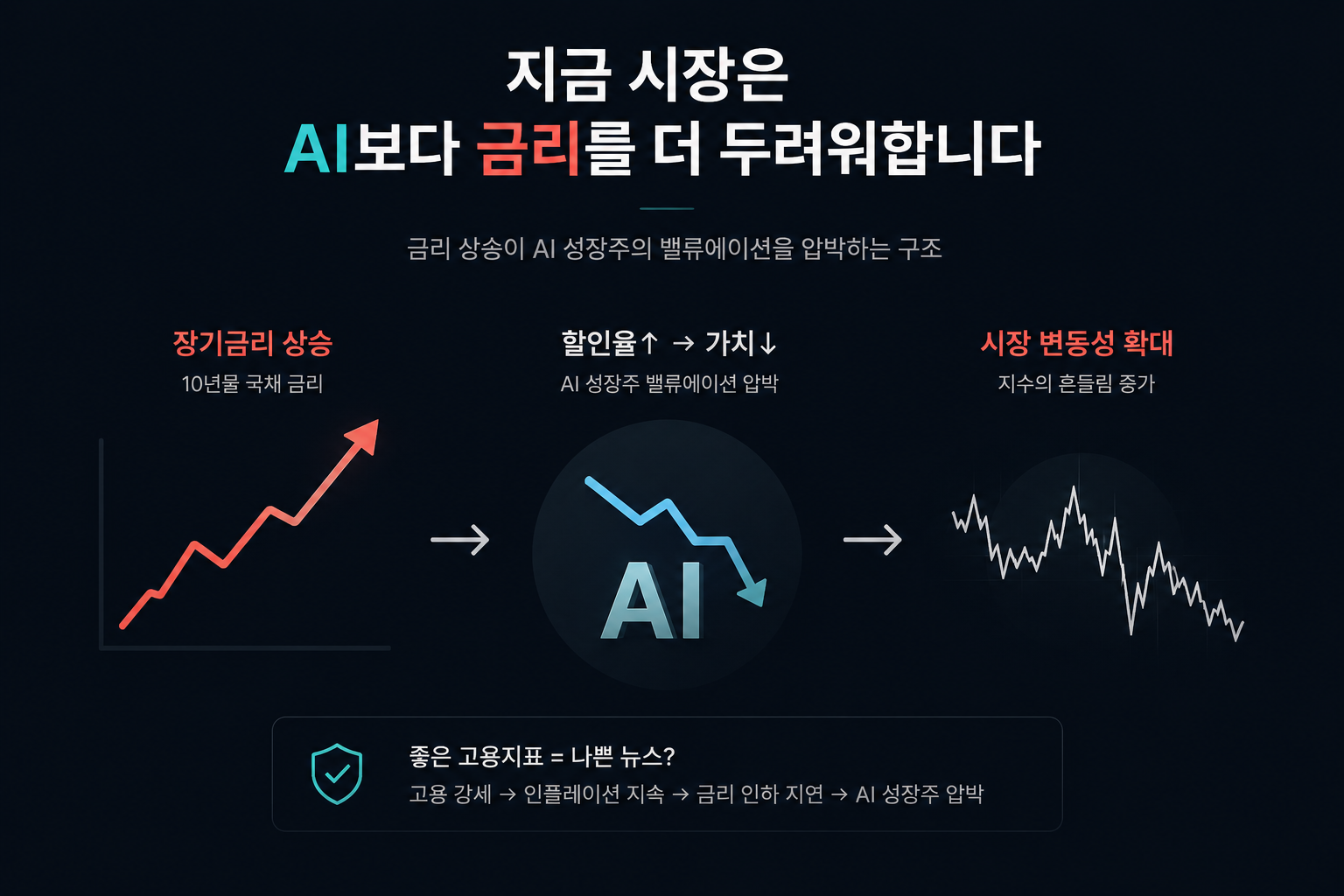
Evidence that the market structure has changed
If you invest for a long time, you will come to realize that the same numbers take on completely different meanings depending on the era.
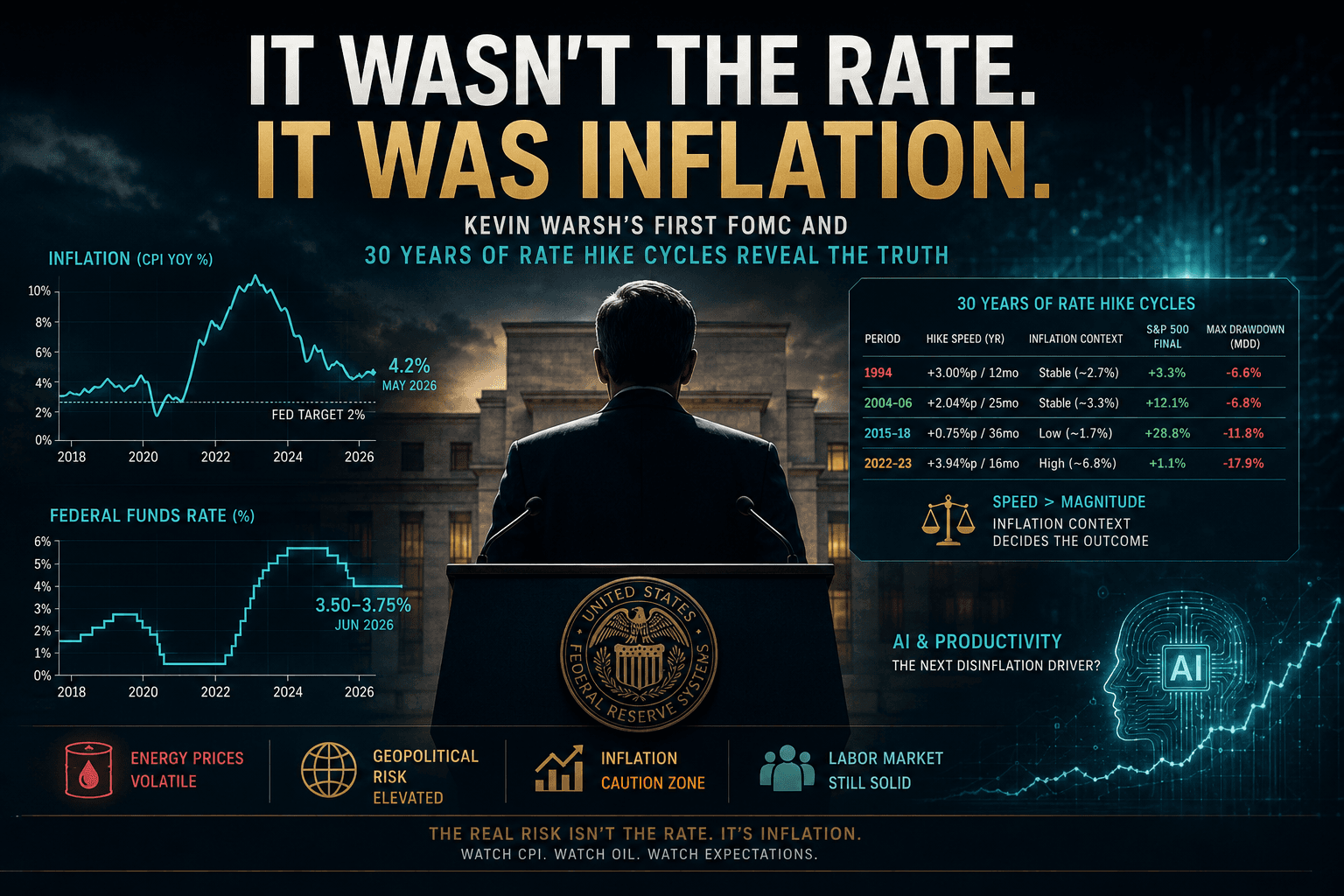
In the past, strong employment figures were reflexively considered a positive sign. This was because when the economy was strong, corporate earnings rose, and stock prices followed suit. However, this connection is no longer as simple as it used to be. Strong employment leads to sustained inflationary pressure, which could delay the timing of interest rate cuts. If long-term interest rates rise, the valuations of AI growth stocks face pressure. We have entered a market where the same starting point can lead to the opposite outcome.
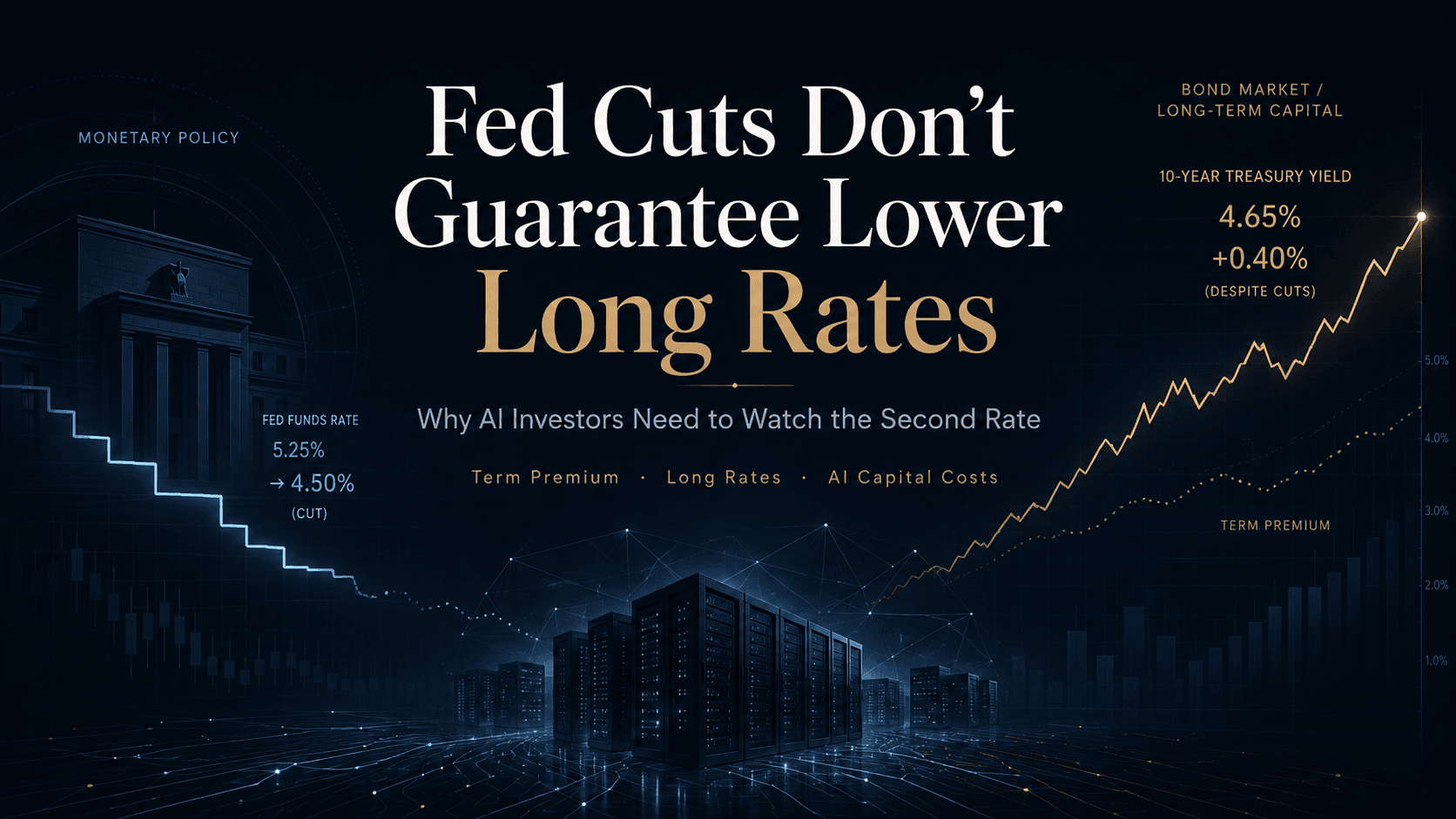
On May 20, the yield on U.S. 10-year Treasuries rose to 4.7% , reaching its highest level in 16 months. This coincided with Moody's downgrade of the U.S. credit rating (from AAA to Aa1) and concerns over the fiscal deficit stemming from Trump's tax cuts. The 30-year yield also hit a 19-year high of 5.2% . This effectively means the bond market has directly raised questions about the fiscal soundness of the United States.
You can understand why this is important by looking at the structure of AI growth stocks. AI megacaps are essentially akin to long-duration assets . They are structured to have high valuations based on the premise that profits will be realized more significantly in the distant future. If the discount rate—that is, long-term interest rates—rises, the present value of those future profits is bound to decrease. This is why stock prices can be suppressed even if the growth story of AI itself remains intact.
2AI is strong — but the market already knows that
Broadcom's Q2 earnings will be announced after the market closes on Wednesday (June 3).
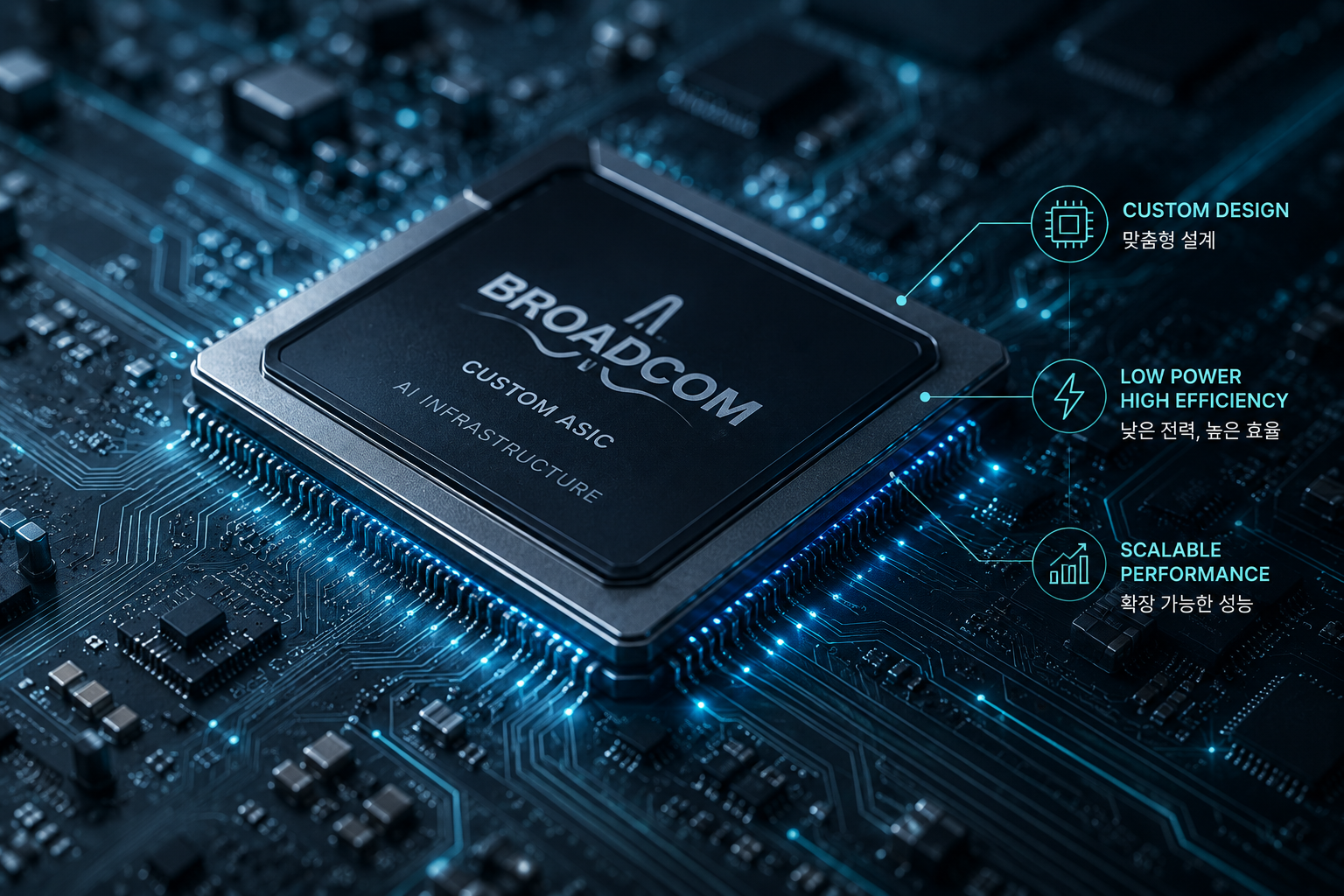
The company's Q2 guidance projects revenue of $22 billion (+47% YoY) , with AI semiconductor revenue alone reaching $10.7 billion . In Q1, AI revenue already exceeded internal guidance at $8.4 billion (+106% YoY) , and the company has secured multi-year supply contracts with Google TPU, Meta MTIA, and Anthropic. Its ASIC market share is approximately 60% . CEO Hock Tan has publicly stated that AI chip revenue will surpass $100 billion by 2027.
Looking at the numbers alone, it is strong. No, it is very strong.
However, the interesting thing is that the market is already largely aware of these figures. Expectations for strong earnings are already significantly reflected in Broadcom's stock price. The structure is such that the price holds steady if guidance is met, but can fall sharply if it falls even slightly short. There is also a possibility that the stock price might not rise as much as expected, even if Broadcom's earnings are excellent. Personally, I believe this paradox is the most difficult point in AI investment right now.
Broadcom's earnings are not just the story of a single company. What is more important is that this serves as a point to confirm whether the AI investment cycle is expanding beyond Nvidia (GPU) to encompass ASICs, AI networking, and infrastructure software across the board. If there are signs that the supply chain is expanding, it will be a positive signal for related stocks in general.
3The price is strong, but what happens if there is a shock?
The S&P 500 is currently maintaining historical high levels. However, if you look inside, the story is a bit different.
A small number of stocks, including AI semiconductors, are driving more than half of the index's total gains. The top 10 stocks in the S&P 500 account for 40% of the total. Regarding this, the CIO of Truist Advisory Services stated, "The more returns are concentrated in specific stocks, the more vulnerable they become to sharp fluctuations." I agree with this assessment.
It is not that the market is unaware of this. In fact, the characteristic of a bubble is that it rises even while knowing this.
However, it is difficult to view the market as being on the verge of an immediate crash. Demand for AI infrastructure is indeed strong, and Broadcom’s multi-year hyperscaler contract supports this trend. The issue is elasticity rather than direction. The moment interest rates surpass 4.5% again, or an unexpected shock occurs from somewhere—if funds concentrated in a few stocks move simultaneously—the index could fluctuate more significantly than usual.
4 How this week's indicators are connected
This week's comments by Fed officials, Tuesday's JOLTS (job openings and turnover statistics), Wednesday's ADP employment and Broadcom earnings, and Friday's NFP (non-farm payrolls). It is true that each of these indicators is important.
However, it seems the market is not currently viewing any single indicator in isolation. This is because everything is ultimately connected to the interest rate channel.
If employment is strong, expectations for interest rate cuts are pushed back. When expectations for rate cuts are pushed back, upward pressure on long-term interest rates returns. If long-term interest rates rise, the valuations of AI growth stocks are suppressed. The market is currently reacting quite sensitively to this interconnectedness.
Broadcom's earnings play a slightly different role here. It serves as an opportunity to verify whether AI infrastructure capex is translating into actual revenue. If AI revenue reaches or exceeds the guidance of $10.7 billion, it is highly likely to signal that the AI investment cycle is expanding beyond GPUs to the entire supply chain, including ASICs, networking, and software.
Ultimately, it seems the market will be watching interest rates and AI capex together throughout this week. This also implies that the market has become difficult to explain using only one of the two.
5Aleph Macro Pulse: The market is currently in a “Caution” zone.
Personally, I operate a system that combines several indicators to assess market conditions. It is a method of classifying market regimes by examining factors such as interest rate stress, credit spreads, stock concentration, and the liquidity environment together.
Currently, Aleph Macro Pulse classifies the market as a “Caution” regime with a score of 56.1 . The system’s recommended position is “Watch.”
What is interesting is that this score does not yet reach the "Risk-Off" level. AI capex and corporate earnings remain strong. However, as sensitivity to long-term interest rates and stock concentration increase simultaneously, this is closer to a signal that internal market stress is slowly rising. This does not mean that a crash is imminent. Rather, it is closer to saying that we have entered a phase where the burden of aggressively increasing leverage is becoming too great.
What I consider most important in this system is not predicting the direction. Rather than correctly guessing whether the market will rise or fall, I place more importance on how well my portfolio can withstand market fluctuations. Ultimately, the core of the current market seems to be resilience rather than direction.
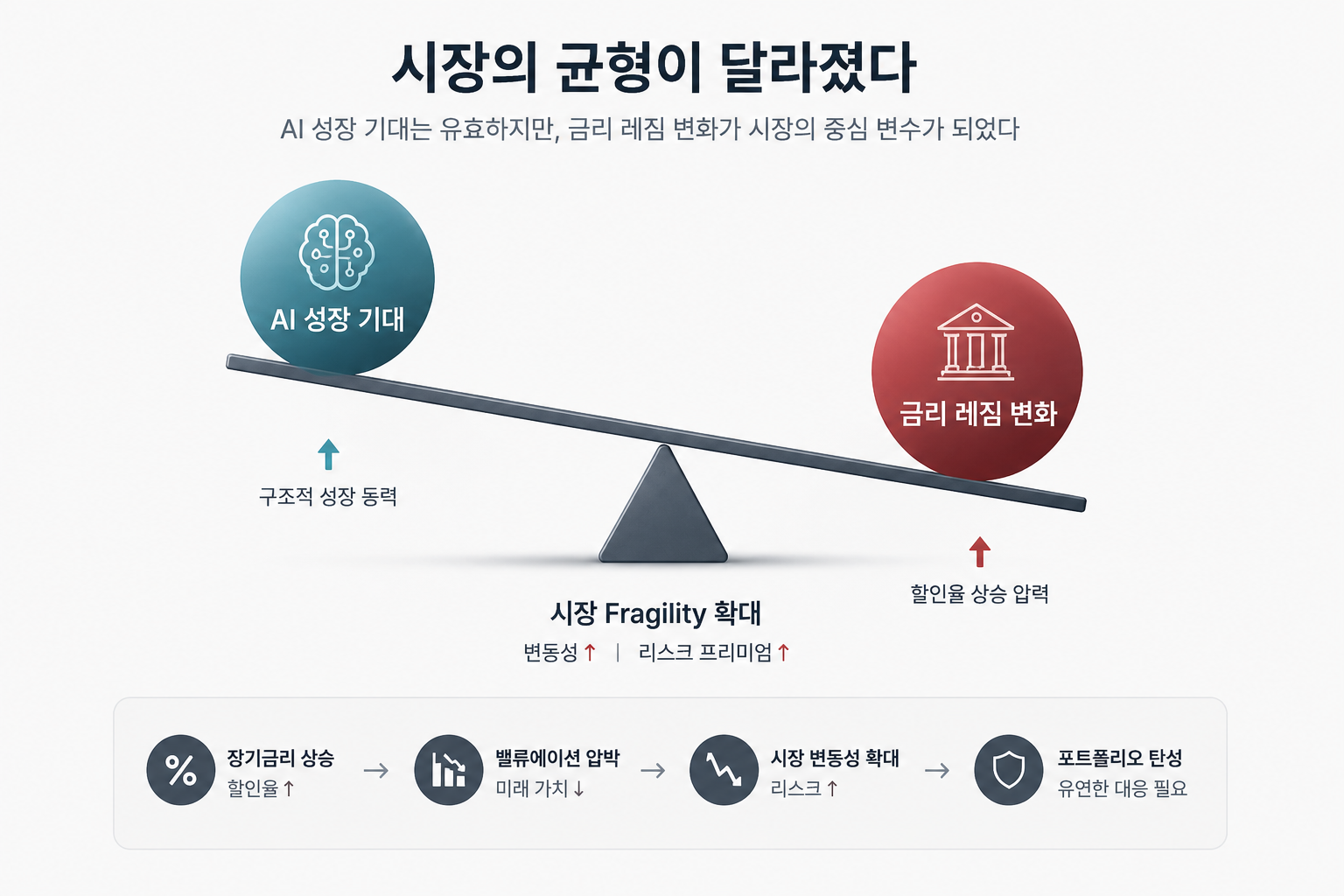
6Frequently Asked Questions
| question | answer |
|---|---|
| If Broadcom's earnings are good, should I buy AI semiconductor stocks? | Guidance and context are more important than the earnings themselves. We need to see how much Q2 AI revenue exceeds the $10.7 billion guidance and whether hyperscalers mention plans for additional capex . If there are signs that the AI investment cycle is spreading across the supply chain, it would be positive for ASIC and networking stocks in general. However, since expectations are already largely reflected in stock prices, upside momentum may be limited based solely on "meeting guidance." |
| With interest rates this high, is it right to keep holding AI stocks? | The first step is to distinguish between stocks that directly supply AI infrastructure and those receiving high valuations based on future growth expectations. The former are structurally backed by earnings, while the latter are highly sensitive to interest rates. Identifying the weight of these two types within a portfolio is a more effective approach right now. |
| What happens if the NFP (Non-Farm Employment) comes out strong? | In the short term, upward pressure on long-term interest rates may arise, placing a burden on AI growth stocks. However, strong employment also implies that the economy itself remains robust. The key this week is to monitor Broadcom's earnings and employment indicators in the same week to see if a situation arises where "AI capex continues while interest rates rise again." |
| Should I increase my cash holdings now? | I do not recommend significantly increasing your cash holdings by betting on a market crash. Demand for AI infrastructure is genuinely strong, and there is currently no evidence that this trend will reverse in the short term. However, a correction moderate enough to review the weighting of interest-rate-sensitive growth stocks and diversify excessive concentration is reasonable at this point. The perspective is to secure resilience rather than defend against market pressure. |
| Will Moody's credit rating downgrade have a long-term impact on the U.S. stock market? | The direct impact already occurred in May. What is more important is the long-term effect. If government bond issuance increases while an annual fiscal deficit of $2 trillion persists, the bond market may demand higher yields. This means that structural upward pressure on long-term interest rates could continue. A structure where expectations for AI growth coexist with pressure on interest rates is highly likely to remain the fundamental landscape of the market for some time to come. |
Conclusion — It is time to check elasticity before direction.
Honestly, I'm not sure whether the market will go up or down this week. And right now, the direction itself doesn't seem to be the most important issue.
The strength of AI and the continued rise of AI stocks are two different stories. Even if Broadcom’s earnings are excellent, the moment long-term interest rates surpass 4.5% again, the valuations of AI growth stocks in general could face pressure. This is not because the market doubts AI; rather, it is because it is an unavoidable structural issue that the present value of future cash flows decreases as the discount rate rises.
The current market is becoming less of a structure for stable growth and more of one where interest rates continue to hold back even when good news emerges. This is also why Macro Pulse is pointing to a “Caution.”
It seems that several questions will continue to remain. When will hyperscalers' AI capex peak? Will long-term interest rates structurally remain above 4%? And will Broadcom really be able to achieve $100 billion in AI chip revenue by 2027?
It seems even the market doesn't know the answer yet. Therefore, for the time being, it appears more important to first assess how much your assets are exposed to shocks, rather than placing directional bets.
All figures and analyses in this article are for informational purposes only and do not constitute investment advice. Broadcom's Q2 earnings are scheduled to be announced on June 3, 2026; the guidance figures presented here are forecasts and may differ from actual results. U.S. Treasury yield figures are based on data from May 29, 2026, and are subject to change thereafter. Aleph Macro Pulse is an in-house classification system for informational purposes only and does not guarantee actual investment results. You bear full responsibility for your own investment decisions and liabilities regarding the companies and stocks mentioned.
📌 Was this analysis helpful?
In the next post, we plan to cover “After Broadcom Earnings — If the Expansion of the AI Supply Chain Is Confirmed, Where Will the Next Beneficiaries Be?”
We continuously track the market structure where interest rates, liquidity, and AI capex are interconnected. Turn on notifications so you don't miss anything.
How this content was produced
Aleph's research AI agent assisted with collecting and analyzing public data, creating charts and visuals, and structuring the draft. Davar personally reviewed and edited the sources, figures, reasoning, and final conclusions.
This content is for informational purposes only and is not personalized investment advice or an individual stock recommendation. Read the full disclaimer

Davar
Davar builds and operates Aleph's research AI agent and writes and reviews analysis on macroeconomic developments and AI industry trends.
© Aleph. All rights reserved.