
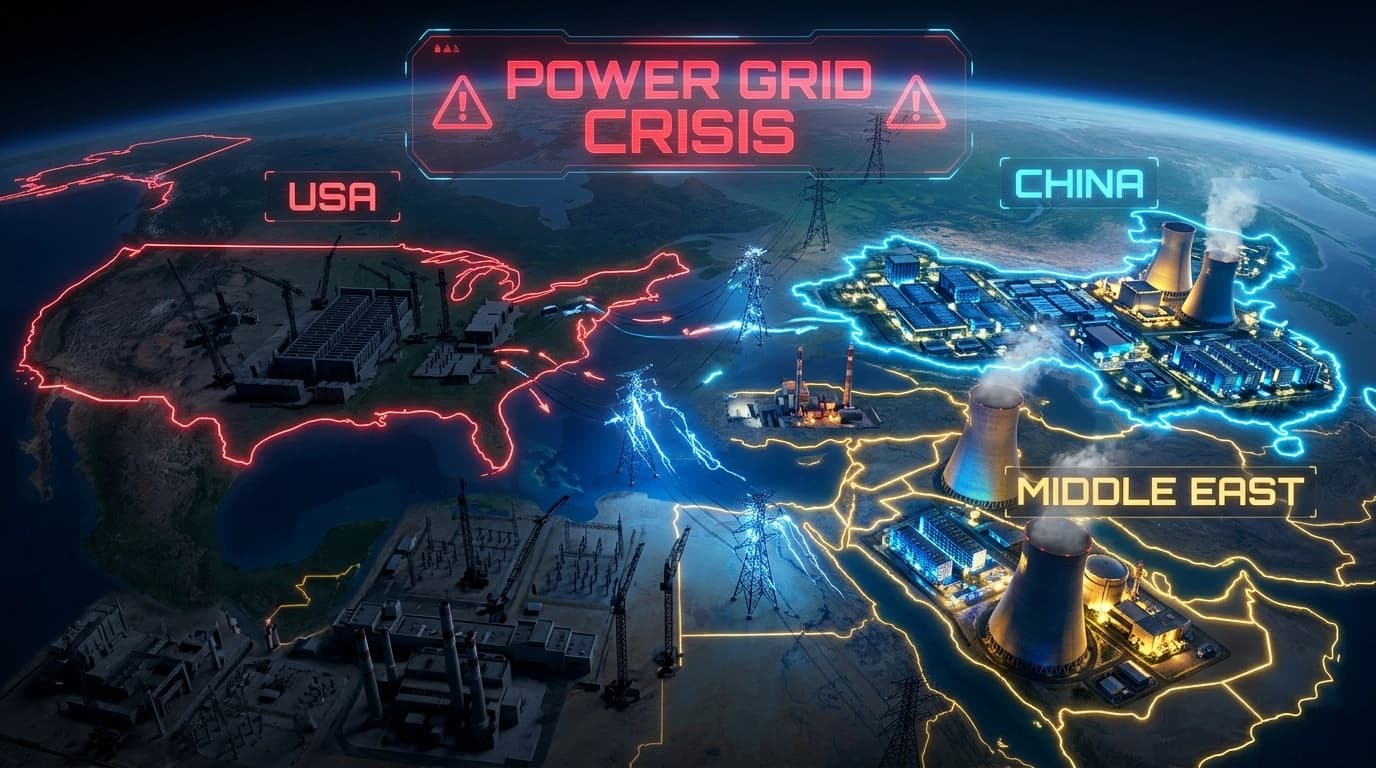
Power grid crisis
AI Hegemony Competition
data center
2026 Investment Strategy
2026.04.22
In the spring of 2026, 40 to 50 percent of U.S. AI data centers quietly shut down. It was not due to a shortage of GPUs or a lack of funds. It was because there were no transformers, making it impossible to draw electricity. While everyone was watching Nvidia's stock price, the bottleneck of the real AI war was unfolding in the power grid. This single line is the key to understanding the landscape of AI hegemony over the next decade.
1 The chip wasn't the problem — it was the electricity.
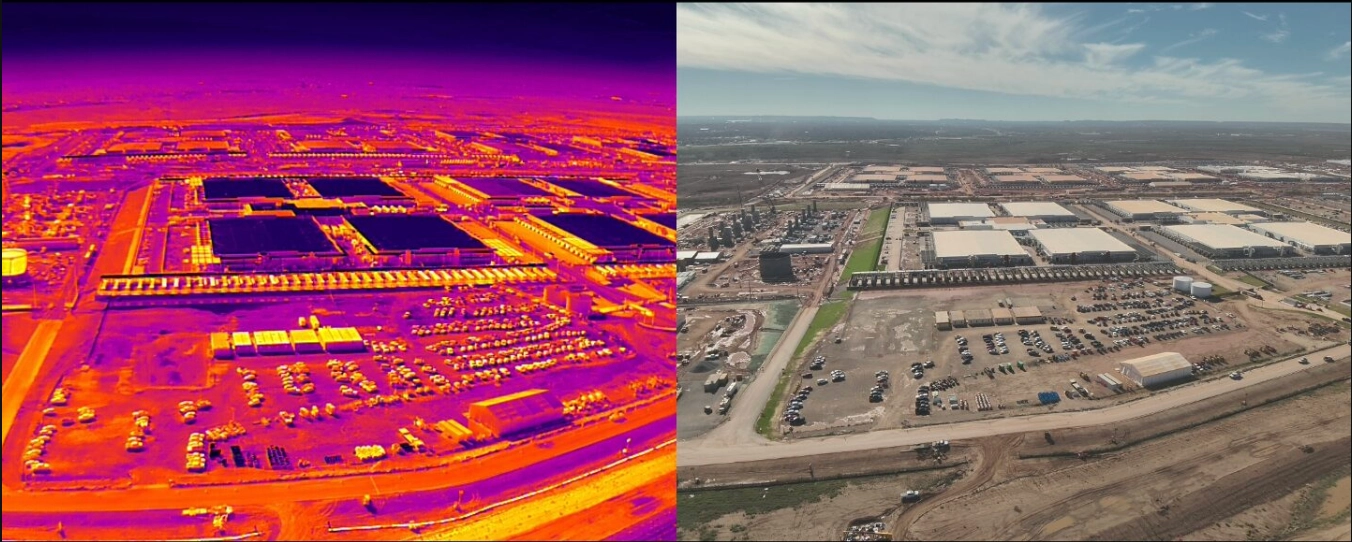
The essence of the AI data center crisis is not technological failure, but a failure of infrastructure governance. A single fact reported by Bloomberg in April proves this. 40 to 50 percent of U.S. AI data centers scheduled to be operational by 2026 have been delayed or canceled. Sites where actual construction has halted have been confirmed through satellite imagery and drone footage (Ars Technica). Projects that had pledged to pour trillions of won have quietly come to a standstill.
The reason is simple. There is no electricity, and there are no transformers to draw power from it. Building a data center ultimately means connecting it to the power grid; China is the primary supplier of high-output transformers, and the Trump administration's tariffs have directly impacted those Chinese-made transformers. A country aiming to beat China in AI is dependent on Chinese components to build its AI infrastructure, and has effectively blocked that supply chain itself through tariffs. This is the essence of the paradox.
2 The Real Formula for AI Hegemony — It's Electricity, Not GPUs
The real variable determining AI supremacy is not model performance or the quantity of GPUs. The key is how stably, quickly, and cheaply the electricity to run those models can be supplied .
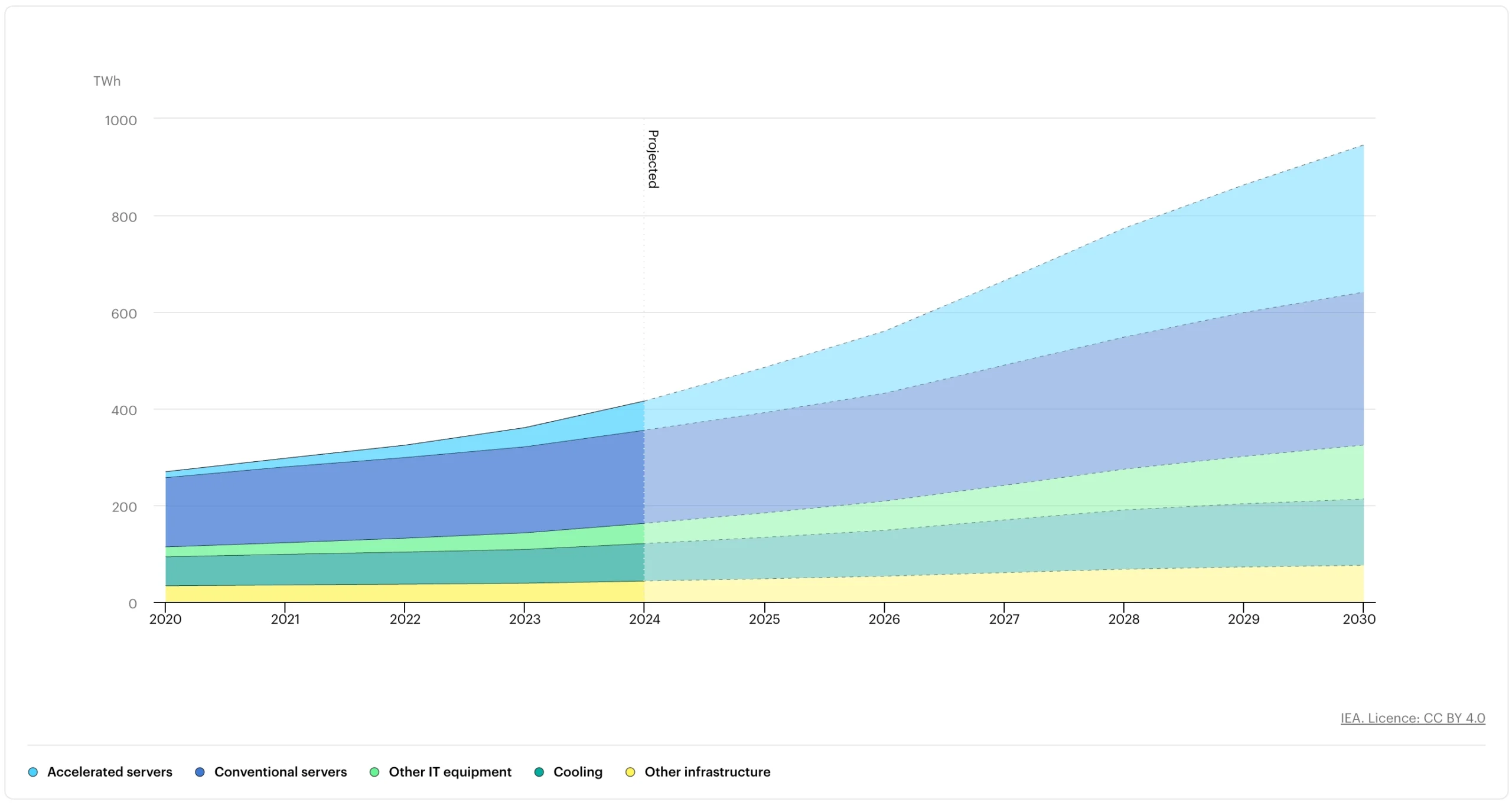
Official data from the International Energy Agency (IEA) proves this claim with numbers. In 2024, global data center power consumption was 415 TWh—1.5% of total global electricity . It is projected to more than double to 945 TWh by 2030, and some organizations predict that it will already surpass 1,000 TWh by 2026. 1,000 TWh is the amount of electricity consumed by all of Japan in a year. The era in which AI devours the entirety of Japan's electricity supply is just around the corner.
If we express this reality mathematically, a single formula emerges: AI Hegemony = Private Sector Innovation × National Execution Power × Energy Self-Sufficiency. Multiplication is the key. If even one of the three approaches zero, the total approaches zero. This is precisely the problem the United States is currently facing.
3 Country Positioning — Who Has the Advantage in This Game
Applying the formula for AI hegemony to each country reveals a picture not found in textbooks. The United States possesses the strongest private sector innovation capabilities but is held back by a lack of national execution power. The Middle East represents a rare combination where money, energy, and national will align simultaneously. South Korea is not a direct belligerent, yet it manufactures indispensable ammunition.
| nation | Private sector innovation power | National execution power | Energy self-sufficiency | Key Points |
|---|---|---|---|---|
| 🇺🇸 USA | ★★★ | ★★☆ (Crisis) | ★★☆ | Transformer shortages, tariff backlash, and 5-7 years for power grid approval. A structural failure where national infrastructure cannot keep up with the speed of the private sector. |
| 🇨🇳 China | ★★☆ | ★★★ | ★★★ | 40% more power production than the combined total of the US and EU. $574 billion in grid investment over the next five years, with plans to build 15 additional ultra-high voltage transmission lines (Reuters). |
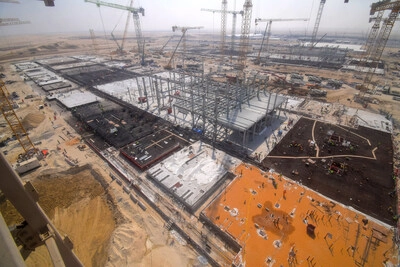
| 🇦🇪 UAE | ★★☆ | ★★★ | ★★★ | $148 billion to be invested in AI after 2024. 5GW Stargate complex under construction in Abu Dhabi. Microsoft-Google partnership confirmed. |
| 🇸🇦 Saudi Arabia | ★★☆ | ★★★ | ★★★ | 2026 Officially Declared 'Year of AI', $40 Billion National AI Investment Program Launched. |
| 🇰🇷 Korea | ★★★ ( HBM ) | ★★☆ | ★★☆ | HBM market share 61% ( SK Hynix ). Implementation of the Framework Act on AI (January 2026), groundbreaking of the 2.9 trillion won Haenam National AI Computing Center. Ammunition supplier position. |
4 Where Should Investors Look — The 3-Layer Approach
Turning this analysis to an investment perspective reveals three layers. The core premise is simple: the real bottleneck is power, not GPUs. The structural beneficiaries are the companies that supply power, the companies that manage that power efficiently, and the companies that supply ammunition regardless of which country wins.
Core — “The one who sells electricity wins”
The biggest misconception regarding AI investment is the idea that one must invest in GPU companies. Nvidia has already risen sufficiently, and the real bottleneck is power. Vistra (VST) is the largest private power generator in the U.S. and currently has long-term Power Purchase Agreements (PPAs) with Meta and AWS. Based on Zacks consensus, its EPS growth is projected to reach +65.6% in 2026, followed by a credit rating upgrade by Fitch and the initiation of an Outperform rating by BNP Paribas. Constellation Energy (CEG) is the largest nuclear power generator in the U.S., and following the completion of its $16.4 billion acquisition of Calpine, it is expected to see an EPS growth of over +20% in 2026. It has already signed long-term nuclear power supply contracts with Microsoft and Google. Vertiv (VRT) , ranked first in AI data center cooling and power management systems, reported an order backlog of $15 billion and projected an EPS growth rate of +43% for 2026. BNP Paribas maintains an Outperform rating even with a +90% year-to-date stock price increase in 2026.
Strategy — “Ammunition Suppliers + Indirect Benefits from the Middle East”
SK Hynix (000660) holds a 61% market share in the HBM market, and its 2026 HBM supply is already fully sold out (WSJ). With operating profit reaching $13.5 billion in Q4 2025, a 137% YoY increase, the company surpassed Samsung Electronics' annual profit for the first time (CNBC). Morgan Stanley raised its target price, forecasting a 62% increase in DRAM prices by 2026. Further increases in average selling prices (ASP) are expected as the transition to HBM4 generations accelerates in 2026. Regardless of who wins the AI war, no GPU can perform at its full potential without HBM. Microsoft (MSFT) has confirmed an additional investment of $7.9 billion by 2029, following a $1.52 billion equity investment in UAE G42. This represents the safest indirect route to the intersection where Middle Eastern oil money meets U.S. AI technology.
Asymmetry — “Bottleneck Relief Theme, Less-Known Opportunity”
This is a relatively undervalued sector as it is not yet classified as an AI theme stock. If the essence of the data center crisis is a shortage of transformers and grid equipment, the companies resolving this bottleneck are the next beneficiaries. Eaton (ETN) is building end-to-end solutions for AI data center power management using a “chip-to-grid” strategy, and its data center order backlog is at an all-time high. Hubbell (HUBB) provided 2026 EPS guidance of $19.15–$19.85 , outperforming the analyst consensus ($17.63) by approximately 12% . ABB is pursuing the supply of 35 synchronous generators by expanding its AI data center power infrastructure supply contract with VoltaGrid in March 2026. Oklo (OKLO) is a frontrunner in SMR commercialization (market capitalization of $9 billion), but due to its high-risk position as it does not yet have any commercially operating nuclear power plants, it should be approached as a minority weighting in a portfolio.
5 If you want to approach it through ETFs — start with what you can buy with a domestic account
If individual stocks feel difficult and unfamiliar, ETFs are a realistic first step. The good news is that ETFs covering the themes discussed in this article—AI power infrastructure, U.S. power grids, and domestic power facilities—already exist that can be purchased directly in Korean Won via domestic brokerage apps. You simply need to search for the ticker number on your MTS (Mobile Trading System) without the need to open an overseas account or go through currency exchange procedures.
An ETF is a product that bundles multiple stocks together and is bought and sold like stocks. For example, buying one share of “KODEX AI Core Power Equipment” has the effect of diversifying your investment in 11 key domestic power equipment companies at once, including Hyosung Heavy Industries, HD Hyundai Electric, and LS ELECTRIC.
🇰🇷 Domestic Listed ETFs — Invest Directly in KRW via MTS
| ETF name | Stock code | Investment targets | Total compensation | characteristic |
|---|---|---|---|---|
| KODEX US AI Power Core Infrastructure | 487230 | US power infrastructure | 0.45% per year | Top 10 US stocks including Vertiv, GE, Vernova, Constellation, Vistra, and Eaton. Net assets over 1.3 trillion KRW (Samsung Asset Management) |
| KODEX AI Core Power Facilities | 487240 | Domestic power facilities | 0.39% per year | Approximately 69% concentration in Hyosung Heavy Industries, HD Hyundai Electric, and LS Electric. 11 domestic power plant stocks. Net assets over 1 trillion won (Samsung Asset Management) |
| RISE AI Power Infrastructure | 0101N0 | Domestic AI power infrastructure | — | 15 domestic companies in data centers, transmission and distribution networks, and power generation facilities. Net assets approximately 198.6 billion KRW (KB Asset Management) |
| TIGER Global AI Power Infrastructure Active | 491010 | Global AI Power Infrastructure | — | Actively manages global companies in power and energy infrastructure, data center infrastructure, and raw materials. Quarterly dividend payments (Mirae Asset Management) |
| KOSEF Global Power GRID Infrastructure | 489860 | Global power grid | — | Tracks the same underlying index as the US GRID ETF. Includes Eaton, ABB, and Schneider. “Korean Version of GRID ETF” (Kiwoom Investment & Asset Management) |
All of the above ETFs can be purchased by searching for their ticker symbols on major domestic brokerage apps (MTS). However, since total fees, constituent stocks, and net asset value are subject to change at any time, be sure to check the latest information on the fund manager's official website or ETF CHECK (etfcheck.co.kr) before investing.
🌐 Overseas Listed ETFs — If you have an overseas stock account
| ETF name | ticker | theme | characteristic |
|---|---|---|---|
| First Trust NASDAQ Clean Edge (Korean Version: KOSEF Global Power GRID Infrastructure) | GRID | Global power grid | Includes Eaton, ABB, and Schneider. Can be replaced domestically with KOSEF. |
| VanEck Semiconductor | SMH | semiconductor | Including SK Hynix and TSMC, indirect beneficiaries of HBM |
| Global X AI & Technology | AIQ | AI in general | AUM $7.8 billion, +28% in 2025 |
| Global X Robotics & AI | BOTZ | Robotics + AI | 0.68% conservative, long-term AI ecosystem decentralization |
6 Frequently Asked Questions
| question | answer |
|---|---|
| Why did the data center suddenly run into an electrical problem? | This is the result of power grid expansion failing to keep pace with the much faster-than-expected growth in demand for AI computing. This situation compounded by structural issues in the U.S., where grid connection permits take an average of 5 to 7 years, and a dependence on China for transformers at approximately 60%. It is not a halt caused by decreased demand, but rather a failure of national infrastructure governance. |
| Is China's AI power infrastructure really ahead of the U.S.? | It already leads in power production scale. China's power grid currently produces 40% more electricity than the combined total of the U.S. and EU, and an additional $574 billion in investment is scheduled over the next five years (Reuters). While the U.S. still leads in private sector AI innovation, the gap in infrastructure execution is widening. |
| What does it mean that SK Hynix is a “ammunition supplier”? | Regardless of which country or model wins the AI war, GPUs cannot perform at their full potential without HBM. Since SK Hynix holds a 61% share of the HBM market, this means it receives structural benefits regardless of the outcome of the war. |
| Is there a way to invest indirectly in the UAE and Saudi Arabia? | Direct investment is not easily accessible. An indirect approach is more realistic through global companies such as Microsoft (MSFT), a key partner of the UAE G42, and ABB and Eaton, which supply equipment for AI infrastructure in the Middle East. |
| How much risk do Layer 3 stocks carry? | Eaton, Hubbell, and ABB are relatively stable industrial companies with proven track records. On the other hand, Oklo is a growth stock with no commercially operating nuclear power plants, making it highly volatile. It is appropriate to approach Oklo with a minority weighting of no more than 5% of the portfolio. |
Conclusion — What to See Before War
Most perspectives on the AI war focus on "who can build a better model." However, this is actually the second question. The first question lies elsewhere: "Who can reliably supply the electricity to keep that model running?"
The United States possesses the world's leading AI companies, yet it cannot build data centers due to a lack of transformers. China is quietly laying down infrastructure using a power grid that generates 40% more electricity than the U.S. The Middle East is creating a new AI hub with its overflowing energy and oil money. And Korea is manufacturing the ammunition for this war. Regardless of who wins this war, HBMs will be sold.
Investment opportunities are always found where people do not see them. When everyone is looking at GPUs, look at electricity. When everyone is looking at models, look at the power grid. When everyone is looking at the United States, look at the Middle East and Korea. The real battlefield of the AI war is not the GPU, but the power grid.
All information regarding stocks and ETFs mentioned in this article is for informational purposes only and does not constitute investment advice. Earnings forecasts for individual stocks are based on analyst consensus from firms such as Zacks, Morgan Stanley, and BNP Paribas, and may differ from actual results. You bear all investment decisions and responsibilities, and we recommend consulting a professional financial advisor before making any significant decisions.
📌 Was this analysis helpful?
In the next post, we plan to cover “In-depth Analysis of AI Power Beneficiary Stocks — Valuation and Entry Timing of Vistra, Constellation, and Vertiv.”
We continue to track the hidden variables of the AI hegemony race. Subscribe to notifications so you don't miss out.
How this content was produced
Aleph's research AI agent assisted with collecting and analyzing public data, creating charts and visuals, and structuring the draft. Davar personally reviewed and edited the sources, figures, reasoning, and final conclusions.
This content is for informational purposes only and is not personalized investment advice or an individual stock recommendation. Read the full disclaimer

Davar
Davar builds and operates Aleph's research AI agent and writes and reviews analysis on macroeconomic developments and AI industry trends.
© Aleph. All rights reserved.