
Big Tech Capex
AI Data Center
Supply Chain Investment
HBM, Power, Optical Communications
2026.04.21
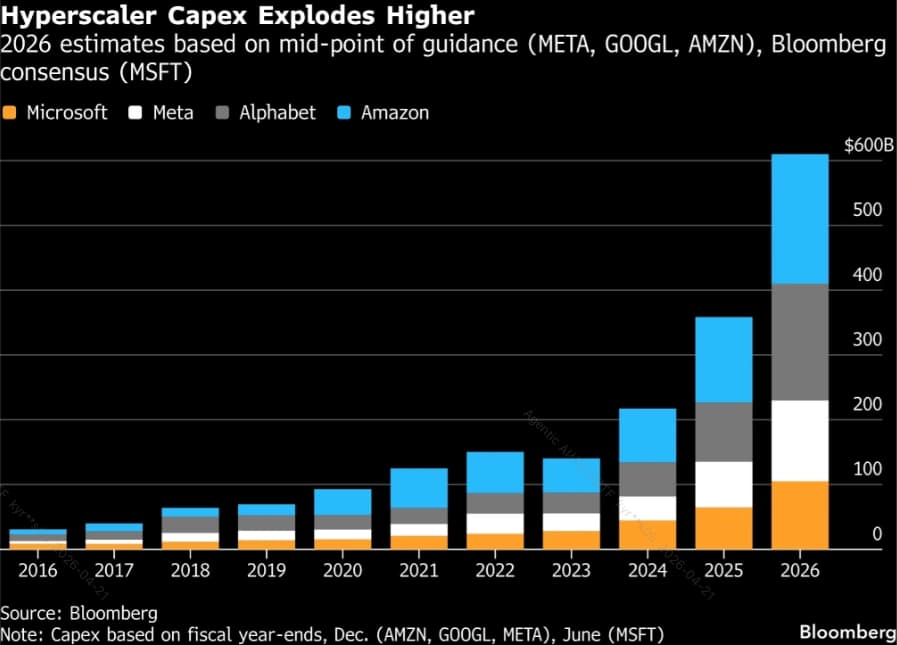
The four major tech companies are set to pour nearly $700 billion into AI data centers by 2026. This figure represents a sevenfold increase compared to 2022 and is close to half of South Korea's GDP. Reuters dubbed this the "AI spending wheel"—a self-reinforcing cycle where creating better AI requires more infrastructure, and AI improves as infrastructure expands. Investment strategies for the next three years will differ completely depending on whether this is simple spending or a structural investment that shapes a new industrial landscape.
1 700 billion dollars — Get a feel for the numbers first
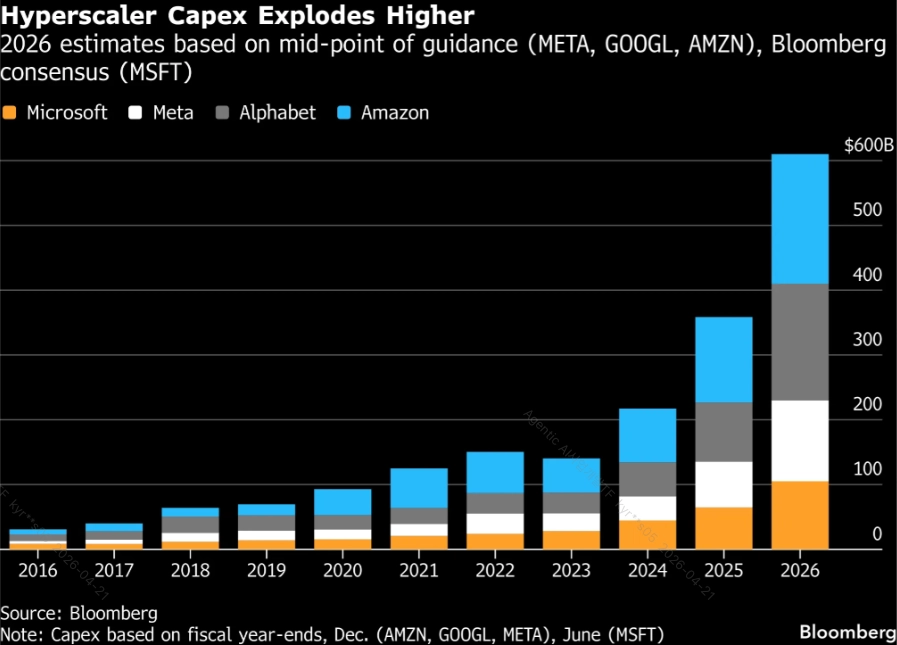
The quickest way to understand the scale of Big Tech AI infrastructure investment in 2026 is to look at the growth rate. The combined capital expenditure of hyperscalers, which stood at $100 billion in 2022, is projected to reach $387 billion in 2025 and between $650 billion and $750 billion in 2026 (estimated by Bloomberg NEF and Morgan Stanley). This represents a sevenfold increase in just four years.
There is a reason why this scale can be maintained. According to CreditSights analysis, 75% of total Capex is invested directly in AI infrastructure —new infrastructure specialized for AI training and inference, rather than general IT maintenance or the expansion of existing cloud services. In the case of Microsoft, it has been reported that the backlog of Azure AI services alone amounts to $80 billion . This means that demand is already confirmed and waiting before investment is made.
2Investment Scale by Company — Who Spends How Much
To grasp the true nature of the $700 billion, we must break it down by company. While Amazon leads, the other three companies are also concentrating unprecedented capital. What is noteworthy is that each of these companies is not simply increasing capacity, but is simultaneously pursuing the internalization of their supply chains in parallel with the development of their own AI chips (Google TPU, Amazon Trainium, Meta MTIA).
| enterprise | 2026 Projected Capex | Main uses | reason |
|---|---|---|---|
| Amazon (AWS) | $200B | Global data center expansion, AI learning and inference infrastructure, Trainium proprietary chip | Reuters, Bloomberg |
| Alphabet (Google) | $175~185B | TPU v5 clusters, multimodal AI infrastructure, search and Gemini inference | Morgan Stanley |
| Microsoft | $120B+ | Azure AI, OpenAI Partnership Infrastructure, Copilot Inference Extension | Bloomberg, Fortune |
| Meta | $115~135B | Llama learning cluster, AI advertising and recommendation infrastructure, MTIA proprietary chip | Meta IR |
| Oracle | $50B | Responding to AI Cloud, xAI Partnership Data Center, and Multi-cloud Demand | Reuters |
3Supply Chain Shock — Find the Gold Rush Pickaxe Merchant
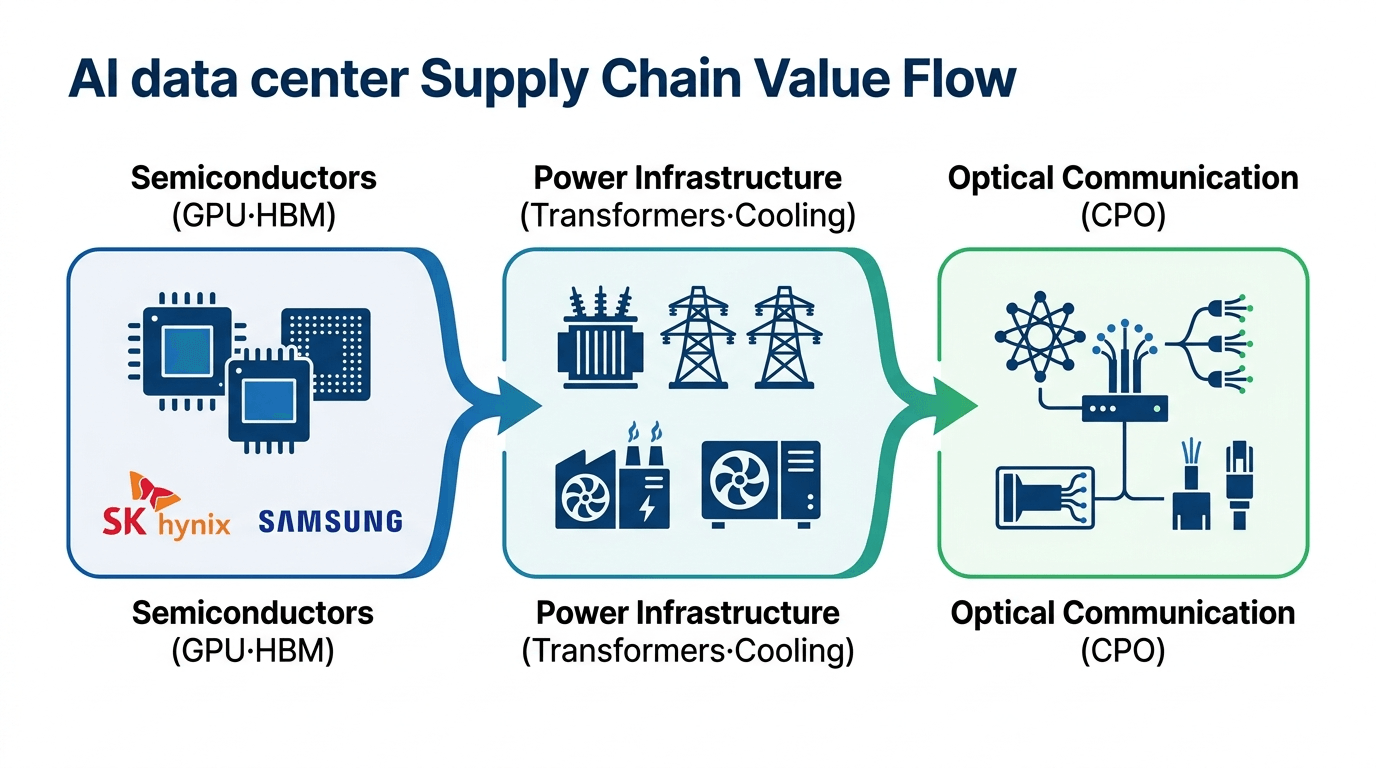
If you track the direction of the $700 billion flow, you can see the 'pickaxe seller of the Gold Rush era.' While directly buying Big Tech stocks is a strategy, a clearer profit structure may be hidden within the parts and infrastructure supply chains they rely on.
Semiconductor — HBM demand increases by 70%
Demand for HBM (High Bandwidth Memory), which is essential for AI training, is expected to increase by more than 70% year-on-year in 2026. SK Hynix and Samsung Electronics are structured to maintain or raise prices by leveraging a supplier-dominated market. TSMC's mass production of its 2nm process is also aligned with this cycle. However, rising costs for specialty gases such as helium simultaneously act as a pressure factor on semiconductor manufacturing costs.
Power infrastructure — 74GW needed by 2028
Morgan Stanley estimates that U.S. data center power demand will reach 74 GW by 2028. Suppliers of power transformers, cooling equipment, and emergency generators will directly benefit. The surge in energy demand is simultaneously accelerating investment in Small Modular Reactors (SMRs) and renewable energy infrastructure. The order trends of domestic power infrastructure companies, such as Doosan Enerbility, are aligned with this trend.
Optical Interconnect (CPO) — Invisible Bottleneck
Co-Packaged Optics (CPO) technology is gaining attention for resolving bottlenecks in inter-chip communication speeds within data centers. Optical interconnect companies such as Astera Labs and Coherent are directly benefiting from the AI Capex cycle. The order pipelines of domestic optical communication component companies serve as an indirect indicator of this trend.
4 Risk — Bubble or Structural Investment?
The reason we must view this investment cycle with balance is the existence of three substantial risks. Counterarguments are just as concrete as the optimism.
| Risk factors | Concerns | Counterarguments / Mitigation Factors |
|---|---|---|
| ROI delay | There is a 2-3 year time lag from AI infrastructure investment to revenue return. | Microsoft Azure Backlog $80B — Demand Already Confirmed Pending (Bloomberg) |
| Hardware Obsolescence | GPU generation replacement cycle less than 3 years, rapid asset depreciation | Nvidia and AMD Roadmaps Already Priced In — Big Tech Continues Investing Despite Recognizing This (Fortune) |
| Energy cost shock | Surge in electricity demand → Rise in electricity rates → Pressure on operating costs | Big Tech is hedging with long-term PPAs and in-house generation (Reuters) |
According to Morgan Stanley analysis, the combined cash and borrowing capacity of hyperscalers exceeds $1 trillion . A more valid question than "Is this a bubble?" is this: "How many entities in the world can execute investments of this scale without stopping?" And those entities are currently making these investments.
5Frequently Asked Questions
| question | answer |
|---|---|
| Is a $700 billion investment a sustainable scale? | As the combined cash flow and borrowing capacity of the four hyperscalers exceed $1 trillion, there are no short-term financing issues. However, due to a 2-3 year time lag for ROI realization, there is a possibility of Capex adjustments in the event of a macroeconomic shock. |
| Which companies directly benefit Korean investors? | The supply of HBM from SK Hynix and Samsung Electronics is the most direct beneficiary. Companies in power transformers, cooling solutions, and optical communication components also benefit indirectly. Before investing, it is important to verify the positioning within the supply chain and the existence of long-term contracts. |
| When does the AI Capex cycle turn around? | Morgan Stanley forecasts an average annual growth of over 20% through 2027–2028. Currently, signals of acceleration outweigh those of a reversal. Major triggers cited include the failure to monetize AI services, a major energy shock, or stricter AI regulations in key countries. |
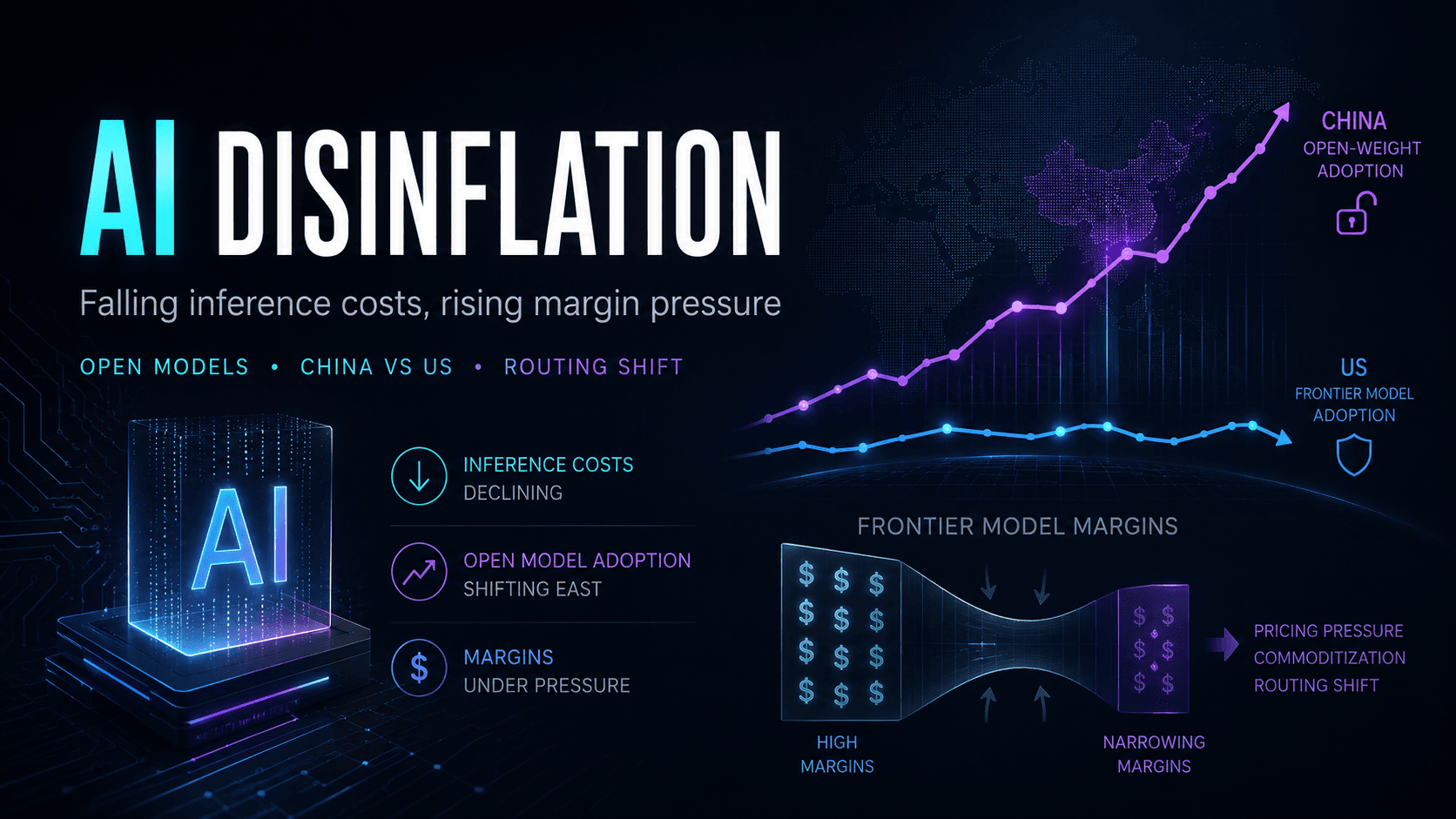
| Doesn't open source and lightweight AI reduce Capex? | Not in the short term. While model efficiency lowers training costs, it simultaneously generates demand for more AI applications and inference (Jevons Paradox). Efficiency does not replace Capex; rather, it tends to expand demand. |
62027~2028 Outlook — It’s Just the Beginning
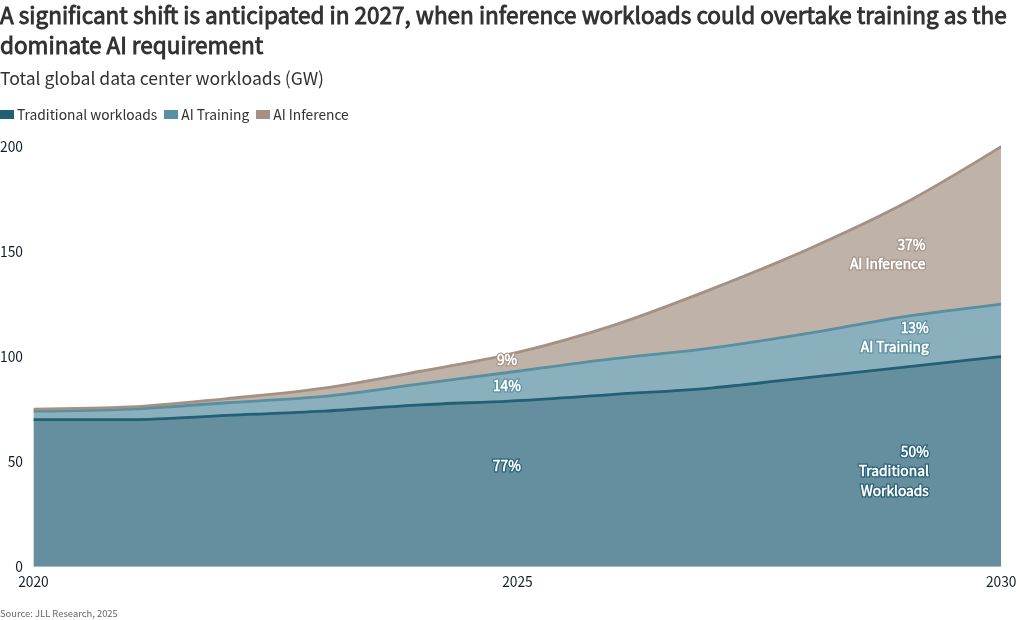
The $700 billion mark in 2026 is not the peak of the AI infrastructure cycle. Morgan Stanley forecasts that total global data center investment will exceed $2.9 trillion between 2025 and 2028. As AI agents become widely adopted, the demand for inference is expected to grow faster than the demand for training, which will lead to an explosion in demand for low-power, high-efficiency inference chips rather than GPU clusters.
From the perspective of Korean companies and investors, the implications of this cycle are clear. AI infrastructure has already become the new 'oil.' While directly purchasing oil (Big Tech stocks) is a strategy, a more stable revenue structure can be found in companies that supply refining facilities and pipelines (HBM, power, and optical communication supply chains). This is why you must start positioning now to prepare for 2027 .
All figures in this article are for informational purposes only and do not constitute investment advice. Company-specific Capex figures are analyst estimates as of April 2026 and may differ from actual executed amounts. All investment decisions and responsibilities rest solely with the investor; please consult with a professional financial advisor before making any significant decisions.
📌 Was this analysis helpful?
In the next post, we plan to cover “The Real Beneficiaries of the AI Capex Cycle — How to Select HBM, Power, and Optical Communication Supply Chain Companies.”
We will continue to translate Big Tech AI investment trends from a domestic investment perspective. Subscribe to notifications so you don't miss out.
How this content was produced
Aleph's research AI agent assisted with collecting and analyzing public data, creating charts and visuals, and structuring the draft. Davar personally reviewed and edited the sources, figures, reasoning, and final conclusions.
This content is for informational purposes only and is not personalized investment advice or an individual stock recommendation. Read the full disclaimer

Davar
Davar builds and operates Aleph's research AI agent and writes and reviews analysis on macroeconomic developments and AI industry trends.

© Aleph. All rights reserved.