
The 0.3%p Erase by the Middle East War — What the Triple Pressure of Slowing Growth, Soaring Inflation, and Interest Rate Freezes Leaves for Investors
While reading the OECD Interim Economic Outlook on March 26, my eyes stopped at the phrase “entirely erased.” It means that the opportunity for the global economy to rise to 3.2% was completely offset by the war in the Middle East. Although the figure remains the same at 2.9%, the atmosphere is entirely different. It is not that the improving economy has stalled, but rather that the opportunity for improvement itself has vanished. This difference is now changing my portfolio strategy.
1Opportunity for Recovery Evaporated — OECD “Entirely Erased”
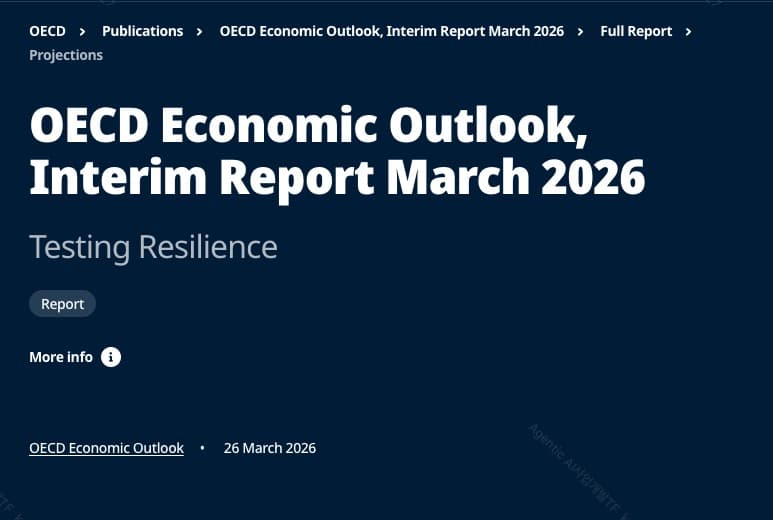
The OECD set the subtitle for its March Interim Economic Outlook as “Testing Resilience.” Last December, it assessed the situation as “Resilient Growth”—meaning the global economy was in a phase of recovery. In just three months, it has reversed this stance, stating that this resilience is now being “tested.”
💡 It is not the same 2.9%
This is the OECD original text: “A preliminary update suggested that global GDP growth could have been upwardly revised by around 0.3 percentage points in 2026. This revision has been entirely erased by the impact from the escalation of conflict in the Middle East.”
Based on data up to the end of February, the global growth rate could have been raised from 2.9% to 3.2%. However, due to the escalation of the war in the Middle East, that upward possibility has been completely eliminated. A 0.3 percentage point increase in global GDP amounts to trillions of dollars.
Source: OECD Economic Outlook, Interim Report March 2026, Projections Section
2Shock in Numbers — Growth and Price Forecasts for Major Countries
The typical pattern of stagflation, with declining growth rates and rising prices, is emerging. The impact is particularly severe for countries highly dependent on energy imports.
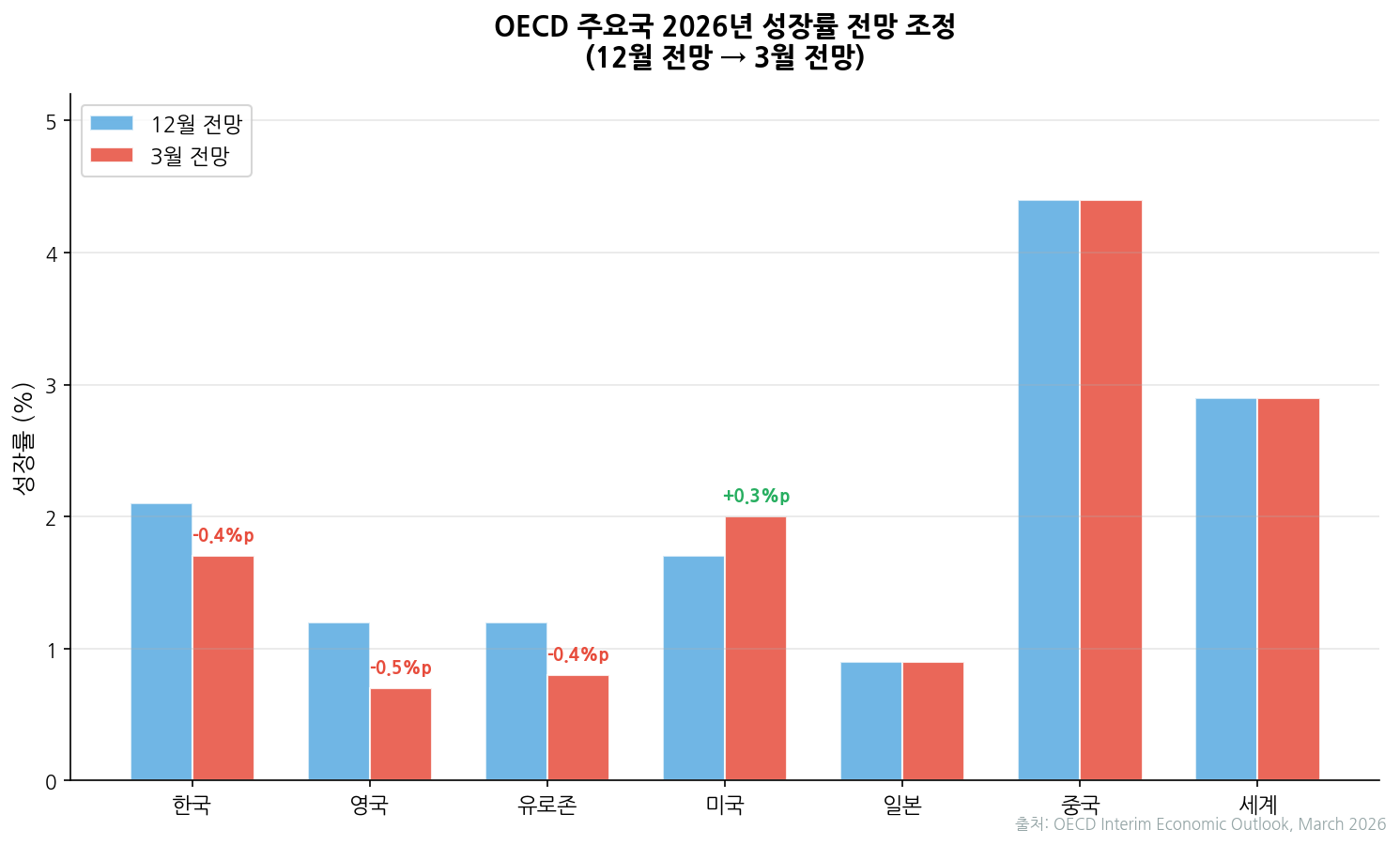
Comparison of 2026 Growth Rate Forecasts for Major Countries
| nation | December Outlook | March Outlook | Adjustment range | note |
|---|---|---|---|---|
| world | 2.9% | 2.9% | – | The possibility of an upward revision to 3.2% has been entirely erased. |
| korea | 2.1% | 1.7% | -0.4%p | Second largest downward revision among G20 |
| uk | 1.2% | 0.7% | -0.5%p | Largest downward revision among G20 |
| Eurozone | 1.2% | 0.8% | -0.4%p | Direct hit by rising energy prices |
| USA | 1.7% | 2.0% | +0.3%p | Net energy exporter, upward revision |
| japan | 0.9% | 0.9% | – | Offsetting upward opportunities |
| china | 4.4% | 4.4% | – | Offsetting upward opportunities, relative avoidance |
※ The 0.3%p upward revision by the U.S. reflects robust economic momentum through February, a result offset by the war in the Middle East. Source: OECD Interim Economic Outlook, March 2026
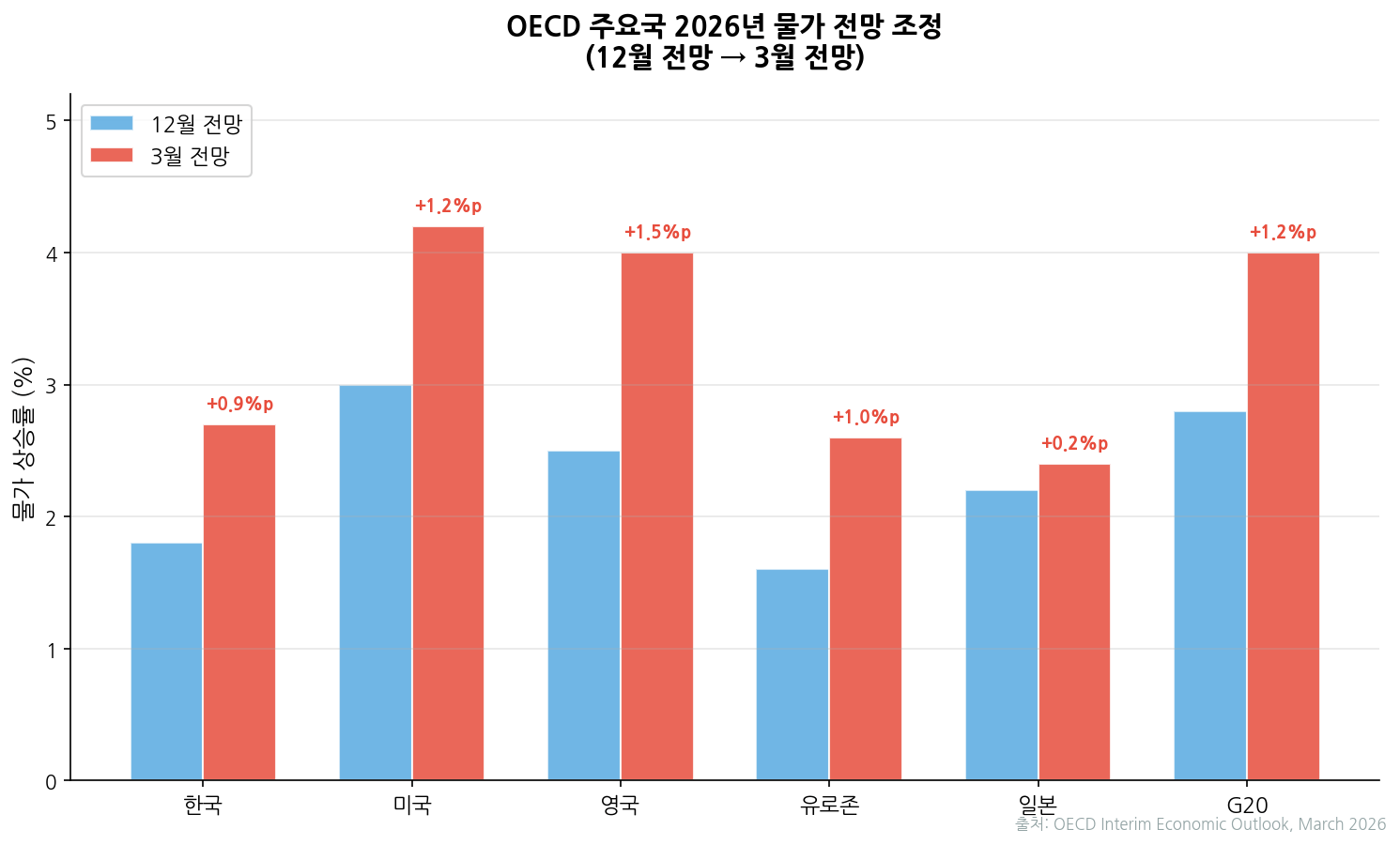
Comparison of 2026 Price Forecasts for Major Countries
| nation | December Outlook | March Outlook | Adjustment range |
|---|---|---|---|
| G20 average | 2.8% | 4.0% | +1.2%p |
| korea | 1.8% | 2.7% | +0.9%p |
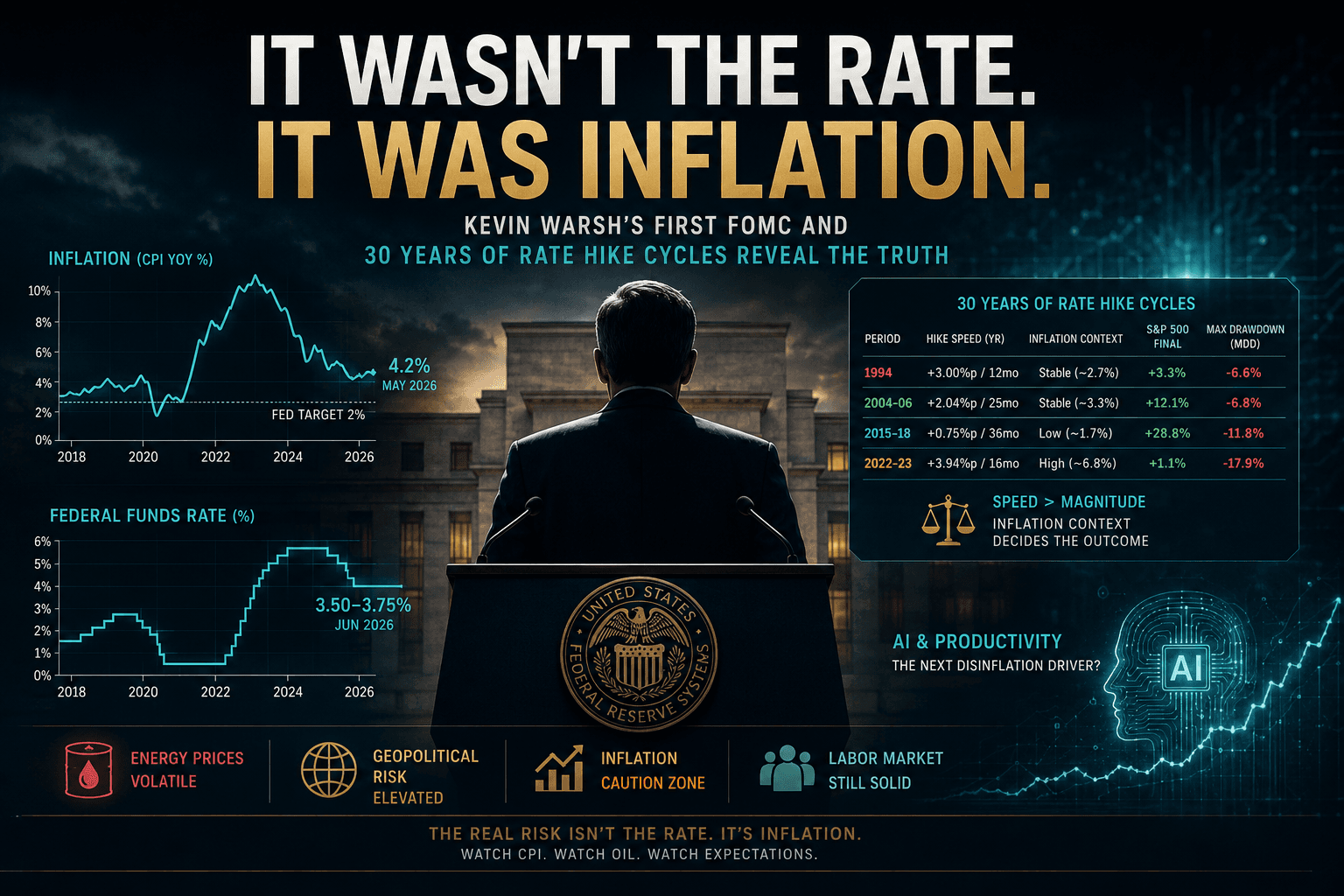
| USA | 3.0% | 4.2% | +1.2%p |
| Eurozone | 1.6% | 2.6% | +1.0%p |
| uk | 2.5% | 4.0% | +1.5%p |
| japan | 2.2% | 2.4% | +0.2%p |
Source: OECD Interim Economic Outlook, March 2026 / Korean figures based on separate OECD release standards
⚠️ Growth slows, prices rise
This is the combination for Korea. Growth rate lowered by 0.4%p + inflation raised by 0.9%p. It is a textbook signal of stagflation. As growth slows while prices rise, the Bank of Korea’s interest rate policy becomes extremely difficult.
How this content was produced
Aleph's research AI agent assisted with collecting and analyzing public data, creating charts and visuals, and structuring the draft. Davar personally reviewed and edited the sources, figures, reasoning, and final conclusions.
This content is for informational purposes only and is not personalized investment advice or an individual stock recommendation. Read the full disclaimer

Davar
Davar builds and operates Aleph's research AI agent and writes and reviews analysis on macroeconomic developments and AI industry trends.

© Aleph. All rights reserved.