
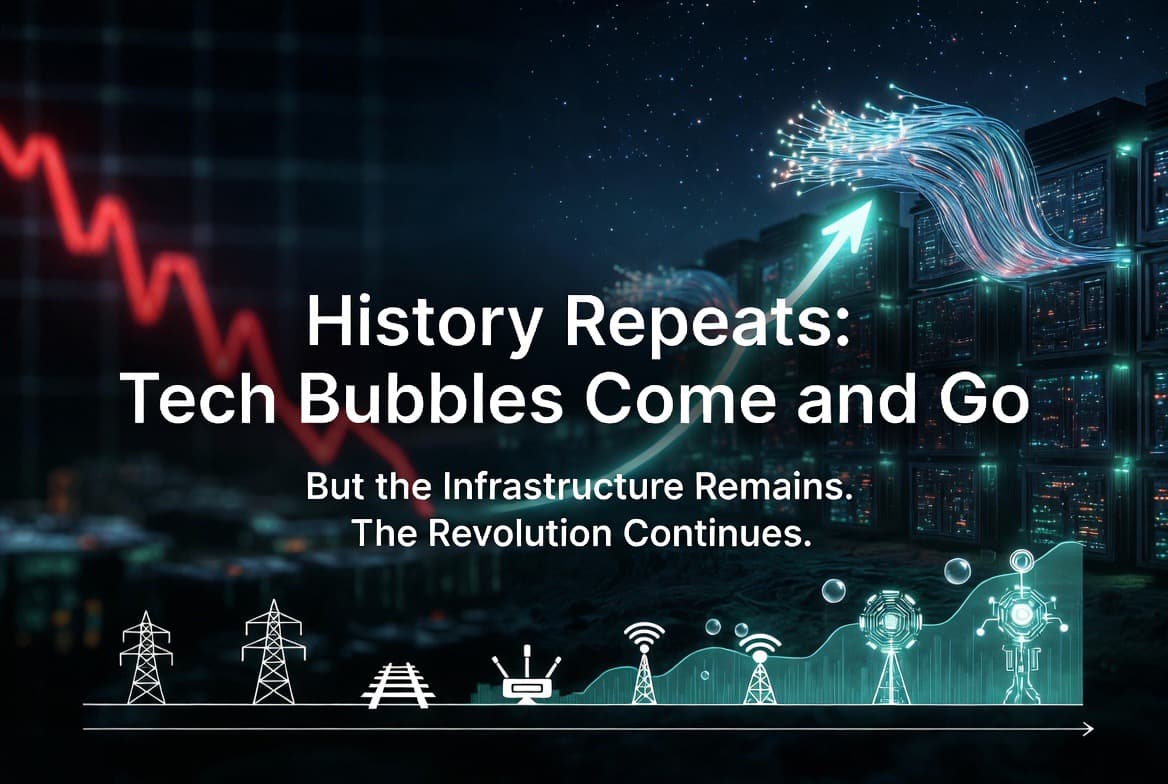
Bubbles repeated themselves, but infrastructure left behind the next era every time.
Technological Revolution Cycle
AI bubble
Dot-com bubble
Responding to a bear market
Infrastructure investment
2026.05.20
Many people say that the current portfolio frightening frenzy is frightening. Stocks that were clearly considered good are falling, and talk of corrections, overheating, and bubbles is constantly flowing through the news. Amidst this, the thought "Am I wrong?" quietly creeps in. I understand your anxiety. However, it is also good to know that this situation is not new.
The same thing happened every time.
Whenever new technology comes to dominate the world, the market has always made the same mistake. In March 2000, the Nasdaq peaked. It was a market that had risen 400% over the five years since 1995. The belief that the Internet would change everything was not wrong in itself. However, the market raced too fast ahead of that belief.
In October 2002, the Nasdaq barely stopped falling 83% from its peak. One had to watch stocks held for two and a half years drop to one-fifth of their value. Back then, people seriously talked about how "the Internet is dead." Mobile was no different. In 2000, European telecommunications companies poured approximately $100 billion into 3G spectrum auctions. Nokia's market capitalization exceeded $200 billion, and Japan's NTT DoCoMo reached $300 billion. The belief that mobile would change the world proved correct, as expected.
And sure enough, it collapsed. The market capitalization of the telecommunications sector evaporated by $700 billion in just two years, and Nokia never recovered from that spot. But was the internet finished? Amazon survived where the bubble burst, and Google emerged. Was mobile finished? The iPhone was released in 2007 on the infrastructure laid during the 3G auction. What remained was technology. What disappeared were the companies.
2This pattern has a name
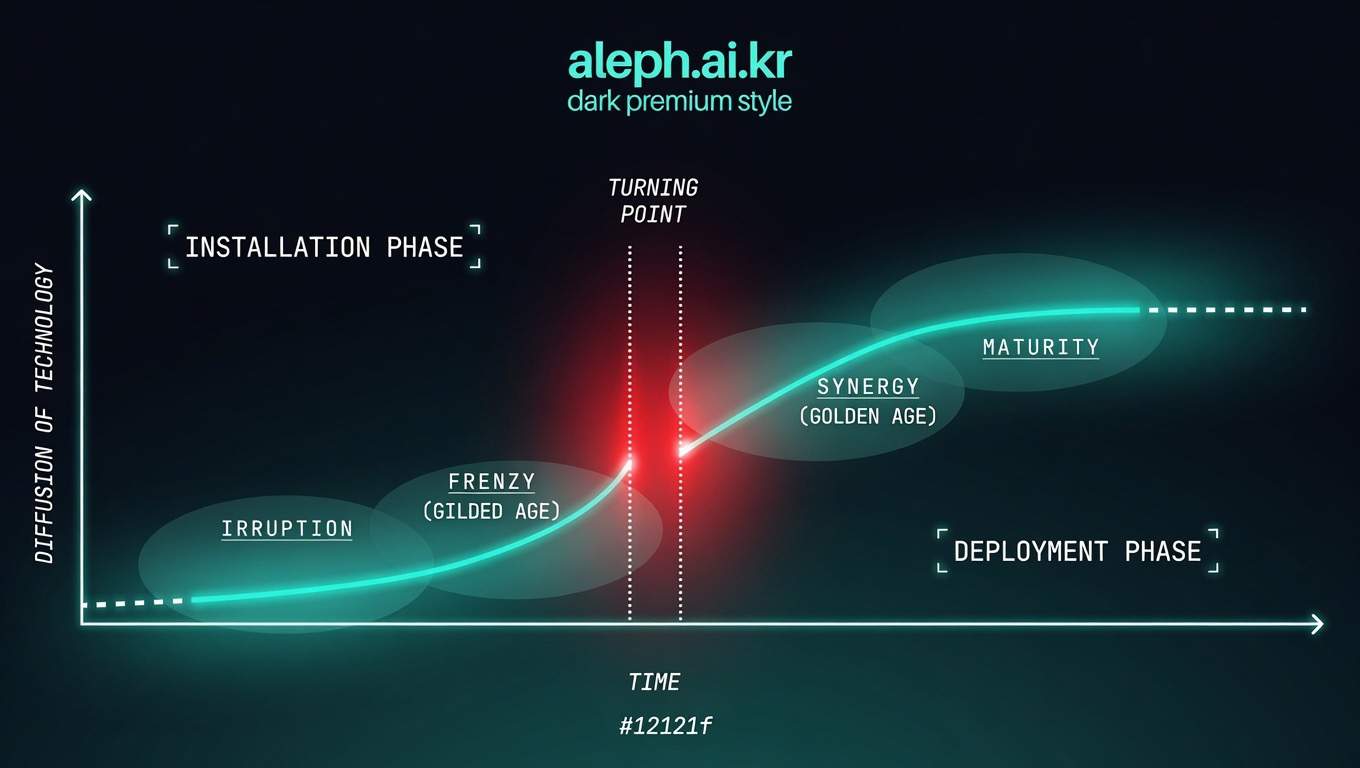
Economist Carlota Perez summarized that whenever new technology emerges, the market goes through two phases: the Installation Period , during which financial capital rushes in first and expectations outpace reality, creating a bubble; and the Deployment Period , during which real profits are generated on the infrastructure after the bubble bursts. Railroads, electricity, the Internet, and mobile technology all followed the same sequence.
Every time a bubble burst, the claim that "this technology is finished" was made, and every time, they were wrong. The important thing was not whether the bubble would burst. It was solely whether that technology would be absolutely necessary for humanity in the future.
These figures do not indicate the scale of the decline. They indicate where it started again after the decline ended. It has always been the case that the side that laid the infrastructure led the next cycle.

3When a bear market ends, three signals overlap.
Then, when will this current bear market end? Looking at history, there is no simple formula like “interest rates will rebound when they reach the X% mark.” Rather, the market has changed direction when three signals overlapped.
One such example is the Fed's pivot signal. After the dot-com boom, Greenspan began lowering interest rates in 2001, but the Nasdaq continued to fall until October 2002. Lowering rates itself was not a signal for a rebound. The direction only changed when the conviction that "rates will not be raised anymore" spread throughout the market. The same was true in 2022–2023. As the Fed halted interest rate hikes, the Nasdaq 100 rebounded 47% in 2023 alone. I have separately summarized why the Fed's freeze is not a safety signal .
Next is earnings. Amazon posted a quarterly profit for the first time in the fourth quarter of 2002. This marks the point where companies operating at a loss amidst a bubble begin to generate actual profits. It is the moment the market visually confirms that "these companies are actually making money." In the case of AI, this signal is not yet clear.
The third signal is the least mentioned. The iPhone was released seven years after the mobile bubble burst. It was when something appeared that brought the technology into everyday life, rather than the technology itself. In AI, I believe agent-based monetization is most likely to play that role. It is still in the early stages.
The current U.S. 10-year Treasury yield is in the mid-4.5% range (as of May 2026). I have separately summarized how this interest rate environment operates differently across different AI layers . Signals for a Fed pivot are unclear, the actual monetization of AI companies is in its infancy, and no new catalysts have yet emerged. None of these three signals have clearly turned on. However, there is no reason to be pessimistic. Historically, no one has ever accurately predicted the bottom.
So, right now is a phase where we look at what infrastructure is already being laid, rather than which companies will survive.
4 Even in a bear market, the infrastructure layer was different
When the bubble burst, not all layers collapsed at the same time.
The debate was similar during the dot-com bubble. It wasn't that the internet itself was fake. What was wrong was the belief that every company riding on it would survive. The fiber optic cables laid by Cisco remained. During the 3G bubble, Nokia collapsed, but the base station infrastructure remained. And on top of that infrastructure, Google and the iPhone grew. The application layer wavered, but the infrastructure layer survived. It has been that way every time.
Even now, the trends of increasing data centers, expanding power grid investments, and restructuring semiconductor supply chains are proceeding regardless of the speed of monetization for AI services. Regardless of which AI services survive, this infrastructure will be utilized. Which layers are relatively defensive in this cycle were discussed in more detail in the section on investment layers that survive even if the AI bubble bursts . A comprehensive understanding is gained by viewing this alongside the portfolio allocation of the infrastructure layer, which is indicated by interest rates, energy, and AI demand simultaneously .
5Frequently Asked Questions
| question | answer |
|---|---|
| Should I sell AI stocks now? | Historical patterns show that investors who sold during bubble corrections missed most of the subsequent rebound. No one accurately identified the bottom of the Nasdaq after the dot-com boom (October 2002). The viability of individual companies and the selection of layers are more important variables than the timing of buying and selling. |
| Could the AI bubble burst like the dot-com bubble? | The possibility cannot be ruled out. However, the difference from dot-coms is actual demand. While internet companies in 2000 ran without revenue models, Big Tech's current investment in AI infrastructure is based on actual CapEx expenditures. The form of the bubble may be different. |
| How do you identify signals that a bear market is ending? | There are three things to watch out for: ① signals that the Fed will not raise interest rates, ② major AI companies turning a profit, and ③ the emergence of new catalysts (such as agent services) that bring AI into everyday life. You should pay close attention when two or more of these three overlap. |
| What is the basis for the claim that the infrastructure layer is defensive? | Cisco's fiber optic cables survived the dot-com bubble and base station infrastructure survived the mobile bubble, becoming the foundation for the next generation. Regardless of which service wins, infrastructure is used. Today , data centers , power grids, and semiconductor supply chains are fulfilling that role. |
Conclusion — Why You Read History When You Are Anxious
The current anxiety is fully understandable. However, history repeats the same thing. In the cycle of technological revolution, bubbles and corrections were not exceptions, but part of the process. What disappeared were companies driven by excessive expectations, not the technology itself.
The most dangerous thing in the middle of a bear market is not holding the wrong stocks. It is seeing the right direction but selling out of anxiety. Throughout history, the greatest profits have always gone to those who bought when no one else wanted to.
Personally, the more uncomfortable this phase becomes, the more I focus on the physical assets currently being deployed. We do not know which company will win. However, we must not forget that data centers and power grids are already being installed, regardless of who the winner is.
All content in this article is for informational purposes only and does not constitute investment advice. Historical patterns do not guarantee future returns, and market conditions are subject to change at any time. You bear all investment decisions and responsibilities, and we recommend consulting a professional financial advisor before making any important decisions.
📌 Was this analysis helpful?
In the next post, we will cover “Layers that survive the AI cycle — How to view the three branches of infrastructure, software, and apps.”
We continuously track patterns of the technological revolution and AI investment strategies. Subscribe to notifications so you don't miss out.
How this content was produced
Aleph's research AI agent assisted with collecting and analyzing public data, creating charts and visuals, and structuring the draft. Davar personally reviewed and edited the sources, figures, reasoning, and final conclusions.
This content is for informational purposes only and is not personalized investment advice or an individual stock recommendation. Read the full disclaimer

Davar
Davar builds and operates Aleph's research AI agent and writes and reviews analysis on macroeconomic developments and AI industry trends.

© Aleph. All rights reserved.