
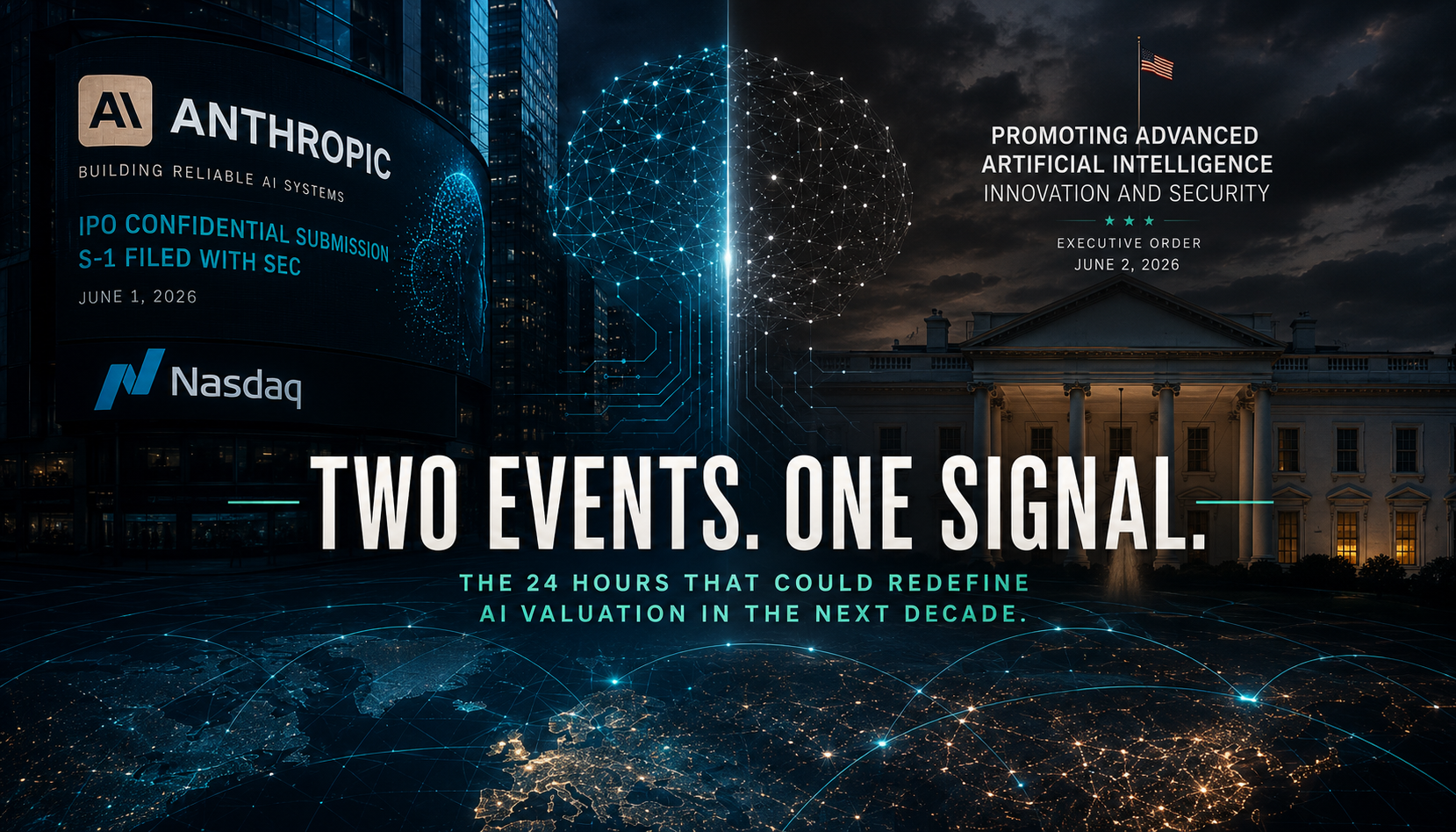
The Anthropic S-1 Classification Submission and the Trump AI Executive Order — What Two Events That Overlapped by Just One Day Tell Us
Anthropic IPO
Trump AI Executive Order
Frontier AI
National strategic infrastructure
AI Valuation
HBM
2026.06.03
A single AI model led to the creation of a law, and the company that developed that model filed for listing the very next day. Behind the AI executive order signed by President Trump lies Anthropic’s Claude Mythos Preview—because the ability to detect cyber vulnerabilities much faster than humans is directly linked to national security concerns. And just a day earlier, Anthropic filed for S-1 status with the SEC. When viewed separately, these two events appear as unrelated policy and market news. However, placing them side by side changes things. The outlines of how these tense 24 hours could change the valuation standards for AI companies are beginning to emerge.

1The 24-Hour Paradox — The model that made the law has filed for listing.
What was interesting was the sequence of events. On June 1, Anthropic filed confidential S-1 documents for its IPO with the SEC. On June 2, President Trump signed the “Promoting Advanced Artificial Intelligence Innovation and Security” executive order.
We need to examine the background behind the creation of this executive order. The U.S. Federal News Network reported that this order was a response to the revelation that Anthropic’s Claude Mythos Preview far outperformed humans in its ability to discover and exploit cyber vulnerabilities. This means that Anthropic’s model was the direct trigger for the new regulations.
Personally, when I first read this passage, it reminded me a bit of Palantir's early days—that moment when national security and private capital were simultaneously paying attention to the same company. Of course, this could be a mere association. However, it is clear that this paradox contains the most noteworthy investment signal of the week.
If you read 2EO as regulation, you miss the point.
At first glance, it appears to be a regulation, as it means the government will review the launch 30 days in advance. However, looking at the key clause reveals a different direction. “Nothing in this section shall be construed to authorize the creation of a mandatory governmental licensing, preclearance, or permitting requirement.” It is voluntary; it is not a mandatory regulation.
In form, it is a “voluntary” regulation. However, the story changes once it begins to be linked to government procurement standards. From that moment on, it is highly likely to function as a de facto industry standard. The law firm WilmerHale also viewed it as “voluntary, but highly likely to become the basis for future procurement contract and regulatory requirements.” The Department of Defense, the Treasury Department, the Department of Homeland Security, and the Department of Commerce are connected to this framework, and a secret benchmarking process is also established in which the NSA sets classification criteria.
What this EO has created is not a regulation, but a classification system . It signifies that the government has begun determining "which models are strategic asset-grade." Companies falling within this classification can become assets with distinct entry barriers and premiums. From the market's perspective, this ultimately leads to discussions regarding multiples. This implies that even among the same AI companies, the premium they command can vary. Of course, further verification is still needed before this voluntary framework solidifies into an actual procurement structure.

3 What $96.5 Billion Says — And What They Haven't Said Yet
Anthropic's S-1 filing is not merely preparation for an IPO. It is an event that sets the standard for how frontier AI companies will be priced in the public market for the first time.
However, it is necessary to take a step back and look at these figures before accepting them at face value. This is because a high revenue run rate does not necessarily equate to profitability. Considering GPU capex , cloud infrastructure costs, and talent expenses, the actual gross margin structure can only be verified when the S-1 filing is released following the IPO. Frankly, there may be some overestimation in this aspect. CNN suggested that this IPO cycle could serve as the most important market lesson since the dot-com era, but it is up to the market to judge whether the structure is one where the narrative leads and the fundamentals follow.
It is still too early to draw conclusions. However, just as Palantir began receiving independent valuations after securing long-term government contracts in the national security sector, pricing methods can change when government procurement and capital market interest converge on the same company. It is possible that AI has already taken the first step in that transition. However, this remains strictly at the stage of possibility.
4Which Companies Receive a Premium — And What the Market Needs to Verify
If reclassified as a “strategic infrastructure asset,” investment benefits will flow differently depending on the layer. However, there are still many aspects that the market has not yet verified. Ultimately, several figures must be confirmed to determine whether this will lead to an actual re-rating.
The most direct beneficiaries are companies that dominate the stack . These are not companies that sell models alone, but rather those that bundle compute, cloud, security, and deployment channels. At Build 2026, Microsoft unveiled agent-based devices, proprietary inference models, and enterprise security deployment tools all at once. Google is pushing TPUs, agent platforms, and security platforms simultaneously. Amazon Bedrock is Anthropic's primary deployment channel. These companies are structured to benefit from the increasing demand for AI infrastructure, regardless of which models are classified as "covered frontier models."
Next is the infrastructure layer . As discussed in the previous post , "Agents Handle Payments — Google I/O 2026 Changes the Investment Landscape," the demand for infrastructure required for training and inference structurally tends to increase as AI usage grows. Personally, I consider this aspect to be more important than it might seem. When an AI company like Anthropic, with a revenue run rate of $47 billion, goes public, the actual scale of its computational demand is verified externally for the first time. As that demand is confirmed, the demand for data centers , semiconductors, and HBM structurally follows suit.
The most uncertain factor is the model companies themselves . Anthropic and OpenAI are growing rapidly, but they are not yet public market companies. Substantive comparisons will become possible once financial data is released following their IPOs.
Ultimately, after the IPO, companies will be validated by numbers. Over the next year, there are three main things investors will seek to verify: whether the “covered frontier model” criteria are actually reflected in U.S. government procurement contracts; whether the growth rate of AI inference costs keeps pace with the growth rate of capex; and whether Anthropic and OpenAI disclose their actual gross margin structures after the IPO. When these three conditions are met, it becomes highly likely that the market will begin to re-evaluate AI companies not merely as SaaS providers, but as strategic infrastructure assets.
5 The part connecting to Korean investors
From the perspective of domestic retail investors, the practical question is where this trend leads. There are three connecting links.
The first factor is the HBM demand structure . The majority of Anthropic’s revenue run rate of $47 billion comes from model inference and training costs. As the demand for AI computing on this scale continues to grow, HBM demand tends to structurally follow suit. The logic that SK Hynix and Samsung Electronics’ HBM businesses can benefit from this trend is valid. However, there is typically a time lag of two to four quarters for this connection to translate into actual earnings.
The second is the U.S. AI export financing program . The Trump administration is pursuing billions of dollars in financial support to enable allies to adopt U.S.-made AI tools. South Korea ranks high on this list of allies. If the program materializes, it could accelerate the adoption of U.S. AI stacks by domestic companies, thereby changing the competitive landscape of domestic AI services.
The third factor is the positioning of domestic AI companies . The Korean language AI models developed by Naver and Kakao are on a different trajectory than the U.S. "covered frontier model." Being outside the U.S. strategic asset classification competition is not a disadvantage in the short term. Since they are not directly exposed to global competition, it also means they have relatively more time to refine domestically specialized services. However, the risk associated with the advertising-dependent revenue structure resulting from the transition to an agent economy remains valid, separate from this trend.

6Frequently Asked Questions
| question | answer |
|---|---|
| Is this EO a regulation that hinders AI development? | No. The EO itself explicitly states that it is “not a mandatory permit or prior approval requirement.” It is a voluntary framework. However, WilmerHale viewed that even though it is voluntary, it is highly likely to become a standard for government procurement contracts and subsequent regulations. It is more accurate to interpret it as the beginning of a classification system rather than a regulation. |
| Can individual investors directly participate in the Anthropic IPO? | The listing schedule and offering structure have not yet been finalized. It is currently in the confidential S-1 filing stage, and there is a time lag of at least several months between the SEC review and the public roadshow. Among indirect exposure methods, Amazon (Bedrock Partner and Equity Holder) is considered the most direct indirect route. |
| How does the valuation change if it is reclassified as a “Strategic Infrastructure Asset”? | SaaS companies typically trade at revenue multiples ranging from 7 to 15 times. Cloud infrastructure companies (AWS, Azure ) trade at 15 to 30 times. When long-term government contracts become part of revenue, revenue visibility increases, which tends to lead to a valuation premium. Palantir has already followed this path, and Frontier AI companies could be justified in a similar manner once government procurement contracts begin in earnest. However, it is premature to say that the market has begun to fully price in this premium. |
| Is HBM demand actually connected to this trend? | Most of Anthropic’s $47 billion revenue run rate comes from model inference and training costs. As the demand for AI computation on this scale continues to grow, the demand for HBM structurally tends to follow suit. While the link remains valid, there is typically a time lag of two to four quarters before it is reflected in earnings. |
| Is Anthropic better compared to the OpenAI IPO? | Judging the investment superiority between the companies is beyond the scope of this post. However, the significance of the timing is noteworthy. By filing a confidential S-1 filing before OpenAI, Anthropic has positioned itself to set the first public benchmark for frontier AI valuations. The price of the second listed company will be determined by referencing this first benchmark. |
Conclusion — When policy and the capital market pay attention to the same company simultaneously
Governments have begun classifying certain AI models as strategic assets, and coincidentally, the company behind the model that served as the direct catalyst is preparing for its public market debut. Just as Palantir did in the early days, valuation logic can shift the moment government and capital market interest converge on the same company. It is possible that the market is currently underestimating this change.
When evaluating portfolios now, we must add one more criterion: the position this company occupies within the national strategic infrastructure order. When viewed through this lens, even among "AI-related stocks," their direction changes. There are those who dominate the stack, those who supply infrastructure, and those who stand apart from that trend.
All figures and analyses in this article are for informational purposes only and do not constitute investment advice. Anthropic’s confidential S-1 filing does not guarantee a listing, and the final offering size, price, and schedule are subject to change depending on market conditions. The Trump AI Executive Order is a voluntary framework, and its impact on the industry may differ from predictions. You bear full responsibility for your own investment decisions regarding the companies and stocks mentioned. Consulting with a professional financial advisor before making any significant decisions is recommended.
📌 Was this analysis helpful?
In the next post, we plan to cover “Anthropic IPO vs. OpenAI IPO — The Frontier AI Valuation War: Where to Bet.”
Ahead of the first public market debut of Frontier AI, we continue to track investment opportunities and risks.
How this content was produced
Aleph's research AI agent assisted with collecting and analyzing public data, creating charts and visuals, and structuring the draft. Davar personally reviewed and edited the sources, figures, reasoning, and final conclusions.
This content is for informational purposes only and is not personalized investment advice or an individual stock recommendation. Read the full disclaimer

Davar
Davar builds and operates Aleph's research AI agent and writes and reviews analysis on macroeconomic developments and AI industry trends.

© Aleph. All rights reserved.