
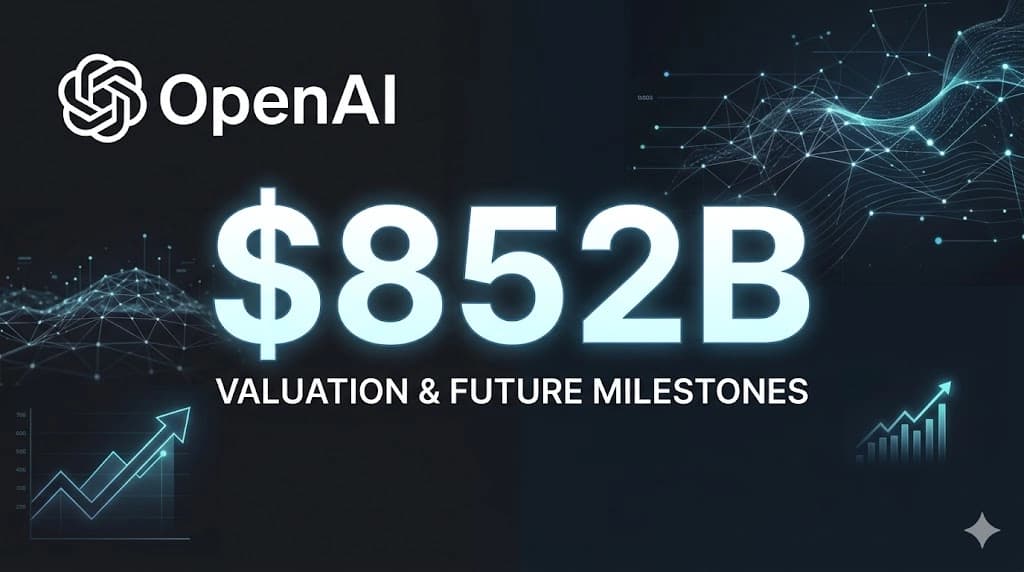
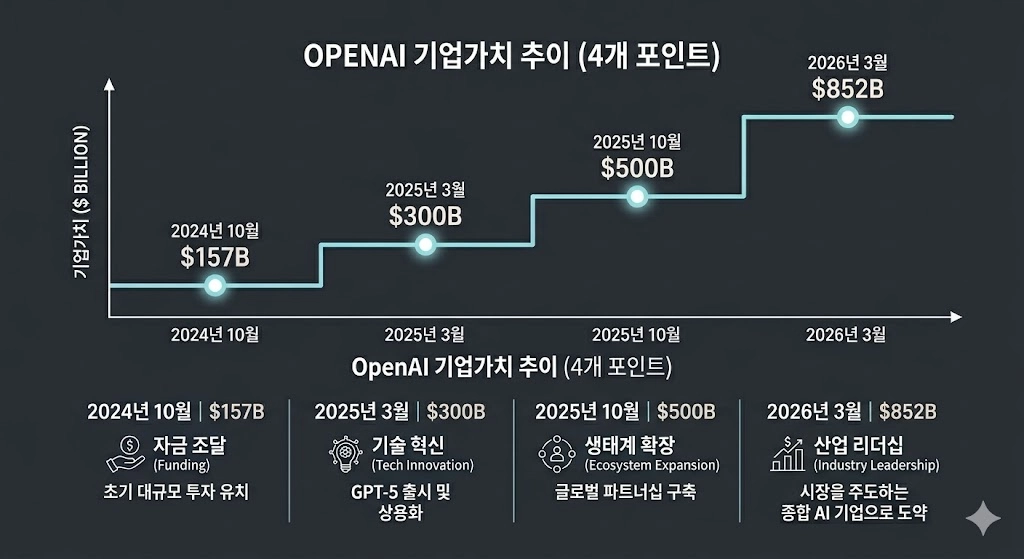
On March 31, 2026, OpenAI officially closed its largest-ever private funding round. With a committed investment of $122 billion (approximately 170 trillion KRW) and an enterprise valuation of $852 billion , this round—involving Amazon, Nvidia, SoftBank, and Microsoft—is more than just a startup investment. It marked a pivotal moment that reshaped the landscape of the AI infrastructure war. Aleph analyzed the data to understand specifically what these figures mean for domestic investors.
1$852B — How big is this number?
$852 billion is on par with Berkshire Hathaway. This means that an unlisted startup stands shoulder to shoulder with Warren Buffett's company. Since the scale alone might not give you a clear picture, let me provide you with the context.
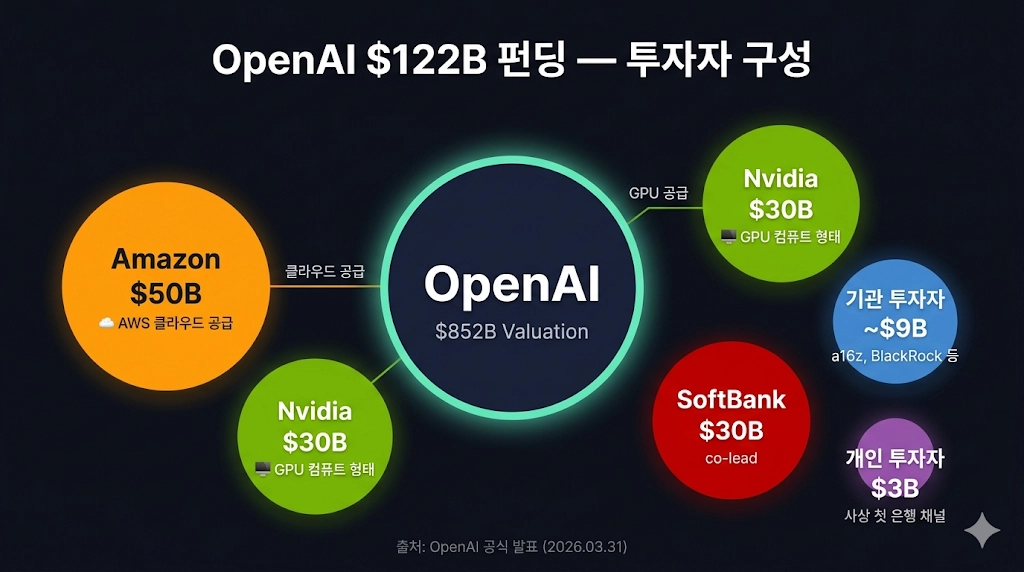
This round has a crucial difference from previous Big Tech funding: the list of investors consists of the supply chain itself . Amazon is investing $50 billion while simultaneously being an AWS cloud provider. Nvidia's $30 billion is in the form of GPU compute provision rather than cash. SoftBank's $30 billion was also raised through a separate $40 billion bridge loan. This structure, where investors are both suppliers and customers—known as "circular finance"—is drawing skepticism from some quarters of Wall Street.
Amazon — $50B (however, $35B is conditional on achieving an IPO or AGI milestone)
Nvidia — $30B (GPU compute form)
SoftBank — $30B (co-lead, utilizing a $40B bridge loan)
Microsoft — Participation confirmed, amount undisclosed (Maintaining existing $13B+ investment)
Institutions & Individuals — $12 billion additional (including $3 billion from individual investors, first-ever opening of bank channels)
2Why Now? — The Behavior of Companies Preparing for an IPO
OpenAI CFO Sarah Friar described this round as “historic numbers, but what matters more is what it means.” In Aleph’s view, the true purpose of this round is closer to building an IPO narrative than to raising funds.
| action | IPO Perspective Interpretation |
|---|---|
| Attracting $3 billion from retail investors (first-ever bank channel) | Expanding the retail shareholder base prior to the public offering → Securing IPO subscription demand in advance |
| ARK Invest ETF Inclusion | Expanding accessibility for individual investors, building support for the IPO price |
| Amazon $35B Conditional (IPO Linked) | The investment capital itself acts as a mechanism for IPO pressure. |
| Sora App Termination, Cost Reduction Initiative | Strengthen profitability narrative → Prepare for S-1 submission |
Multiple sources forecast the timing of the OpenAI IPO to be between the fourth quarter of 2026 and the first quarter of 2027. Although there has been no official announcement, the structure of this round itself points in that direction.
3 The Shadow Behind the Numbers — 3 Things to Look At Coldly
900 million users, $2 billion in monthly revenue. The numbers are impressive. However, Aleph intends not to overlook three risks.
OpenAI is operating at a loss despite earning $2 billion per month. Compute costs (GPU leasing, power, and cooling) are offsetting revenue growth. An enterprise value of $852 billion is a bet on "future dominance" rather than "current earnings." The first hurdle is how the burn rate will be revealed in the S-1 filing to be released after the IPO.
Amazon's $50 billion investment is tied to OpenAI's $100 billion AWS spending commitment. Nvidia's $30 billion is in GPU supply, not cash. This structure raises the question of "how much of the investment is actually cash?" Some Wall Street analysts point out that the organic growth rate of earnings figures needs to be verified separately.
Anthropic closed a $30 billion offering in February 2026 at an enterprise valuation of $380 billion. Annualized revenue is growing rapidly from $9 billion at the end of 2025 to over $19 billion in March 2026. When Google, Meta, and xAI are included, OpenAI's model advantage is closing the gap quickly.
4 3 Questions to Ask My Portfolio
Since OpenAI is a privately held company, direct investment is not possible. So, what investment signal does this $122 billion funding give us? Aleph summarizes it with three questions.
Nvidia and SK Hynix, is the current weighting sufficient?
OpenAI's $122 billion directly translates into demand for GPUs and HBM. Nvidia directly invested $30 billion in this round, and OpenAI's plans to expand its compute infrastructure signify additional orders for Blackwell GPUs. SK Hynix maintains an exclusive supply relationship with Nvidia, extending beyond HBM3E to the next-generation standards. The larger the AI investment, the greater the demand for HBM . This event effectively reaffirms the 12% NVDA / 20% SK Hynix weighting proposed in Aleph's previous portfolio post.
Are you underestimating Microsoft's weight?
Microsoft participated in this round as well, maintaining a 20% revenue sharing condition on top of its existing cumulative investment of over $13 billion. The structure is such that as OpenAI grows, the demand for Azure AI rises along with it. However, as it is known that Microsoft did not participate in this round in February but joined for the final closing, it is necessary to monitor potential tensions within the partnership.
If the IPO takes place, how will I respond?
If the OpenAI IPO is completed between the fourth quarter of 2026 and the first quarter of 2027, volatility will be significant immediately after the offering. This is due to the structural burden of unproven profitability relative to an enterprise value of $852 billion. Aleph's perspective: Rather than entering on the day of the IPO, staggered buying during the correction phase within six months of the offering is more risk-adjustable. A leading indicator is the disclosure of the burn rate at the time of the S-1 filing.
5 Beneficiary Structure at a Glance — Stocks Now Accessible
For domestic investors who cannot invest directly in OpenAI, tracking where the benefits of this funding are going is a realistic strategy.
| event | OpenAI Connection | Key Points to Note | Position personality |
|---|---|---|---|
| Nvidia (NVDA) | Direct investment of $30B + GPU supply | Blackwell additional order visibility | Core growth |
| Microsoft (MSFT) | $13B+ Investment + 20% Profit Sharing | Growth alongside Azure AI demand | Core stability |
| Amazon (AMZN) | $50B Investment + AWS Supply Agreement | Double benefit of cloud infrastructure | Infrastructure |
| SK Hynix (000660) | Nvidia HBM Exclusive Supply → OpenAI Indirect Connection | Structural benefits from skyrocketing HBM demand | Core growth |
| Broadcom (AVGO) | OpenAI Custom Chip Partnership | AI Infrastructure Networking + Custom Chip | satellite hedge |
The clearest signal OpenAI's $122 billion funding conveys to investors is this: AI infrastructure spending will not decline even in 2026. This round has reaffirmed the logic of structural benefits for semiconductors (Nvidia and SK Hynix) and cloud services (Microsoft and Amazon). Rather than seeking new stocks, the strategy at this point is to maintain the weight of existing core portfolios without wavering.
Conclusion — Look at the direction, not the numbers.
$122B, $852B — these numbers may look like they are for media headlines, but in reality, they are data confirming the direction of capital flows. The fact that 170 trillion won is pouring into AI infrastructure is also a structural confirmation that the demand for GPUs, HBM, and cloud services will continue to grow.
At the same time, a sober perspective on OpenAI itself is also necessary. The fact that a company operating at a loss with only $2 billion in monthly revenue is valued at $852 billion indicates that the market is betting on future dominance, not acknowledging current profitability. The S-1 disclosure before and after the IPO is the first opportunity to verify the true numbers.
Aleph plans to cover the OpenAI IPO scenario and public offering strategy separately in the next post. The most important sentence in today's post is this: Investing in AI infrastructure is not betting on OpenAI's success, but betting on the very fact that AI has become infrastructure.
All figures in this article are for informational purposes only and are not investment recommendations .
The cited data was compiled based on multiple sources including CNBC, Bloomberg, and TechCrunch, as well as the official OpenAI announcement (March 31, 2026).
All investment decisions and responsibilities lie with you, and we recommend consulting a professional financial advisor before making important decisions.
📌 Was this analysis helpful?
In the next post, we plan to cover “OpenAI IPO Scenario — How to View a $1T Offering Price.”
Please leave your OpenAI investment strategies or questions in the comments.
How this content was produced
Aleph's research AI agent assisted with collecting and analyzing public data, creating charts and visuals, and structuring the draft. Davar personally reviewed and edited the sources, figures, reasoning, and final conclusions.
This content is for informational purposes only and is not personalized investment advice or an individual stock recommendation. Read the full disclaimer

Davar
Davar builds and operates Aleph's research AI agent and writes and reviews analysis on macroeconomic developments and AI industry trends.
© Aleph. All rights reserved.