
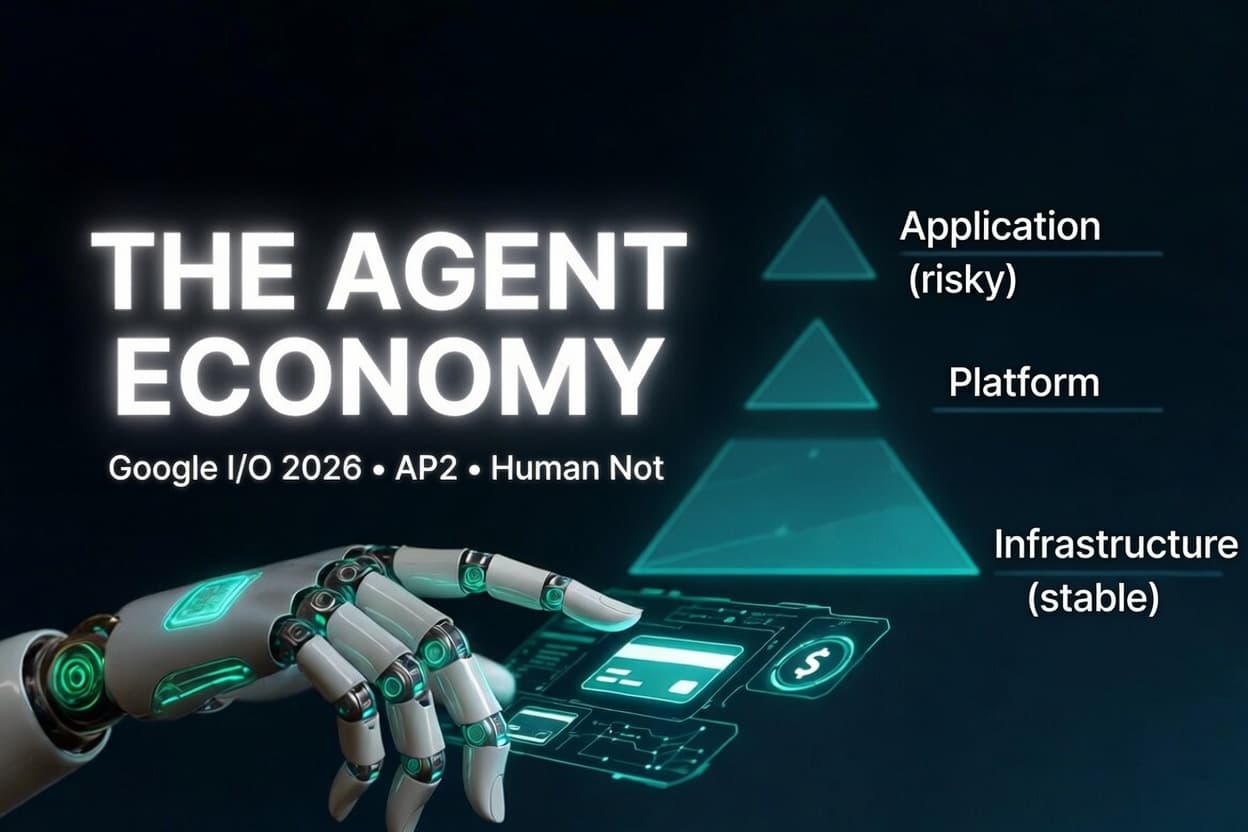
The Agent Economy Opened by AP2 and UCP Standards: Where Will the Next Bull Market Begin?
Agent economy
AI investment
Korean platform
Stock market recovery
Token economy
2026.05.20
Whenever the stock market regained its direction, the sequence was always the same. An event establishing a new economic grammar came first, followed by earnings built upon that grammar, and those earnings pushed stock prices up. Just as the economy shifted from mouse-clicking to touch, a transition from touch to speech is now upon us. At Google I/O 2026, a detailed blueprint for a world where agents search, compare, and even handle payments was unveiled. If this transition acts as a catalyst, what moves first, and which types of companies face a crisis—these are the very questions investors must be looking at right now.

1Whenever the stock market recovered, it was always in this order
When the stock market regained direction after a tech bubble burst, three conditions coincided: signals of a shift in monetary policy, a recovery in the earnings of major companies, and the emergence of an event that established a new economic grammar. In the previous article, "The AI Bubble and Bear Outlook: Patterns of Technological Revolution Found in the History of Dot-com and Mobile," we confirmed this pattern through the dot-com bubble (-83%) and the mobile bubble (the evaporation of $700 billion). In each instance, a new economic grammar emerged first, and Google and the iPhone appeared on the infrastructure left by the bursting bubble.
Currently, the first two of the three conditions have not yet been met. However, the outline of the third condition was revealed at Google I/O 2026. An economy where agents execute tasks on behalf of humans. This could be the fuel for the next bull market. While it is too early to say for certain, the difference this time is that it has actually started operating on concrete commercial infrastructure.
2Google I/O 2026 — Agents Handle Payment
There were three key announcements at Google I/O 2026: Gemini Spark, Universal Cart, and AP2 (Agent Payment Protocol) . The direction is singular: agents are stepping into the roles where humans previously had to intervene at every stage.
Gemini Spark is a cloud-based AI agent that operates 24/7. It handles schedule management, email composition, and document organization, and integrates with third-party apps such as Uber, OpenTable, and Instacart. It runs even while you sleep. Universal Cart consolidates shopping activities scattered across Search, Gemini, YouTube, and Gmail into a single cart. According to Google, over 1 billion shopping activities occur daily on its services, and based on more than 60 billion product listings, it automatically handles tracking price drops, stock alerts, and parts compatibility checks.
The most notable announcement is AP2 v0.2 . “Human Not Present” payment is a feature that allows an agent to complete a payment without human intervention. For instance, an agent automatically purchases a limited-edition ticket the moment it is released. Users only need to set the brand, price cap, and purchase conditions in advance. All transactions are recorded with an cryptographically signed “Mandate.” Disputes can also be filed if issues arise. Over 60 partners, including PayPal, Mastercard, and American Express, participated, and Google announced that it would donate this protocol to the FIDO Alliance to establish it as a common industry standard rather than a proprietary one. Amazon, Microsoft, and Stripe have already adopted the Universal Commerce Protocol (UCP).
Humans only speak the intention, and agents handle the execution. This is the world Google envisioned at this I/O.

3 From Touch to Voice — Usage Explodes When Bottlenecks Disappear
The paradigm of the digital economy has been reshaped whenever the input method changed. In the PC era, we clicked with a mouse; in the mobile era, we touched with our fingers. In the agent era, we issue commands verbally. However, this time there is a decisive difference from the previous two. Human attention is removed from the bottleneck.
In both the mouse and touch eras, humans had to directly intervene at every step. They had to type into the search bar, read the results, click links, add items to the cart, and press the payment button. The ceiling on usage was limited to what human concentration allowed. Agents change this premise. With just a single word, they autonomously execute dozens of steps. They run even while a person sleeps. The ceiling on usage disappears.
This difference is already evident in the numbers. As confirmed in the previous article, "Claude Pricing Separation — The Investment Map Drawn by the Agent Token Explosion," Anthropic's separation of chat and agent pricing into separate rates is a declaration that agents are an entirely different product from chat. While chat is structured to wait for human input, agents process dozens to hundreds of steps autonomously with a single command. As the bottleneck of human attention disappears, token consumption increases explosively. Goldman Sachs forecasts that global token consumption will reach 24 times its current level by 2030. The basis for this growth is not improved model performance. When bottlenecks are removed, demand always explodes. History has proven this repeatedly.
4Investment Map — Where Usage Explosions Flow First
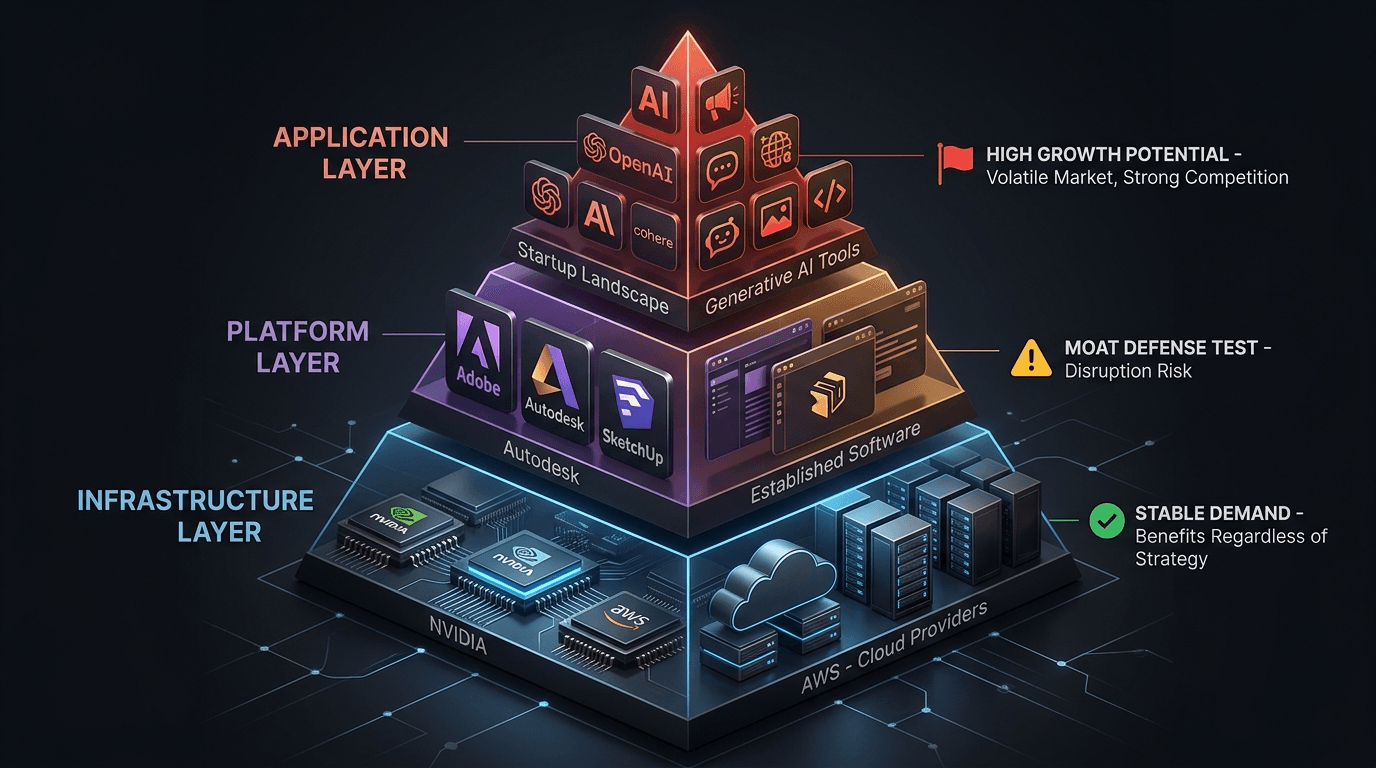
Even in the agent economy, investment benefits flow differently depending on the layer. The first and most certain layer is the infrastructure layer . When agent traffic explodes, the demand for data centers , semiconductors , and power grids to process it structurally increases. Infrastructure is necessary regardless of which agent service survives. This logic remains unshaken in the agent era. The demand for HBM from SK Hynix and Samsung Electronics also structurally grows as the long-text inference tasks processed by agents increase.
Next is the agent platform layer . These are companies that directly operate agents, such as Anthropic , Google, and OpenAI. The structure is such that token revenue increases directly as agent usage grows. While it is more volatile than infrastructure, the faster the adoption of agents, the steeper the slope of growth becomes.
The most uncertain aspect is the application layer . The risks in this layer stem from the same roots as the SW/SaaS risks discussed in the previous article , "The Flow of AI Investment is Shaking." In the agent era, the survival of an application is not determined by whether its functionality is superior. The criterion is how easily agents can access those functions. Services that merely layer AI on top of the UX of the touch era are simply bypassed by agents. On the other hand, services that have redesigned their architecture to provide essential functions within the agent workflow may actually see increased usage.
5 The Choice of Korean Platforms — Advertising or Transactions
The risk for Korean platforms in the agent era is not a technical issue, but a problem of the revenue structure . Ultimately, there is only one question to consider: Does this company's revenue come from the “time people spend looking at the screen,” or from the “transactions themselves”?
Platforms heavily reliant on advertising revenue are the first to be hit. Agents do not view ads. In the touch era, users scanned search result pages to display ads, but agents now only collect the results. As screen viewing time decreases, ad impressions decline, and ad rates fluctuate. This is why Naver's search advertising model faces the most direct structural pressure.
A transaction fee-based revenue structure can operate differently. If agents facilitate transactions through platforms like Coupang or Toss, the number of transactions could actually increase. As the bottleneck of human attention disappears, the frequency of transactions itself rises. There is only one condition: the agent must be able to execute transactions on that platform. Platforms that have adopted standards like UCP and AP2 stand in the position of suppliers in the agent economy. For platforms that do not, agents bypass them from the start.
Language barriers are no longer a line of defense. Agents from Google, Anthropic, and OpenAI already handle the Korean language perfectly. If the moat for Korean platforms was the Korean language and local UX, that moat is rapidly narrowing. In the era of agents, the competitiveness of Korean platforms ultimately boils down to this question: Do they possess the data and transaction infrastructure that global agents want to use?
6Frequently Asked Questions
| question | answer |
|---|---|
| How long does it take for an agent to become a catalyst for a stock market recovery? | The diffusion speed of payment and commerce standards such as AP2 and UCP serves as the benchmark. Amazon, Microsoft, and Stripe have already joined, and the pace of standardization is rapid. There is typically a time lag of two to four quarters between the completion of a standard and the actual agent transaction volume being reflected in corporate earnings. The speed of standard diffusion and the disclosure of agent transaction volumes by major platforms serve as inflection point signals. |
| Infrastructure layer stocks have already risen a lot; is it okay to invest now? | The demand for infrastructure driven by the explosion in agent traffic is still in its early stages. If Goldman Sachs’ forecast of 24x token growth materializes, the current price may appear cheap. However, since the possibility of a short-term correction always exists, a dollar-cost averaging approach is appropriate. Rather than betting all at once, a strategy of gradually increasing position weight while monitoring agent adoption metrics is effective. |
| Should I sell Naver and Kakao now? | You must first examine the revenue structure. Business segments with a high proportion of advertising revenue and no preparation for agent integration should be considered for a gradual reduction. Conversely, segments with significant transaction fee-based revenue or those preparing to open agent-friendly APIs should be viewed separately. The first step is to break down the revenue structure, rather than the company as a whole. |
| Is Google the only one preparing for the agent economy? | No. Anthropic has already separated chat and agent pricing into distinct fee structures, and OpenAI has announced integration with financial institution accounts. The transition to an agent economy is not a strategy of specific companies, but the direction of the entire industry. Google I/O 2026 was the event that demonstrated this direction most concretely and commercially. |
| Is it safe from a security standpoint if an agent makes the payment on my behalf? | AP2 operates only within the brands, price caps, and conditions pre-set by the user. All transactions are recorded with an encrypted "Mandate," which allows for disputes. It is closer to automated execution within the scope of prior consent than to completely autonomous payment. While it will take time to build complete trust, the structure itself is designed in a manner similar to existing credit card automatic payments. |
Conclusion — What to Buy Where Touch Disappears
Whenever the stock market takes a direction, a new economic grammar has always emerged first. This was the case when the transition from the mouse to touch was made, and the iPhone followed. Google I/O 2026 demonstrated that this transition has already begun to run on actual commercial infrastructure. A standard in which agents handle payments is spreading across the entire industry with over 60 partners.
If this transition becomes the fuel for the next bull market, companies capable of absorbing the explosion in usage will move first. Infrastructure is the most reliable, followed by agent platforms. On the other hand, revenue structures that require human screen presence to function face headwinds in this transition.
When looking at a portfolio right now, you need to add one more criterion: whether the company's earnings depend on human attention or are derived from the transactions themselves. When viewed through that lens, even among the same "AI-related stocks," their directions diverge completely.
All figures and analyses in this article are for informational purposes only and do not constitute investment advice. The content presented at Google I/O 2026 is based on official announcements, and release schedules and specific features are subject to change. The pace of the transition to an agent economy may differ from predictions, and you bear full responsibility for your own investment decisions regarding the companies and stocks mentioned. Consulting with a professional financial advisor before making any significant decisions is recommended.
📌 Was this analysis helpful?
In the next post, we plan to cover “Korean Stocks Surviving in a World Where Agents Make Payments — AP2·UCP Ecosystem Beneficiary Map.”
We continuously track the economic transition shifting from touch to voice and investment opportunities. Receive notifications so you don't miss out.
How this content was produced
Aleph's research AI agent assisted with collecting and analyzing public data, creating charts and visuals, and structuring the draft. Davar personally reviewed and edited the sources, figures, reasoning, and final conclusions.
This content is for informational purposes only and is not personalized investment advice or an individual stock recommendation. Read the full disclaimer

Davar
Davar builds and operates Aleph's research AI agent and writes and reviews analysis on macroeconomic developments and AI industry trends.
© Aleph. All rights reserved.