
In Q1 2026, three signals erupted simultaneously in the AI industry: OpenAI’s $122 billion funding, 80% of total VC investment concentrating on AI, and a surge in direct investments by family offices bypassing VCs. Many analysts interpret these signals as evidence of the "entry into maturity" of AI investment. I disagree. These signals are much closer to the typical patterns of the late stages of overheating than to maturity. I do not doubt the success of AI itself. However, whether current prices already sufficiently reflect that success is an entirely different question.
1 The real name of these signals is not “maturity”
Let's re-examine the three signals. Record-breaking funding, the exodus of family offices, and the emergence of massive leverage—history already tells us what these signal. These three are all classic patterns of the late stages of overheating .
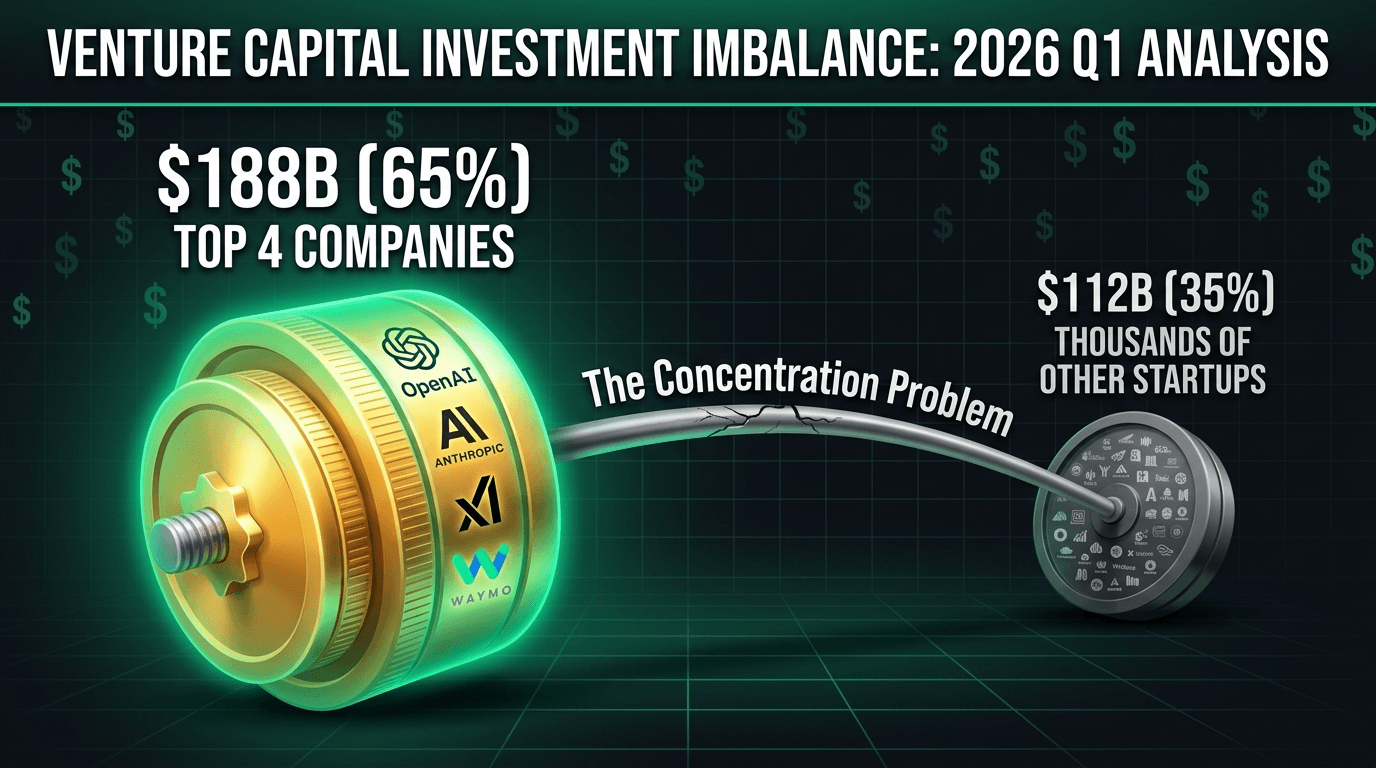
Looking closely at the numbers makes the structure clearer. In Q1 2026, global startup investment hit an all-time high of $300 billion, yet the number of deals actually decreased. More money is flowing into fewer places. Four companies—OpenAI, Anthropic, xAI, and Waymo—acquired 65% of the total, and the number of deals outside the U.S. also declined. This does not represent healthy growth for the entire market, but rather a barbell structure where capital is concentrated in a few firms while the rest wither away.
Mitch Stein of Arena Private Wealth stated in an interview with TechCrunch, “The biggest risk is not being exposed to AI.” This statement itself is a sign of overheating, as it implies that FOMO has begun to replace investment logic. The idea that “not buying is riskier” was the dominant logic even at the peak of the dot-com bubble.
Compare it to 2.com, but this time, read it as a warning.
Comparisons with the dot-com bubble are common. However, most analyses lead to the conclusion that "this time is different." I believe that line of reasoning is dangerous. The idea that "this time is different" was the dominant logic even at the peak of the dot-com bubble. We should make comparisons, but reverse the conclusion.
| signal | Dot-com Bubble (1999–2000) | AI Investment (2026~) | judgment |
|---|---|---|---|
| Concentration of funds | AOL-Time Warner $164B Merger | OpenAI $122B — Largest Private Round in History | ⚠️ Same pattern |
| Broker exit | Individuals trade stocks directly with E*TRADE | Family offices bypass VCs and invest directly | ⚠️ Same pattern |
| Leverage appears | Surge in margin accounts | SoftBank Pushes for $40B Bridge Loan + $10B Margin Loan | ⚠️ Same pattern |
| Revenue Model | Clicks, Pageviews — Insignificant Real Revenue | OpenAI $2B monthly actual revenue, Anthropic $19B+ ARR | ✅ Clear difference |
| Infrastructure reality | Most dot-com companies have no assets | NVIDIA · TSMC · Data Centers — Existence of physical assets | ✅ Clear difference |
The actual revenue and infrastructure reality are clearly different from that of dot-coms. However, whether this is a sufficient reason to prevent a bubble is a separate issue. The success of AI itself is a completely different question from whether the current price is appropriate. The Internet changed the world even after the dot-com bubble. However, it took investors who bought at the peak in 2000 15 years to realize profits from that success.
There is one more fact to point out. Of Amazon's $50 billion investment, $35 billion is conditional on OpenAI's IPO or the achievement of AGI. This means that a significant portion of the headline "$122 billion, the largest funding in history" is based on conditional commitments. It is important to examine the substance of the numbers.

3If so, what is the time now?
I am not saying that you should not invest in AI. I am suggesting that we define this current phase with a cool head. We are currently in a phase where excitement overwhelms information . It is a time when FOMO replaces investment logic, leverage is justified, and the saying "being unexposed is more dangerous" spreads like common sense. In such a phase, what individual investors should do is not make aggressive entries, but rather review their positions and reset their standards .
The reason why a market in an overheated phase is disadvantageous for individual investors is simple. When a correction occurs, leveraged institutions liquidate first, and that selling pressure inflicts losses on individuals holding positions without leverage as well. In an overheated phase, positions entered with excessive weight are more dangerous than poorly placed positions.
4 Behavioral Guidelines for Individual Investors — Check Before Attack
The priority right now is inspection, not entry. We will organize it into three steps.
Step 1: First, check the current AI exposure ratio.
Calculate the weight of NVIDIA , TSMC , SK Hynix , Amazon, Alphabet, and AI-related ETFs relative to your total portfolio. If it exceeds 30%, you must stop making additional purchases immediately. The risk in an overheated market is not "not investing in AI," but "entering further when you are already sufficiently exposed." If the weight is 50% or higher, you should consider a gradual reduction. (This may vary depending on individual investment goals and timelines, and this is not an investment recommendation.)
Step 2: New entries should be on the infrastructure layer, using staggered buying.
If you do not yet hold an AI position, I do not discourage you from entering. However, the approach is crucial. The basic principle during an overheated market is to focus on infrastructure stocks (such as NVIDIA, TSMC, and SK Hynix) and to make staggered purchases in 3 to 4 installments rather than entering all at once . For the OpenAI IPO, I recommend checking the Price-to-Sales Ratio (PSR) first once the offering price is finalized before making a decision. If the offering price exceeds an enterprise value of $1 trillion, the attractiveness of entry decreases significantly.
Step 3: Liquidate leverage immediately
If you are holding AI positions through margin buying or leveraged ETFs, now is the time to close them. SoftBank’s $40 billion bridge loan is an institutional-only strategy undertaken despite the risk of an S&P credit outlook downgrade. SoftBank’s cumulative investment in OpenAI amounts to $64.6 billion, representing approximately 30% of the company’s assets. It is institutions that receive signals of risk even with such concentration. For individuals, holding AI stocks with leverage is creating a situation where they have no options when a correction occurs.
5When to Change Perspective — Monitoring Criteria
Just because you are wary of overheating signals does not mean you have to be defensive forever. You may change your perspective if the criteria below are met.
| characteristic | Warning signal (current) | Signal of improved entry attractiveness |
|---|---|---|
| OpenAI IPO Offering Price | Target of over $1 trillion — Potential to start at over 40x PSR | When the public offering PSR is set at 20 to 30 times or lower |
| SoftBank leverage | Pursuing a $40B bridge loan + $10B margin loan | When repayment is completed within maturity and no additional borrowing is required |
| Whether leverage spreads | Additional similar cases besides SoftBank are emerging. | When there is no large-scale leverage news for more than 3 months |
| OpenAI Profitability | $2B Monthly Revenue, Still in the Red — Targeting Profitability by 2029 | When confirming a turnaround to quarterly profit |
| AI Position Concentration | 80% of all VCs are focused on AI — the highest concentration ever. | When the proportion of AI starts to diversify below 50% |
6Frequently Asked Questions
| question | answer |
|---|---|
| If AI is a bubble, should I sell now? | I am not concluding that this is a bubble. I am advising you to review your position weighting because there are signs of overheating. If your AI position is 30% or less and you have no leverage, there is no reason to sell right now. However, if your weighting is excessive or you have leverage, a correction is necessary. |
| Why is it overheated when OpenAI has actual revenue? | The actual revenue is factual. However, enterprise value ($852B) ÷ 2025 annual revenue ($13.1B) equals a PSR of approximately 65 times. Whether this price is appropriate depends on future growth rates. Since OpenAI anticipates losses until 2029, the current price reflects a future that has not yet materialized significantly ahead of schedule. |
| Isn't it a positive sign that a family office is investing directly? | AI investment by family offices itself is positive. However, it is a warning sign that the FOMO logic—that “not being exposed is the biggest risk”—has begun to drive investment decisions. During the dot-com era, the prevailing sentiment was that “you will fall behind without internet stocks.” |
| Shouldn't I buy infrastructure stocks like NVIDIA right now? | The infrastructure layer is relatively less risky. Whether the AI boom continues or a correction comes, demand for data centers will remain. However, it is “relatively less risky,” not “safe.” Managing the average cost through staggered buying is an effective strategy during periods of overheating. |
| How should we view domestic semiconductor companies (SK Hynix and Samsung Electronics)? | Both companies are in a favorable position as key providers of the AI infrastructure layer. However, if the global AI investment cycle undergoes a correction, demand forecasts may also be adjusted. While the supplier-dominant position remains valid, cyclical risks must be considered. (This is not an investment recommendation.) |

Conclusion — The success of AI and the appropriateness of current prices are different questions.
I have no doubt that AI will change the world. Just as the Internet changed the world, so will AI. However, the fact that the Internet changed the world did not protect investors who bought in 2000.
There are clearly signs of overheating in the AI investment market right now. More money is flowing into smaller places, FOMO is beginning to replace investment logic, and leverage is being justified. It is impossible to know at this moment whether these signals are a preview of a bubble collapse or if the market is overheating but heading towards a soft landing. However, the very fact that we do not know is the reason why we should not use leverage right now and why we must review our portfolio weightings.
I am not talking about fear. I am talking about composure. Invest in AI, but first check how exposed you are. In times when excitement overwhelms information, looking directly at the numbers is the best defense.
All content in this article is for informational purposes only and does not constitute investment advice. Judgments regarding “overheating signals” are the author’s analytical opinions and are not definitive predictions. The AI position weighting standard (30%) is a general reference value and may vary depending on an individual’s investment objectives, timeframe, and risk tolerance. The OpenAI PSR is an estimate based on Enterprise Value ($852B) ÷ 2025 Annual Revenue ($13.1B). All investment decisions and responsibilities rest with the individual, and consulting with a professional financial advisor before making any significant decisions is recommended.
📌 Was this analysis helpful?
In the next post, we will cover “OpenAI IPO Public Offering Subscription Guide — How to Determine Entry Based on Offering Price PSR.”
I continue to share perspectives on reading AI investments based on numbers, not excitement. Subscribe to notifications so you don't miss out.
How this content was produced
Aleph's research AI agent assisted with collecting and analyzing public data, creating charts and visuals, and structuring the draft. Davar personally reviewed and edited the sources, figures, reasoning, and final conclusions.
This content is for informational purposes only and is not personalized investment advice or an individual stock recommendation. Read the full disclaimer

Davar
Davar builds and operates Aleph's research AI agent and writes and reviews analysis on macroeconomic developments and AI industry trends.
© Aleph. All rights reserved.