
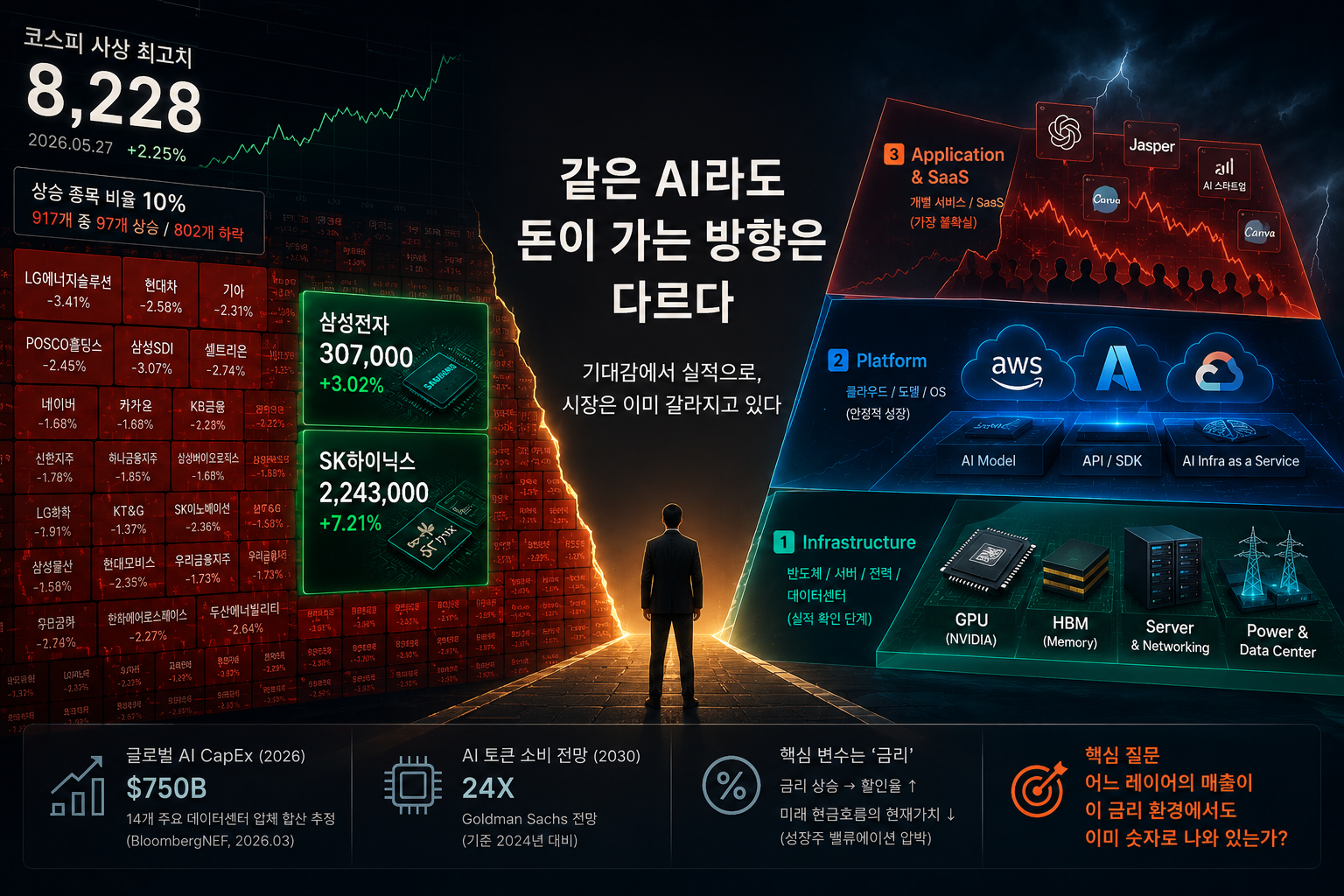
Stocks that rise due to expectations are different from stocks that rise due to cash flow.
Infrastructure layer
AI bubble
KOSPI
AI semiconductors
Portfolio
2026.05.27
The KOSPI stands at 8,228, an all-time high. However, if you open the stock screen, most of them are in the red. “I bought AI-related stocks, so why isn’t my account rising?” If you have had this thought even once today, the critical perspective of this article will not feel unfamiliar.
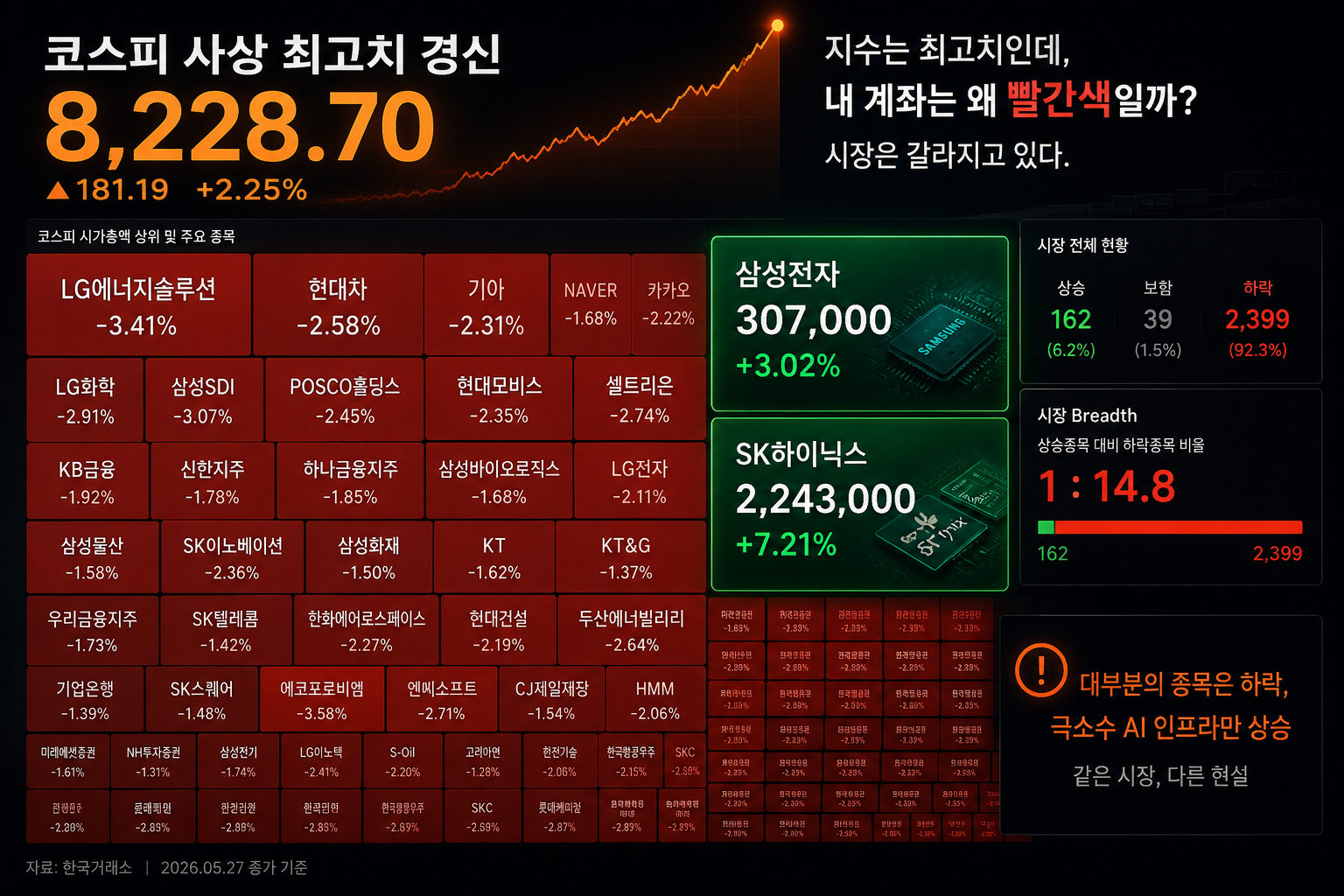
My number is 18228, but why is my account number red?
Today, only 10% of the stocks on the KOSPI rose. 802 out of 917 stocks declined. Most of the index's gains were concentrated in Samsung Electronics and SK Hynix. SK Hynix surged 9.31% during the trading session, reaching a market capitalization of approximately $1.12 trillion, while Samsung Electronics surpassed 300,000 won for the first time. The KOSDAQ fell 3.36%.
I also initially interpreted today's surge in semiconductors as an event related to the listing of a single-stock leveraged ETF . However, my perspective changed after reviewing the breadth data. Even if the ETF listing served as the catalyst, the very fact that the market has turned that ETF into a semiconductor stock is an important signal. The shift toward just two stocks while selling off 90% of other stocks demonstrates where the market places its confidence.
The 2 market now distinguishes AI.
A similar sequence emerges whenever the AI investment cycle repeats. Initially, the word "AI" itself moves stock prices. The market reacts whenever any company mentions AI. However, that phase ends faster than expected. Eventually, the market begins to bury something.
Is cash actually coming in?
The current narrowing of the KOSPI breadth is closely related to the result of that question. The market has now begun to distinguish areas where actual cash flow is generated, rather than focusing on the term "AI" itself. There are many AI-related stocks among the 80% of stocks that fell today. Stocks that had their narratives driven more by their revenue are being filtered out.
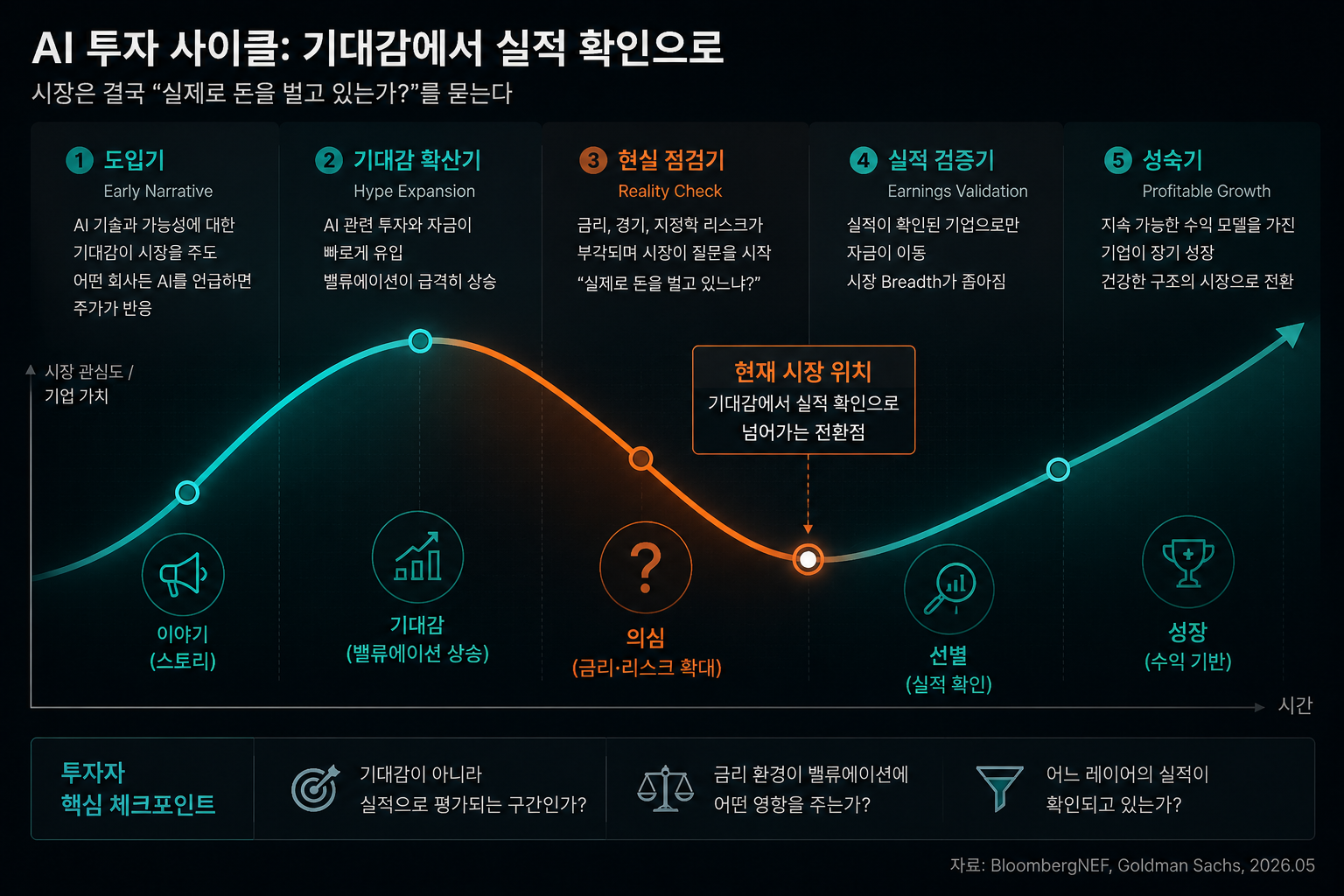
The real cause of the NUM2 AI bubble controversy is not technology.
There is one interesting point whenever the AI bubble debate periodically bursts: the controversy does not erupt when AI models suddenly become bad.
The pattern is clear. Whenever a war breaks out, oil prices rise, or inflation concerns intensify, the same question arises: “Is AI valuation appropriate at current prices?” Conversely, when signals of interest rate stability appear, talk of an AI supercycle resurfaces. The AI technology itself has not changed, yet the temperature of the debate shifts drastically.
The reason is simple. Growth stocks, which have a large proportion of future earnings, face greater valuation pressure as interest rates rise because the discount rate increases. The valuation of AI companies is a calculation of the present value of future growth, and the structure is such that this calculated value decreases as interest rates rise. This is why it appears as though only the price is fluctuating while the AI technology remains the same.
Therefore, when the debate over the AI bubble arises, simply asking "Is AI real or not?" is not sufficient. There is a more important question in the current market: which layer's revenue is already being verified by numbers even in this interest rate environment?
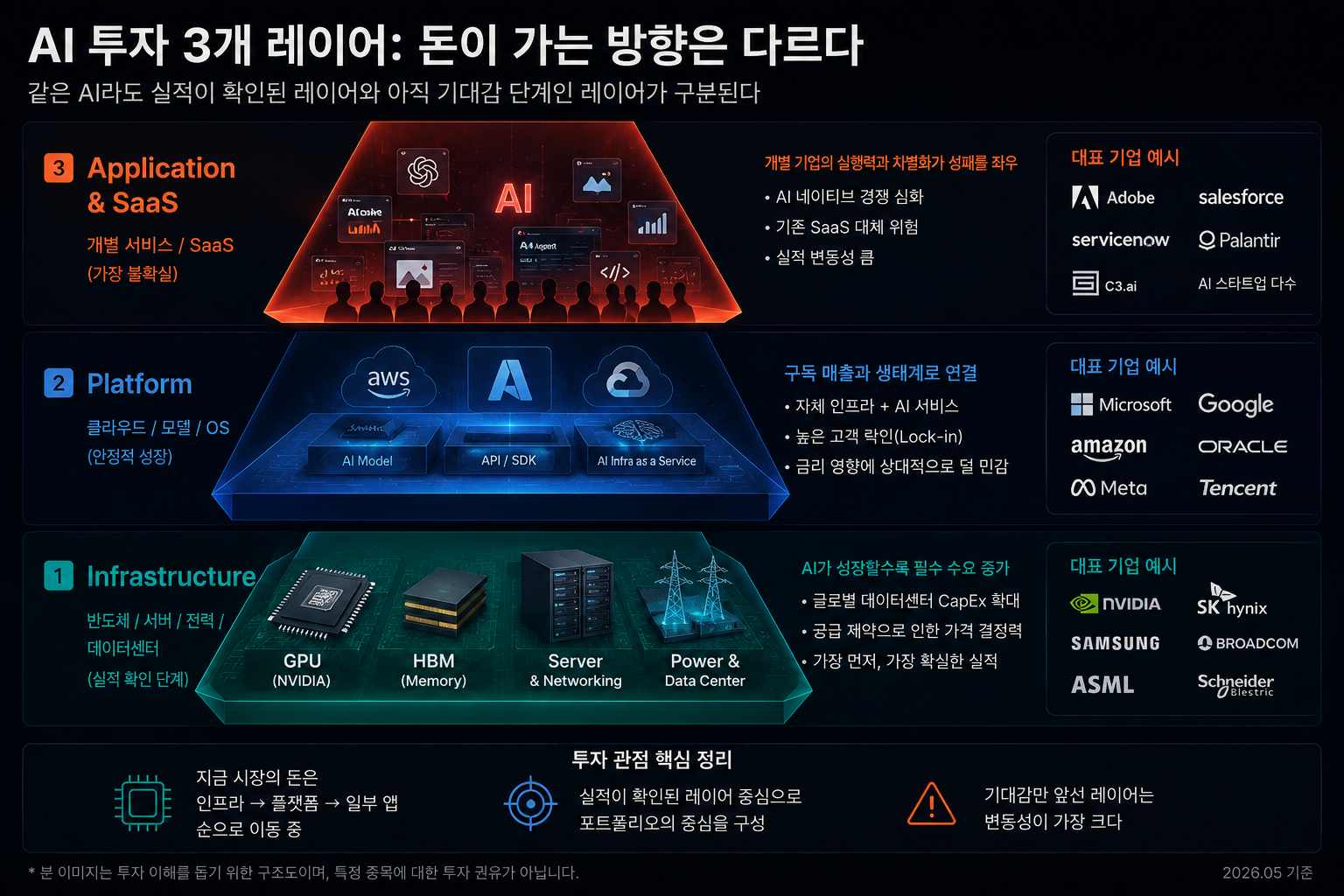
4 The important thing is “which layer’s performance has been verified”
If you break down AI investments into layers, the structure becomes visible. It separates into sections where cash flow has already been generated and sections where only valuation is currently ahead.
Infrastructure Layer — AI Semiconductors and Data Centers: Demand Has Been Proven First
The infrastructure layer was the first and most clearly to demonstrate demand. By 2026, the combined CapEx of 14 major global data center vendors is projected to reach approximately $750 billion. This infrastructure will continue to be necessary regardless of which AI service survives. No matter which agent platform takes the market, GPUs must run, and HBM memory is required.
Goldman Sachs forecasts that global token consumption will reach 24 times its current level by 2030. The answer to where the semiconductors and memory needed to process those tokens will come from is already somewhat clear. The fact that SK Hynix's market capitalization reached $1.12 trillion today can be seen as a process in which that structural demand is being manifested in numbers.
Platform layer — stable, but the upside has narrowed.
Microsoft, Alphabet, and Amazon operate with a structure where they own their own infrastructure and link AI services to subscription revenue. They possess the ability to absorb interest rate shocks and exhibit lower volatility than infrastructure. However, stock prices have already risen significantly, and the consensus upside has narrowed to the +10–35% range. They are closer to serving as portfolio stability rather than aggressive returns.
Application·SaaS — There are some places where the narrative has outpaced revenue.
While Meta has succeeded in directly connecting AI advertising revenue, there is significant uncertainty in areas where it competes against AI-native rivals, such as the creative tool market. Streams generating actual revenue and those that are only ahead in terms of story are mixed within the same layer. Therefore, individual stock evaluation is required in this segment.
The table below summarizes stocks for each layer where both current revenue and expectations have been confirmed. The 12-month expected return is based on the average consensus of major investment advisory firms and is as of May 27, 2026.
| Layer | enterprise | Demand basis | 12-month expected rate of return | Risk |
|---|---|---|---|---|
| Infrastructure | NVIDIA | AI GPU + Data Center, Key Beneficiary of $750B CapEx | +25~45% | middle |
| Infrastructure | SK Hynix | HBM Supply Oligopoly, Market Cap Reaches $1.12 Trillion | +10~25% * | Medium to high |
| Infrastructure | Samsung Electronics | HBM + Foundry, Memory Supply Tight Until 2027 | +10~20% | middle |
| Infrastructure | Broadcom | Custom AI ASIC + Networking Infrastructure | +15~35% | middle |
| Platform | Microsoft | Expanding Azure AI + Copilot subscription revenue | +20~35% | slander |
| Platform | Alphabet | Google Cloud + Gemini AI Service | +10~15% | slander |
| Platform | Amazon | AWS Bedrock + AI Infrastructure Services | +18~30% | slander |
| App·SaaS | Meta | Llama Model + AI Direct Connection to Ad Revenue | +20~40% | height |
| App·SaaS | Adobe | Firefly AI — Caution: Intensifying Competition Among AI Natives | +10~25% | height |
SK Hynix's current price (2,243,000 won) has already exceeded the average of the existing consensus. The expected rate of return is based on the latest target prices, including KB Securities (2.8 million won).
5Frequently Asked Questions
| question | answer |
|---|---|
| Should I join SK Hynix now? | It is true that it has risen significantly. The current price has already surpassed the existing consensus average, and the market cap has exceeded $1 trillion. However, if Goldman Sachs’ forecast of a 24x increase in token consumption materializes, the current price could appear cheap. Rather than betting all at once, it is more realistic to gradually increase your position while monitoring AI agent adoption metrics. |
| Will Nvidia crash if the AI bubble bursts? | In the short term, they may fluctuate together. However, even during the dot-com bubble , telecommunications infrastructure eventually became the foundation of the internet era. Regardless of how AI services are restructured, it is highly likely that demand for semiconductors will remain. If the bubble bursts, the pace of growth will slow down, but it is difficult to view the direction itself as changing. |
| Which should I buy, SK Hynix or Samsung Electronics? | While SK Hynix leads in HBM market share and profitability, its price has already risen significantly, resulting in high short-term volatility. Although Samsung Electronics entered the HBM market relatively late, its structure encompassing foundry operations allows it to benefit from a broader scope. Rather than choosing one over the other, a more realistic approach is to diversify your portfolio. |
| Can Naver and Kakao be considered beneficiaries of AI? | You must first examine the revenue structure. A structure heavily reliant on advertising revenue may face structural pressure in the era of agents, as agents do not view ads. On the other hand, sectors based on transaction fees or those preparing APIs for AI agent integration can be viewed differently. You need to break down the revenue structure rather than looking at the company as a whole. |
Conclusion — Even with the same AI, the direction is different.
What the market showed today was clear. On the day the KOSPI hit an all-time high, 90% of stocks fell. There are few scenes that show where the market places its confidence more directly than this.
Of course, there is no guarantee that this trend will hold true in the end. If interest rates fall sharply, the phase where only the narrative was ahead could resurface. The outlook for AI infrastructure demand could also change. Uncertainty remains high.
However, when looking at portfolios right now, it is necessary to add one more criterion: has the stock already generated cash flow, or is its story still moving forward? When viewed through that lens, even among "AI-related stocks," their directions diverge completely.
All figures and analyses in this article are for informational purposes only and do not constitute investment advice. The 12-month expected return is based on the average consensus of major investment advisory firms and may differ from actual returns. The expected return for SK Hynix was calculated based on the latest target prices from brokerage firms, assuming the current price has already exceeded the existing consensus. You bear full responsibility for your investment decisions regarding the mentioned stocks. Consulting with a professional financial advisor before making any significant decisions is recommended.
📌 Was this analysis helpful?
In the next post, we plan to cover “In-depth Analysis of AI Infrastructure Layer Stocks — Which One Should You Look At First.”
I will continue to track layers with confirmed cash flows separately from layers that are still in the story stage.
How this content was produced
Aleph's research AI agent assisted with collecting and analyzing public data, creating charts and visuals, and structuring the draft. Davar personally reviewed and edited the sources, figures, reasoning, and final conclusions.
This content is for informational purposes only and is not personalized investment advice or an individual stock recommendation. Read the full disclaimer

Davar
Davar builds and operates Aleph's research AI agent and writes and reviews analysis on macroeconomic developments and AI industry trends.

© Aleph. All rights reserved.