
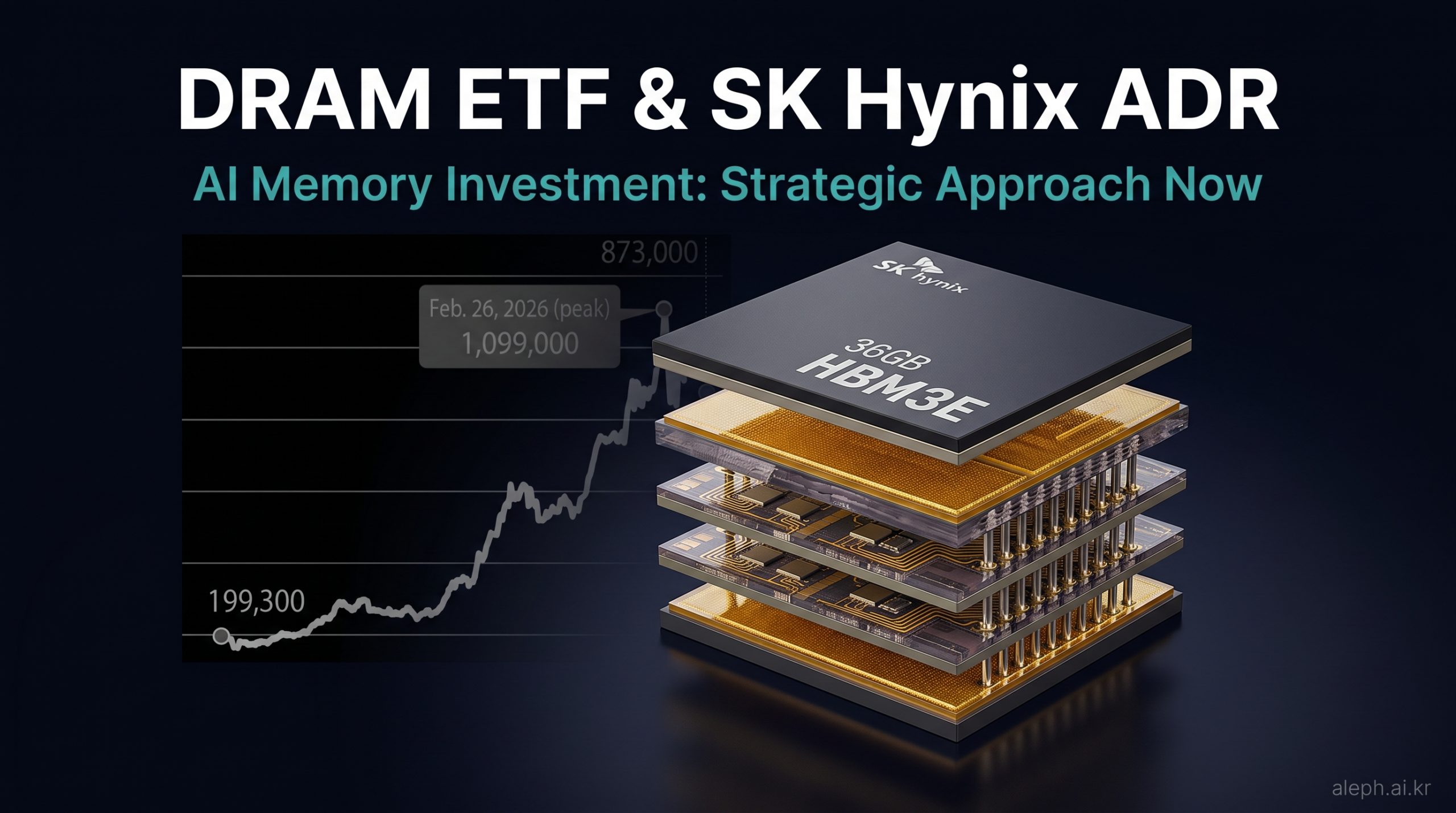
To start with the conclusion: investing in AI memory is the right direction. With HBM selling out, server DRAM growing by 50–60% quarterly, and the HBM market projected to grow by 58% by 2026, the numbers point in the right direction. However, you must carefully examine your portfolio when approaching this sector. If AI and semiconductors account for more than 30% of your portfolio, diversify it. If you are already using leverage, adding more only exponentially increases the risk. If you are trying to jump on the bandwagon of ADR listing events, you are joining the herd mentality too late. You might criticize me for stating old-fashioned investment principles. However, current market signals tell us to hedge risk using old-fashioned methods. In my previous post, I warned of a barbell structure where institutional funds were concentrated 65% in just four companies; now, that concentration pattern has descended to the level of retail investors. $1 billion poured into the $DRAM ETF in just 10 trading days. The way investors flock to concentrated tools is the real risk in this market right now.
1Focus does not end at the institution
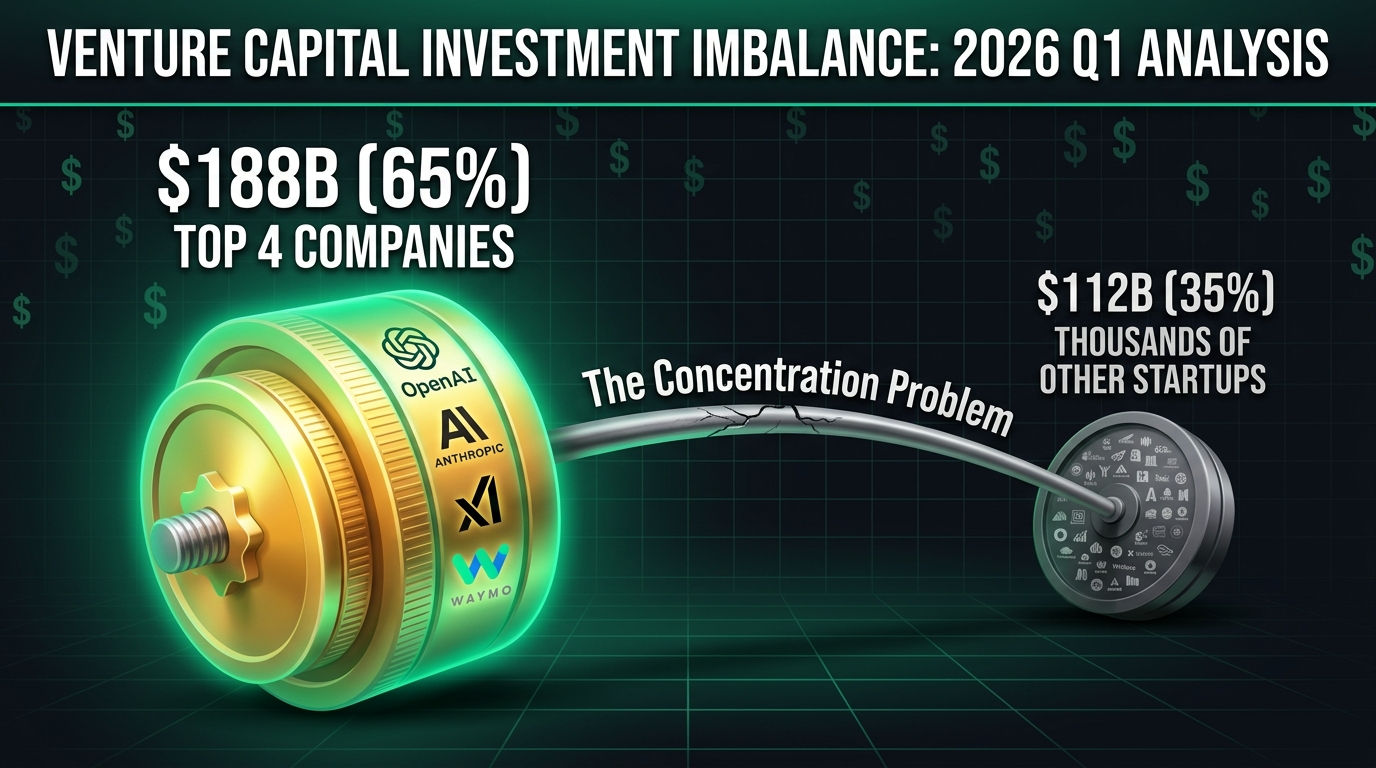
In my previous post ( AI Investment Has Entered Maturity ), I analyzed that capital flows in Q1 2026 would resemble the pattern of the late-stage overheating phase rather than maturity. The key basis for this was the barbell structure. Four companies—OpenAI, Anthropic, xAI, and Waymo—absorbed 65% of the total $300 billion in VC investment, while the number of deals actually decreased by 26%. It is a structure where more money flows into fewer places.
However, this pattern of concentration is not limited to institutional funds. Historically, once the concentration of large capital intensifies, a phase follows where retail investors follow the trend. We are currently at that exact moment. A consensus has formed that AI memory is the mainstream trend, and retail funds seeking to ride that consensus are concentrating in one direction. And a product has emerged that accurately captures this demand: the $DRAM ETF.
The danger of herd mentality lies not simply in the fact that "a lot has flocked to it." There is a mechanism at play. If one enters a market in a herded state, they buy at a high price when expectations have already been reflected in the price. Subsequently, if performance falls even slightly short of expectations, a mass exit occurs. However, since the $DRAM ETF is essentially a bet on three stocks, the exit strategy is narrow when investors decide to exit. If Samsung, SK Hynix, and Micron all face pressure simultaneously, the entire ETF is shaken. The barbell structure of institutional funds and the herd mentality of retail funds in ETFs share the same pattern.
2$DRAM ETF — A product capturing concentrated demand, yet it is not diversification
If you understand why the $DRAM ETF emerged, you can also understand why money is flowing into it. From the perspective of U.S. institutional investors, there was no direct avenue to invest in Samsung Electronics and SK Hynix. As these are stocks listed on the Korean stock exchange, there were high barriers to account opening, currency exchange, and accessibility. $DRAM is the first product to break through these barriers using a total return swap method. April 2026 marks the first time that simultaneous access to two Korean memory companies on a U.S. exchange has become possible, whereas SMH (VanEck Semiconductor ETF) could not cover them.
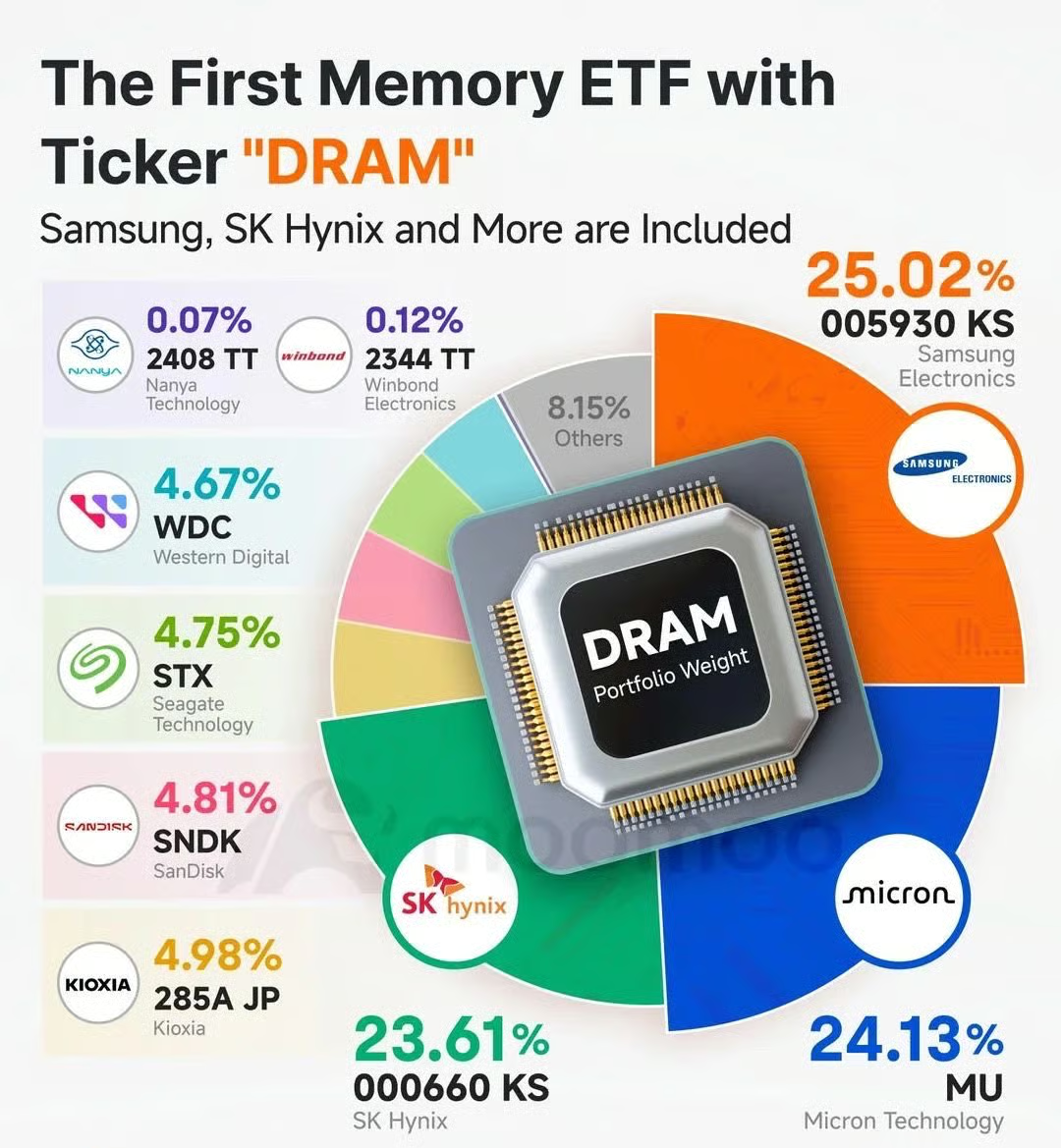
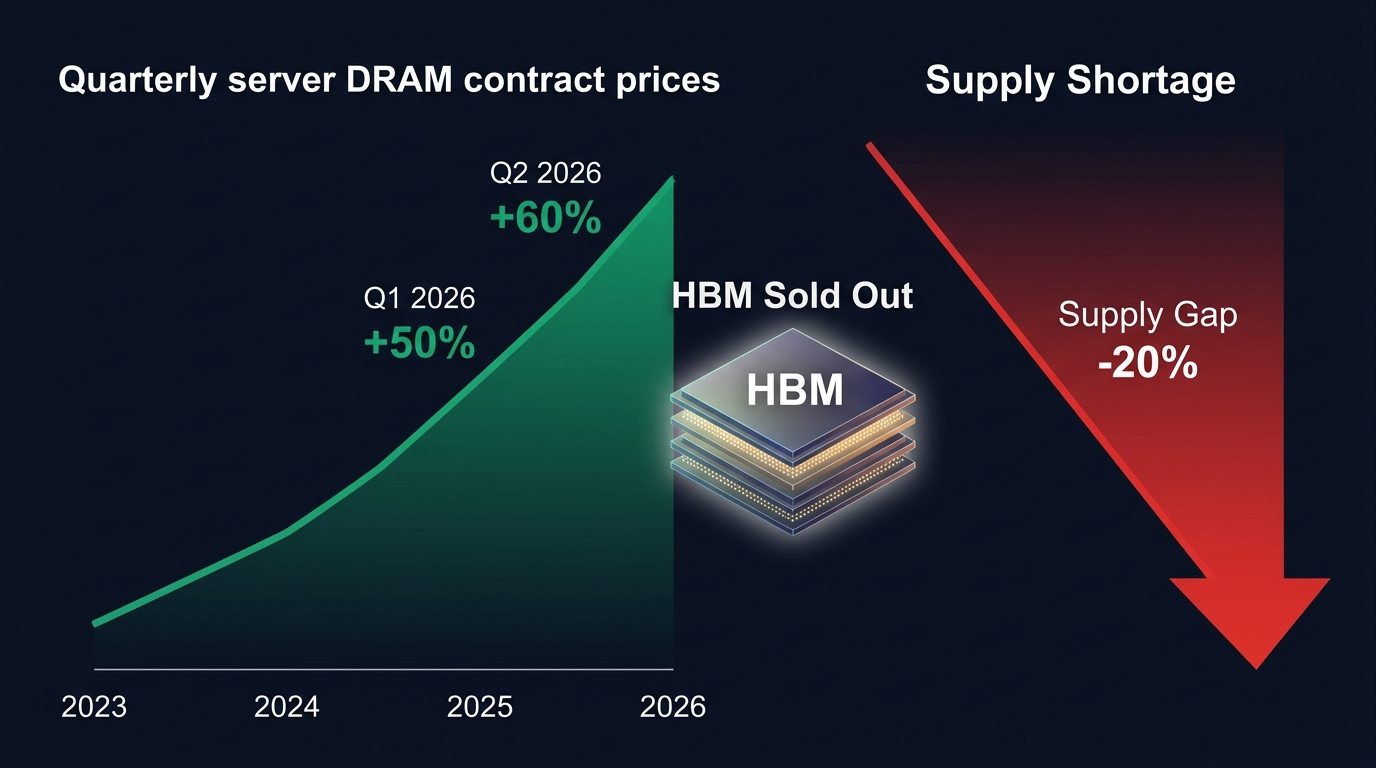
The structural changes are substantial. The HBM market is estimated to reach $54.5 billion by 2026, a 58% year-over-year growth (BofA), and server DRAM contract prices are rising by 50–60% quarterly (TrendForce). The direction that AI memory is the mainstream trend is not wrong in itself. However, there is something easy to misunderstand here: the ETF format makes it feel like diversified investment. At the time of launch, the top three stocks— Samsung Electronics (approx. 25%), SK Hynix (approx. 24%), and Micron (approx. 24%)—accounted for 73% of the total (Roundhill, 2026.04.02). You invested thinking it was diversification, but it is effectively just three stocks. If you already hold products related to NVIDIA, TSMC, or AI semiconductors, adding DRAM is not diversification but rather adding another layer of concentration in the same direction.
3SK Hynix ADR — The Next Phase of Concentration
SK Hynix's plan to list its ADRs in the U.S. is the next step in this skewed structure. It filed a confidential Form F-1 with the SEC on March 24, 2026, aiming for completion in the second half of 2026 (CNBC, March 25, 2026). The market estimates the fundraising size to be between $10 billion and $14 billion . SK Group Chairman Chey Tae-won stated, "Memory supply will fall short of demand by about 20% by 2030" (KED Global, March 23, 2026). The basis for this structural supply shortage is solid.
However, the demand structure generated by the ADR listing follows the same pattern. Inclusion in US indices, institutional capital inflows, and demand for leveraged ETFs—it is highly likely that all these flows will concentrate on a single stock, SK Hynix. The Hong Kong-listed CSOP SK Hynix 2x ETF (ticker: 7709) has already been trading since October 2025, and approximately $1.6 billion flowed in during 2026 alone (Bloomberg, April 1, 2026). The industry anticipates that demand for the 2x single-stock ETF, scheduled for domestic launch in May 2026, will also be concentrated on SK Hynix. It is a chain reaction of concentration that breeds concentration.
| item | The practical effects of ADR listing | Misunderstandings to Watch Out For |
|---|---|---|
| Expanded accessibility | Creation of a direct inflow channel for U.S. institutional funds. Expansion of the structural demand base. | An ADR listing event does not guarantee an immediate stock price rise. Expectations may be priced in advance. |
| Index inclusion | Structural inflow of passive funds upon inclusion in MSCI and S&P Global Indices | Inclusion is subject to a separate review after listing. It is not automatic. You may sell if you are disappointed that inclusion is not granted. |
| leverage demand | Hong Kong CSOP 2x ETF Already Attracts $1.6 Billion. Demand Expected to Expand with Domestic 2x ETF Launch in May. | Leveraged ETFs are products separate from ADRs. They are structured to add leverage to a skewed direction. |
| Price linkage | Domestic stock prices and ADRs are structurally linked | Volatility may increase if short-term premiums/discounts occur. |
Same Sector, Different Position — Samsung vs. SK Hynix
Just because Samsung and SK Hynix are held in similar weightings in $DRAM ETFs, one should not be mistaken into thinking that the two companies are in the same situation. Even within concentrated instruments, the actual structures of benefit differ.
| division | SK Hynix | Samsung Electronics |
|---|---|---|
| HBM Market Status | Global No. 1 (~62% market share), NVIDIA Priority Supplier Partner (Goldman Sachs, early 2026) | HBM3E NVIDIA Approval Process in Progress — Relative Delay |
| Directness of AI benefits | Directly linked to HBM demand. Equipped with NVIDIA H100, H200, and B200. | High proportion of general-purpose DRAM — Indirect benefits from AI |
| Valuation | 12-month forward PER approximately 3.7x (iM Securities) — Relatively undervalued | 12-month forward P/E approximately 6.3x — Relatively overvalued |
| US accessibility | Pursuing ADR listing (targeting second half of 2026). Concentrated demand expected. | OTC trading (SSNLF). Limited accessibility |
SK Hynix leads in the directness of structural benefits. However, it is precisely for this reason that the concentration on SK Hynix is the strongest. The principle confirmed in April 2025, when HSBC downgraded Nvidia from Buy to Hold and the stock price fell by more than 6%, remains valid. If demand for Nvidia GPUs falters, demand for HBM moves in the same direction. The status of being the No. 1 HBM manufacturer cannot prevent a slowdown in demand itself.
5So What Should Be Done — Judgment Criteria and Practical Approach
There are many articles warning against skewed structures. What is needed more is the question, “So, what should I do?” You simply need to diagnose your current situation with three questions and choose an approach that suits it.
Am I in a position to buy the $DRAM ETF right now?
You should consider approaching this only if all three of the following conditions are met: your AI and semiconductor positions account for less than 30% of your total portfolio , you have no existing direct exposure to Samsung, SK Hynix, or Micron, and you are approaching it with cash without leverage (credit or 2x ETFs). If you already hold NVIDIA, TSMC, or SMH, adding $DRAM will only increase concentration in the same direction. If you meet these conditions, you should consider liquidating your existing positions first rather than adding them now.
If you approach, wait for these three triggers, not events.
News regarding ADR listing schedules and ETF launches is merely the surface of the concentration. The real entry triggers lie elsewhere. 1st: NVIDIA GB300 actual shipment data — confirming whether HBM demand remains as planned. 2nd: Whether SK Hynix is included in MSCI or S&P indices following its ADR listing — confirming structural inflows of passive funds. 3rd: HBM4 transition timing — whether SK Hynix maintains its status as a next-generation supplier. The principle is to enter in 3 to 4 installments whenever these three factors confirm the direction.
Avoid leverage unconditionally
Hong Kong CSOP 2x ETF (7709), a 2x single-stock ETF scheduled for domestic launch — the stronger the conviction that the direction is correct, the tighter the leverage becomes. However, if the underlying asset falls 20% and then rebounds 20%, the principal is 96%, but the 2x leverage is 84%. It is a structure where losses accumulate compounded when leverage is added at a time when investment is concentrated in already skewed sectors. Leverage does not double profits when the direction is correct; rather, it doubles volatility. In the current market, it is appropriate to exclude leverage from your options.
6Frequently Asked Questions
| question | answer |
|---|---|
| If the AI memory orientation is correct, isn't it okay even if it's skewed? | Direction and herd mentality are different issues. During the dot-com bubble, the direction of the internet was correct, but the herd mentality caused massive losses. Even if the direction was right, those who entered at skewed prices suffered losses. Even now, the direction of the HBM supercycle is correct, but the price and concentration skewed in that direction are the core of the risk. |
| Which is better, the $DRAM ETF or SMH ? | Their objectives are different. SMH diversifies across the entire semiconductor sector, including NVIDIA, TSMC, and Broadcom. $DRAM, on the other hand, is structured to bet heavily on memory. If you already hold an AI semiconductor ETF, adding $DRAM is a choice that increases concentration rather than diversification. You must make this decision within the context of your overall position. |
| Wouldn't it be a good idea to buy SK Hynix ADRs at the time of listing? | The ADR listing event marks the point where herded demand is most concentrated. Entering the market when expectations are already priced in makes you vulnerable to subsequent selling pressure due to disappointment. It is better to approach the market in stages after the listing, confirming actual index inclusion and the inflow of institutional demand, rather than focusing on the event itself. |
| What Korean investors tend to miss when buying $DRAM? | The factors are taxes and exchange rates. A 22% capital gains tax is imposed on annual capital gains exceeding 2.5 million won. Dollar-denominated returns are diluted during periods of a strong won. You should make a choice after comparing the after-tax returns with the SK Hynix 2x single-stock ETF (15.4% tax rate), which is scheduled for domestic launch in May 2026. |
| Then, should I not invest in AI memory right now? | That is not what I meant. The direction is correct. You just need to recognize the structure of the concentration, check the concentration of your portfolio, and approach it with a split strategy, following structural changes rather than specific events. What you should be wary of is not the memory sector, but the method of entering all at once with concentrated tools at concentrated prices. |
Conclusion — The direction is right. Change your approach.
The AI memory supercycle is real. The HBM market is projected to grow 58% by 2026, server DRAM contract prices are rising 50–60% quarterly, and HBM is sold out. This is not to say you should avoid this sector.
The problem lies in the current approach to this sector. The concentration of 65% of institutional funds in just four companies was referred to as a "barbell structure," and retail investors are repeating the same pattern. $1 billion flowed into the $DRAM ETF in just 10 trading days. Conviction that the direction is correct creates this herd mentality, and that herd mentality becomes a risk. Even during the dot-com bubble, the direction of the internet was correct. Those who jumped in all at once at the concentrated price suffered losses.
You just need to check three things right now. First, does your AI and semiconductor position exceed 30%? If so, you should liquidate your existing position before adding to it. Second, are you using leverage? If so, there is no additional leverage in this sector. Third, are you trying to ride an event or follow a structural change? If it is an event, now is not the time. If it is a structural change, you should enter in 3 to 4 installments while monitoring NVIDIA GB300 shipments, index inclusion, and the transition to HBM4.
All content in this article is for informational purposes only and does not constitute investment advice. The figures presented are estimates from various sources and may differ from actual figures. All investments carry the risk of principal loss, and you bear all responsibility for your investment decisions. We recommend consulting with a professional financial advisor before making any important decisions.
📌 Was this analysis helpful?
In the next post, I plan to cover “After SK Hynix ADR Listing — Where to Be When the Concentration Ends.”
We continuously track the concentration structure of AI investments and practical response strategies. Subscribe to notifications so you don't miss out.
How this content was produced
Aleph's research AI agent assisted with collecting and analyzing public data, creating charts and visuals, and structuring the draft. Davar personally reviewed and edited the sources, figures, reasoning, and final conclusions.
This content is for informational purposes only and is not personalized investment advice or an individual stock recommendation. Read the full disclaimer

Davar
Davar builds and operates Aleph's research AI agent and writes and reviews analysis on macroeconomic developments and AI industry trends.
© Aleph. All rights reserved.