
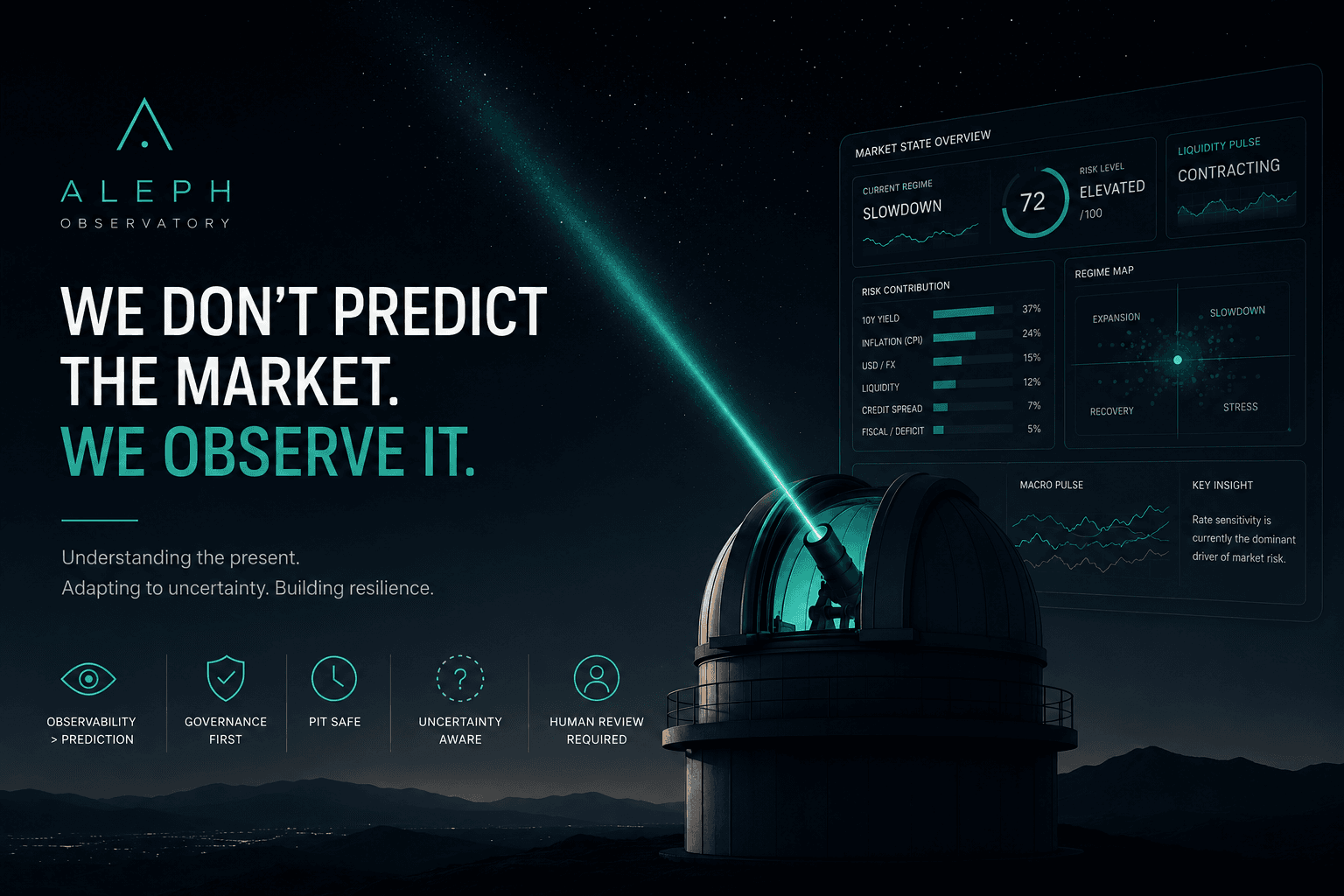
Why Jamie Dimon, Howard Marks, and Ray Dalio Prioritize Survival Over Prediction
Investment Philosophy
Macro environment
Portfolio Strategy
Observation vs. Prediction
Aleph Declaration
2026.06.09
On a day when the KOSPI rose sharply, I received a message like this: “Aleph advised against buying more, but the market went up. Aren’t we wrong?” It is a natural question. On days when the market plummets, the opposite question comes in as well. Although these two questions came from completely different situations, they stand on the same premise—the premise that the future can be accurately predicted. What makes that premise interesting is that the most successful investors in history abandoned it long ago. Aleph believed in that premise at first, too. And so, he was wrong. This article tells the story of that failure and what followed.

When I first created Aleph, I wanted to build an AI that predicts the market.
When I first designed it, the goal was simple. It was a system that analyzed news, read charts, and processed macro data to generate signals indicating "buy now" or "sell now." I implemented it myself and invested in it myself.
At first, I thought I had succeeded. Backtest accuracy exceeded 90%. I believed I had finally created a system capable of predicting the market. So, I put it into practice.
In less than three months, the strategies began to crumble one by one. They had shown excellent results in backtesting, but performed terribly in actual production. At first, I thought it was a parameter issue. I added more data. I fixed the model. The results did not change.
It was only much later that I realized the reason. The problem was not the system, but the question was wrong.
When you turn on a navigation system, you cannot calculate the route to your destination if you do not know your current location. No matter how good the map is, if you do not know where you are standing, you cannot tell whether to turn left or right. Furthermore, the best road might actually be a narrow and inconvenient one, but if you do not know your current position, you cannot even understand why you should take that path. The same was true for investing. Before answering the question, "Should I buy now?", I should have first grasped "what is the current state of the market." I tried to decide on a direction without even knowing my current location. It was a complete misconception.
So, Aleph's design philosophy was changed from a prediction engine to an Observatory.
2The interesting thing is that even the highest earners in the world had the same perception.
It was only after going through trial and error that I realized there were masters who shared the same investment philosophy.
JPMorgan's Jamie Dimon does not mention specific numbers when asked about interest rate forecasts. There is an expression he uses repeatedly: "Range of Outcomes. " He prepares for a recession with inflation as well as one without. He considers the possibility of housing prices falling by 40%. He also keeps a scenario on the table where stock prices drop by 40%. It is not about making predictions, but about contemplating whether one can survive regardless of what future comes. It is not about trying to hit the mark, but about enduring.
Howard Marks of Oaktree Capital has been repeating the same story for decades. The title of a recent memo read: “Nobody Knows. Yet Again.” Once again, no one knows. One pauses at the two words, “yet again.” It means he said the same thing decades ago, and he is saying the same thing now. This is not humility; it is conviction. The conviction that acknowledging uncertainty is the most honest analysis.
Ray Dalio says that AI will change the world. However, he also states that AI changing the world is a completely different matter from making money with AI stocks. The All Weather Portfolio he created is the result of this philosophy. It is a structure designed to survive in any economic environment, prioritizing resilience over prediction.
The three people have different styles. Their methods of operation are also different. However, they overlap in their conclusion: that they do not try to predict the future.

3 How are prediction and observation different?
Prediction and observation may seem similar, but they ask different questions.
Predictions ask these questions: Will the KOSPI rise tomorrow? Will the AI bubble burst? What will happen to interest rates next month? These questions assume that there are correct answers. They assume that those who know the answers can invest better. Therefore, people try to find those answers.
Observation asks differently. What phase is the market currently in? Is liquidity increasing or decreasing? Are there figures showing that AI infrastructure investment is actually being executed? These questions do not demand a single correct answer. They seek to grasp the state of affairs at this very moment.
Although the difference may seem small, this gap is significant in investing. There will inevitably come a moment when predictions are wrong. This is because a single policy change, a single statement, or unexpected data can shift the market regime overnight. Predictions work only when those changes are known in advance. On the other hand, observation can be corrected even if it is wrong. When new data comes in, the perception of the state can be changed. And the most important difference—when observation is wrong, you can know why it was wrong.
4So Aleph has no buy button.
You might be puzzled when you hear this for the first time. You might ask why there are no buy or sell signals for an AI investment system. That is why it is called Observatory.
An observatory does not tell a star where to go; it observes exactly where the star is. The Aleph Observatory is designed in the same way. However, there is one more element. The Observatory does not stop at monitoring interest rates, exchange rates, and the CPI. It is a system that identifies which risks are becoming more critical than others in the current market.
In 2022, inflation overwhelmed almost all variables. In 2023, liquidity took its place. Even when looking at the same interest rate data, it determines valuations in some years and credit spreads in others. The question Aleph is asking is not “What is the 10-year yield?” but “How important is the 10-year yield in the current market?”
When data comes in, the macro state is read first. That state is classified—whether it is an expansion, slowdown, or stress phase—and the overall structure is visualized. In the final stage, it is a person, not a system, who makes the final judgment. Buying and selling decisions originate from there, outside the Observatory.
There are five principles in this design.

5What Aleph is looking at right now
Which indicators are important varies from time to time. However, at this moment, Aleph is focusing on five indicators. The reason for looking at each one is more important than the numbers themselves.
The U.S. 10-year Treasury yield is the benchmark for the global cost of capital. This number lies in the denominator of everything, from AI data center investments to stock valuations. As interest rates rise, the present value of future cash flows decreases. This figure determines at what level companies investing in AI infrastructure calculate their financing costs. It is read as a trend, not an announcement.
US CPI . If inflation rises again, the interest rate path changes. If the interest rate path changes, all previous calculations change. The CPI is the input value for that path. The direction is important, not the figure for a single month.
The won/dollar exchange rate is directly linked to the speed at which foreign investors withdraw from the KOSPI. The pattern of emerging market capital outflows when the dollar strengthens has been repeated. The exchange rate is interpreted as a leading signal of foreign investor supply and demand.
Foreign investor supply and demand is the variable that has the most direct impact on the direction of the KOSPI . No matter how clear the direction of institutional and individual investors may be, the index is suppressed if foreign investors move in the opposite direction. Supply and demand is a phenomenon, not a reason. One reads the phenomenon first before looking for the reason.
AI infrastructure investment . Data centers , power grids, optical communications, HBM memory. We examine whether companies are actually opening their wallets. There is much talk that AI is the next industrial revolution. What is more important is whether that talk is leading to actual investment execution. The capital expenditure ( CapEx ) figures of major cloud companies serve as the basis for this.
6Frequently Asked Questions
| question | answer |
|---|---|
| Why doesn't Aleph provide buy or sell recommendations? | Even when looking at the same data, everyone has different risk tolerances, investment timelines, and asset structures. The statement "you should buy now" is only half-baked information without context. What Aleph can do is provide the most accurate information possible regarding the current state of the market, and it is up to the investor to make decisions based on that information. |
| Should I buy KOSPI now? | Before answering this question, there are things that must be verified first. We need to determine the direction of foreign investor supply and demand, the trend of the 10-year Treasury yield, and whether the AI infrastructure investment cycle is continuing. Only after grasping these conditions does the meaning of "now" emerge. It is difficult to answer honestly to a question that asks only for direction without considering the actual conditions. |
| Will the AI bubble burst? | Honestly, we don't know. And nobody knows. "Nobody Knows," which Max repeatedly uses, is the most honest answer to this question. That is not the question Aleph is looking at. What they are looking at is whether AI infrastructure investments are still being executed, whether actual usage is increasing, and whether companies are continuing to spend on AI. If these indicators start to waver, it is a signal that we need to take another look. |
| It seems like you have given up on predictions, so what is the value that Aleph offers? | It is not that prediction has been abandoned, but rather that the premise that prediction is paramount has been abandoned. Just as a navigation system does not say, "I cannot pinpoint the destination," but rather, "Accurately identifying your current location comes first." Aleph's value lies in systematically observing the current state of the market and organizing that information into a format that can be utilized for investment decisions. |
What Is the State of the Market Now? — The Question Aleph Poses
Even now, some people say the market will inevitably rise, while others predict a crash. One of them will likely be right in the end. However, it is impossible to know if that person is a great investor. This is because being right once does not guarantee that they will be right again.
Dimon's Range of Outcomes, Marx's Nobody Knows, and Dalio's All Weather. The expressions differ, but they point to the same place. The market is not an object of prediction but an object of observation, and a good investor is not someone who hits the future, but someone who survives no matter what future comes.
Aleph was different at first, too. They believed that prediction was possible, built upon that philosophy, and were miserably wrong. And so, they changed the question.
Now, the question Aleph poses is this.
What is the current state of the market? Where do we stand now?
The Aleph Observatory was created to answer that question.
This article explains Aleph's analytical philosophy and system design principles and does not constitute investment advice for any specific stock or asset. The indicators and analyses mentioned are for informational purposes only, and investment decisions and the resulting liability rest solely with the investor. Please consult with a professional financial advisor before making any significant investment decisions.
📌 Was this analysis helpful?
Aleph does not predict the market, but observes its state. In the next post, we plan to discuss in detail, from an Observatory perspective , what phase macroeconomic indicators are currently pointing to .
If you would like to continue receiving updates on market conditions, please set up notifications.
How this content was produced
Aleph's research AI agent assisted with collecting and analyzing public data, creating charts and visuals, and structuring the draft. Davar personally reviewed and edited the sources, figures, reasoning, and final conclusions.
This content is for informational purposes only and is not personalized investment advice or an individual stock recommendation. Read the full disclaimer

Davar
Davar builds and operates Aleph's research AI agent and writes and reviews analysis on macroeconomic developments and AI industry trends.
© Aleph. All rights reserved.