
“Why did the bot reply twice?” “Where on earth did this command come from?” If you have ever used AI automation, there has likely been a moment when you wanted to bang your head against the wall.
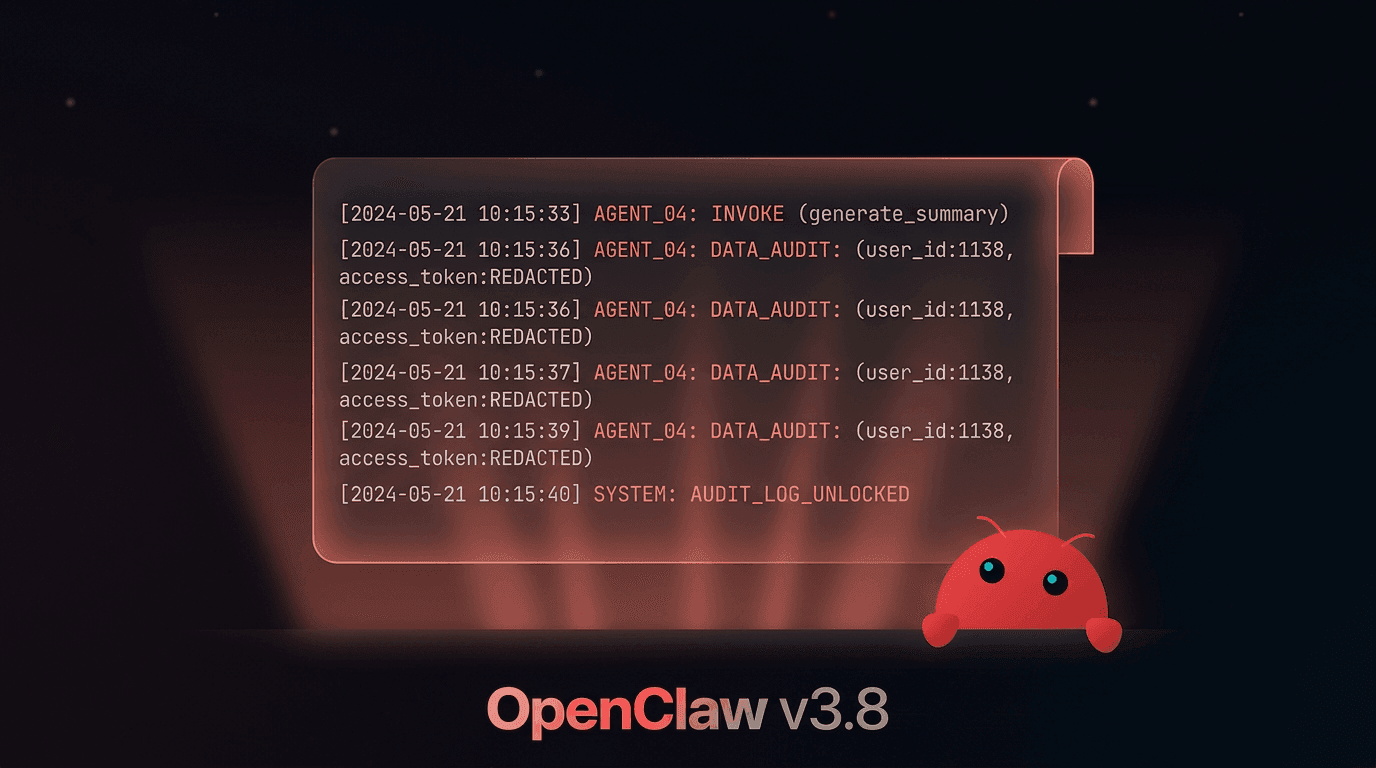
OpenClaw v3.8 completely opens that black box.
From ACP source tracking and automatic backups to enhanced security — this update marks a turning point toward an “infrastructure where you can trust AI automation.”
I will quickly go over the key points right now.
1Key v3.8 Changes at a Glance
For those who are busy, here is the conclusion first. You only need to remember four things about v3.8.
① The source of all commands is recorded , ② the backup is completed with a single line of command , and
③ The duplicate response bug has completely disappeared , and ④ it automatically filters out malicious plugins.
I will explain why this is important, one by one, below.
It is a local-first AI agent platform created by Austrian developer Peter Steinberger.
It acts as a hub that connects chat apps such as WhatsApp, Telegram, Discord, and iMessage with AI models like Claude, GPT, and DeepSeek.
The biggest feature is that my data is not uploaded to an external server, and it is free because it is MIT licensed open source.
2 The Chronic Problem of AI Automation — The Dashcam Issue
AI agents are really convenient. But the real problem is when something goes wrong.
The deployment command was executed twice for unknown reasons, and a command from an unknown source interfered with the workflow,
External services could have injected commands without the user's knowledge.
Simply put, there was no way to explain what the AI did.
Auditing was impossible, debugging relied on 'intuition,' and tracing the cause of security incidents was practically at the level of giving up.
An incident where the server deployment was executed twice because the Telegram bot recognized a single deployment command twice .
“Who on earth triggered this order?” — No one knew.
This was a common sight in the field of AI agent automation prior to v3.8.
3v3.8 Core Update Complete Dissection
Now, let's take a look at how v3.8 solved these problems, one by one.
Although it involves technical details, I will explain it in human language as much as possible.
🔍 3-1. ACP Provenance Tracking — “Issuing a Receipt”
ACP (Agent Communication Protocol) Provenance is the core of this update.
Caller information + unique tracking ID + execution history receipt are automatically attached to all AI agent commands.
Just like a delivery tracking number. Everything—“who sent it, when it was shipped, and where it was processed”—is tracked.
| function | Before v3.8 | After v3.8 |
|---|---|---|
| Verify command source | ❌ Impossible | ✅ Automatic caller log |
| Execution flow tracing | ❌ Relying on guesswork | ✅ Track the entire process with the session tracking ID |
| Audit Log | ❌ Manual configuration required | ✅ Automatic generation of interactive receipts |
| Role-based automation | ❌ Not supported | ✅ Branching for New/Existing/Administrators |
With source verification now possible, different workflows can be automatically executed based on user type.
New users → Automatic onboarding guidance, Existing users → Advanced support flow, Administrators → Access to operations tools.
It is a powerful feature that can be immediately applied to community bots or SaaS customer support automation.
💾 3-2. Automatic Backup Command — “No More Excuses”
I'm sure everyone has had the experience of thinking, "I should back it up..." but not doing it, only to end up losing their settings, right?
Starting with v3.8, you can save and restore the entire system state with a single command line .
If you create a restore point before a major update or setting change, you can revert to it within 5 minutes even if something goes wrong.
openclaw backup create → Create current state backup
openclaw backup verify → Pre-verification of backup recovery feasibility
🔧 3-3. Fixed 4 Stability Bugs — “Finally, We Can Trust It”
Even good features are meaningless if they aren't stable. The bugs fixed this time are exactly that kind of case.
These are things that may seem trivial but were fatal in actual operating environments.
Complete fix for duplicate Telegram responses
The bug where the bot replied twice to a single command or executed a task twice has been completely resolved.
This is the most welcome change for those operating deployment automation or task bots.
The nightmare of accidentally deploying the server twice is gone.
File download stabilization even on slow networks
The issue where downloads would suddenly cut off in the middle of a cafe Wi-Fi connection, overseas server connection, or slow mobile data environment has been fixed.
Now, the file download will be completed from start to finish.
Automatic gateway restart after crash
Fixed an issue where the service did not automatically restart when it crashed due to an unexpected error.
The situation where a bot was dead all night and no one knew about it no longer exists.
Pre-checking setting validation
When incorrect settings are entered, the system detects them before applying them.
It prevents the situation where the entire system freezes after saving settings.
🛡️ 3-4. Enhanced Security for VirusTotal Integration — “Suspect Unknown Plugins First”
One of OpenClaw's strengths is its infinitely expandable 'Skills' plugin system.
As powerful as it was, there was also a risk of malicious plugins interfering.
Starting with v3.8, the VirusTotal API automatically scans for malware before installing external plugins.
Untrusted senders are automatically blocked, and unauthorized execution is completely prevented through the application of a permission layer.
AI agents send emails, handle files, and issue commands to the server.
A single malicious plugin can hijack all these permissions.
VirusTotal integration blocks this attack vector during the installation phase. Even those who found security a hassle are now automatically protected.
4 How to Actually Use It? — 3 Usage Scenarios
Now that I have sufficiently explained the features, I will move on to “how I can actually use it.”
Development Team Deployment Automation
Deployment command via Telegram → Automatically generate audit logs to ACP Provenance showing “who issued the deployment command and when.”
Completely prevents double deployment incidents by fixing duplicate response bugs.
The team leader can check the distribution history the next morning even after leaving work.
Community Management Automation
Large Discord communities utilize role-based automation.
New Subscribers → User Guide, Premium Members → Private Materials, Administrators → Operation Dashboard.
Even if you manage hundreds of people, it becomes possible to operate it as a one-person operation .
Personal AI assistant
Manage emails, schedules, and flight check-ins with WhatsApp.
Thanks to the local-first policy , sensitive personal schedule and email data are not stored on external servers.
This is the perfect alternative for those who found cloud AI services inconvenient.
5 How to get started right now
Installation is much simpler than you might think. There are only two prerequisites — Node.js 22 or higher and an AI provider API key ( OpenAI , Claude , etc.) .
macOS / Linux / WSL:
curl -fsSL https://openclaw.bot/install.sh | bash
Windows (PowerShell):
iwr -useb https://openclaw.ai/install.ps1 | iex
After installation, configure the daemon with openclaw onboard --install-daemon → access http://127.0.0.1:18789/ in your browser and you're done.
Never expose the default port (18789) directly to the public internet.
If external access is required, we strongly recommend using Tailscale or SSH tunneling.
Since the AI agent accesses emails and files, this single setting is the entirety of security.
6 Overall Review — The Beginning of a Reliable AI Infrastructure
OpenClaw v3.8 is not just a simple bug fix release.
This is an update that breaks the stereotype that “AI automation is powerful but unreliable.”
Traceability with ACP Provenance, security with VirusTotal, and recoverability with backups — these three are essential requirements for AI infrastructure to move out of the laboratory and operate in actual production environments.
Reliability has been added on top of existing strengths such as a local-first policy, open-source transparency, and multi-AI support.
If multi-agent orchestration features are added in the future,
It has sufficient potential to grow beyond a personal assistant into an enterprise-grade automation tool .
Official site: openclaw.ai ·
Official documentation: docs.openclaw.ai ·
GitHub: github.com/openclaw/openclaw
📌 Was this article helpful?
Please share your experiences in the comments if you have personally built AI agent automation.
In the next post, we will cover “Setting up your own AI assistant in 5 minutes with OpenClaw.”
How this content was produced
Aleph's research AI agent assisted with collecting and analyzing public data, creating charts and visuals, and structuring the draft. Davar personally reviewed and edited the sources, figures, reasoning, and final conclusions.
This content is for informational purposes only and is not personalized investment advice or an individual stock recommendation. Read the full disclaimer

Davar
Davar builds and operates Aleph's research AI agent and writes and reviews analysis on macroeconomic developments and AI industry trends.


© Aleph. All rights reserved.