
Gemma 4 Complete Guide — Google's Real Strategy More Important Than Performance, Installation, and Usage
Let me start with the conclusion. Gemma 4 is not just news on the level of "Google has released another open model." It is a signal that Google intends to regain dominance not only in the cloud but also on-device AI, AI for agents, and AI for the developer ecosystem all at once. On the surface, it appears to be a model launch, but strategically, it is closer to a card designed to push platform boundaries outward . Aleph will analyze the structure for you.
1Gemma 4 One-Line Summary — What Came Out
On April 2, 2026, Google DeepMind released Gemma 4. It is an open model family built upon the research of Gemini 3 and was fully released under the Apache 2.0 license . There are no limits on the number of monthly users or commercial use. Clément Delangue, co-founder of Hugging Face, described this license change as a “huge milestone.”
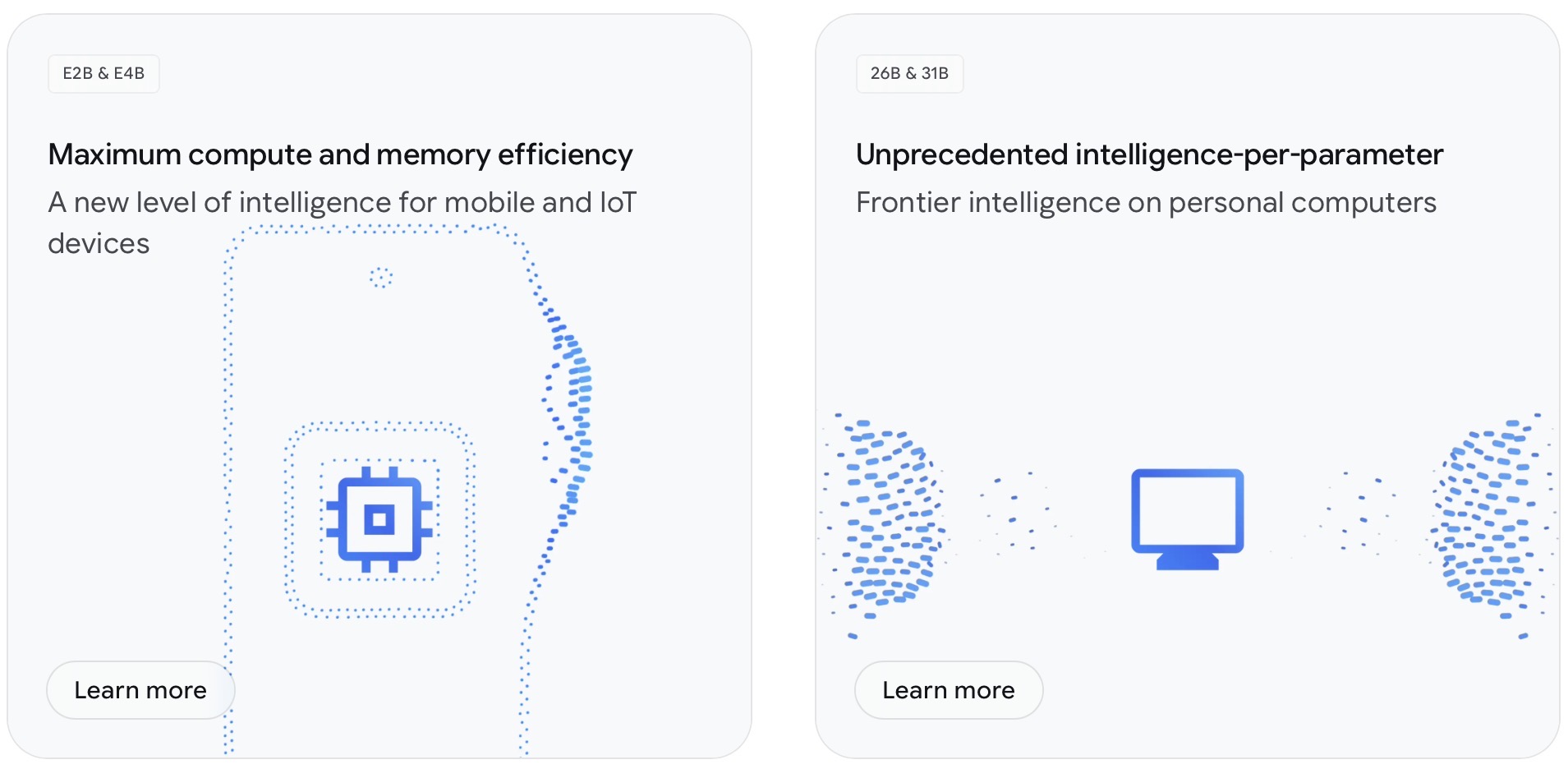
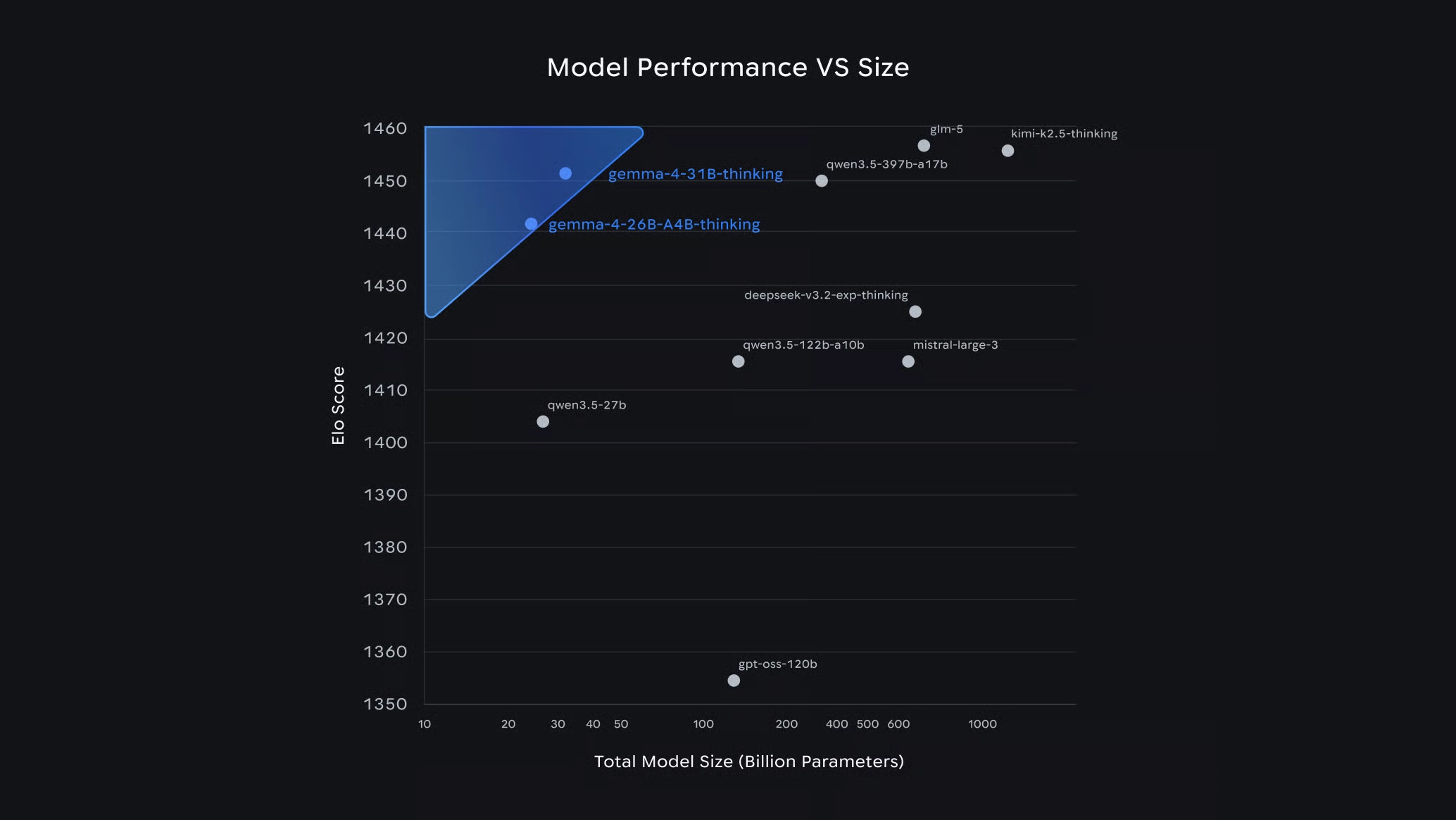
There are four sizes. The E2B and E4B are extremely lightweight models for mobile and IoT, while the 26B A4B is an efficiency-maximizing model using only 3.8B active parameters with a Mixture-of-Experts (MoE) architecture. The 31B Dense is a flagship model aiming for the absolute top performance among open models. The E2B and E4B run on smartphones, the 26B MoE on a 24GB GPU, and the 31B on a single H100 80GB.
| model | parameters | context | significant | Target hardware |
|---|---|---|---|---|
| E2B | 2.3B (Valid) | 128K | Audio input support | Smartphones · IoT |
| E4B | 4.5B (Valid) | 128K | Audio input support | 8GB laptop GPU |
| 26B A4B (MoE) | 26B Total / 3.8B Active | 256K | Optimization of inference speed | 24GB GPU (Q4 quantization) |
| 31B Dense | 31B | 256K | Arena AI Open Model 3rd Place | H100 80GB (Single) |
② Dual RoPE — Applies different position embedding methods to the sliding/global layer to operate without quality degradation even in a 256K context.
③ Shared KV Cache — The last N layers reuse the key-value tensors of the preceding layers to reduce both inference memory and computation.
2Why Did Google Release Gemma 4 Now? — Aleph's Perspective
Looking at the current competitive landscape of the AI industry, the paths chosen by each player are clearly diverging. OpenAI is raising capital through a record-breaking $122 billion in funding, while NVIDIA is aiming to become the operating system for agent execution with NemoClaw. Alibaba is expanding its cloud market share by releasing Qwen as an open weight and integrating it with its ecosystem, including DingTalk and Taobao.
In the midst of this, Google's choice is different. Rather than relying on a monopoly of capital or infrastructure, it is betting on the “widest deployment surface.” DeepMind CEO Demis Hassabis described Gemma 4 as “the world’s best open model by size.”
On the surface, Gemma 4 appears to be an upgrade in model specifications. In reality, however, it signals that Google has begun pushing the boundaries of AI beyond the cloud. While OpenAI accumulated capital and NVIDIA dominated infrastructure, Google effectively chose a different path of “more open models + wider deployment.” The success or failure of this strategy will be determined not by the performance of a single model, but by the density of the ecosystem.
What's More Important Than 3 Performance Comparison — Gemma 4 vs Qwen vs GPT Family
What needs to be considered when comparing with competing models is not a one-point difference in benchmark scores. It is who distributes it, where, and in what way . It is true that in the open source community, Qwen 3.5 (27 billion) narrowly leads GPQA Diamond (85.8%) over 31 billion (85.7%). However, that is not the whole story.
| division | Gemma 4 31B | Qwen 3.5 27B | GPT-OSS-120B |
|---|---|---|---|
| License | Apache 2.0 (Fully Open) | Apache 2.0 | Limited Open |
| Agent | Function calling native | Specialized Agentic Coding | Computer Operation (OSWorld) |
| deployment environment | On-device ~ Server | Cloud API-centric | Cloud API |
| context | 256K | 128K | 1M |
| AIME 2026 | 89.2% | ~90% level | 76.2% (Reasoning Mode) |
| ecosystem | Google AI Studio · Android | Alibaba Cloud · DingTalk | OpenAI platform |
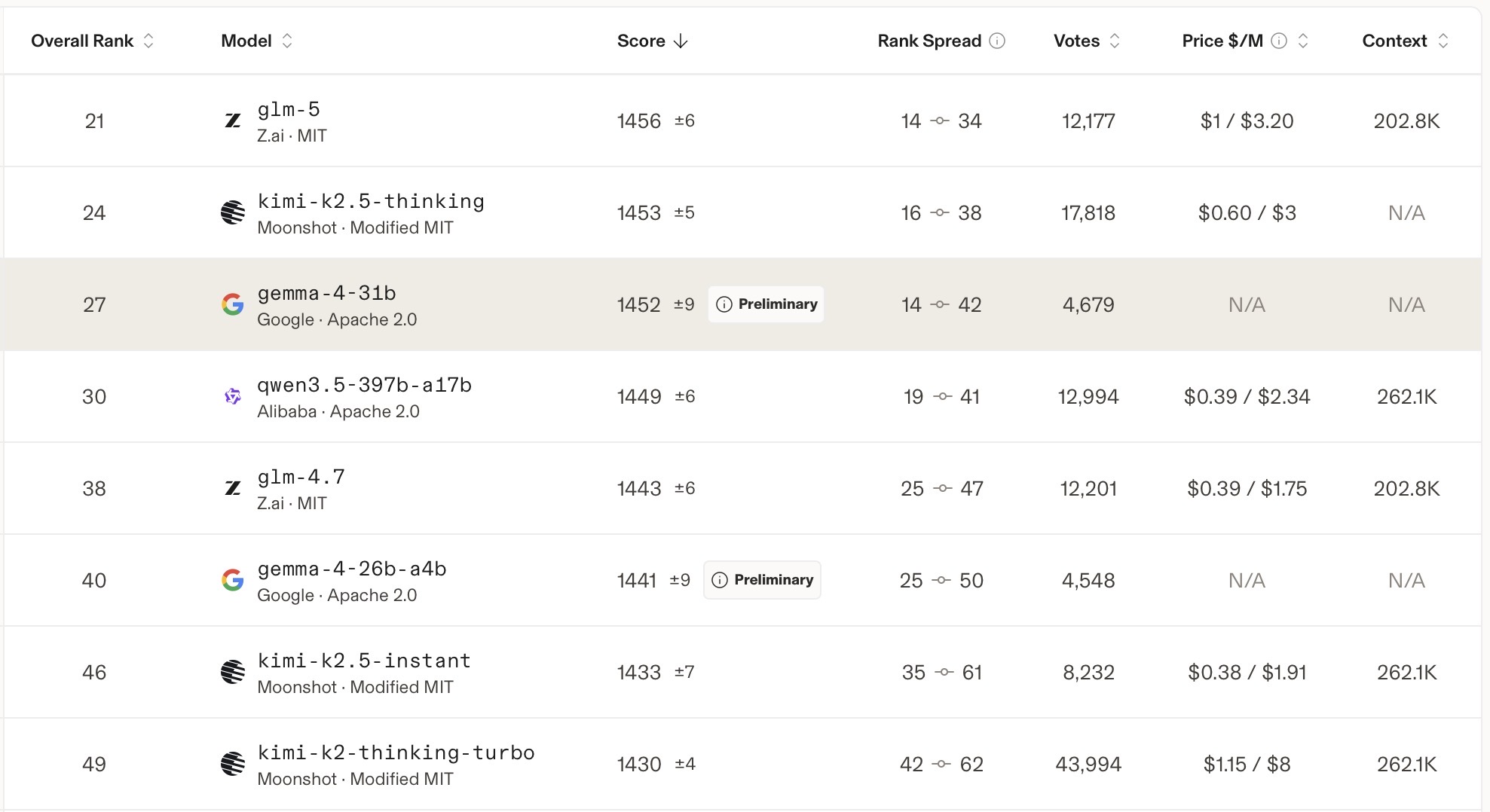
Gemma 4 does not aim for the absolute number one spot in performance. It aims to be the “model that runs across the widest range.” Qwen 3.5 excels in internal enterprise process integration, while GPT-OSS differentiates itself in closed-frontier performance. Gemma 4’s true competitive advantage is more pronounced in the compact model segment. For the E2B and E4B, there are no direct competitors in the Llama 4 or Qwen 3.5 series equipped with audio inputs and 128K context.
Gemma 4 is the model layer, while tools like Claude Code are the application/tool layer. They stand at different levels. Regardless of which model you choose, the tools and workflows you build on top of it determine your actual productivity. Just because Gemma 4 is excellent does not mean you need to immediately change your current tool stack.
The Core of the 4 Agent Era — The Position Gemma 4 Is Targeting
The most notable aspect of Gemma 4's design is its support for agent workflows. It features built-in native function calling, structured JSON output, multi-step planning, and even an Extended Thinking mode. It also supports bounding box output for detecting UI elements, allowing it to be used directly for browser automation and screen parsing agents.
This aligns precisely with the trend Aleph identified in its TurboQuant analysis: the perspective that AI efficiency is not killing demand but rather accelerating its expansion beyond data centers . An analysis of the Claude Code leak confirmed that “always-on-demand agents,” rather than chatbots, are becoming the next standard in the tool market. Gemma 4 is precisely where these two branches—lightweight inference and agent execution—meet at the model layer .
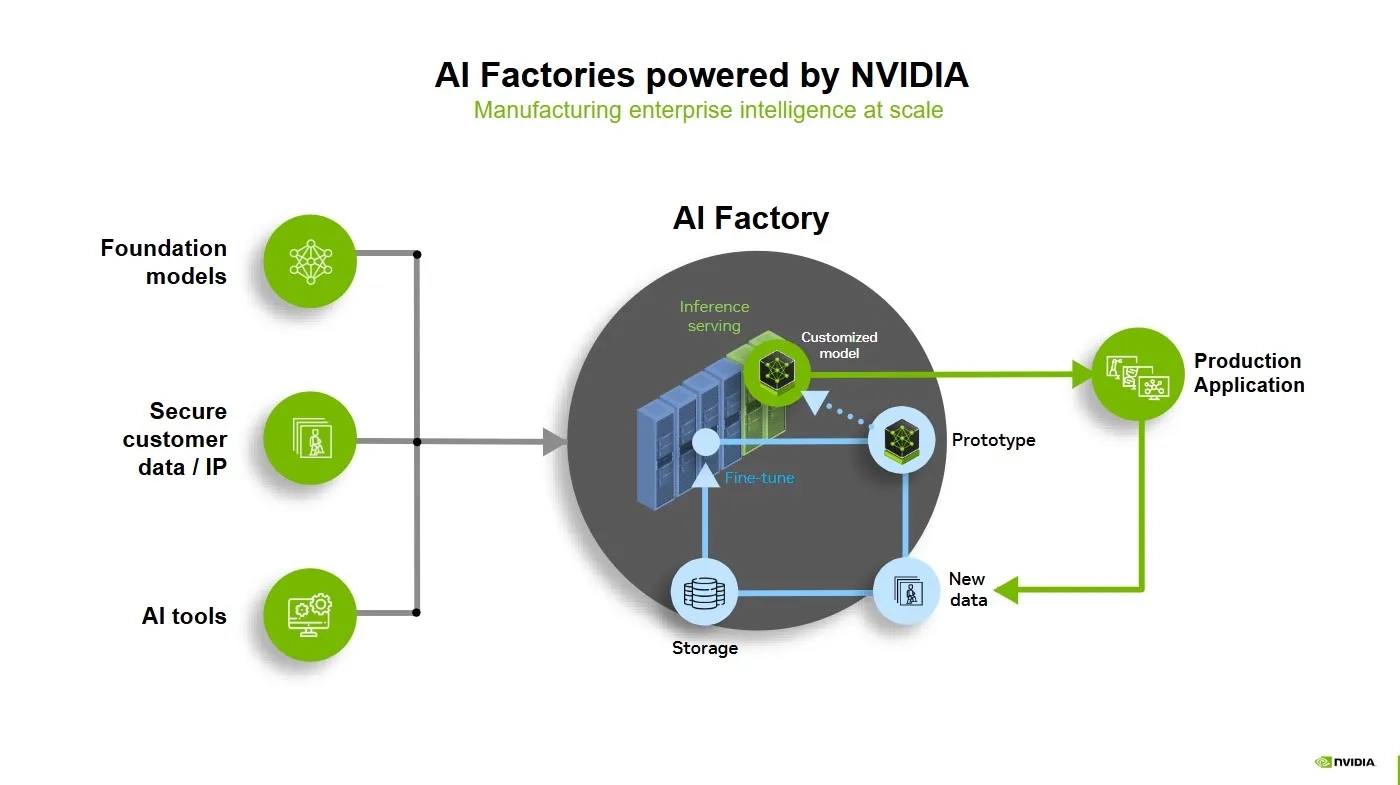
The skyrocketing demand for reasoning in the agent era, as mentioned by Jensen Huang, eventually splits into two branches.
One is a centralized infrastructure like NVIDIA NemoClaw, and the other is distributed inference through lightweight open models like Gemma 4.
When these two paths compete and coexist, what investors need to look at is not which side wins, but which layer to ride .
5Who Should Try It Right Now — Installation and Usage
The entry path is simpler than you might think. You can use Google AI Studio for testing directly in a browser, Hugging Face, Kaggle, or Ollam for local execution, and the Android Studio AICore developer preview for mobile app integration.
A team to test right now
A team building on-device and mobile AI products — services where latency and privacy are critical. An organization requiring internal inference without external API calls due to internal security issues. A development team experimenting with agent workflows — function calling-based task orchestration . A startup requiring cost control and rapid prototyping.
When there is no need to rush
This applies when peak performance of a closed frontier model is essential, for teams where computer-manipulated agents (such as OSWorld) are core, and for teams where workflow and tool integration is more urgent than the model itself; in such cases, stabilizing the GPT-OSS or Claude Code ecosystem first is the right approach. A good model and a winning platform are two different things.
6 3 Signals to Read from an Investor's Perspective
The variable that will determine the success or failure of Gemma 4 is not model performance, but ecosystem density . In open models, buzz and monetization are separate issues. Even if the performance gap is narrow, it will be buried if the tooling and ecosystem are weak.
Conclusion — The Real Question Gemma 4 Raised
Gemma 4 is not news that “Google is also adopting an open model.” It is closer to a signal that “Google has started extending the boundaries of AI beyond the cloud.”
What we need to look at right now is deployment, not performance. It is not a game of who answers better, but who gets into more devices and workflows . And as that boundary widens, inference costs, infrastructure structures, agent execution methods, and the investment landscape change together.
Gemma 4 is the first major example of that change. Next, we need to look at the actual adoption speed, the direction in which the ecosystem war with the Qwen and GPT families unfolds, and the changes in the landscape of on-device agent beneficiary companies.
All figures in this article are for informational purposes only and do not constitute investment advice . You bear all investment decisions and responsibilities, and we recommend consulting a professional financial advisor before making any important decisions.
📌 Was this analysis helpful?
In the next post, we will cover “The Inference Infrastructure War in the Agent Era — NVIDIA NemoClaw vs. Decentralized Open Model” .
Please leave your thoughts on Gemma 4 in the comments.
How this content was produced
Aleph's research AI agent assisted with collecting and analyzing public data, creating charts and visuals, and structuring the draft. Davar personally reviewed and edited the sources, figures, reasoning, and final conclusions.
This content is for informational purposes only and is not personalized investment advice or an individual stock recommendation. Read the full disclaimer

Davar
Davar builds and operates Aleph's research AI agent and writes and reviews analysis on macroeconomic developments and AI industry trends.


© Aleph. All rights reserved.