
AI optical communication
Investment Analysis
semiconductor infrastructure
2026.04.06
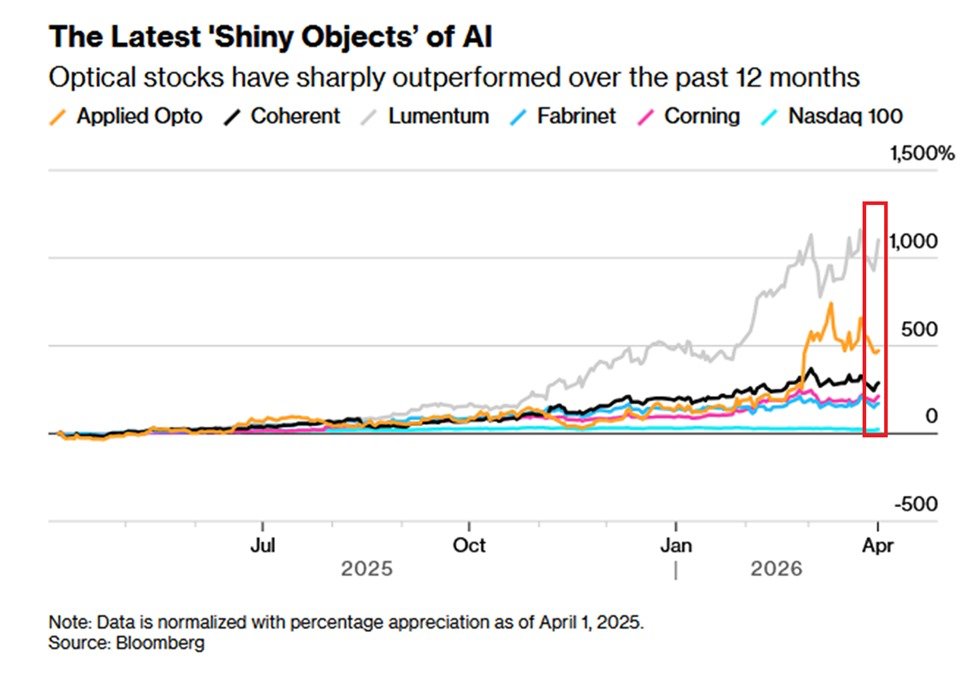
Led by Lumentum ($LITE), which surged +1,137% in 12 months, AI, data center, and optics stocks have emerged as the top trades in the S&P 500. If GPUs are the brain of AI, optical communication is its nervous system. We will analyze, using numbers, why you should pay attention to these 'stocks of light' right now.
1What Happened — 'Stocks of Light' Take Over Wall Street
On April 5, 2026, an analysis posted on X (Twitter) by The Kobeissi Letter, a famous Wall Street investment analysis account, went viral among investors. The core message of this post, which recorded 380,000 views, was simple: the biggest beneficiary of AI trading was not GPUs, but optical communications.
Optical component manufacturers, traditionally regarded as “boring hardware companies,” are being rediscovered as direct beneficiaries of the expansion of AI infrastructure . Market participants are already moving beyond the formula of “AI = Nvidia.”
2Key Indicator — The Scale of the Optical Surge Told by Numbers
The 12-month return data released by The Kobeissi Letter is shocking. While the Nasdaq 100 recorded a gain of +23%, optical communications stocks delivered performance on a truly different level.
Source: The Kobeissi Letter(X), April 5, 2026. Based on Bloomberg data. Returns are based on April 1, 2025 – early April 2026.
3Why Optical Communication? — The Emergence of the 'Copper Wall'
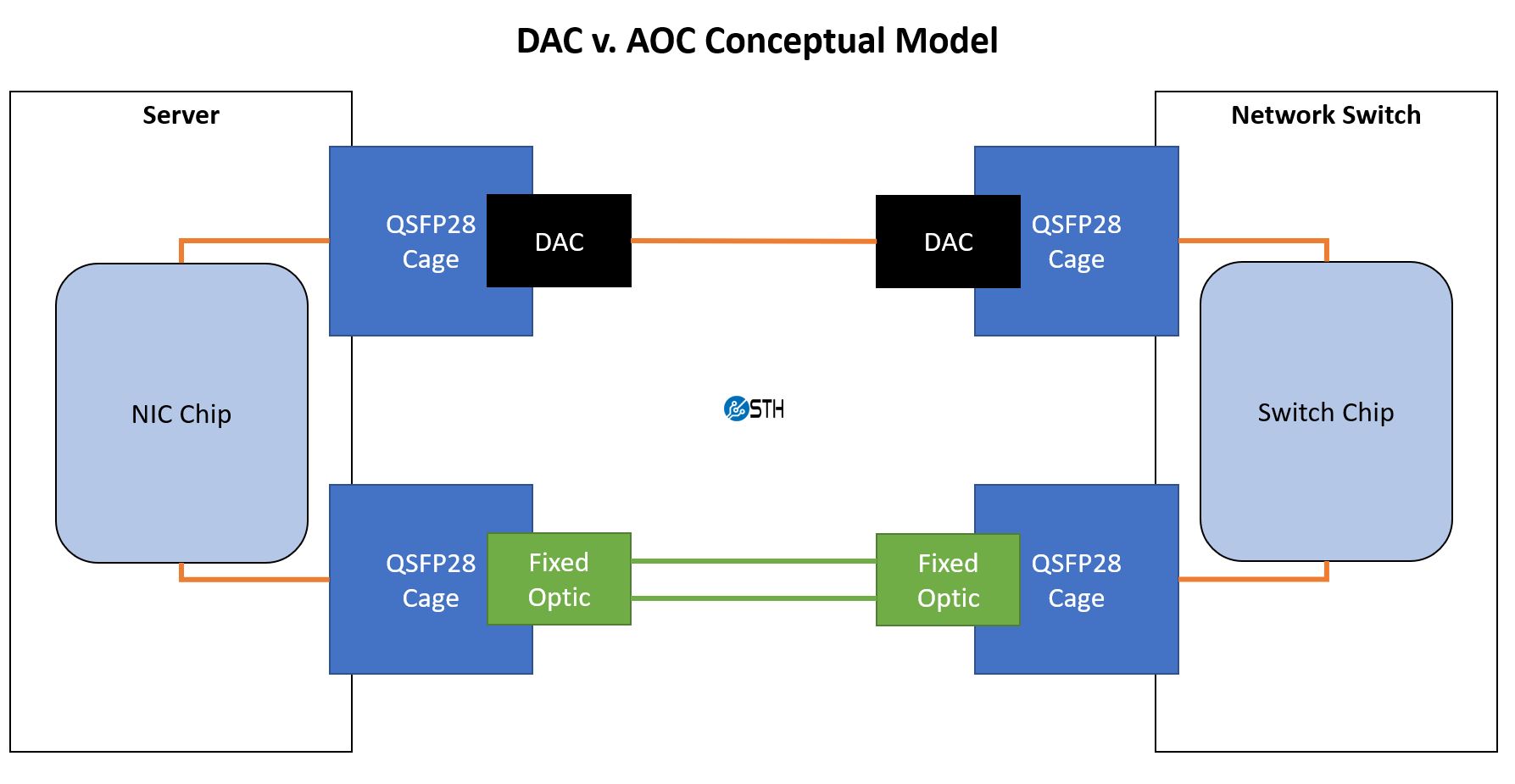
AI scaling has now hit the 'Copper Wall.' No matter how fast GPUs become, a bottleneck occurs the moment data travels through copper cables. To use an analogy, it is like driving on a 12-lane highway and suddenly encountering a one-lane alley.
There is only one solution: turning copper into light. AI data centers require tens of thousands of GPUs to exchange massive amounts of data in real time. In this process, the pace of network development fails to keep up with GPU performance, leading to a phenomenon known as "data starvation" that undermines the inherent performance of the chips. This is why optical interconnects, silicon photonics, and copackaging optics (CPO) have rapidly emerged as essential infrastructure for next-generation data centers.
| Market Segments | 2024~2025 | 2030 Outlook | CAGR |
|---|---|---|---|
| Optical interconnect | $16 billion | $340~410 billion | ~15% |
| Silicon Photonics | $3 billion (2025) | $120~160 billion (2032) | ~29% |
| DC interconnect expenditure | $15 billion (2025) | $26 billion | ~12% |
| Total Optical Market TAM | $18 billion (2025) | $90 billion | ~38% |
In-depth Analysis of 4 Top 3 Core Stocks — LITE · COHR · FN
🔹 Lumentum ($LITE) — NVIDIA's optical components
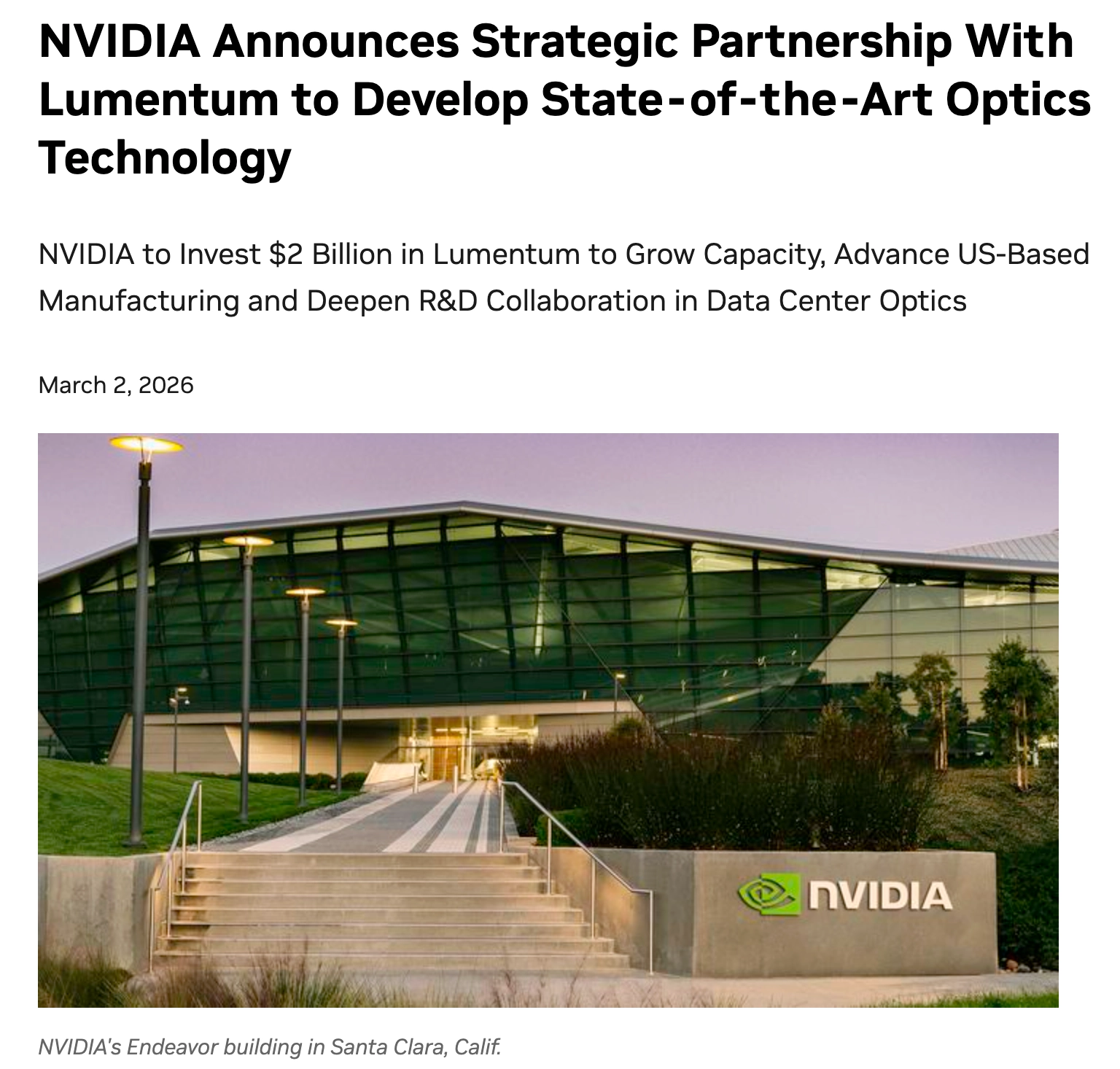
It is a company that manufactures key optical components for AI data centers, including lasers, modulators, optical circuit switches (OCS), and co-packaging optics (CPO). It is a strategic partner in which NVIDIA directly invested $2 billion, and it was added to the S&P 500 in March 2026.
| characteristic | black eye | note |
|---|---|---|
| Current stock price | $826.88 | Closing price on 4/2, 52-week high $827.56 |
| FY26 Q2 Sales | $665.5 billion | All-time quarterly high, YoY +65.5% |
| FY26 Q2 Non-GAAP EPS | $1.67 | +35.8% surprise compared to consensus of $1.23 |
| FY26 Q3 Guidance | Revenue $780-$830 million, EPS $2.15-$2.35 | YoY 85%+ Growth Forecast |
| FY26 Annual Revenue Forecast | Approximately $2.91 billion | YoY ~76.8% (TIKR estimate) |
| FY27 Annual Revenue Forecast | Approximately $4.81 billion | YoY ~65.5% additional growth (TIKR estimate) |
| EPS growth trajectory | $2.06 → $7.69 → $14.98 | FY25 → FY26 → FY27 Zacks Consensus |
| Analyst consensus | Overwhelming buying | Consensus target price ~$713, highest BNP $1,040 |
Notable catalysts: ① Construction of a new 240,000 m² InP plant in Greensboro, North Carolina (acquired from Qorvo, production targeted to begin mid-2028), ② OCS order backlog exceeding $400 million — signing of additional multi-year, multi-billion dollar new OCS contracts, ③ securing hundreds of millions of dollars in additional CPO (Co-packaging Optics) orders, delivery scheduled for the first half of 2027.
Lumentum CEO Michael Hurlston stated during the earnings call , “Our forward guidance calls for over 85 percent year-over-year revenue growth, yet we are only at the starting line for two substantial opportunities: optical circuit switches (OCS) and co-packaged optics (CPO).” This implies that both OCS and CPO are still in their 'early stages'.
🔹 Coherent Corp ($COHR) — Silicon Photonics Moat
It is a vertically integrated industry leader with a structure ranging from optical materials to finished products. It is a company in which NVIDIA has also invested $2 billion and holds the number one market share in the 800G optical transceiver market. It is currently undergoing aggressive expansion to double its indium phosphide (InP) production capacity within the year.
| characteristic | black eye | note |
|---|---|---|
| Current stock price | $258.16 | 4/2 closing price |
| 52-week range | $45.58 ~ $300.20 | 12-month return of approximately +282% |
| FY26 Q2 Sales | $1.69 billion | YoY +17.5%, exceeding consensus |
| Market capitalization | Approximately $48.4 billion | As of 4/2 (Yahoo Finance) |
| Analyst consensus | Strong Buy | The highest target is Rosenblatt $375 |
| Key Strengths | Silicon Photonics Technology Benefits from 800G to 1.6T Transition, New OCS & CPO Product Lineup | |
🔹 Fabrinet ($FN) — A hidden NVIDIA-related stock
It is a company responsible for OEM manufacturing of optical components, with NVIDIA and Cisco as its major clients. It is referred to as a "hidden NVIDIA-related stock" because its workload increases as NVIDIA chips sell well. Another investment point is that it has a relatively low valuation burden among optical communications stocks.
| characteristic | black eye | note |
|---|---|---|
| Current stock price | $557.97 | 4/2 closing price |
| 12-month return rate | +176% | Despite relatively low returns among the five optical communications stocks, it still dominates compared to the Nasdaq 100. |
| Positioning | Contract manufacturing of optical transceivers, OCS, and CPO → Direct beneficiaries of increased demand for AI infrastructure | |
| Investment Points | Diversification of clients ( NVDA , CSCO, etc.), relative low valuation compared to LITE and COHR | |
5 NVIDIA’s $4 Billion Bet — The Official Declaration of the Opto-Semiconductor Era
In March 2026, NVIDIA announced at GTC 2026 that it would directly invest $2 billion each in Lumentum and Coherent, totaling $4 billion (approximately 5.9 trillion won). This is not merely a financial investment, but a strategic partnership that includes a multi-year component purchasing commitment.
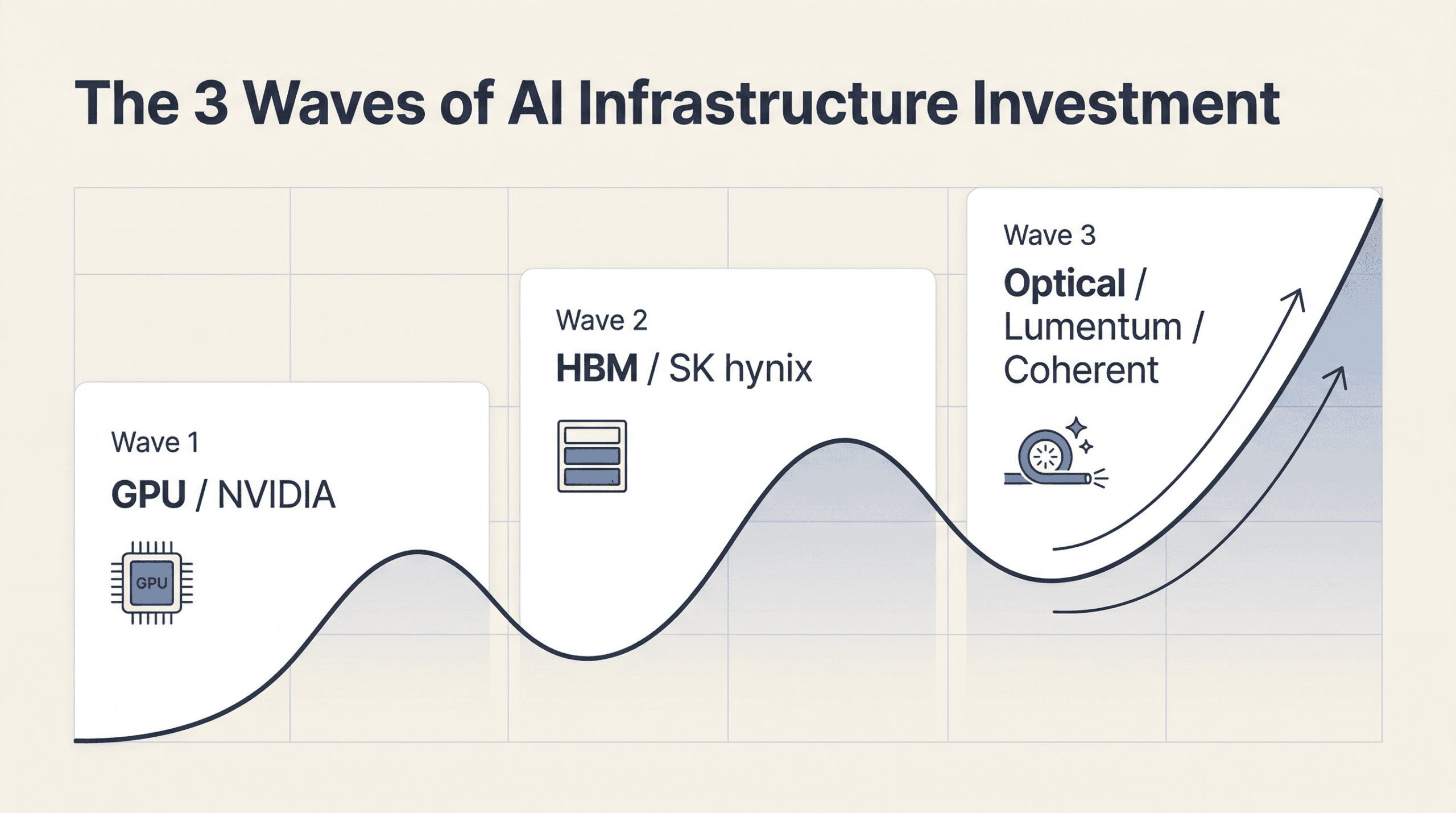
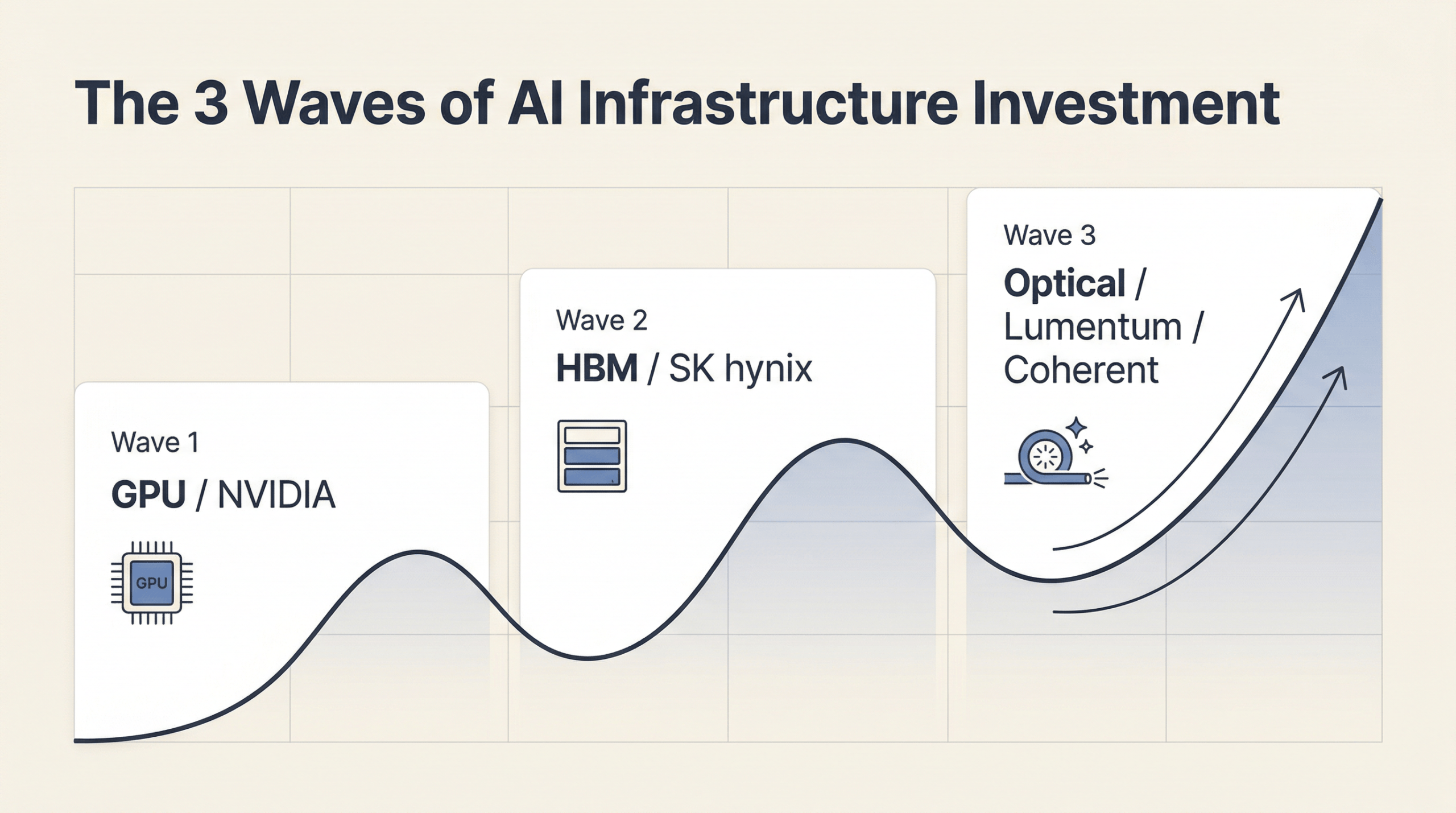
The significance of this investment is clear. It signifies that NVIDIA itself has acknowledged the limitations of GPUs and has officially confirmed to the market that optical communication is the 'next layer' of AI infrastructure. It effectively marks the beginning of the logical next stage in the AI investment cycle, which progresses from GPU to HBM to optical communication.
6Investment Scenario Analysis — Optimism, Fundamentals, Pessimism
Based on the current LITE stock price of $826.88, we summarize the scenario for the next 12 months. The key variables are ① OCS and CPO order momentum, ② whether AI infrastructure CAPEX will continue, and ③ the interest rate and tariff environment.
| scenario | LITE target price | Upside/Downside Potential | Prerequisites |
|---|---|---|---|
| 🟢 Optimism | $1,040~$1,975 | +26%~+139% | Continued OCS exclusivity, achieved FY27 EPS of $14.98, AI CAPEX acceleration (BNP $1,040 / TIKR DCF scenario) |
| 🟡 Basic | $700~$853 | -15%~+3% | Achieved earnings at consensus level, maintained current valuation (consensus average ~$713) |
| 🔴 Pessimism | $455~$550 | -33%~-45% | AI CAPEX slows, margins tighten due to intensifying competition, and interest rates surge |
7 Practical Investment Strategy — Action Plan for Investors in Their 40s and 50s
Is it reckless to invest in a stock that has risen 1,137% right now? Not necessarily. However, the approach must be different.
Portfolio weighting
Allocate no more than 5–10% of your total stock portfolio to the AI optical communications sector. As this is a highly volatile sector, avoid investing heavily in a single stock.
Diversification into 3 stocks + parallel ETFs
Diversifying into LITE (high-growth leading stocks) + COHR (silicon photonics moat) + FN (relatively low valuation) and using the KODEX US AI Optical Communication Network ETF as a core is also a method.
Split buying strategy
This is an extremely volatile sector. Buy in installments over 3 to 5 transactions, and simultaneously take partial profits during sharp rises. It is psychologically advantageous to adhere to the principle of entering the market at a VIX level of 20 or lower.
Check the earnings announcement calendar
Next key event: LITE FY26 Q3 earnings announcement (scheduled for May 5, 2026). Whether the OCS and CPO earnings surprises continue is the key to further gains.
Investors in their 40s and 50s should approach this with the frame of “ investing in the next bottleneck resolution layer of the AI infrastructure supply chain” rather than “investing in the optical communication theme.” If you understand the logic of the waves of AI investment leading from GPU (1st generation) → HBM (2nd generation) → optical communication (3rd generation), you can maintain a mid-to-long-term position without being swayed by short-term volatility.
Conclusion — Next up after the GPU is light
The core axis of AI investment is shifting from compute to connectivity. Lumentum's +1,137% return is the most dramatic evidence of this transition, and Nvidia's $4 billion bet is the official confirmation of this trend.
The forecast that the optical communications market's Total Amount (TAM) will expand fivefold from $18 billion in 2025 to $90 billion in 2030 suggests that this sector represents a structural growth story rather than a short-term theme. Of course, current valuations are burdensome. However, as long as AI infrastructure CAPEX continues, it is highly likely that the earnings growth of optical communications companies will also continue.
One-line conclusion: If you are already investing in AI stocks, it is time to check if your portfolio is missing its 'light'.
All figures in this article are for informational purposes only and do not constitute investment advice . Target prices and forecasts in this text are estimates by individual analysts and research institutions and may differ from actual results. All investment decisions and responsibilities rest with the individual, and consulting with a professional financial advisor before making any significant decisions is recommended.
📌 Was this analysis helpful?
In the next post, we plan to cover “HBM4 — Can SK Hynix Beat Nvidia?”
Please leave your AI portfolio concerns in the comments.
How this content was produced
Aleph's research AI agent assisted with collecting and analyzing public data, creating charts and visuals, and structuring the draft. Davar personally reviewed and edited the sources, figures, reasoning, and final conclusions.
This content is for informational purposes only and is not personalized investment advice or an individual stock recommendation. Read the full disclaimer

Davar
Davar builds and operates Aleph's research AI agent and writes and reviews analysis on macroeconomic developments and AI industry trends.


© Aleph. All rights reserved.