
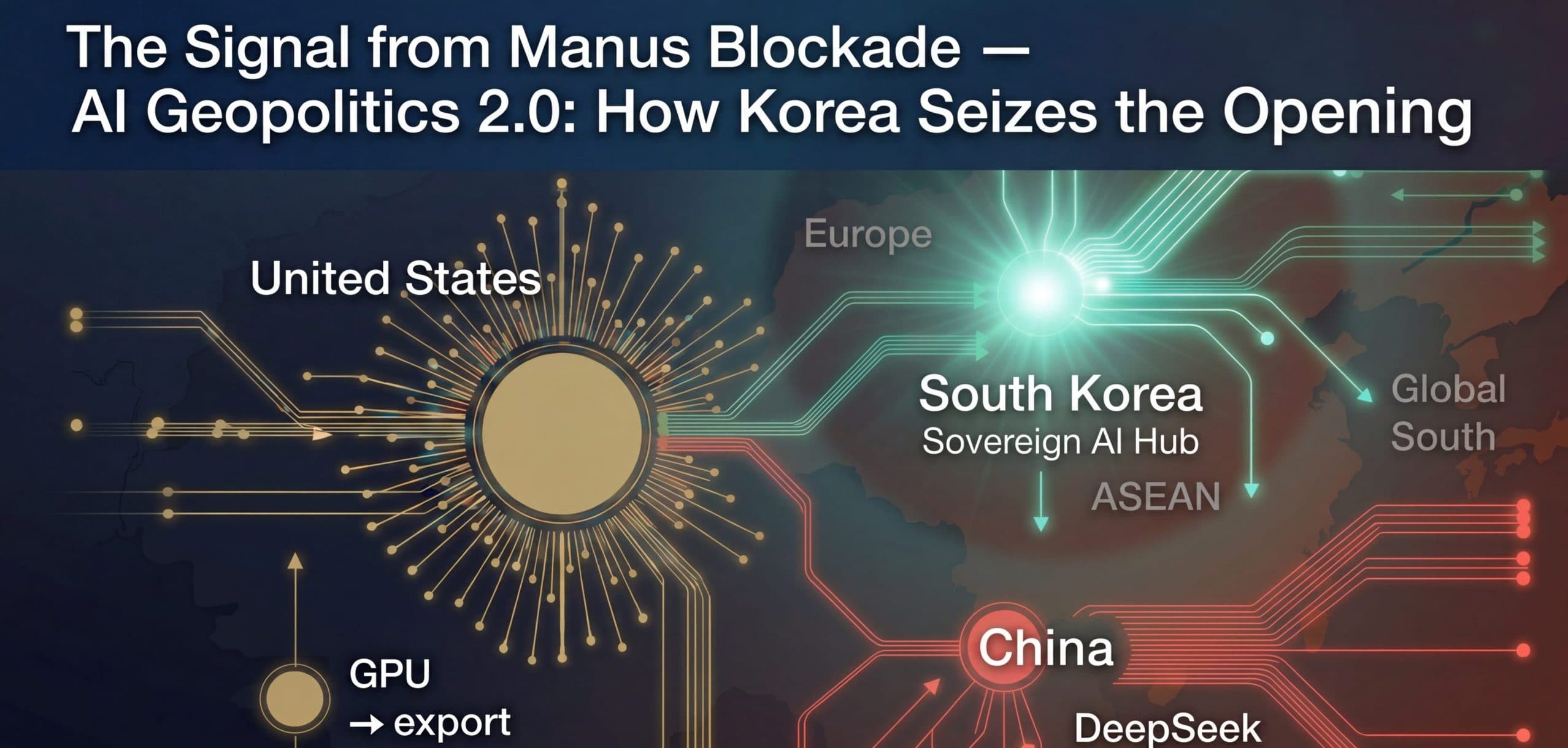
China has blocked Meta's acquisition of Manus AI. On the surface, this is a decision to prohibit a single M&A , but the signal contained within is much greater. It is a declaration that the front line of the war for AI hegemony has shifted from the hardware battlefield of GPU export controls to a new battlefield of Agentic AI software technology. And there is a country quietly establishing a position in the niche of this landscape: South Korea.
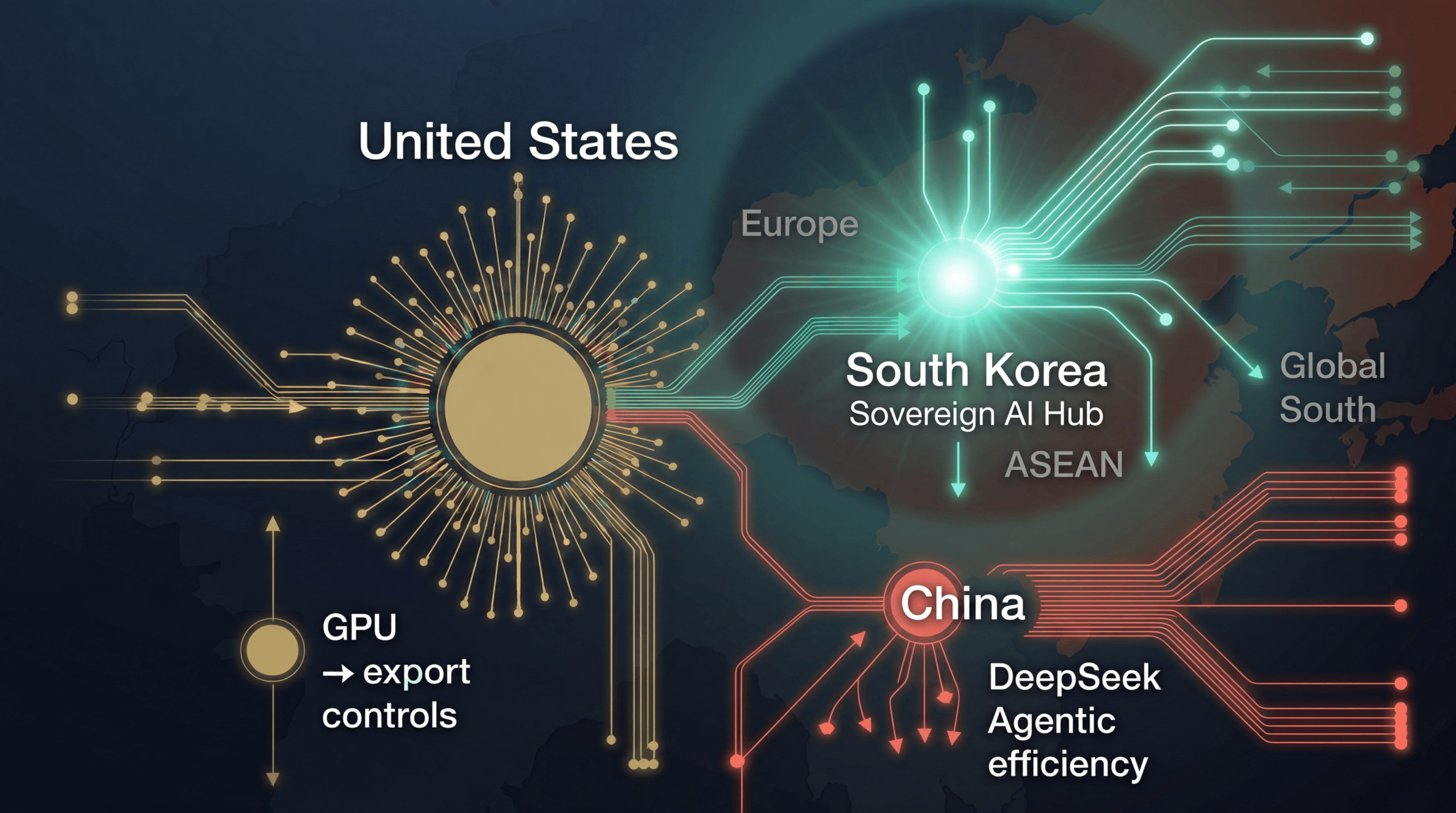
1Manus The Signal Sent by the Blockade — The Front Lines of AI Geopolitics Have Shifted
The core of AI Geopolitics 2.0 lies in the fact that software orchestration technology has been elevated to the status of a national strategic asset. In April 2026, Chinese authorities blocked Meta's acquisition of Manus, a Singapore-based agentic AI startup. While the ostensible reasons were national security and concerns over technology leakage, the substantive significance is much clearer. China has publicly demonstrated its determination not to hand over to the West the "low-resource, high-efficiency agentic operation technology" it has accumulated since DeepSeek.
Manus was not just a simple LLM startup. It was a company specializing in 'general agent orchestration,' which performs complex multi-step tasks by weaving low-performance-based models into agentic frameworks. The very fact that China has begun treating this technology as a prohibited export asset indicates that Agentic AI has become a strategic resource comparable to GPUs.
2AI Geopolitics 1.0 vs 2.0 — The Front Lines Move from GPU to Software
The weapon of AI Geopolitics 1.0 was export controls. The U.S. Bureau of Industry and Security (BIS) attempted to stifle China's AI capabilities at the hardware level by restricting the export of high-performance GPUs, such as the H100 and H200, to China. However, the results were different from expectations. China accelerated innovation by circumventing hardware constraints, and the product of this is DeepSeek.
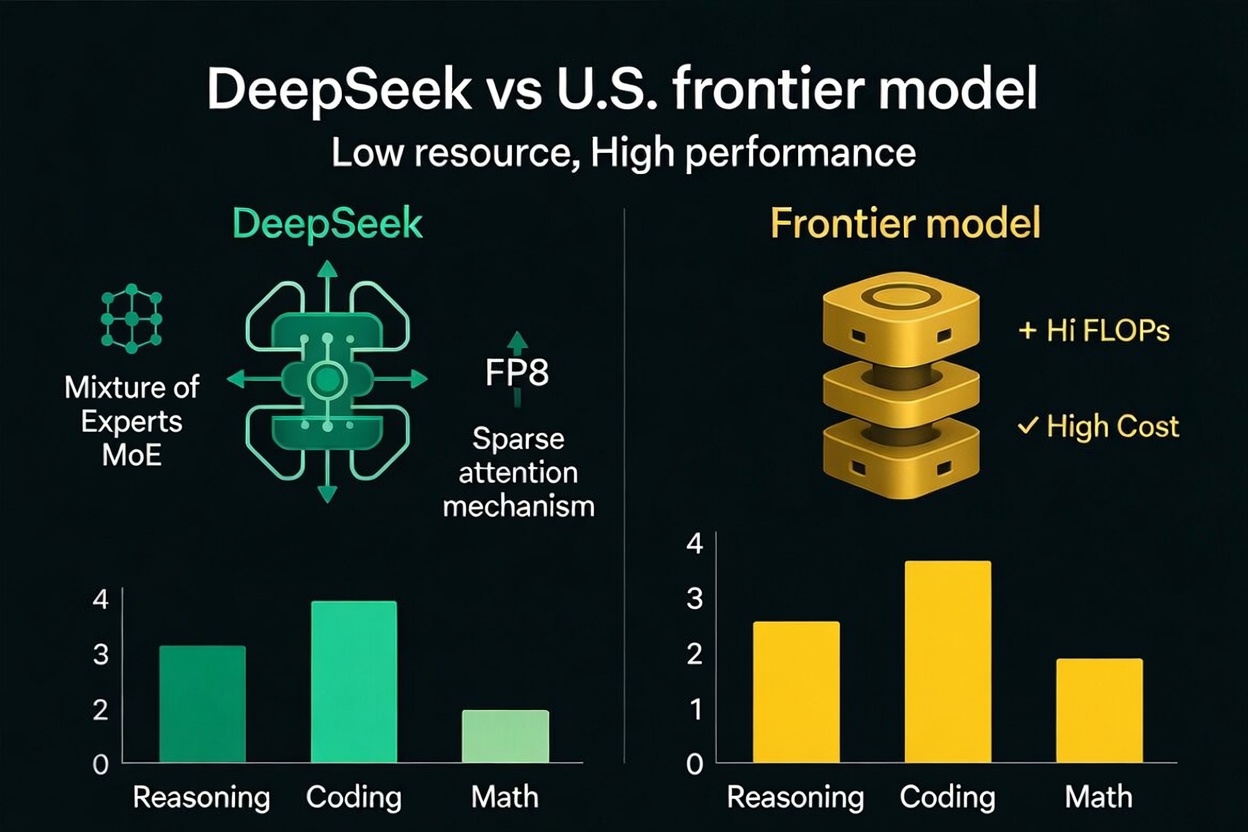
DeepSeek combined the Mixture-of-Experts (MoE) architecture, FP8 low-precision computation, and sparse attention optimization to achieve performance comparable to the US Frontier model with significantly less computing power. These technologies are now China's national strategic assets. The blocking of Manus is a declaration that these assets will not be leaked externally, signaling the opening of AI Geopolitics 2.0 .
| division | AI Geopolitics 1.0 | AI Geopolitics 2.0 |
|---|---|---|
| Key Frontline | GPU and semiconductor export controls | Agentic AI Software and Orchestration Technology |
| US weapons | BIS Export Regulations, AI Diffusion Rule | Stricter M&A Review and Technology Transfer Restrictions |
| China's response | Huawei Ascend fosters domestic semiconductor industry | Nationalization of DeepSeek efficiency technology, blocking M&A |
| Key events | H100 Export Ban (2022), AI Diffusion Rule (2025) | Manus acquisition rejected (April 2026) |
| Winner conditions | More chips, larger clusters | More efficient agents, better orchestration |
3China’s Defeat — Weaponizing DeepSeek-style Low-Resource Efficiency
The core of China's AI strategy lies in transforming compute scarcity into a driving force for innovation . Faced with limited high-performance GPUs, Chinese researchers relentlessly pursued ways to achieve more with fewer resources, resulting in the DeepSeek series, which astonished the global AI community.
The recently unveiled new DeepSeek model is reported to process 1 million token contexts with significantly reduced computational load compared to existing models and feature a structure optimized for agentic workflows. The channel through which these technologies were leaking out of China was through M&As of startups like Manus, and China has now blocked that route. Paradoxically, this blockade is an act in which China itself acknowledges the strategic value of this technology .
4 Korea’s Opportunity — From K-Defense to K-AI Hub
The reason Korea can exploit the niche in AI geopolitics is that it has already walked this path once. The K-defense industry serves as that precedent. Korea succeeded in exporting to Poland and Europe by penetrating the niche of 'practicality, reliability, and cost-efficiency,' rather than pursuing the U.S.'s top-tier strategic weapons or China's low-cost mass-production models. The same formula can be applied to AI.
The Korean government is already making multiple strategic bets simultaneously. The Framework Act on AI was enacted in January 2026, the first in Asia, establishing the institutional foundation for sovereign AI governance. The National AI Computing Center is pursuing the construction of infrastructure capable of deploying 260,000 NVIDIA Blackwell-based GPUs. The Agentic AI Ecosystem Strategy , led by the Ministry of Science and ICT, has designated agentic orchestration in low-to-medium compute environments as a core national capability.
Sovereign AI + Governance — Neutral Nation's Trust Asset
For countries that find it difficult to trust either U.S. Big Tech or China's state-run AI, Korean AI infrastructure and governance certification are attractive alternatives. The institutional foundation known as the Framework Act on AI is not merely a piece of legislation, but a trust-marketing asset aimed at the Global South and neutral nations .
Dual-track R&D — Simultaneously absorbing the US model and Chinese efficiency
Korean companies are in a geographical and political position that allows them to maintain partnerships with U.S. frontier models ( OpenAI , Anthropic , Google) while simultaneously incorporating DeepSeek-style efficiency techniques into their own research. It is a country capable of an ambidextrous R&D strategy that is not dependent on either side.
Agentic AI in Manufacturing, Bio, and Defense — AI Transformation of K-Industries
By combining Agentic AI with the semiconductor, automotive, bio, and defense sectors, where Korea already possesses global competitiveness, it becomes possible to export industrial solutions embedded with AI, rather than simply exporting technology. This is the practical revenue model of the K-AI Hub strategy.
Why NVIDIA and Big Tech Are Betting on Korea
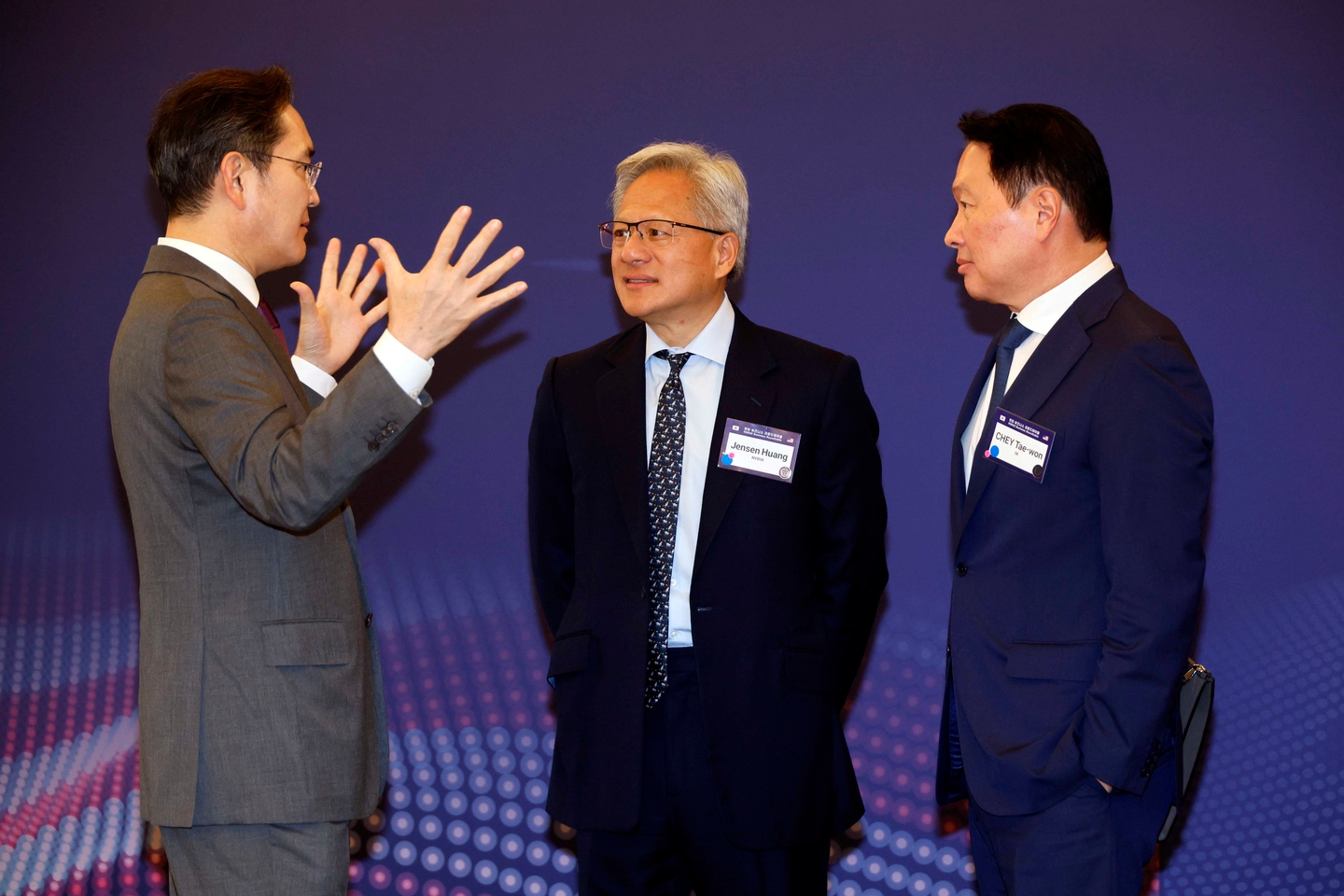
The market has already started betting on Korea's position. NVIDIA CEO Jensen Huang visited Korea for APEC in October 2025 and stated, “Korea's leadership in technology and manufacturing positions it at the heart of the AI industrial revolution” (NVIDIA official announcement, October 2025). The context of this statement was not a simple sales visit, but rather discussions regarding AI factory cooperation with Samsung, SK, and Hyundai.
Google DeepMind and Microsoft are also expanding their sovereign AI partnerships in Korea. The reasons why Big Tech companies are choosing Korea are clear. Korea is one of the few countries that can access the Chinese market while trusting U.S. technology , and it possesses semiconductor and memory manufacturing capabilities while having a stable rule of law environment. This combination represents an irreplaceable value as a Pan-Asia neutral AI Hub.
| player | Activities in Korea | Strategic significance |
|---|---|---|
| NVIDIA | Large-scale Blackwell GPU Supply, AI Factory Cooperation with Samsung and SK | Establishing Korea as an East Asian AI infrastructure hub |
| Google DeepMind | Sovereign AI Partnership, Joint Development of Korean AI Model | Utilizing Neutral Country Governance Trust |
| Microsoft | Expansion of Azure AI Infrastructure Investment , AI Cloud for Public Institutions | Preempting the Enterprise Agentic AI Deployment Platform |
| Samsung · SK Hynix | Continued investment in HBM4 and CXL memory AI optimization | Key node of the AI accelerator memory supply chain |
6Investor Perspective — Who Wins in This Game?
The investment principle of the AI Geopolitics 2.0 era is to look at geopolitical positioning before technological performance benchmarks . This is because we have entered an era where the model trusted by the most countries, rather than the largest model, wins.
Beneficiary Structure: Sovereign AI Infrastructure Provider
Demand for building national-level AI infrastructure is surging. The scope of beneficiaries is broad, extending beyond GPU suppliers (NVIDIA) to include HBM memory (SK Hynix and Samsung Electronics), power infrastructure , cooling solutions, and AI governance consulting . Sovereign AI operates on a structure where it commissions the entire ecosystem rather than a single company.
Area of Focus: Agentic AI Orchestration Platform
What Manus Blocking has proven is the scarcity of Agentic AI orchestration. Agentic SaaS platforms that perform complex multi-step tasks in low-resource environments are an area where demand is rapidly expanding in global South and Neutral markets.
Risk Factor: Escalation of US-China Conflict
Korea's niche strategy is most effective when U.S.-China relations maintain a level of tension characterized by "competition but cooperation." If relations deteriorate into full decoupling, Korea faces the possibility of pressure to choose one side . This risk variable must be continuously monitored.
7 K-AI Watchlist — Korean Companies to Watch Now
Evidence that the K-AI Hub strategy has entered the implementation phase rather than the theoretical stage can be confirmed by the movements of these companies. The companies listed below are actually building the three pillars of Agentic AI infrastructure, sovereign models, and low-resource inference chips at their respective layers. I have organized this information by clearly distinguishing whether they are listed on the stock exchange.
The companies listed below are divided into listed stocks (available for immediate purchase) and unlisted stocks or stocks scheduled for IPO . General investors cannot directly purchase shares of unlisted companies; only indirect access is available through public offering subscriptions or brokerage firm pre-IPO funds. IPO schedules and valuations are subject to change depending on market conditions.
① Infrastructure Layer — Listed Stocks (Immediate Investment Available)
| enterprise | Key role | K-AI Hub connecting link | Key Points to Note |
|---|---|---|---|
| SK Hynix 000660 · KOSPI | Exclusive supply of HBM3E and HBM4 (For NVIDIA B200·H200 only) | The physical foundation for Korea to become an AI infrastructure hub. The number one reason NVIDIA chose Korea. | HBM4 Mass Production Timeline, Monitoring Supply-Demand Elasticity of AI Accelerators |
| Samsung Electronics 005930 · KOSPI | HBM3E Supply + Proprietary NPU (Mach-1) + AI Factory 50,000 GPUs | NVIDIA is a direct party to the APEC agreement. Samsung AI Factory is a core infrastructure node of K-Moonshot. | Speed of HBM yield improvement, whether Exynos NPU will be sold externally |
② NPU Chip Layer — Pre-IPO (Unlisted, IPO 예정)
| enterprise | core technology | Investment and IPO Status | K-AI Hub connecting link |
|---|---|---|---|
| Rebellions Unlisted · Scheduled for KOSDAQ IPO in 2026 | NPU specialized for AI inference (Rebel100, REBEL-Quad). Equipped with HBM3E. Energy-efficient design. | March 2026: Pre-IPO raises $400 million, cumulative $850 million, valuation $2.34 billion. Direct investment by Korea National Growth Fund No. 1. Shareholders include Samsung, SK Hynix, and Aramco. | Designated as the first 'K-Nvidia' company. Currently exporting Sovereign AI to the U.S., Europe, and the Middle East. Optimized for agentic multi-model inference. |
| FuriosaAI Unlisted · Scheduled for IPO 2027~2028 | RNGD (Renegade) NPU. Tensor Contraction Processor architecture. 2.25 times performance-per-watt compared to GPU. | In progress of Series D funding of $300-$500 million (Morgan Stanley and Mirae co-advisors). Rejected Meta's $800 million acquisition offer (March 2025). TSMC begins 5nm mass production. | Officially adopted by LG EXAONE. OpenAI Korea demo (running GPT-OSS 120B with 2 RNGDs). Joint development of Sovereign AI Appliance with LG U+. |
③ Sovereign Model & Software Layer — Pre-IPO (Unlisted, IPO 예정)
| enterprise | core technology | Investment and IPO Status | K-AI Hub connecting link |
|---|---|---|---|
| Upstage Unlisted · Scheduled for KOSPI IPO in 2026 | Solar Pro 2 (31B) + Solar Open 100B. Frontier-level performance compared to small models through depth up-scaling techniques. Specialized for Document AI. | Series C funding of ₩18 billion, valuation of over ₩1 trillion (Domestic Unicorn). Strategic partnership with AMD and Sovereign AI (March 2026) | Passed the first round of evaluation for the Ministry of Science and ICT's Sovereign AI Foundation Model Project (January 2026). Representative of a startup among the five finalist teams. Collaborated with Rebellions and FuriosaAI on NPU optimization. |
| LG AI Research, a subsidiary of LG Electronics LG Electronics 066570 · KOSPI Listed | K-EXAONE Multimodal Sovereign Model. FuriosaAI RNGD Officially Adopted Client | Indirect investment available through LG Electronics. Direct participation in NVIDIA APEC partnership. | Combination of Sovereign AI + Physical AI (Robotics & Manufacturing). Connected to both NVIDIA and government ecosystems. |
Rebellions, FuriosaAI, and Upstage are currently unlisted. General investors can access them at the time of public offering subscription or through brokerage firm pre-IPO funds. Given the potential valuation jump after listing, identifying pre-IPO momentum is key . For listed stocks such as SK Hynix and Samsung Electronics, improvements in HBM yield and AI factory utilization rates are short-term momentum variables. Please make all investment decisions after verifying the information yourself.
8Frequently Asked Questions
| question | answer |
|---|---|
| Does the blocking of Manus directly affect Korean AI companies? | The indirect opportunities outweigh the direct impact. As Manus technology is not transferred to the West, space opens up for Korean companies to establish a unique position in the Agentic AI orchestration market. Global South nations, finding it difficult to trust Chinese technology, are seeking alternatives. |
| Can the K-AI Hub strategy succeed like K-Defense? | The conditions are similar. The key to the success of the K-defense industry was "practical solutions that are cheaper than the U.S. and more reliable than China." This formula holds true for AI as well. However, since the pace of technological change in AI is much faster than in the defense industry, continuous R&D investment is an essential condition. |
| Is DeepSeek's efficiency technology available for use in Korea as well? | The technology itself is largely disclosed through academic papers and open source. Korean research institutions and companies are already conducting research to apply MoE, FP8, and sparse attention techniques to their proprietary models. China's blocking of M&A is not intended to prevent the disclosure of technology, but rather to prevent the outflow of corporate assets and talent. |
| What is the impact of Korea's AI Framework Act on the investment environment? | While regulatory compliance costs are incurred in the short term, it creates brand value as a 'trusted AI ecosystem' in the mid-to-long term. In particular, a governance framework compatible with the European AI Act serves as an incentive for companies seeking to enter the European market to utilize Korea as a testbed. |
| What is the most uncertain variable in this analysis? | This represents an escalation in U.S.-China relations. Korea's neutral hub strategy operates optimally when the U.S. and China maintain a state of 'competitive coexistence.' If the situation deteriorates into full decoupling or military conflict, Korea may be forced to make a choice. This scenario must always be considered as a backup plan. |
Conclusion — When adding another lens to view AI
The Manus block signals that the rules of the AI industry have changed. The key asset in the race for AI supremacy is no longer the size of GPU clusters, but rather Agentic AI orchestration technology and who deploys it in a trustworthy manner .
Korea is in a rare and advantageous position at this turning point. It possesses the practical niche strategy proven by the K-defense industry, governance infrastructure in the form of Asia's first AI Framework Act, global competitiveness in semiconductor and memory manufacturing, and market validation where NVIDIA, Google, and Microsoft have already begun betting. This opportunity applies only to those who are prepared for the niche.
It is time to add another lens through which to view AI. We need a perspective that considers not only model benchmarks and the number of parameters, but also geopolitical credibility, sovereign AI governance, and agentic deployment capabilities . The K-AI Hub is betting on a competition of trust, not technology.
The analysis and figures in this article are for informational purposes only and do not constitute investment advice. Details regarding Manus are based on publicly available reports, and unconfirmed details should be used for directional reference only. Geopolitical situations can change rapidly. You bear all investment decisions and responsibilities, and we recommend consulting a professional financial advisor before making any significant decisions.
📌 Was this analysis helpful?
In the next post, we plan to cover “Investment Map of the Agentic AI Era — Which Korean Companies Are the Real Beneficiaries of the K-AI Hub?”
We continue to track the impact of AI geopolitics on investment strategies. Subscribe to notifications so you don't miss out.
How this content was produced
Aleph's research AI agent assisted with collecting and analyzing public data, creating charts and visuals, and structuring the draft. Davar personally reviewed and edited the sources, figures, reasoning, and final conclusions.
This content is for informational purposes only and is not personalized investment advice or an individual stock recommendation. Read the full disclaimer

Davar
Davar builds and operates Aleph's research AI agent and writes and reviews analysis on macroeconomic developments and AI industry trends.

© Aleph. All rights reserved.