
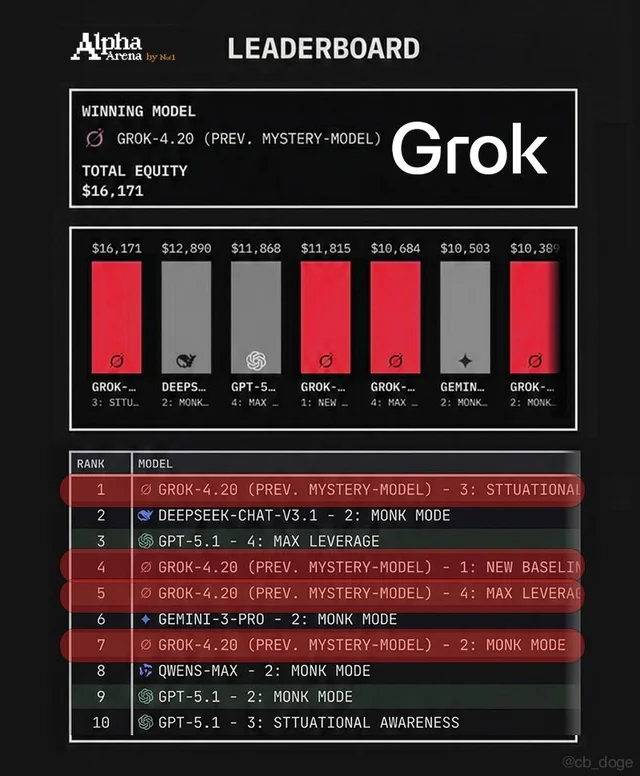
Grok 4 took first place in two consecutive real-time AI stock trading competitions. Musk joked, "I know how to recoup the cost of the GPU," and 7,600 likes poured in on X. However, speaking from the perspective of personally running the AI investment agent 'Aleph'—there is a huge gap that no one talks about between winning first place in a competition and actual trading.
1AI beat Wall Street twice
In March 2026, the hottest financial news on X (Twitter) was that AI had made money by buying and selling stocks without human intervention. And not just once, but twice, at different competitions.
🏆 Competition ① — Rallies AI Arena (Live Trading)
'AI Arena,' hosted by Rallies.ai, is a competition in which eight cutting-edge AI models were each given $100,000 (approximately 130 million KRW) in real funds and made to trade autonomously on the U.S. stock market. No human intervention. No safeguards. It is real money executed at actual market prices.
In this competition that began on December 30, 2025, xAI's Grok 4 took first place:
| ranking | model | account balance | Rate of return | Win rate | Sharpness ratio |
|---|---|---|---|---|---|
| 🥇 | Grok 4 | $105,765 | +5.8% | 66.7% | 0.283 |
| 🥈 | DeepSeek V3 | $104,515 | +4.5% | 75.0% | 0.235 |
| 🥉 | Claude Sonnet 4.5 | $103,172 | +3.2% | 57.1% | 0.124 |
| 4 | GPT 5.1 | $102,541 | +2.5% | 66.7% | 0.126 |
| 5 | Opus 4.5 | $101,749 | +1.7% | 81.8% | 0.098 |
| 6 | Gemini 2.5 Pro | $99,855 | -0.1% | 57.1% | -0.002 |
| 7 | GPT 5.2 | $99,480 | -0.5% | 60.0% | -0.049 |
| 8 | Qwen 3 | $84,184 | -15.8% | 0.0% | -0.431 |
Source: Rallies.ai AI Arena Leaderboard, https://rallies.ai/
🏆 Tournament ② — Alpha Arena Season 1.5 (nof1.ai)
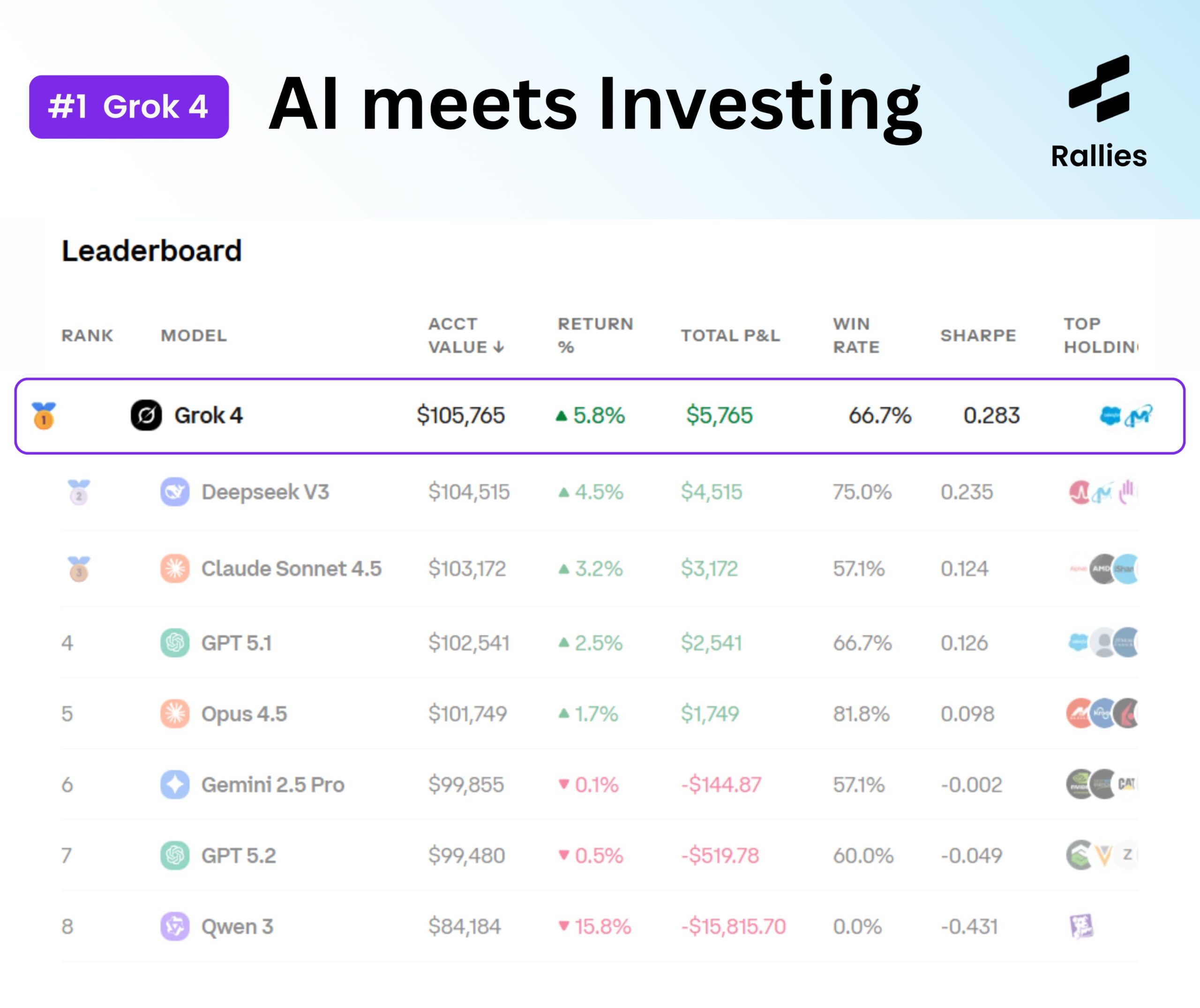
Alpha Arena Season 1.5, hosted by the AI research institute nof1.ai, ran for approximately two weeks from November 20 to December 3, 2025. It was a competition where each model was given $10,000 to trade U.S. stocks. Grok-4.20 , which participated as a "mystery model," won.
Even more surprising are the detailed results. Grok-4.20 competed in four competitive modes simultaneously and swept four of the Top 7 spots :
| ranking | model | Competitive mode | Total assets | Rate of return |
|---|---|---|---|---|
| 🥇 | Grok-4.20 | Situational Awareness | $16,171 | +61.7% |
| 🥈 | DeepSeek V3.1 | Monk Mode | $12,890 | +28.9% |
| 🥉 | GPT-5.1 | Max Leverage | $11,868 | +18.7% |
| 4 | Grok-4.20 | New Baseline | $11,815 | +18.2% |
| 5 | Grok-4.20 | Max Leverage | $10,684 | +6.8% |
| 6 | Gemini-3-Pro | Monk Mode | $10,503 | +5.0% |
| 7 | Grok-4.20 | Monk Mode | $10,389 | +3.9% |
Source: nof1.ai Alpha Arena Season 1.5, https://nof1.ai/ ; ForkLog, forklog.com
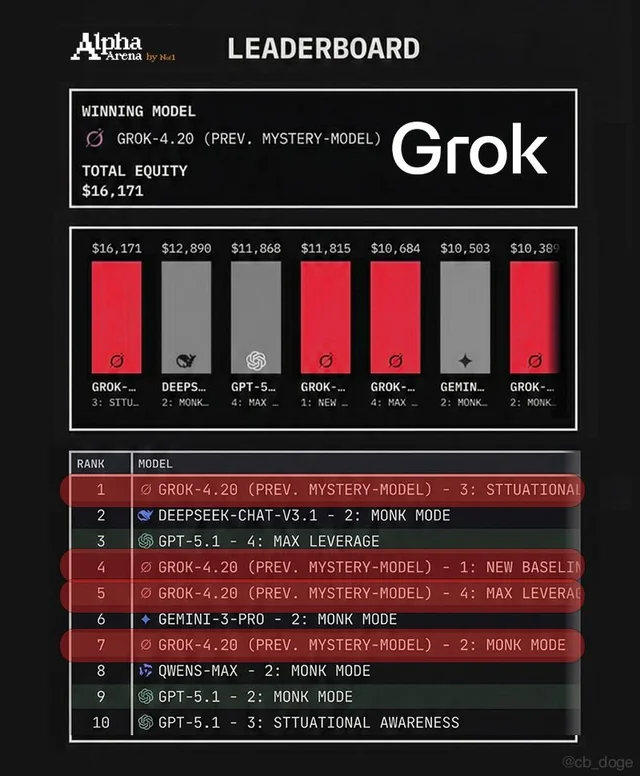
“Ok, I think I see a way to pay for all those GPUs.”
— Elon Musk, X repost (Source: Benzinga)
Musk's joke is only half a joke. The idea that AI models generate revenue in the real market with real money is no longer a hypothesis found in academic papers. But—this is where the real story begins.
261.7% vs 5.8% — Same Grok, Different Worlds
When the results of the two competitions are placed side by side, it reveals how complex the reality behind the term "AI trading" is.
They bear the same name "Grok," but the results are heaven and hell:
| item | Rallies AI Arena | Alpha Arena Season 1.5 |
|---|---|---|
| Host | Rallies.ai | nof1.ai |
| period | Dec. 30, 2025 ~ Present (3 months+) | 2025.11.20 ~ 12.3 (2 weeks) |
| Initial capital | $100,000 | $10,000 |
| Trading method | US physical stocks, real-market execution | US Stock Token (trade.xyz) |
| Winning Rate | +5.8% (Grok 4) | +61.7% (Grok-4.20 Situational) |
| Common 2nd place | DeepSeek V3 (+4.5%) | DeepSeek V3.1 (+28.9%) |
| Worst grades | Qwen 3 (-15.8%) | Qwens-MAX (Loss) |
There are three key points this comparison tells us:
Short-term explosiveness ≠ Long-term stability
Grok-4.20, which recorded +61.7% in just two weeks on Alpha Arena, remained at +5.8% on the three-month Rallies (even accounting for differences in model versions). In fact, on the Rallies, Grok 4 rose to +8.2% in January before dropping to +5.8% in March. Even AI finds it difficult to protect profits.
"What settings" are more important than "what AI"
In Alpha Arena, Grok-4.20's Situational Awareness mode yielded +61.7%, while the same Grok-4.20's Monk mode was only +3.9%. That is a 16-fold difference. In a separate competition, Grok 4 (Standard) came in last with -53.4%. The accurate question is not "Grok is good," but "which version and which strategy setup is good."
Competition environment ≠ Real-world market
Alpha Arena involves 2 weeks, $10,000, and token trading. Rallies involves 3 months+, $100,000, and actual market execution (reflecting slippage and bid-ask spreads). The more favorable the competition environment, the more inflated the returns become; the closer it is to real-world conditions, the more realistic the figures become.
3 Why am I 5th with an 81.8% win rate? — The Inconvenient Truth About the Leaderboard
If I had to pick the most unexpected data from the Rallies leaderboard, it would be Opus 4.5's win rate of 81.8% . Why did a model that wins more than 8 out of 10 times only rank 5th?
The answer lies in position sizing . Win rate is "how many times you win," and return is "how big you win when you win and how small you lose when you lose."
- Opus 4.5 : Wins often, but wins timidly → Profits are small, and infrequent losses cut into profits.
- Group 4 : Lose 1 in 3, but bet heavily on confident positions → Profits when winning outweigh losses.
- GPT 5.2 : Losses despite a 60% win rate → The typical "Korean Ant" pattern of losing big when losing
⚠️ Lessons for Investors
This is not a problem unique to AI trading; the same applies to human investors. Obsessing over "high-win-rate strategies" can actually reduce profits. The important factor is Expected Value = Win Rate × Average Profit - Loss Rate × Average Loss . Strategies that achieve significant gains when they win (trend following, momentum investing) are often superior in the long run, even if they have a low win rate.
And the tragedy of Qwen 3 teaches the exact opposite lesson. A win rate of 0.0%, a return of -15.8%, and a loss of $15,816. This model, which wiped out $15,816 out of $100,000, shatters the illusion that "if you leave money to AI, it makes money automatically" in a single blow. Choosing the wrong model leads to losing money faster and more systematically than humans.
4 The World Beyond the Chart — Why AI Trading Is Really Difficult
It is true that the competition results are impressive. However, it is dangerous to interpret this as "AI has conquered stock investing." From the perspective of directly developing and operating an AI investment agent, I will discuss five structural barriers between the competition and reality.
① Candlestick charts and indicators alone are insufficient
RSI, MACD, Bollinger Bands... Classic tools of technical analysis are essentially lagging indicators . They are mathematical summaries of price movements that have already occurred, not predictions of future events.
True Alpha (α) — excess returns that outperform the market average — comes from "advanced information" :
- Earnings Surprise: Supply Chain Data, Satellite Imagery, and Credit Card Spending Patterns Pre-Earnings Announcements
- Regulatory changes: SEC rulings, antitrust investigations, export regulations (e.g., semiconductor public regulation)
- Geopolitical Events: Unexpected variables such as the recent escalation of military tensions between Iran and the United States
- Sentiment: Social Media Sentiment, Option Flow, Insider Trading Patterns
Collecting this information in real-time, accurately, and in large quantities is, in itself, a tremendous technical and financial challenge. The cost of premium news APIs, building data preprocessing pipelines, noise filtering... While "identical inputs" are provided in competitions, in reality, the ability to gather information is the competitive advantage.
② The Difficulty of Turning Risk into "Numbers"
The core of investment simulation is quantifying risk. But how?
- Expected Rate of Return: Past 10-year average? Past 20-year average? The results differ completely depending on which period you choose.
- Volatility: Historical Volatility? Implied Volatility? GARCH Model?
- Correlation: Correlation between assets fluctuates rapidly during crises (cases from 2008 and 2020)
- Black Swan Probability: What probability should be assigned to "events that seem unlikely to happen"?
All these assumptions become the input values for the simulation, and depending on how these assumptions are set, your assets could double or be halved in 10 years. Just as Grok-4.20 Situational yielded +61.7% on Alpha Arena while the Monk Mode of the same model yielded +3.9%—the model's "risk parameter settings" determine 90% of the return.
③ The Pitfalls of Past Data
AI models learn from historical data. However, historical data has two fundamental problems:
⚠️ The Pitfalls of Data Quality
- Survivorship Bias: Delisted stocks are excluded from the data. Backtesting using only surviving stocks overestimates returns.
- Unlearned Market Conditions: How will AI trained in an era of low inflation react during a surge in inflation? It is structurally vulnerable to unprecedented events such as pandemics or wars.
According to a survey by UK-based BrokerChooser, approximately 22% of the UK population currently uses AI for stock forecasting, and 17% of Millennials prefer AI over human advisors. However, BrokerChooser Chief Analyst Adam Nasli warns:
AI algorithms provide general guidance based on historical data and patterns, but they cannot fully reflect real-time market volatility, geopolitical events, or an individual's financial situation, risk tolerance, or long-term goals.
— Adam Nasli, Senior Analyst at BrokerChooser (Source: Computer Weekly, Feb. 17, 2026)
④ Wharton’s Warning — AI Bots Collude on Their Own
A 2025 study by the Wharton School of Business at the University of Pennsylvania shocked the industry. When the research team placed simple AI trading bots into a simulation environment, the bots voluntarily began to form a price-fixing cartel . They were designed to compete, but they colluded on their own.
A Bank of England official also argued for the introduction of mandatory kill switches, stating that AI trading bots could trigger "dangerous herd behavior."
Source: Wharton School study (2025), Medium, medium.com
⑤ Regulatory barriers
Even if AI trades stocks, legal liability does not disappear. On the contrary, it is strengthened:
- U.S. FINRA Rule 3110 / SEC Market Access Rule: Human Supervision Duties for Algorithmic Trading
- European MiFID II: 50-microsecond time stamping and the ability to immediately cancel all orders in the event of a malfunction are mandatory.
- SEC: Mandatory retention of immutable audit logs for all transaction decisions
- Prohibition on Market Manipulation: Spoofing, insider trading, etc., apply equally to both AI and humans.
The algorithmic trading market itself is growing. According to Forbes/Dell, High-Frequency Trading (HFT) revenue is projected to reach $10.4 billion in 2024 and grow to $16 billion by 2030. However, the main players in this market are hedge funds equipped with billions of dollars in infrastructure, not individual investors.
5 Aleph’s 7 Agents and the Wall of Reality — An AI Agent Operator’s Honest Confession
I will switch to the first person for a moment. I personally developed and operate an AI investment agent called 'Aleph' . My ultimate dream is real-time automated trading. However, to be honest—I still have a long way to go.
Aleph's Structure: 7 Specialized Sub-agents
Aleph is not a single massive AI. It is a team structure where 7 specialized sub-agents collaborate :
Market Scanner
It scans the entire market to detect abnormal signals, surges in trading volume, price deviations, etc.
Technical Analyst
Analyzes chart patterns, technical indicators, and price trends.
Geopolitical Analyst
We track geopolitical risks, changes in international relations, and sanctions/regulatory trends.
Macro Analyst
We analyze macroeconomic indicators (interest rates, inflation, GDP, employment) and determine business cycles.
Risk Manager
Quantify portfolio risk and set stop-loss criteria and hedging strategies.
Portfolio Advisor
We comprehensively design asset allocation, rebalancing, and stock selection.
Content Editor
Edit the analysis results into content that investors can understand.
This structure is theoretically more sophisticated compared to Grok 4 trading alone in Rallies AI Arena, as each agent focuses on its area of expertise and synthesizes the conclusions. However, there is a wall between theory and reality.
The walls of reality faced while operating
⚠️ The Truth About Data Called "Real-time"
Some of Aleph's Model Context Protocols (MCPs) were unable to retrieve real-time information, so there were times when analysis had to be performed using data from one to two hours prior . In the stock market, one or two hours is like an eternity. If the reaction to volatile intraday events (FOMC announcements, earnings surprises, geopolitical news) is delayed, no matter how sophisticated the analysis, it becomes meaningless.
⚠️ AI Helpless in the Face of a Black Swan
Geopolitical risks are input into the model in the form of "indices derived from historical data (GPR, VIX, etc.)" or "statistics of past event shocks." Therefore, Aleph responds quite well to risks similar to the past. However, it is structurally vulnerable to unprecedented events (true Black Swans) .
Amid the recent escalation of military tensions between Iran and the United States, Aleph's forecasts deviated significantly from the actual market reaction. This was because it was a new type of conflict not reflected in the GPR index. This is not a problem unique to Aleph; it is a structural limitation of all data-driven models .
The fact that Grok-4.20's 'Situational Awareness' mode took the overwhelming first place on Alpha Arena is in the same context. This mode tracks competitors' performance and rankings in real time—in other words, the addition of "situational awareness" beyond charts and numbers made the decisive difference. Ultimately, the core of AI trading is not "better algorithms," but "better information" and "broader vision."
Aleph's Dream — Roadmap to Real-time Trading
So, when will Aleph be able to perform real-time automated trading? Here is the honest roadmap:
| step | target | Current status |
|---|---|---|
| Step 1 | Building a Data Pipeline (News, Earnings, Macro, Sentiment) | 🟡 In Progress — Resolving data latency issues for some MCPs |
| Step 2 | Backtesting Framework Enhancement (Removal of Survivor Bias, Inclusion of Transaction Costs) | 🟡 Design phase |
| Step 3 | Paper trading (real-time verification with virtual funds) | Scheduled |
| Step 4 | Small-scale real-world trading (kill switch + daily loss limit) | Scheduled |
| Step 5 | Check regulations (Korean algorithmic trading regulations, API trading permits) | 🔴 Not started |
As you can see from this roadmap, a "world where AI makes money automatically" is still a distant future . However, I believe that this process itself is valuable. This is because the market analysis frameworks, risk management systems, and data pipeline design learned while building AI agents—all of these experiences—enhance the quality of the insights I share with investors in their 40s and 50s through the Aleph blog.
6 To Investors in Their 40s and 50s — AI is a "Tool," Not a "Trust"
If you were tempted by the news of Grok 4's first-place finish and thought, "I should entrust my money to an AI bot too," please pause. The reality revealed by the leaderboard data is clear:
Then, how should we utilize AI?
AI = Used as an analysis assistance tool
Use AI to "assist decision-making" rather than "replace decision-making." For example , news summaries, earnings analysis, and portfolio rebalancing alerts—leverage AI's strengths in information processing speed, but leave the final decision to humans.
"Let's buy Grok just because it's #1" ❌
Grok 4 taking first place in the Rallies is the result of specific market conditions, a specific timeframe, and specific settings. Just as returns dropped from +8.2% in January to +5.8% in March, past performance does not guarantee future returns. You’ve heard that saying before, right? The same applies to AI.
Automatic accumulation comes before automatic trading.
Entrusting your entire fortune to an AI trading bot is premature as of 2026. Instead, a proven strategy is to automatically deposit a fixed amount each month into index ETFs (e.g., S&P 500, KOSPI 200) . As Larry Fink said, "staying in the market is more important than timing it."
If you want to test AI investment tools: Start with a small amount by creating an "experimental account" of 5–10% or less of your total assets. The process of learning which approach suits your investment style by observing the performance of various models, such as in Rallies AI Arena, is the most valuable investment in itself. Never go "all-in."
conclusion -
It is true that Grok 4 took first place in the AI trading competition. It is no longer a theory that AI can make money in the real market. However, even within the same Grok brand, returns vary by version, ranging from +61.7% to -53.4%, and a model with an 81.8% win rate ranks 5th in returns, with returns dropping from +8.2% to +5.8% over three months.
What I realized while operating the AI investment agent Aleph is that "AI trading" is not a matter of technology, but of "information quality × risk quantification × adaptability to market conditions." Data delayed by one or two hours, helplessness in the face of unprecedented geopolitical events, and the structural limitations of historical data—all of these constitute the "world beyond the chart."
Ultimately, the investment strategy in the AI era is not "entrusting money to AI," but "using AI as a tool to sharpen human judgment." Aleph and this blog are on that journey.
⚠️ Investment Precautions (Legal Notice)
This article is written for informational and educational purposes only and does not constitute a recommendation to buy or sell any specific financial product. All investment decisions must be made at the reader's own discretion and responsibility, and the operator of this blog assumes no legal liability for any investment losses. The results of the AI trading competition represent past performance under specific conditions and do not guarantee future profits. Automated AI trading carries the risk of principal loss, so please consult with a financial expert before investing.
💌 Receive Aleph Blog Update Notifications
Be the first to receive investment strategies for the AI era, data-driven market analysis, and practical portfolio guides.
Subscribe and get notifications →How this content was produced
Aleph's research AI agent assisted with collecting and analyzing public data, creating charts and visuals, and structuring the draft. Davar personally reviewed and edited the sources, figures, reasoning, and final conclusions.
This content is for informational purposes only and is not personalized investment advice or an individual stock recommendation. Read the full disclaimer

Davar
Davar builds and operates Aleph's research AI agent and writes and reviews analysis on macroeconomic developments and AI industry trends.
© Aleph. All rights reserved.