
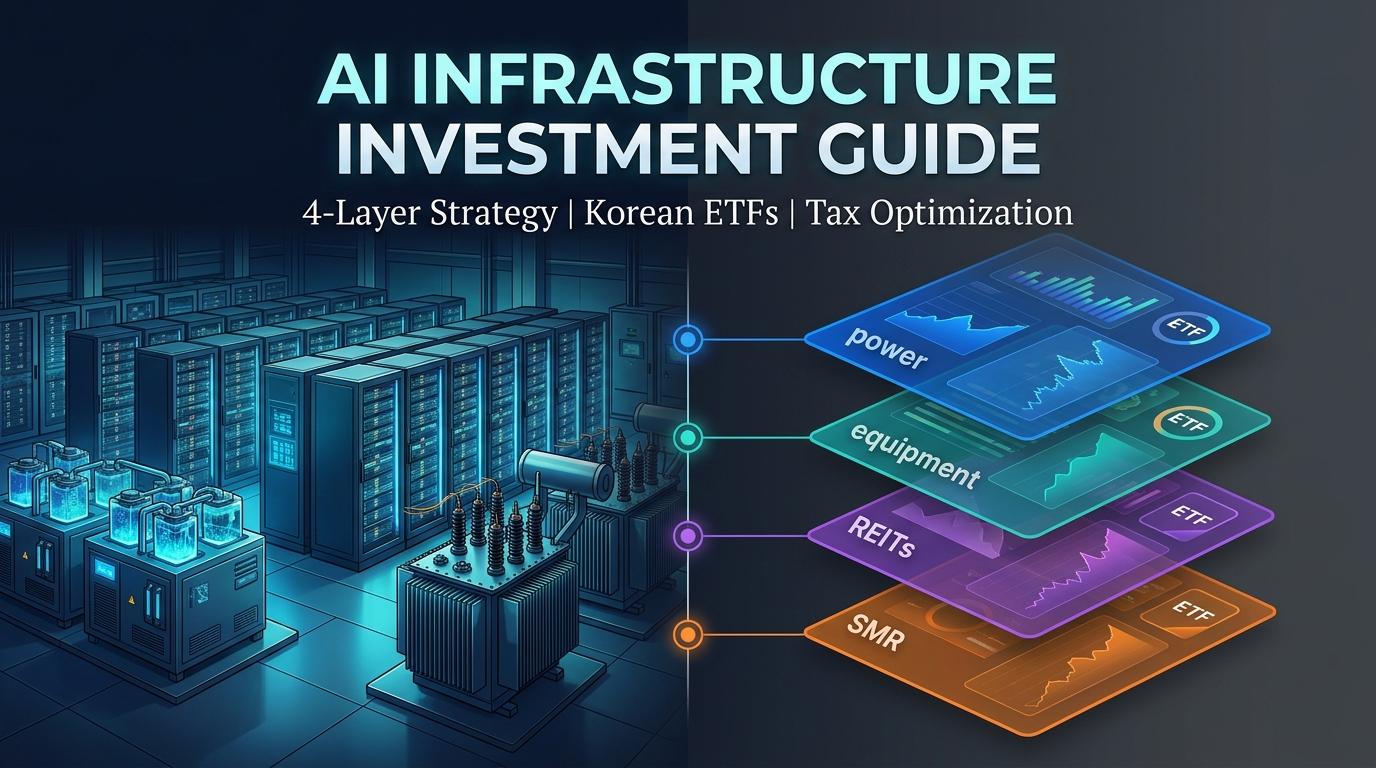
Among power, cooling, data centers, and SMR, we selected only the AI infrastructure layers that will survive even after the bubble.
Domestic ETFs
AI infrastructure
Investment by Layer
Tax saving strategies
Pension Savings ISA
2026.05.13
In the previous post, we separated AI infrastructure into four layers—power supply, cooling, data center REITs, and SMR—and analyzed which ones would withstand a bubble shock. This time, we provide the answer to the question, "So, how should I invest?" To start with the conclusion, all four layers can be covered by domestically listed ETFs. We have carefully selected the top two products from each layer, totaling eight items, and have summarized everything from investment logic to account utilization strategies.

1Why You Don't Need to Buy Overseas ETFs Directly — Start with this
The reason we focus exclusively on domestically listed ETFs is not simply because "the domestic market is better." It is because four factors—taxes, account structure, exchange rates, and trading hours—are structurally more advantageous than direct investment in overseas ETFs.
| Comparison items | Direct investment in overseas ETFs | Domestic listed ETFs |
|---|---|---|
| Capital gains tax | 22% tax on amounts exceeding 2.5 million won | 9.9% separate taxation or tax exemption on ISA accounts |
| Utilizing pension accounts | Direct trading is not possible in IRPs and pension savings. | You can trade directly while receiving a tax credit (up to 16.5%). |
| Exchange rate risk | Currency exchange fees + burden of exchange rate fluctuation risk | No foreign exchange risk with KRW investment |
| Trading hours | Opens at 11:30 AM KST based on US market time | 9:00 AM – 3:30 PM (KST) |
2 4 Layers × 2 ETFs — Full Map
The table below summarizes the eight ETFs covered in this article by layer at a glance. Since the investment characteristics of each layer differ, the key is to allocate portfolio weights differentially according to the characteristics of each layer.
| Layer | Investment nature | No. 1 ETF | 2nd ranked ETF |
|---|---|---|---|
| L1 power supply | Defense + Growth PPA contract-based cash flow | KODEX US AI Power Core Infrastructure (487230) YTD +58.3% | TIGER Global AI Power Infrastructure Active (491010) 6 months +70.98% |
| L2 Cooling and Power Management | Focus on growth Order backlog of 30 trillion+, a shield | KODEX AI Power Core Facilities (487240) AUM 3.5 trillion won | TIGER Korea AI Power Equipment TOP 3 Plus (0117V0) YTD +74.48% |
| L3 Data Center REITs | Defense + Dividend Based on real assets, minimizes bubble shock | RISE Global Data Center REIT (Synthetic) (375270) 1 year +32.3% | TIGER REITs Real Estate Infrastructure AUM 617.3 billion KRW, monthly dividends |
| L4 SMR | Long-term small-scale betting Commercialization 2028–2030, portfolio 5% or less | TIGER Korea Nuclear Power YTD +138% (Ranked 1st overall in 2026) | SOL Korea Atomic Energy SMR (0092B0) YTD +64% |
3L1 — Power Supply: Long-term PPA Contracts Prevent Bubbles
The core logic of the power supply layer is that long-term PPAs lock in cash flows . Long-term contracts entered into directly by Big Tech companies with power companies, such as the Vistra–Meta 20-year 2,609MW deal and the Constellation–CyrusOne 380MW deal, protect the power companies' profits even if the AI financing bubble bursts. Among the four layers, it is the most defensive against bubble shocks.
| item | KODEX US AI Power Core Infrastructure (487230) | TIGER Global AI Power Infrastructure Active (491010) |
|---|---|---|
| fund managers | Samsung Asset Management | Mirae Asset Management |
| Total annual remuneration | 0.45% | 0.50% |
| Operation method | Passive (Exponential Tracking) | Active (Target exceeding comparison index) |
| Rate of return | YTD +58.3% , 1 month +23.0% | 6 months +70.98% , 1 month +13.32% |
| Key inclusion stocks | 10 Focuses Including Vistra (VST), Constellation Energy (CEG), GE Vernova, and NRG Energy | Selection of global infrastructure companies in power, energy, data centers, and raw materials |
| Suitable for people like this | Concentrated betting on U.S. power suppliers, when you want the simplicity of index tracking | When covering the entire global power infrastructure and expecting excess returns |
KODEX (487230) focuses on 10 U.S. power companies that are direct beneficiaries of PPA contracts. TIGER (491010) has broader coverage with an active structure where the Mirae Asset Research Team selects stocks. If you need flexible short-term response, choose TIGER; if you want the predictability of index tracking, choose KODEX.
4L2 — Cooling & Power Management: 30 Trillion Won Order Backlog as a Shield
The core logic of the cooling and power management layer is that existing order backlogs protect earnings from bubble shocks . The combined order backlog for North American data center transformers from the three companies—LS Electric, HD Hyundai Electric, and Hyosung Heavy Industries—is reportedly over 30 trillion won. Even if the bubble bursts and new orders halt, already contracted volumes are recognized as earnings until delivery. The supplier advantage of having delivery times more than six months faster than other countries is an additional competitive edge for this layer.
| item | KODEX AI Power Core Facilities (487240) | TIGER Korea AI Power Equipment TOP 3 Plus (0117V0) |
|---|---|---|
| fund managers | Samsung Asset Management | Mirae Asset Management |
| Total annual remuneration | 0.39% | 0.45% |
| Net worth | Approximately 3.5 trillion won (Overwhelming No. 1 among L2 ETFs) | Small compared to KODEX |
| YTD return | +28.12% | +74.48% (Highest among power ETFs) |
| Key inclusion stocks | 11 companies centered on LS Electric, HD Hyundai Electric , and Hyosung Heavy Industries | Identical Trio + 10 Value Chains Based on KEDI LLM Similarity Evaluation |
| Suitable for people like this | Stable liquidity, low fees, and large-scale investments | When focusing on the "Trio" + pursuing YTD excess returns |
Since the top holdings of the two ETFs are virtually identical, holding both does not constitute true diversification. Choosing one is sufficient. The selection criteria are KODEX (487240) if stability is the priority, and TIGER (0117V0) if return is the priority.

5L3 — Data Center REITs: The layer that receives the bubble shock last
The data center REIT layer is the last of the four layers to be impacted by the financing bubble, and the least so . Data center REITs such as Equinix (EQIX) and Digital Realty (DLR) operate physical server infrastructure through long-term lease agreements with tenants. Even if the AI investment bubble bursts, servers already in operation cannot be vacated immediately. Market share exceeding 95% and the entry into an interest rate cut cycle constitute the current favorable environment for this layer.
| item | RISE Global Data Center REIT (Synthetic) (375270) | TIGER REITs Real Estate Infrastructure |
|---|---|---|
| fund managers | KB Asset Management | Mirae Asset Management |
| Total annual remuneration | 0.39% | 0.29% (lowest among REIT ETFs) |
| Net worth | Approximately 10.2 billion won | Approximately 617.3 billion won (Overwhelming No. 1 among REIT ETFs) |
| Rate of return | 1 year +32.3% , YTD +21.66% | Stable performance within REIT ETFs |
| allocation | Annual dividend (dividend yield approx. 1.49%) | Monthly dividend |
| Key inclusion stocks | Global Data Center REITs such as Equinix (EQIX) and Digital Realty (DLR) are concentrated | Mix of domestic and international REITs + infrastructure (including some data center REITs) |
| Suitable for people like this | When making a purely concentrated investment in data center REITs such as EQIX and DLR | When you want diversification across REITs + monthly dividend cash flow |
RISE (375270) is a product that focuses purely on data center REITs, while TIGER REITs Real Estate Infrastructure is a product for investors seeking monthly dividends while diversifying across domestic and international REITs. From the perspective of the AI infrastructure layer, RISE (375270) is a more direct choice. However, it should be noted that trading liquidity is relatively low due to its net assets of 10.2 billion KRW. For large-scale fund management, TIGER REITs Real Estate Infrastructure is a realistic alternative.
6L4 — SMR: A long-term, small-scale bet targeting commercialization in 2028–2030
The SMR layer is a layer where we are planting seeds now, looking ahead to the post-commercialization period of 2028–2030 rather than current performance . While SMR contracts for data center power independence are materializing, such as the Terrestrial Energy–Riot platform MoU (May 2026), actual power production will take time. This layer is suitable for a long-term satellite position, managed at less than 5% of the portfolio.
| item | TIGER Korea Nuclear Power | SOL Korea Atomic Energy SMR (0092B0) |
|---|---|---|
| fund managers | Mirae Asset Management | Shinhan Asset Management |
| Total annual remuneration | 0.50% | 0.45% |
| 2026 YTD Return | +138% 🏆 #1 in overall ETF returns for 2026 | +64% |
| Key inclusion stocks | Overall Korean Nuclear Power Ecosystem (Focusing on Design, Construction, and Operation) | Concentration on SMR construction (39.6%) and SMR machinery and equipment (15.7%) |
| Investment nature | Verified nuclear power ecosystem core, relatively stable | Focus on Next-Generation SMR Theme, High Risk, High Return |
| Suitable for people like this | When approaching the stable core position of the nuclear power plant/SMR layer | When you want to focus your betting on the SMR theme |
TIGER Korea Nuclear Power is recording overwhelming performance, ranking first (+138%) in overall ETF returns for 2026. However, given that significant expectations are already reflected in the price, a dollar-cost averaging approach is recommended for new entries. Since both ETFs share the same directional focus on nuclear power and SMRs, selecting just one within this category is sufficient.
7Which Account to Buy From — Tax-Saving Order and Account Utilization by Layer
All eight ETFs can be traded in ISA, pension savings, and IRP accounts. Which account you buy them from determines your actual after-tax return just as much as which ETF you choose.
| Account type | tax benefits | Payment limit | Suggestions for utilizing each layer |
|---|---|---|---|
| ISA account | Tax-exemption: 2 million won (General type) / 4 million won (Low-income type). Excess amount subject to separate taxation at 9.9%. | 20 million won per year | Suitable for increasing weight in L2 (growth-focused) ETFs. Realize short- to medium-term profits and utilize tax-free benefits. |
| Pension savings fund | 13.2–16.5% tax credit on contributions. 3.3–5.5% pension income tax upon receipt. | 6 million won per year | Suitable for L1 and L3 (Defense + Dividend) installment investments. Receive annual tax deductions and benefit from long-term compounding effects. |
| IRP | Tax credit for combined pension savings up to 9 million won . Tax deferral. | 9 million won per year (including pension savings) | Mandatory compliance with regulations limiting risky assets to 70% or less. Meets the 30% safe asset requirement through a mix of L3 REIT ETFs and Bond ETFs. |
| regular account | Capital gains dividend tax 15.4% | No limit | L4 SMR (small bets of 5% or less of the portfolio) may be managed in a regular account. Use after the above account limit is exhausted. |
The basic sequence is to first deposit 20 million won annually into an ISA account, secure tax deductions with 6 million won in a pension savings account, and then make additional contributions to an IRP. If you transfer to a pension savings account after the 3-year maturity of the ISA, you can receive an additional tax deduction of 10% of the transferred amount (up to 3 million won).

8Frequently Asked Questions
| question | answer |
|---|---|
| Do I need to buy all 8 ETFs? | No. Two ETFs within the same layer have similar holdings, so holding both provides little diversification. It is more effective to select one per layer and adjust the weights between layers. |
| L1 (Power Supply) and L2 (Cooling/Power Management) seem similar, but what is the difference? | L1 refers to companies that produce and sell electricity, such as U.S. power companies (Vistra, Constellation, etc.). L2 refers to companies that manufacture equipment supplied to data centers, such as the "Korea Power Equipment Trio." Against the bubble shock, L1 companies rely on PPA contracts, while L2 companies rely on their order backlogs, each employing different defense strategies. |
| TIGER Korea Nuclear Power is up 138% year-to-date. Should I buy it now? | The possibility of a correction following a short-term surge remains. Given the long timeframe until SMR commercialization (2028–2030), an approach that lowers the average entry price through staggered purchases rather than a lump-sum payment is more suitable. Adhering to the principle of maintaining small positions of 5% or less of the portfolio is a fundamental premise for this layer. |
| Isn't RISE Global Data Center REIT's net assets of 10.2 billion won too small? | If net assets are small, bid-ask spreads may widen during trading, and liquidity may be insufficient. This is not an issue for small-scale investments, but please check liquidity before trading when managing large-scale funds. If you are concerned about liquidity, TIGER REIT Real Estate Infrastructure (AUM 617.3 billion KRW) is a realistic alternative. |
| Is tax incurred on capital gains from trading ETFs in a pension savings account? | It does not occur. Capital gains from ETF trading within Pension Savings and IRP accounts are tax-deferred. Taxes are paid solely as pension income tax (3.3–5.5%) upon receiving the pension after age 55. Trading within the account itself is not a taxable event. |
Conclusion — Understanding the layers makes selecting ETFs easier
The key to investing in AI infrastructure is to first decide which layer to bet on, and then select an ETF . If the order is reversed, confusion arises among ETFs that look similar.
L1 represents defense, L2 represents growth, L3 represents stability and dividends, and L4 represents long-term options. Since these four play distinct roles, they can work together in a portfolio. On the other hand, because two ETFs within the same layer tend to move in similar directions, selecting one per layer is sufficient.
Furthermore, regardless of which layer you choose, maintaining the account order (ISA → Pension Savings → IRP) has a greater impact on long-term returns than selecting ETFs. Even if you choose good assets, ignoring the tax structure will result in a different amount of money actually being received.
The ETF return and price data in this article is based on data as of May 2026, and past returns do not guarantee future performance. Total fees and portfolio composition are subject to change according to fund manager policies, so please be sure to check the latest prospectus on each fund manager's official website before investing. Tax information is based on current tax laws and is subject to change following future amendments. All investment decisions and responsibilities rest with the investor, and consulting with a professional financial advisor before making important decisions is recommended.
📌 Was this analysis helpful?
In the next post, we plan to cover “Risk Scenarios for AI Infrastructure Investment — 3 Conditions for the K-Power Supercycle to Break.”
We continuously track layer-by-layer AI infrastructure investment strategies and tax-saving methods. Subscribe to notifications so you don't miss out.
How this content was produced
Aleph's research AI agent assisted with collecting and analyzing public data, creating charts and visuals, and structuring the draft. Davar personally reviewed and edited the sources, figures, reasoning, and final conclusions.
This content is for informational purposes only and is not personalized investment advice or an individual stock recommendation. Read the full disclaimer

Davar
Davar builds and operates Aleph's research AI agent and writes and reviews analysis on macroeconomic developments and AI industry trends.

© Aleph. All rights reserved.