
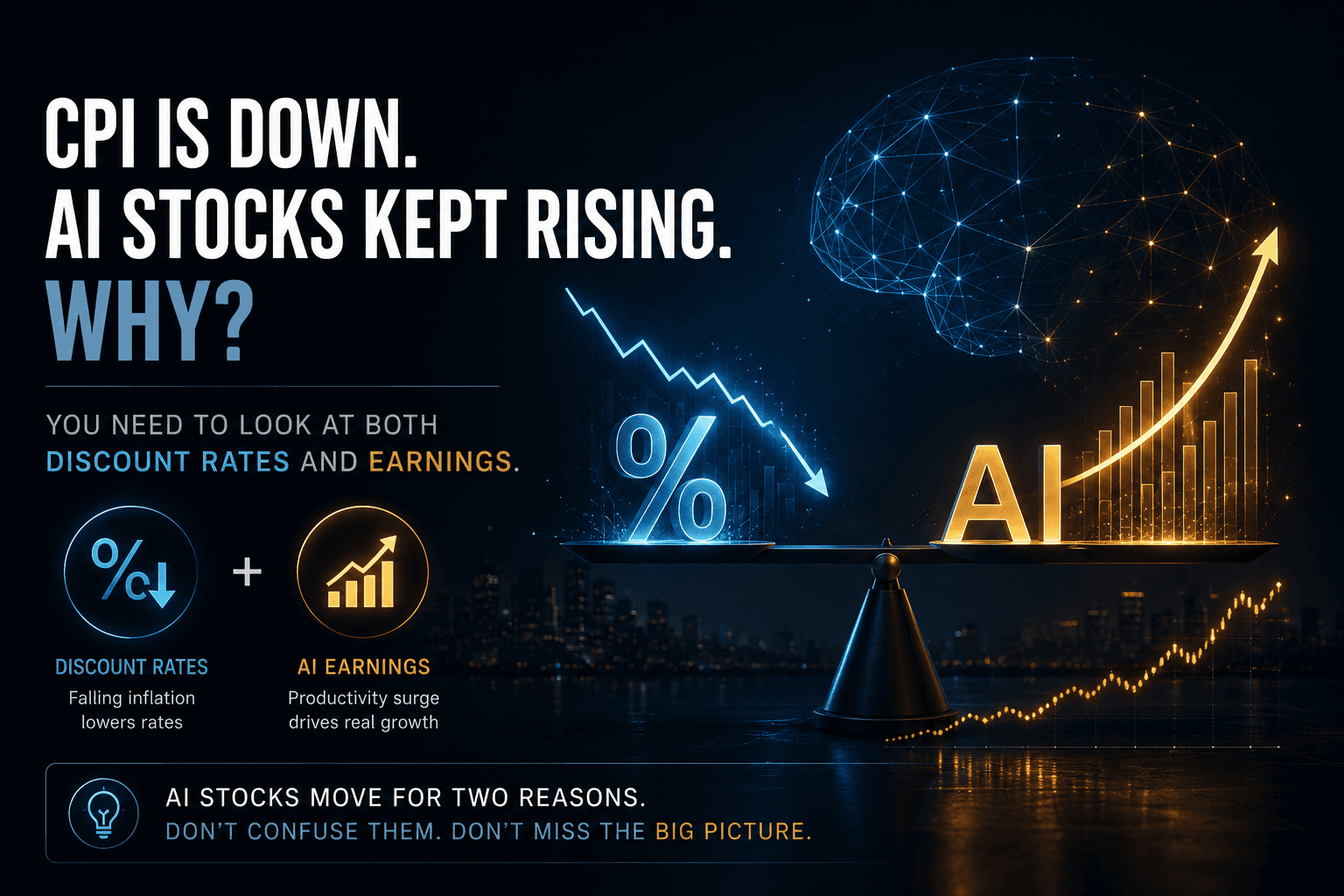
Low CPI lowered the discount rate of AI stocks, but it could not sustain the rally to the end.
On July 14, the market first breathed a sigh of relief when the U.S. June CPI came in lower than expected. Nasdaq AI and semiconductor stocks showed strength on news that the headline CPI had fallen 0.4% from the previous month, and the gains widened the following day as the PPI also dropped unexpectedly. Low inflation eased the burden of interest rates and seemed to briefly justify the high valuations of AI and semiconductor stocks.
However, not long after, the market began to ask a different question. Why did semiconductor stocks waver even though the CPI had fallen? Why did Korean AI-related stocks fall even more sharply? The answer is simple. While a low CPI can lower the discount rate, what ultimately sustains the rise of AI stocks is actual orders, profits, and cash flow.
If we examine the recent price decline itself, one more question remains. Is this price drop a result of AI making the economy more efficient, or is it the result of falling oil prices as tensions in the Middle East temporarily eased? Depending on how much AI productivity and falling energy prices contributed to this price slowdown, respectively, the way the current volatility of AI-related stocks is interpreted will also differ.
Immediately after the announcement of the CPI and PPI, the market reacted to the easing of interest rate pressures, but subsequently, AI and semiconductor stocks showed significant volatility again. The Korean KOSPI plummeted amid selling off AI-related stocks and concerns over a renewed rise in oil prices, while Brent crude also rose back to around $90 per barrel. This article focuses on examining how easily the rally can be shaken, rather than on the relief rally created by the low CPI.

1CPI and PPI have clearly improved.
Looking solely at the numbers, the June inflation figures were clearly positive. According to the U.S. Bureau of Labor Statistics (BLS), the June CPI fell 0.4% from the previous month on a seasonally adjusted basis. This decline was larger than the market expectation of -0.1%.
The unseasonally adjusted year-over-year growth rate also fell significantly from 4.2% in May to 3.5% in June. The core CPI, excluding food and energy, remained flat at 0.0% compared to the previous month and recorded 2.6% year-over-year.
The PPI also pointed in the same direction. The final demand PPI fell 0.3% compared to the previous month. This was a lower-than-expected result, as the market had anticipated a flat trend. The year-on-year growth rate also dropped from 6.5% in May to 5.5% in June.
The market reacted swiftly as well. Immediately after the CPI announcement, concerns about further tightening eased in the interest rate futures market, and the Nasdaq and major semiconductor stocks also showed strength. The market accepted the lower inflation as a factor to ease the burden of discount rates.
What is more important than the fact that prices have gone down is what drove them down.
2However, the protagonist was energy rather than AI.
If you break down the components of the CPI and PPI, the item that contributed most to this decline becomes apparent. It is energy.
The energy index in the CPI fell 5.7% in June. This reversed the upward trend that had continued from March to May. The BLS explained that falling energy prices led the decline in the headline CPI, offsetting increases in housing and food prices.
The PPI was similar. Prices for final demand goods fell by 1.4%, with energy prices dropping by 6.4% and gasoline prices by 12.0%. On the other hand, prices for final demand services rose by 0.2%, and the final demand index excluding food, energy, and trade services also increased by 0.1%.
To understand this trend, we must look at why energy prices suddenly plummeted after soaring throughout the spring. Brent crude near-month futures rose to $126 per barrel during trading on April 30. Subsequently, as ceasefire negotiations between the U.S. and Iran progressed and more oil tankers exited the Strait of Hormuz, Brent crude near-month futures fell to the $72 per barrel range as of the closing price on June 25.
Looking at the month of June alone, it amounts to a decline of over 20%. The decline in energy prices in the June CPI and PPI can be seen as largely reflecting the reversal of international oil and gasoline prices.
There are three facts confirmed so far.
- Confirmed fact: Energy and commodity prices dragged down headline indicators significantly, while service prices did not slow down as quickly as commodity prices.
- Reasonable interpretation: This price improvement is largely due to the normalization of energy prices rather than broad productivity gains.
- Unconfirmed inference: The claim that the introduction of AI lowered unit production costs, thereby directly reducing CPI and PPI.
The fact that final demand service prices and the PPI excluding food, energy, and trade services have still risen does not lend weight to the argument that AI productivity has directly lowered prices.
The energy stability demonstrated by June prices is already being put to the test again as I write this. The ceasefire began to waver again in mid-July as the U.S. resumed a naval blockade and airstrikes against Iran, and Iran attacked the Gulf region.
In the aftermath, Brent crude futures for the nearest month rose to the $85–$86 range as of the closing price on July 15. Although this is lower than the intraday high of $126, it represents a significant rise again in just a few weeks compared to the $72 range at the end of June.
Even if this CPI has lowered the discount rate burden on AI stocks, the energy stability that served as its premise is already wavering again.
What 3AI defended was growth, not prices.
Why are the OECD and IMF still wary of the price path even though the CPI and PPI have declined? The reason is that monthly price indicators and annual forecasts cover different timeframes.
The CPI and PPI show how prices have moved over the course of a month. In particular, highly volatile items such as energy are quickly reflected in the monthly indicators. On the other hand, the annual forecasts of the OECD and IMF include the overall average price level for 2026, the cumulative effects of energy and food shocks, wage and service prices, inflation expectations, and the continuity of monetary policy.
It can be simultaneously true that monthly prices have decreased and that the average price level for this year remains high.
In its June Economic Outlook, the OECD projected the G20 consumer price inflation rate at 4.0% in 2026 and 3.1% in 2027. In its July WEO update, the IMF raised its global inflation forecast for 2026 from 4.4% to 4.7% and for 2027 from 3.7% to 3.9%.
Both institutions are wary of the possibility that inflationary pressures could persist longer than expected. In particular, the IMF warned that monetary policy could be less accommodative than market expectations, and that nominal interest rates could rise in some countries to maintain real rates.
In fact, similar signals appeared in the June dot plot as well. At the first FOMC meeting under Chair Kevin Warsh held on June 16–17, the benchmark interest rate was kept unchanged at 3.50–3.75%, but the dot plot became more hawkish than before. Expectations for a rate cut within the year, which were reflected in the March forecast, receded in the June dot plot.
Half of the 18 FOMC participants who took part in the June economic outlook projected that the benchmark interest rate would be higher by the end of the year than it is now. This indicates that while the Fed has confirmed a slowdown in inflation, it is not completely ruling out the possibility of further tightening.
This logic is also consistent with the direction I pointed out in "Wash FOMC — The Problem Is Inflation, Not Interest Rates," which I discussed earlier.
The IMF analyzed that AI hardware exporting countries are showing a relatively strong growth trajectory even amidst energy shocks. The OECD also cited the robust semiconductor cycle as the background for the upward revision of Korea's growth rate. Major hyperscalers such as Microsoft, Alphabet, Amazon, and Meta are expanding their investments in data centers and AI infrastructure even in 2026.
The IMF grouped South Korea, Taiwan, Malaysia, and Thailand into the top four countries for AI hardware exports. These countries are partially offsetting the burden on growth caused by energy shocks and high interest rates through the expansion of the technology cycle.
What remains unconfirmed is whether AI productivity has actually lowered costs and service prices. A spread of productivity leading to a decline in unit labor costs across industries or a slowdown in service prices is not yet clearly observed. Surveys of various companies and economic experts also assess that it will take a significant time lag before AI investments are reflected in overall industry productivity statistics.
There are differing views even within the Fed. Chair Warsh has emphasized the possibility that AI could lower inflationary pressures by increasing supply capacity in the long term. On the other hand, Director Cook has cautioned that increased investment in AI could boost demand for semiconductors, high-tech equipment, construction workers, electricity, and water in the short term.
This interpretation also follows the points I raised in Part 4 of the inflation series , "Can AI Beat Inflation? — The Answer Lies in the Unit Price of Inference."
If AI lowers prices, the signal is likely to appear first in inference unit price competition rather than in overall industry productivity statistics. However, the effects currently being observed are closer to growth than disinflation. This is because investment in AI and semiconductors, along with exports, is partially offsetting the slowdown in growth caused by high interest rates and energy shocks.
4 Two Paths for Low CPI to Boost AI Stocks
Simplifying the factors that determine stock price value, there are two: how much cash flow will be generated in the future, and at what discount rate that cash flow will be converted to present value.
Among AI-related stocks, companies where long-term growth expectations account for a large portion of their valuation are particularly sensitive to changes in the discount rate. If prices fall, the likelihood of further interest rate hikes decreases, and the burden of long-term and real interest rates may also be alleviated.
Energy market stability also helps reduce uncertainty regarding power procurement, transportation, and construction costs for data centers. However, it must be noted that data center electricity costs are more directly influenced by natural gas prices, regional grid bottlenecks, and long-term power purchase agreements than by oil prices.
In the actual market as well, major semiconductor stocks, including Nvidia and Micron, showed strength following the announcement of CPI and PPI. Low inflation can push up stock prices by lowering the discount rate applied to future earnings, even if the productivity of AI companies has not yet been proven.
A decline in the discount rate does not automatically justify current high valuations. By mid-2026, the S&P 500 will have reached historically high levels of concentration in a small number of mega-cap tech stocks.
In funding rounds for privately held AI companies, valuations in the hundreds of billions of dollars are being discussed, while projections of massive operating losses accumulating over the next few years are also being raised. While a decline in the discount rate increases present value, whether future earnings estimates are fully achievable is a separate issue.
The question to ask when interpreting this CPI is not a dichotomy of choosing between AI productivity and falling energy. A more accurate question is how much each of the two factors contributed to the price slowdown in June.
| division | When productivity improvement is confirmed | Cases driven by falling energy prices |
|---|---|---|
| Nature of price decline | Structural possibility | Temporary possibility |
| Corporate profits | Improved productivity | Separate performance verification required |
| Valuation | Strengthening the basis for valuation | Valuation burden remains |
| Sustained upward trend | Relatively high | Depends on performance and oil prices |
Looking solely at the causes of the price decline in the June CPI and PPI, the energy price trajectory offers greater explanatory power. However, as the stock market simultaneously reflects AI earnings and interest rate expectations, the sustainability of this upward trend is likely to be gradually verified through earnings and hyperscaler investment guidance over the next few quarters.

5Therefore, we need to look at differentiation between stocks rather than direction.
Now, rather than focusing on the direction of the market, we must look at the clash of price-determining variables. While falling prices lower discount rates and work favorably for AI stocks, rising oil prices could trigger a renewed inflationary pressure on valuations. A favorable environment for semiconductors and AI infrastructure will persist as long as hyperscalers increase their capital expenditures, but the risk of earnings downgrades increases if the pace of investment growth slows or monetization is delayed.
If productivity improvements are confirmed to translate into corporate profits, the basis for explaining high valuations is strengthened. If productivity effects do not lead to profits, the debate over overinvestment in AI could reignite.
The recent case of SK Hynix demonstrates how market structure can amplify volatility. After debuting as an ADR on the Nasdaq on July 10, SK Hynix showed strength relative to its offering price on the first day.
Subsequently, a significant price discrepancy emerged between U.S. ADRs and Seoul-listed stocks due to factors such as accessibility for U.S. investors, limited ADR trading volume, and the overlap of leveraged products and margin trading. According to related reports, on some trading days, U.S. ADRs traded at prices more than 30% higher than Seoul-listed stocks.
This case demonstrates that market structure and positioning can amplify volatility more than AI earnings forecasts themselves. Gap in returns between stocks within the AI ecosystem, or even price differences between the listing markets of the same company, may widen before the volatility of the overall market increases.
It is also necessary to abandon the habit of lumping AI-related stocks together. Even with the same news regarding prices and demand, for some companies it is interest rate news, for others it is order news, and for still others it is productivity news.
| AI ecosystem | Key observation variables | Evidence to support the stock price |
|---|---|---|
| Platform and software | Customer monetization | Customer cost reduction and margin improvement |
| GPU | Hyperscaler capital expenditure | Order backlog and demand sustainability |
| HBM memory | Contract Price · Supply | Volume, Price, Yield |
| semiconductor equipment | Fab investment | Actual equipment order |
| data center | Operating rate and electricity costs | Lease agreements and return on investment |
| deficit AI growth stocks | financing | Break-even point |
Going forward, the important question is not whether to buy AI stocks. It is the task of distinguishing whether each company's stock price relies more on interest rate expectations or actual cash flow.
6What Makes Korean Semiconductor Stocks Different?
Both the OECD and the IMF raised their 2026 growth forecast to 2.6%, but they differed in their 2027 projections. The OECD projected 1.9%, while the IMF projected 2.5%. This difference is linked to how highly they assess the likelihood that the AI hardware cycle will continue with the same intensity until 2027.
According to the Ministry of Trade, Industry and Energy's import and export trends for June, South Korea's semiconductor exports recorded $44.82 billion (44.82 billion USD) in June. This represents a 199.5% increase compared to the same month last year. Total exports also reached $102.25 billion (102.25 billion USD), surpassing $100 billion in a single month for the first time in history.
In IDC's revenue-based survey, SK Hynix maintained its top position with a 56.4% market share in the HBM market in the first quarter of 2026. Market share estimates may vary depending on which criteria—shipments, revenue, or capacity—are used by the research firm.
Some securities firms are significantly raising their annual operating profit forecasts for SK Hynix to reflect rising prices for HBM and general-purpose DRAM. However, it is also important to note that forecasts vary widely depending on memory prices and assumptions regarding supply expansion. For Samsung Electronics as well, while expectations for increased supply of next-generation HBM are rising, actual supply and yield improvements remain key verification variables.
In the U.S. market, long-term productivity expectations are reflected relatively significantly, centered on platform and software companies. In contrast, the Korean market, with its high proportion of memory and components, shows a more direct impact from contract prices and actual shipment volumes.
Therefore, in the Korean market, variables such as HBM and DRAM contract prices, hyperscaler capital expenditures, semiconductor export growth rates, the won-dollar exchange rate, oil prices, and electricity costs are reflected more directly in stock prices.
The Bank of Korea raised the base interest rate by 0.25 percentage points from 2.50% to 2.75% on July 16. This is the first hike in three and a half years since January 2023.
With the consumer price inflation rate rising to 3.2% in June, the weak won, the burden of household debt and housing prices, and the strengthening of semiconductor-centered growth were taken into account.
In the U.S., a lower CPI eased concerns about further tightening, whereas in Korea, renewed price acceleration and pressures regarding exchange rates and financial stability led to interest rate hikes. Even when sharing the same AI cycle, monetary policy can move differently depending on energy and exchange rate exposure.
This exchange rate sensitivity is connected to the amplification effect of the crisis regime that I previously discussed in "Why the Won Wobbled 4.7 Times More Between the Iran War and the KOSPI."
Korea is an economy that is long on AI market conditions but remains close to short on Middle East energy shocks and won volatility.
7Evidence to be verified in the future
What remains is observation, not prediction. Above all, we must verify whether oil prices, service prices, and semiconductor orders are pointing in the same direction.
In macroeconomic indicators, we need to check the gap between headline CPI and core CPI, service prices, wage growth, oil and natural gas prices, and the policy message from the next FOMC meeting scheduled for July 28–29.
In the AI industry, key factors include whether hyperscalers adjust their capital expenditure guidance, the growth rate of AI-related revenue, GPU and HBM orders, contract prices, and the speed of supply growth.
In verifying productivity, one must examine unit production costs, costs per customer, operating profit margins, labor time reductions, and return on investment before and after the introduction of AI. It is also important to see whether the effects, currently confirmed only in a few corporate cases, are spreading to industry-wide statistics.
In the market, it is necessary to monitor the yield gap between stocks within the AI sector, volatility before and after earnings announcements, the concentration of funds in a few large-cap stocks, and the extent to which stock price increases and upward revisions of earnings estimates move in tandem.
Rather than attempting to predict the direction of AI stocks, it is currently a more verifiable approach to observe how much actual earnings, rather than interest rate expectations, explain the rise in stock prices.
Frequently Asked Questions
| question | answer |
|---|---|
| If low CPI and PPI are reported, will AI stocks continue to rise? | While short-term direction may be influenced by expectations regarding oil prices and interest rates, what ultimately sustains the rally in the long run is the actual performance of AI companies. |
| Is there any evidence that the recent price drop is due to AI productivity? | There is no clear basis for this when looking only at the June indicators. While energy and commodity prices dragged down the headline, service prices and the PPI excluding food, energy, and trade services continued to rise. |
| How do Korean semiconductor and AI-related stocks differ from those in the U.S.? | Due to the high proportion of memory and components, Korea is more directly affected by contract prices and actual shipment volumes. It is also structurally highly sensitive to the won-dollar exchange rate and oil prices. |
A low CPI can boost AI stocks.
The recent CPI and PPI have created a favorable financial environment for AI-related stocks. This is because reduced inflationary pressure can lead to lower burdens on interest rates and discount rates.
However, there is not yet sufficient evidence that this price improvement is a result of AI productivity. Service prices and core production cost indicators were still rising gradually, and even the energy stability that served as their premise began to waver again due to the renewed escalation of tensions in the Middle East in mid-July.
Going forward, rather than focusing on whether AI stocks will rise, we need to observe how actual profits and productivity vary from company to company.
A low CPI can drive up AI stocks. However, what sustains that rise is not the CPI, but ultimately the cash flow generated by AI.
The figures cited in this article are based on publicly available data from the U.S. Bureau of Labor Statistics (BLS), the Federal Reserve, the OECD, the IMF, the Bank of Korea, and the Ministry of Trade, Industry and Energy, as well as reports from major media outlets. This article is intended for informational purposes only and does not constitute investment advice. Market conditions and geopolitical situations are subject to change after publication, and actual figures may differ from the time of writing. The investor bears the sole responsibility for investment decisions and liabilities regarding the companies and stocks mentioned.
📌 Was this analysis helpful?
In the next inflation series, we plan to delve deeper into the metrics that allow us to actually observe AI productivity—from unit labor costs to inference unit costs .
We continue to track the diverging phases of inflation and AI valuations. Receive notifications to ensure you do not miss the next analysis.
Subscribe and get notifications →How this content was produced
Aleph's research AI agent assisted with collecting and analyzing public data, creating charts and visuals, and structuring the draft. Davar personally reviewed and edited the sources, figures, reasoning, and final conclusions.
This content is for informational purposes only and is not personalized investment advice or an individual stock recommendation. Read the full disclaimer

Davar
Davar builds and operates Aleph's research AI agent and writes and reviews analysis on macroeconomic developments and AI industry trends.
© Aleph. All rights reserved.