

IMF's U.S. Debt Warning and Coreweave's 15% Bond Yield — Questions Remain Even If Stock Prices Rebound
On October 15, the KOSPI closed at 5,554.22, down 7.57% from the previous trading day. Samsung Electronics fell 9.48%, and SK Hynix dropped 11.06%. The day before in the U.S., the stock price of GPU cloud company CoreWeave fell by more than 15%, and corporate bonds issued by the company in June traded below 80% of their face value. Domestic securities analysts cited concerns over the profitability of AI investments and the debt of AI companies, as well as higher-than-expected U.S. inflation figures, as the reasons for the decline.
However, the atmosphere changed in just one day. On the 15th, Coreweave's stock price rose by approximately 5.9% on the U.S. stock market, and on the 16th, the KOSPI also rebounded for the first time in eight trading days, closing at 5,668.05 up 2.05%. It is understandable that investors who witnessed both a plunge and a rebound within two days would be confused. Has an AI-induced financial crisis begun, or is the market simply reacting too sensitively?
Along with these two points, there is a question to consider. Coreweave is a company that borrows money to purchase computers for AI and leases them to AI firms for several years. This is similar to a car rental company buying cars with loans and leasing them to corporations on a long-term basis. No matter how many rental contracts there are, the cost of the vehicle and loan interest are paid upfront, while the rent is collected over several years. In the same week, the IMF Managing Director stated that even the U.S. government finds it difficult to reduce its inflated debt sufficiently quickly through economic growth alone. If so, even if AI generates sufficient revenue in the future, who will bear the burden of the accumulating debt and interest until that money comes in? In this article, drawing an analogy to a car rental company, I will examine Coreweave's bonds and cash flow, and by tracing the debt of other AI companies and the U.S. government, I intend to summarize what AI stock investors need to check going forward.
The value of promissory notes has dropped due to fears of losing the money lent.
Let's assume a rental car company borrows money from various people to purchase cars. For every 1 million won borrowed, the company issues a promissory note stating, "I will repay the principal after six years and pay 96,000 won in interest annually until then." The lender can also sell this promissory note to someone else. When the company is doing well, the note sells for nearly 1 million won. However, if rumors spread that the company might not be able to repay the debt, the buyer offers to pay only about 800,000 won.
Coreweave's corporate bonds are precisely these promissory notes. In June, Coreweave issued $1.25 billion worth of unsecured senior bonds at face value, maturing in July 2032 with a coupon rate of 9.625% per annum. According to Bloomberg, these bonds traded below 80 cents per dollar of face value on the 14th. When bond prices fall below 80% of face value, the market closely monitors whether the issuing company is under financial pressure. Reuters reported that the bonds traded around 78 cents on the morning of the 15th (based on TradeWeb).
The calculation for someone buying a promissory note for 800,000 won is as follows. Since they receive 96,000 won in interest annually, the interest alone amounts to 12% per year. If they receive 1 million won back at maturity, they also generate a profit of 200,000 won. Combining the two, the annual return comes out to around 15%. This is what it means when people say Coreweave's bond yield has exceeded 15% . This 15% figure (yield to maturity) is derived from the assumption that both the promised interest and principal are received; therefore, if the company fails to repay all its debt, investors will not earn that amount. The figure rose as investors, perceiving increased risk, sought to buy only at lower prices.
The interest paid by Coreweave remains unchanged. As stated in the promissory note, it pays 9.625% annually, amounting to approximately $120 million per year for the entire bond. The burden arises when Coreweave borrows money for the first time. If a company whose existing promissory note sells for 800,000 won issues a new one, lenders are highly likely to demand a higher interest rate than before. The actual interest rate is determined by conditions such as collateral, guarantees, and maturity. Consequently, refinancing—paying off maturing debt with new debt—becomes correspondingly more expensive or difficult.
The cost of preparing for default has also risen significantly. A Credit Default Swap (CDS) is a contract similar to guarantee insurance that covers the debt if the company fails to repay it. According to Reuters , on the 15th, Coreweave's 5-year CDS spread exceeded 1,100 basis points based on S&P Global Market Intelligence data. This means that to guarantee against default risk for a principal of 100 million won, one must pay approximately 11 million won annually. The fact that insurance premiums have become this expensive is a signal that the market views Coreweave's default risk as correspondingly high. Coreweave has not yet failed to repay its debt.
Shareholders of a car rental company first look at how many cars the company will expand and how many contracts it will secure in the future. Lenders first look at whether the company can repay the interest and principal on the promised date. This time, the bond market sent a clearer warning.

2Even with many rental contracts, the car cost goes out first.
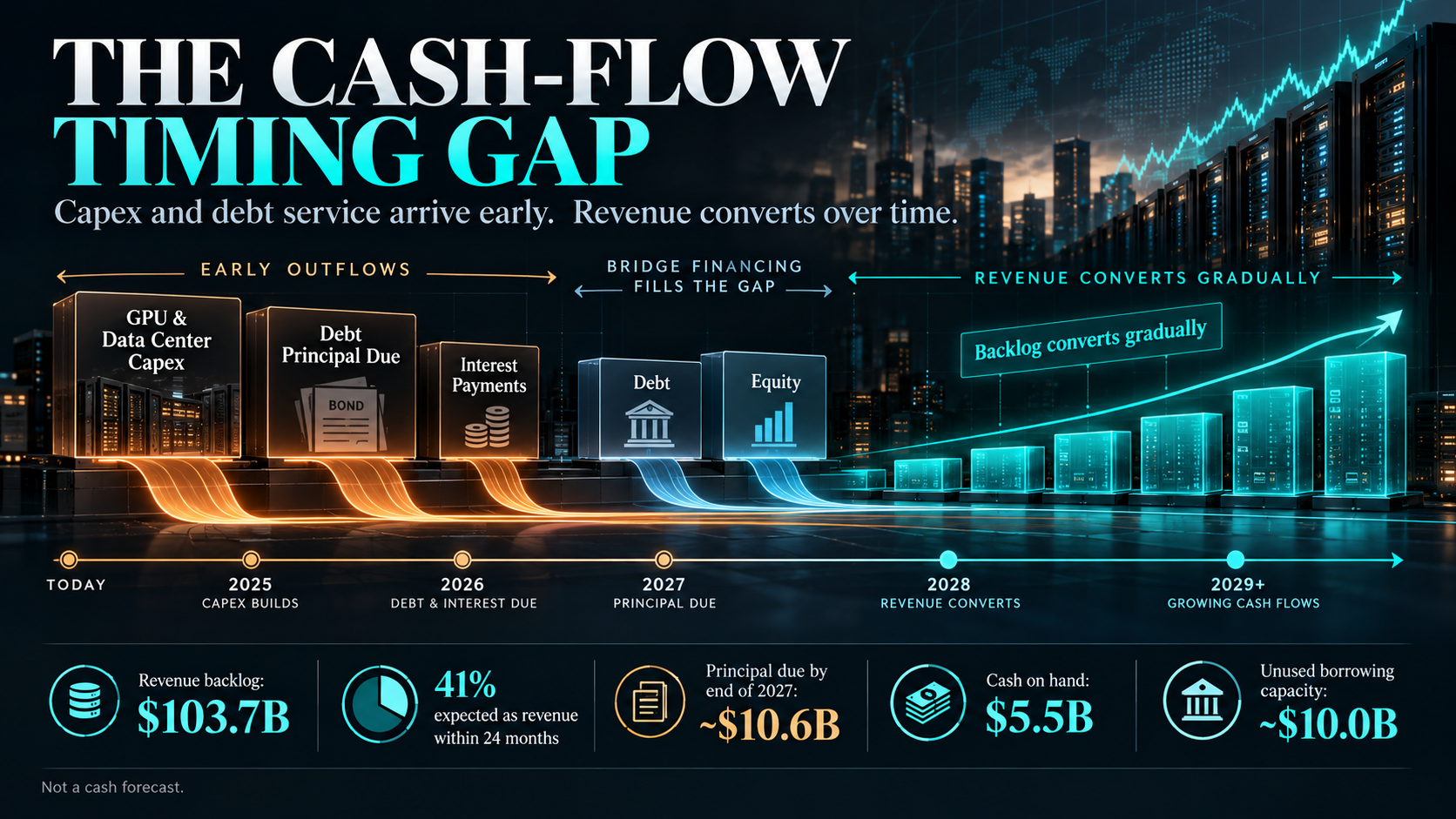
Coreweave's revenue is growing rapidly. Second-quarter revenue, announced in August, stood at $2.575 billion, more than double the $1.212 billion recorded a year earlier. As of the end of June, the revenue backlog stood at approximately $104 billion . In the context of a car rental company, this means that a significant amount of rental contracts are backlogged up for the next few years. The company states that it can recognize this amount as revenue only if it provides services and installs facilities in a timely manner.
However, rental contracts do not represent money that has yet entered the account. Rental fees are only received once the car is rented out, and these fees are paid out in installments over the contract period. According to Coreweave’s quarterly report (10-Q), of the $103.7 billion in outstanding contract balances not yet recognized as revenue as of the end of June, 41% will become revenue within two years by June 2028, while the remainder will be distributed over the following four and a half years. The cost of the car is paid out in a lump sum upfront. If the second-quarter earnings data submitted to the U.S. Securities and Exchange Commission (SEC) is organized like the books of a car rental company, it looks like this:
| item | If you compare it to a rental car | amount |
|---|---|---|
| Operating Cash Flow (January–June) | The difference between money inflow and outflow from operating activities | +$3.663 billion |
| Cash-based capital investment (Jan-June) | The money spent on buying a new car | -$14.117 billion |
| Simple Free Cash Flow (Jan–June) | The amount remaining after deducting the car price from the money received | -$10.454 billion |
| New borrowing / Repayment (Jan-June) | Newly borrowed money / Money repaid | +$16.747 billion / -$5.219 billion |
| Net interest expense (April–June) | Accounting interest expense (three months) | $640 million ($267 million in the same period last year) |
| Cash interest payments (January–June) | Interest withdrawn from the account (excluding capitalization interest) | $806 million |
| Cash and cash equivalents (June 30) | bank balance | $5.524 billion |
| Total principal of borrowings (June 30) | Loan principal to be repaid | Approximately $35.55 billion |
| Principal repayment scheduled (second half of 2026–2027) | Principal to be repaid within one and a half years | Approximately $10.6 billion |
※ Source: CoreWeave Q2 2026 Earnings Announcement and Quarterly Report (10-Q, filed with SEC). Simple free cash flow is calculated by subtracting cash-based capital expenditures from operating cash flow, excluding other investing activities and non-cash investments. Net interest expense is the amount on the income statement. Cash interest payments of $806 million exclude interest recognized as cost for facilities under construction (capitalized interest); total cash interest payments for the first half of the year, including this amount, are $982 million. The principal and scheduled repayment amounts of borrowings are based on the principal repayment schedule disclosed by the company, and other contractual obligations, such as lease liabilities, are separate.
In the first half of the year, cash remaining from operating activities was $3.663 billion, while $14.117 billion was spent on purchasing new assets—specifically GPUs and data centers. This left a shortfall of $10.454 billion. Coreweave raised the funds by taking on debt and issuing new shares. During the same period, the company borrowed approximately $16.7 billion and repaid $5.2 billion, while raising an additional $3 billion through a private placement of new shares. As debt increased, so did interest payments. According to the income statement, net interest expense for the second quarter was $640 million, 2.4 times higher than a year ago. Since revenue increased 2.1-fold during the same period, accounting interest expenses grew faster than revenue.
This alone does not mean we can conclude that the company is dangerous. Rental car companies typically purchase vehicles first and recoup the cost through rental fees over several years. Coreweave will also generate revenue over the next few years using the GPUs currently installed. CEO Mike Intrater reportedly explained to employees on the 14th that the company can manage its debt with $104.2 billion in contract revenue. There is also cash remaining in the bank and existing loan agreements.
There are also differences compared to car rentals. Performance competition in GPUs is much faster than in automobiles. If the rental cost or remaining value of existing equipment drops faster than expected due to the release of new GPUs, the payback period for the initial investment also lengthens.
We also examined the principal amounts due in the future. According to the 10-Q, as of the end of June, the principal scheduled for repayment in the second half of 2026 and 2027 totals approximately $10.6 billion . At the same time, cash reserves stood at about $5.5 billion. Since Coreweave has about $10 billion in unused credit limits and upcoming customer payments, and can also refinance debt by paying off old debt with new debt, it is difficult to conclude that there is a cash shortage based solely on these two figures. One must also consider that the unused credit limits may come with conditions attached to their use. Nevertheless, the numbers confirm a schedule in which a significant amount of principal must be repaid or new funds must be raised before the cash from long-term contracts fully materializes.
To survive, the conditions must be right. Services must be provided as per the contract, and the cash remaining from operating activities must be sufficient to cover the burden of additional capital investment and principal repayment. If lending channels narrow before then, it becomes difficult to raise the money for immediate repayment, no matter how many contracts are piled up. The recent drop in bond prices raises concerns about whether Coreweave will be able to borrow money as easily as it does now in the future .
3 Even if the base interest rate falls, loan interest does not decrease if the spread rises
Anyone who has taken out a mortgage knows that interest rates consist of two parts. A base rate, such as COFIX, is added to a margin rate that banks apply based on the borrower's credit. Even if the base rate falls, if the bank raises the margin rate, my loan interest remains the same or even increases.
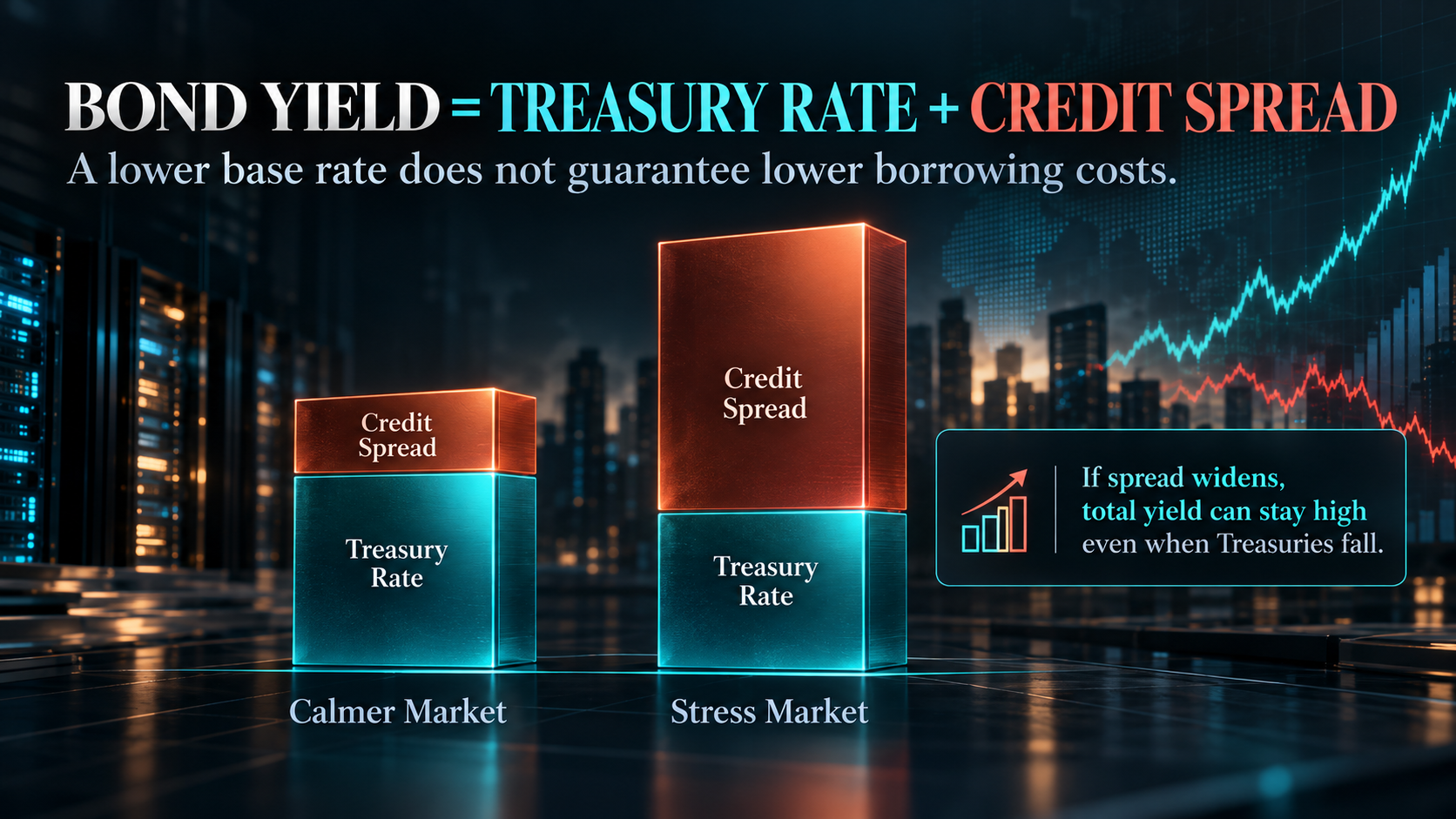
Corporate bonds move in the same way. Corporate bond yield ≈ Government bond yield with similar maturity + Credit spread . The government bond yield acts as the base rate, and the additional rate added based on the company's credit is called the credit spread. The fact that government bond yields do not move solely due to the Federal Reserve's (Fed) policies was discussed in "What is a Term Premium?" .
This is what happened on the 15th and 16th. On the 15th, CoreWeave's stock price fell by more than 6% before the market opened, but rebounded during regular trading to close up about 5.9%. Bloomberg reported that on the same day, NVIDIA CEO Jensen Huang stated that CoreWeave's financing costs were actually decreasing and that the company was becoming stronger every day, so NVIDIA did not need to step in to provide support. NVIDIA is both a shareholder and a GPU supplier for CoreWeave. It is akin to the president of a car company selling cars to a rental car company telling that the rental car company is strong. On the 16th, the KOSPI rose 2.05%, while Samsung Electronics closed at 215,500 won, up 2.62%, and SK Hynix closed at 1,272,000 won, up 0.79%. Domestic securities analysts cited falling U.S. Treasury yields, CEO Huang's remarks, and bargain buying following seven consecutive trading days of decline as the reasons for the rebound.
U.S. Treasury yields, which serve as the benchmark rate, fell sharply on the 15th. The Nasdaq rebounded as Treasury prices rose despite producer prices coming in higher than expected. However, Coreweave's spread remained high. According to Reuters, the yield on Coreweave's 2031 maturity bonds rose to 16% at one point on the 15th before falling back to around 14%. This refers to a bond issued in April with a coupon rate of 9.75%, distinct from the 2032 maturity bond discussed in Section 1. Given that the yield on U.S. 5-year Treasuries with a similar maturity is around 4.9%, this effectively means bond investors are asking for nearly 9 percentage points more than the Treasury yield (a simple estimate based on market prices). The actual interest rate when Coreweave borrows new money varies from this yield depending on contractual conditions such as collateral, guarantees, and maturity. Nevertheless, this implies that the risk compensation demanded by the credit market is that significant. Even on the 15th, when CEO Hwang said that funding costs were falling, Coreweave's CDS premiums were at an all-time high.
I paid the most attention to this point when observing this rebound. The rise in the stock price means that more people are willing to bet on the company's future again. The ability to repay debt improves only when the cash remaining from operating activities can cover capital investment and principal repayment. If one judges that risk has disappeared whenever the stock price rises, one tends to view these two factors together.
4 Companies that expanded their fleets with debt are the first to be shaken by interest rates
Warnings from the credit market were not limited to Coreweave. According to Reuters, on the 15th, CDS premiums for technology companies rose to all-time highs. Oracle's 5-year CDS neared 300 basis points and rose by about 31 basis points this week alone. CDSs for Nvidia, STMicroelectronics, and SpaceX also rose significantly. CDSs for Amazon, Alphabet, and Meta also traded at all-time highs, but at a much slower pace than those of Oracle or Coreweave.
In terms of the car rental industry, this is akin to having large corporations that purchase vehicles with their own money alongside startups that have expanded their fleets through loans. When interest rates rise, startups with heavy debt are the first to falter. Large platform companies like Microsoft and Alphabet can easily withstand investment burdens due to their substantial cash flow, whereas emerging GPU cloud providers like Coreweave (NeoCloud) rely more heavily on borrowed funds. Jim Read, a strategist at Deutsche Bank, also stated that movements in the credit market should be viewed with greater gravity as funding for AI capital investment shifts from free cash flow to debt. It is difficult to rank companies based solely on CDS figures regarding their probability of default, as their business structures, debt compositions, and contract terms vary significantly.
Nevertheless, these companies are interconnected. If a rental car company reduces new car orders due to blocked loans, the sales of automakers and parts suppliers also decline. In the AI industry, companies that build AI models rent cloud services, cloud companies buy NVIDIA GPUs, and NVIDIA purchases memory from SK Hynix and Samsung Electronics. This is why Korean semiconductor investors need to keep a close eye on news regarding Coreweave's bonds.
We addressed a similar issue last September while analyzing the financial structure of Oracle's Project Jupiter . If securing power for a data center or construction is delayed, the start date of the lease is also delayed, but the accumulated financial costs may still have to be paid. Who actually bears the losses depends on long-term usage agreements, guarantees, collateral, and financial arrangements.
Therefore, the first step is to categorize companies. We must distinguish between those that fund investments with current cash flow and those that continue to increase debt relying on future rent payments to see where the financial risks of the AI industry are concentrated.
5Even the U.S. government finds it difficult to reduce debt quickly through growth alone
On October 14, as Coreweave bonds were fluctuating, IMF Managing Director Kristalina Georgieva raised the issue of U.S. fiscal affairs at the IMF-World Bank Annual Meetings held in Bangkok, Thailand. U.S. Treasury Secretary Scott Besant had outlined a plan to alleviate fiscal burdens through strong growth, stating that 3% growth would allow the country to escape debt problems. While acknowledging that growth is helpful, Georgieva stated that fiscal measures were necessary because growth alone could not make the required adjustments quickly enough.
From this point on, there are aspects that are difficult to explain using the rental car analogy. The government has the ability to collect taxes, and its institutional framework for issuing government bonds differs from that of corporations. Managing Director Georgieva conveyed that Minister Besant also acknowledges that the U.S. fiscal deficit and total debt, exceeding $40 trillion, are too high. The $40 trillion figure represents the total federal debt, including government bonds held in the government's internal accounts; the debt that the market actually needs to purchase is considered separately as "Debt Held by the Public," which consists of private entities and foreign investors.
Here are the figures. In its February forecast, the Congressional Budget Office (CBO) projected the fiscal deficit for fiscal year 2026 to be approximately $1.9 trillion , or 5.8% of GDP. Even excluding interest payments, the deficit amounts to 2.6% of GDP (the primary fiscal deficit). Interest payments will increase from 3.3% of GDP to 4.6% in 2036, and market-held debt will rise from 101% of GDP in 2026 to 120% in 2036.
When the U.S. economy grows, corporate profits and personal income increase, leading to higher tax revenues. However, if deficits persist even after interest payments and interest expenses rise rapidly, it is difficult to stabilize the debt ratio through growth alone. The IMF's call for fiscal measures is in the same context.
Coreweave receives payment when customers use its computing services as per the contract. The U.S. government collects more taxes if AI increases productivity and drives economic growth. These two sources of revenue are different in nature, and it is not yet known when or how much will be received. On the other hand, interest on existing debt must be paid now. This is why we must separately calculate how much future growth will alleviate the current burden, and it is also the reason this article examines the IMF's warning alongside the sharp drop in Coreweave bond prices.
6When rental car companies buy cars all at once, car prices go up first.
In the article "Why Is the Market So Obsessed with AI?" published last June, we discussed how AI can boost productivity and mitigate inflation. When work becomes more efficient thanks to AI, it enables greater production with the same resources, which helps reduce the upward pressure on prices in the long run.
There is something that happens before that. When rental car companies buy up new cars all at once, the prices of automobiles and parts rise first. The IMF World Economic Outlook , released on October 13 (local time), offered a similar explanation. Silvana Tenreiro, the IMF's Chief Economist, explained that the AI-driven technology boom acts like a demand shock that drives up both economic activity and prices. This is because demand for semiconductors, construction, and electricity increases while equipping up GPUs, data centers, power facilities, cooling systems, and network equipment. The IMF projected the global consumer price inflation rate for this year at 4.7% .
The U.S. September Consumer Price Index (CPI), announced on October 14, cannot be attributed solely to AI investment. The September CPI rose 3.7% year-over-year and 0.6% month-over-month, with more than half of the monthly increase attributed to gasoline prices, which jumped 9.1% in just one month. The core CPI, excluding energy and food, rose 0.3% from the previous month.
However, if inflation remains high, interest rates do not fall easily, and these rates lead to an interest burden for heavily indebted AI companies. Reuters reported that higher-than-expected U.S. inflation and the outlook for interest rate hikes have heightened concerns about when AI investments will yield profits and whether heavily indebted companies can earn money quickly enough to cover rising interest payments. Even if AI eventually lowers inflation, current investment costs and interest payments must still be made.
There is one more point to consider. As AI increases productivity, opportunities for investment expand, and the demand for borrowing grows. All other things being equal, as investment and borrowing demand increase, real interest rates tend to rise. This implies that improved productivity could actually help support interest rates. Given that both the U.S. government and AI companies are affected by interest costs, it is difficult to assume that all problems will be solved simply by increasing AI productivity.
7 Five Things to Watch Ahead — Spread, Cash Flow, Insurance Premiums, National Finance, Semiconductor Demand
There is still insufficient evidence to conclude that this week's market marks the beginning of an AI-driven financial crisis. No instances of AI infrastructure companies failing to repay debts were confirmed this time. Coreweave is increasing its revenue and has many long-term contracts. It also benefits from support from Nvidia and major clients, the attraction of new investments, and existing loan commitments. It is possible that the credit market was overly pessimistic in the short term. Conversely, a rebound in the stock price does not mean that cash flow issues have been resolved.
For a car rental company, there are three paths ahead. If customers rent cars as per the contract and rental fees are received on time, reliance on debt decreases. If the number of customers remains the same but rental fees are delayed, the company must continue renting cars to cover the cost of the vehicles and interest. If rental fees are delayed and loan interest rates rise, the company will reduce new car orders and postpone certain business operations. The direction the company is heading is revealed in the following five points.
- Coreweave's Credit Spread: If the credit spread falls while the stock price rebounds, it means that lenders also view the risk as low again. If only the stock price rises while the credit spread remains high, it is a signal that shareholders and bond investors still view the company differently.
- Difference between rent and car value (operating cash flow and capital expenditure): No matter how large the contract revenue is, cash must come in to pay interest. In Coreweave's next earnings report, we intend to first check how much this difference has narrowed rather than the revenue growth rate.
- CDS premiums and spreads of other AI infrastructure companies: By observing whether rates are rising for other firms like Oracle as well, one can gauge whether this is an issue limited to a single company or if the entire AI infrastructure industry is facing a liquidity crunch.
- U.S. Primary Fiscal Balance and Government Bond Interest Expenses: Looking at the growth rate alone does not reveal whether national finances are improving. We examine how the deficit excluding interest and interest expenses move together.
- Performance and Demand Outlook for Korean Semiconductor Companies: If rental car companies reduce new car orders, the sales of parts companies decline first. When a phase of actual reduction in AI infrastructure investment arrives, it is necessary to distinguish whether the stock price fluctuation is merely temporary or if demand has decreased.
The sharp decline in the Korean stock market cannot be explained solely by the debt issues of AI companies. Foreign investors net sold over 3.6 trillion won on the KOSPI on the 15th alone, marking eight consecutive trading days of net selling since October 2. The KOSPI fell for seven consecutive trading days through the 15th. This sharp decline can be attributed to a combination of factors, including this foreign selling, concerns over the pursuit by Chinese memory manufacturers , and the burden of high stock prices.
8Frequently Asked Questions
| question | answer |
|---|---|
| What kind of company is Coreweave? | As a cloud provider that leases NVIDIA GPU-based computing resources to AI companies, it went public on the Nasdaq in March 2025. Second-quarter revenue was $2.575 billion, more than double that of a year ago, but the net loss for the same quarter was $626 million. It finances a significant portion of its GPU purchases by borrowing. |
| If the bond yield is 15%, does Coreweave pay 15% interest? | No. The interest rate on the promissory note already written remains at 9.625%. 15% is the rate of return assuming that the person buying the bond at a low price now receives both the promised interest and the principal. It is highly likely that Coreweave will be asked for a higher interest rate than before when borrowing money again, and the actual interest rate is determined by collateral, guarantees, and maturity. |
| What does CDS 1,100bp mean? | This means that to guarantee against the default risk of a principal of 100 million won, one pays approximately 11 million won annually. CDSs can be purchased even by people who do not hold the bonds. However, this figure does not represent an 11% probability of default. The probability must be calculated separately by applying assumptions such as how much of the defaulted money will be recovered, and the figures vary depending on the data provider. |
| Was the KOSPI plunge on October 15 due to Coreweave? | It cannot be concluded that way. Concerns regarding the profitability of AI investments and corporate debt, U.S. inflation data, large-scale net selling by foreign investors, and the burden resulting from the recent surge were cited together. The sharp decline in Coreweave bonds is one of the contributing factors. |
Conclusion — The cost of the car has already been paid, and the rental fees have just started coming in.
The market fluctuated significantly in a short period this week. On the 14th, stock prices and bond prices of AI infrastructure companies in the U.S. plummeted, and on the 15th, the KOSPI fell 7.57%. However, Coreweave's stock price rebounded in the U.S. on the same day, and on the 16th, the KOSPI rose 2.05%, recovering some of its losses. Looking solely at stock prices, it appears as though risk had increased but then diminished within a single day.
If we draw an analogy with a car rental company, the question remains. The cost of the cars and loan interest are already being paid out, while the rental fees will come in over the next few years. During that time, Coreweave must repay or re-borrow approximately $10.6 billion in principal within just a year and a half. The ability to weather that period varies from company to company. The U.S. government also looks forward to future growth and tax revenue, but it must first manage its current deficits and interest expenses.
Over the past few months , AI data centers have calculated how much revenue is needed to break even and who would bear the losses if things went wrong . Now, I believe we must also consider when that money will come in. There is one more step between the judgment that AI will be used more widely and the judgment that a specific company can withstand the debt required for that growth.
I would also like to acknowledge the limitations of this article. It is difficult to evaluate the detailed terms of Coreweave’s loan agreements or the termination conditions of customer contracts based solely on publicly available data, and CDS and bond prices fluctuate significantly within a single day. Therefore, I intend to continue verifying three questions: whether the spread decreases as the stock price rises, whether cash surplus from operations keeps pace with capital expenditures and principal repayments, and whether growth keeps up with the rate at which U.S. interest expenses increase. I plan to find the answers to these questions one by one once Coreweave’s next earnings and U.S. fiscal year results are released.
How significantly AI will grow remains an important question. However, there is something to verify before that for now. Will AI companies be able to withstand debt until the cash generated from AI investments grows enough to cover capital expenditures and financing costs?
📌 Was this analysis helpful?
I will continue to track the cash flows of AI infrastructure companies, credit markets, and changes in U.S. finance. Please subscribe below to receive new posts.
Subscribe and get notifications →How this content was produced
Aleph's research AI agent assisted with collecting and analyzing public data, creating charts and visuals, and structuring the draft. Davar personally reviewed and edited the sources, figures, reasoning, and final conclusions.
This content is for informational purposes only and is not personalized investment advice or an individual stock recommendation. Read the full disclaimer

Davar
Davar builds and operates Aleph's research AI agent and writes and reviews analysis on macroeconomic developments and AI industry trends.
© Aleph. All rights reserved.