
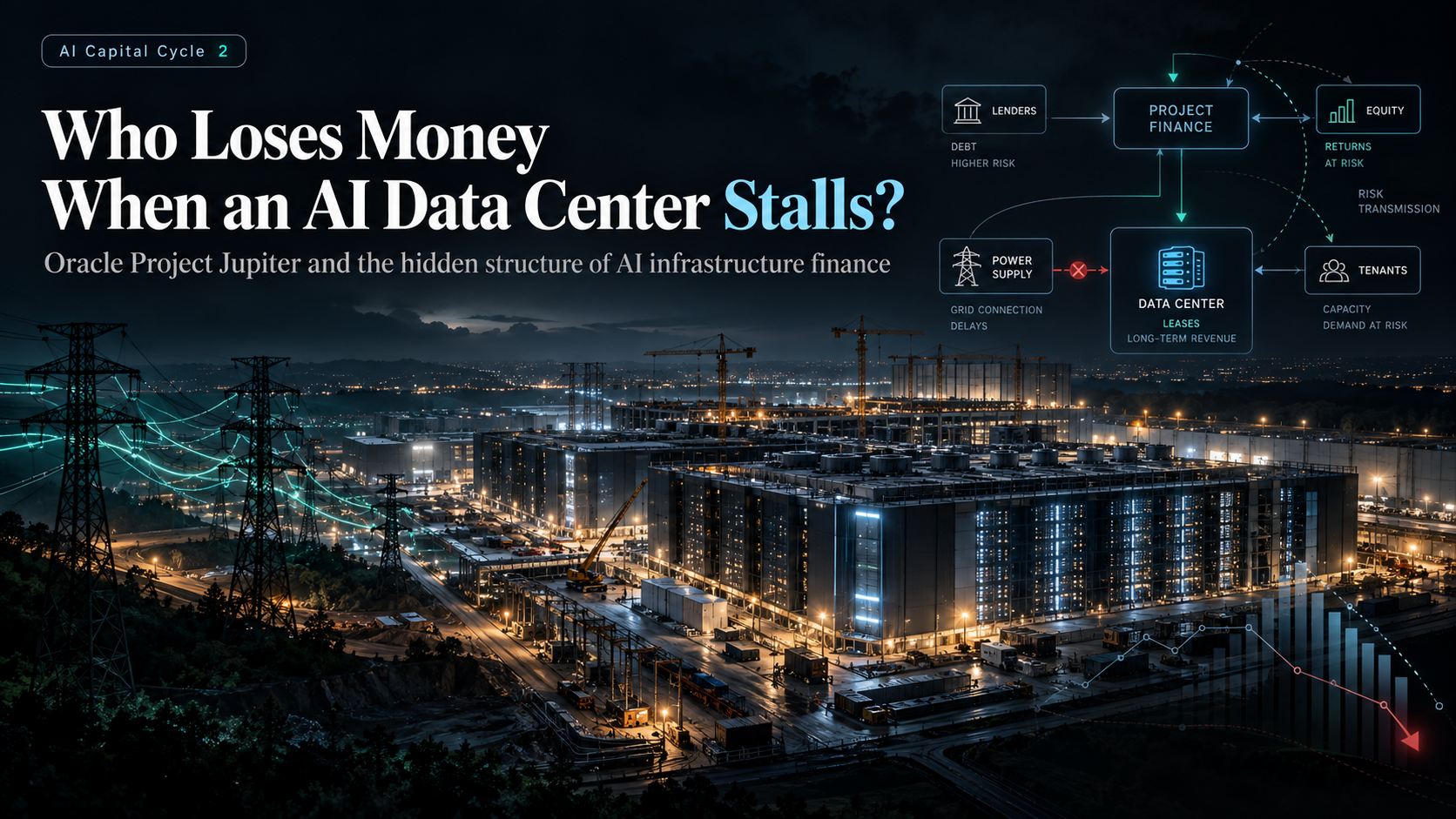
AI Data Center Financing Structures Through Oracle Project Jupiter — Who Pays for Leases, Project Loans, and Guarantees?
In my previous post, I compared how much of the operating cash generated by five major tech companies is reinvesting back into data centers. At that time, I believed that the burden of AI investment could be gauged to some extent by the capital expenditure (Capex) figures. However, a few days ago, reports emerged that Oracle had sent a force majeure notice to the developer regarding Project Jupiter, a large AI data center in New Mexico. The background of this notice was the possibility that securing power would be delayed beyond schedule. Oracle's stock price fell by nearly 4% during trading that day, and concerns about an AI bubble grew again. I, too, initially read it simply as news about a construction delay. However, upon examining the related contracts and financing structures, I realized that this incident involved more aspects to consider from the perspective of project finance than demand. If this data center does not operate as planned, who will bear the costs? In this post, I intend to first summarize Project Jupiter's financing structure, examine how schedule delays affect return on investment and loan prices, and then sequentially look at whether similar agreements exist in the disclosures of Meta and Alphabet.
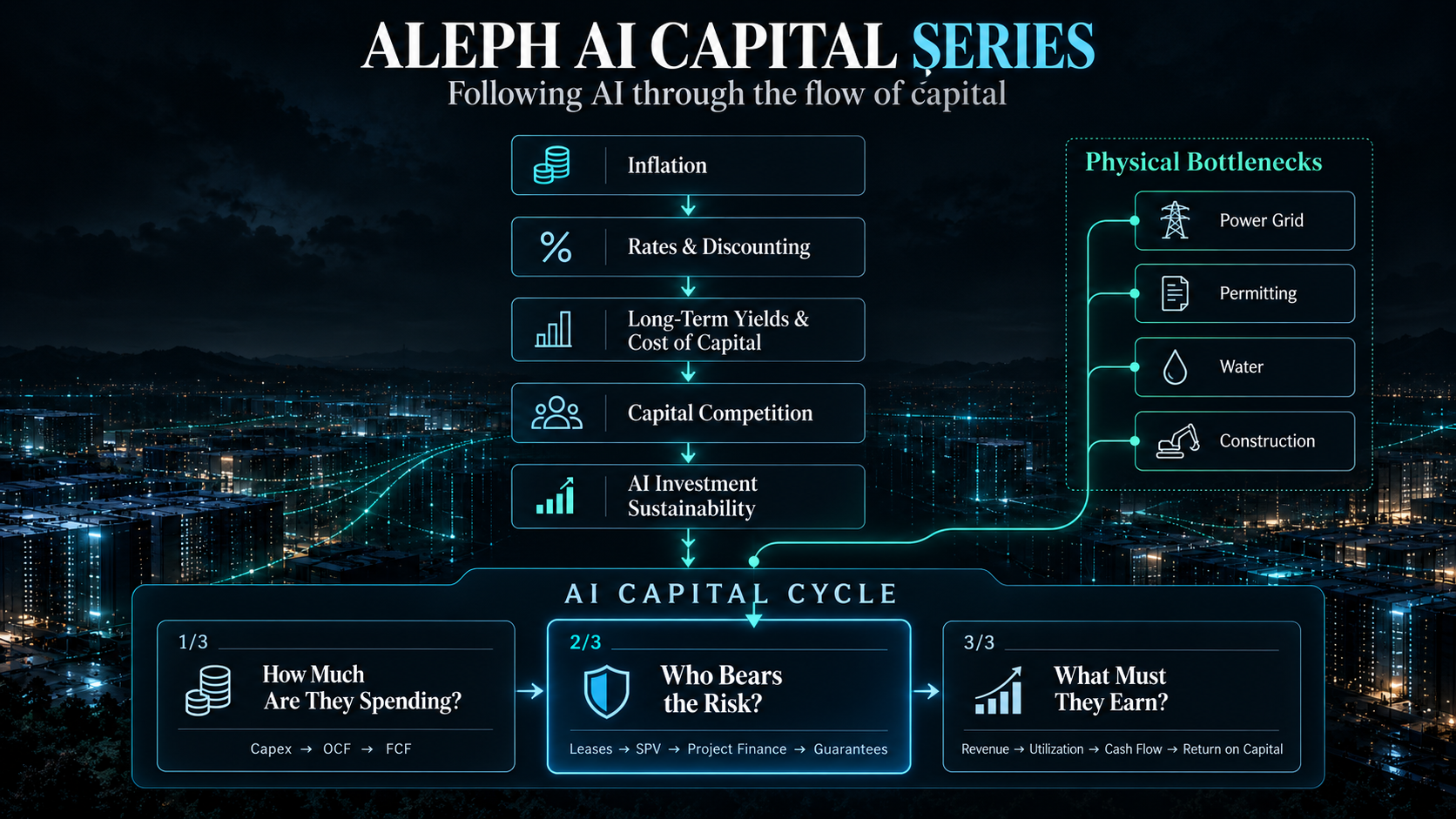
The position of this article in the 1AI Capital Series
This article is the second part of the AI Capital Cycle trilogy, and it covers who bears the costs when there are setbacks in AI infrastructure investment.
Looking back at the AI-related articles I wrote this year, my questions kept shifting toward capital. Initially, I began by examining the relationship between prices and interest rates. The familiar logic was that when prices fall, interest rates drop, and the discount rate used to convert distant future earnings to present value also decreases, which is advantageous for AI stocks.
However, long-term interest rates have risen to a level that is difficult to explain solely by the Fed's policy rate. Therefore, in "What is a Term Premium — Why AI Stocks Get Hit by Interest Rates Twice," we discussed how long-term interest rates drive up not only the discount rate but also the financing costs of AI companies.
Next, in "Treasury Bond Buybacks Are Not QE," we examined the fact that the U.S. government's issuance of Treasury bonds and the financing of AI companies compete in the same long-term money market. In "The Theory on AI Speed Control and the Plunge in Semiconductor Stocks," we confirmed that Big Tech's AI investment did not decrease even after financing costs rose. In the previous article , "Who Is Using Expensive Capital Most Efficiently," we compared operating cash flow (OCF), Capex, and free cash flow (FCF) by company.
However, that comparison was centered on Capex that had already been executed. The more I looked into data center contracts, the more I found that there were quite a few commitments not included in Capex, such as long-term leases, project loans, and guarantees. Therefore, I decided to divide the AI Capital Cycle into three parts.
- Part 1 — How Much Are We Spending : Capex → OCF → FCF
- Part 2 — Who Bears the Burden If Things Go Wrong (This Article): Lease → Project Loan → Guarantee
- Part 3 — How Much Should You Earn : Revenue → Capacity Utilization → Cash Flow → Return on Capital
Apart from funding issues, data centers are also tied up with power grids, licensing, water supply, and construction schedules. This is an issue covered in "40% of AI Data Centers Have Stalled" in April of this year. In Project Jupiter, funding and power issues emerged simultaneously.
How Was 2Project Jupiter’s $18 Billion Loan Structured?
First, it is necessary to distinguish the nature of the $18 billion. This money is not corporate bonds directly issued by Oracle, but project finance connected to Project Jupiter.
Project Jupiter is an approximately 1,400-acre AI data center campus currently under construction in New Mexico. It is part of the Stargate project, involving OpenAI, SoftBank, and Oracle, and is linked to a contract in which Oracle supplies AI computing capacity to OpenAI. The target date for operation is 2028 .
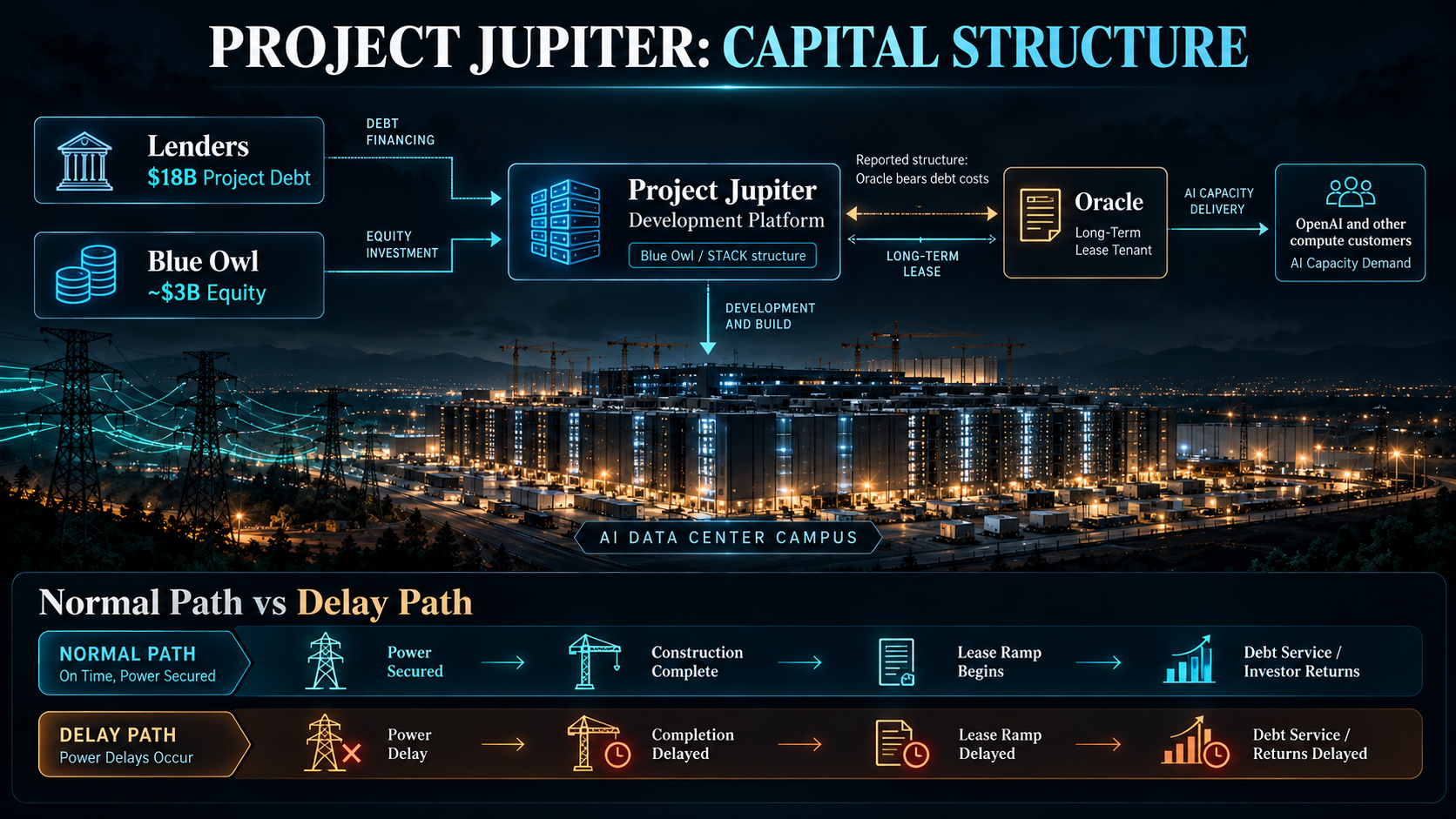
Based on Reuters reports, the structure is as follows. Development is being handled by STACK Infrastructure, a data center subsidiary of Blue Owl, with Blue Owl having invested approximately $3 billion in equity. The project is linked to loans of about $18 billion from a bank consortium. Oracle is a tenant leasing the completed facility for an extended period. According to Reuters sources, Oracle bears the project's debt costs and cannot unilaterally terminate the lease.
1. Bank Consortium → Approx. $18 billion project loan → Project Jupiter (Blue Owl/STACK structure)
2. Blue Owl → Approx. $3 billion equity investment → Project Jupiter
3. STACK Infrastructure → Data Center Development and Construction
4. Oracle → Long-term lease of completed facilities, contractual payments support the repayment of the project's principal and interest.
5. Oracle → Supply of AI computing capacity to OpenAI (Separate contract. Flow directly linked to loan repayment not disclosed)
※ The exact name of the corporation that received the loan and its overall ownership structure were not disclosed.
The $18 billion is not recorded as direct borrowing by Oracle. However, given that Oracle bears the project's debt costs as a long-term tenant, it is difficult to completely separate the project's repayment capacity from Oracle's contractual payment obligations.
In large-scale data center projects, it is common practice for a separate business entity to handle assets and project financing, while a highly creditworthy long-term tenant provides the contractual cash flow. Big Tech companies do not need to build facilities costing tens of trillions of won entirely with their own money from the start, and investors provide funding based on long-term lease agreements. When projects proceed on schedule, this is a reasonable approach for both parties. Reuters reported that, in light of this incident, banks and investors are re-examining how contractual safeguards function and who bears the costs when projects are delayed.
3 If construction is delayed, the return on investment also decreases.
This force majeure notice stems from the possibility that securing power may not proceed as scheduled. If the data center's launch is delayed, the timing of changes to lease terms and investors' expected returns will also be affected.
According to Reuters, securing power to the site is Oracle's contractual responsibility. Oracle sent a notice allowing for payment delays if the data center fails to operate as planned in 2028 due to delays in securing power. Power issues had been emerging since the summer. In July, the New Mexico State Land Authority again rejected a request for reconsideration regarding permission for a natural gas pipeline leading to Project Jupiter to pass through state-owned land. On September 8, Oracle issued a tender for 2GW of new renewable energy in New Mexico.
There are conflicting reports regarding the schedule. Reuters reported, citing sources involved in the deal, that the project is delayed by about a year. On the other hand, Oracle maintains that “Project Jupiter is proceeding according to the planned schedule,” and Blue Owl stated that this notice does not alter the project’s financial commitments. Neither company indicated any intention to halt the project.
Under normal circumstances, money circulates in the order of securing power → completion → commencement of Oracle usage → rent payment → loan repayment → investor returns . If securing power is delayed, completion and the start of usage are delayed, and the subsequent payment and revenue schedules are also pushed back.
The impact becomes concrete when examining Blue Owl's revenue structure. According to Reuters, Blue Owl is structured to receive a return of approximately 9% during the development phase and expect about 11% based on leverage after completion. If force majeure is recognized, the period during which Oracle pays the lower development-phase rent is extended. The longer completion is delayed, the later Blue Owl moves to the stage where it expects a return of approximately 11%. It is a structure where the return on investment can be affected solely by schedule delays, even if the project is not canceled.
4Who Pays the Cost If the Schedule Is Delayed?
If AI data center schedules are delayed, costs and risks can spread to equity investors, lenders, tenants, and computing customers in different ways. The magnitude and timing of the burden vary depending on each party's contractual roles and obligations.
① Equity Investors. If a project is delayed, the period during which investment funds are tied up becomes longer. In the case of Project Jupiter, this applies to Blue Owl's stake of approximately $3 billion. This money does not immediately turn into a loss simply because completion is delayed. However, if the project fails to reach a high-yield stage by the expected time, the return on investment decreases.
② Lenders. The $18 billion loan has already been quoted below its face value. According to Reuters on September 18, citing the FT, the price was approximately 89 to 91 cents per dollar of face value. It is reported that the syndication process—where banks distribute the loan bonds to other investors—due to community opposition and concerns over Oracle's rising debt. This price does not imply default. However, it can be seen as investors assigning a higher risk to this loan than before.
③ Oracle. Just because project loans are not recorded as Oracle's direct borrowing does not mean Oracle is free from this issue. This is because the burden of long-term leases and debt costs is linked by contract. Furthermore, the data center lease commitments that Oracle will bear in the future are much larger than those for Project Jupiter. According to the latest quarterly report (10-Q), additional lease commitments that have not yet commenced amount to $288 billion as of August 31, 2026. Almost all of these are data center-related, scheduled to commence between the second quarter of FY2027 and FY2029, with contract terms generally ranging from 15 to 19 years. Since facility usage has not yet begun, these amounts are not currently recorded in lease liabilities. Once the leases actually commence, this amount will lead to obligations to pay long-term rent for 15 to 19 years.
④ Computing purchasing customers. If data center operations are delayed, buyers like OpenAI will also receive the necessary computing capacity late. However, it is not confirmed in public data how the delay costs of Project Jupiter are passed on to OpenAI. Since there are no reported details, such as the contract between Oracle and Blue Owl, I intend to leave this part unconfirmed.
A similar structure is also seen in NUM4 Meta and Alphabet disclosures.
Even in the latest disclosures from Meta and Alphabet, long-term leases and data center-related warranties that have not yet started are listed on a large scale.
As of the end of June 2026, Meta had approximately $279 billion in uncommitted data center and network lease commitments, and in July, it entered into an additional $68 billion in data center leases. This $68 billion is scheduled to commence in 2027–2028.
There is one more unit at the Hyperion data center in Louisiana. Meta invests 20% in this joint venture and leases the facility, providing a Residual Value Guarantee (RVG) with a guarantee threshold of approximately $28 billion . A Residual Value Guarantee is an agreement under which the lessee agrees to cover part of the difference if the value of the facility falls below a predetermined threshold at the end of the contract. If the facility value falls below the threshold under certain conditions, such as Meta failing to renew the lease, Meta may bear part of the difference. Meta did not recognize this guarantee as a liability, judging that the likelihood of payment was low.
Alphabet has entered into credit derivative contracts to hedge against third-party defaults related to data centers. As of the end of June 2026, the notional value of these contracts is approximately $43.8 billion , which Alphabet has disclosed as its maximum potential exposure in specific default scenarios. If the counterparty fails to make payments, Alphabet may take over the leases for its own use or sublease them elsewhere. Separately, the maximum payable amount of the financial guarantee is $7.6 billion .
※ The figures above represent commitment amounts, guarantee baselines, and maximum potential exposures as defined in each company's SEC disclosures, and do not correspond to currently recognized liabilities or estimated losses. As they differ in nature, they should not be aggregated and do not constitute an investment solicitation for any specific stock.
These numbers should not be added up like debt. Meta's $28 billion is not a debt that needs to be repaid right now, and Alphabet's $43.8 billion is not an expected loss. Nevertheless, it has become difficult to gauge the cost of AI infrastructure solely through corporate bond issuances and Capex.
Why It Is Difficult to Group 6 “Hidden Debt”
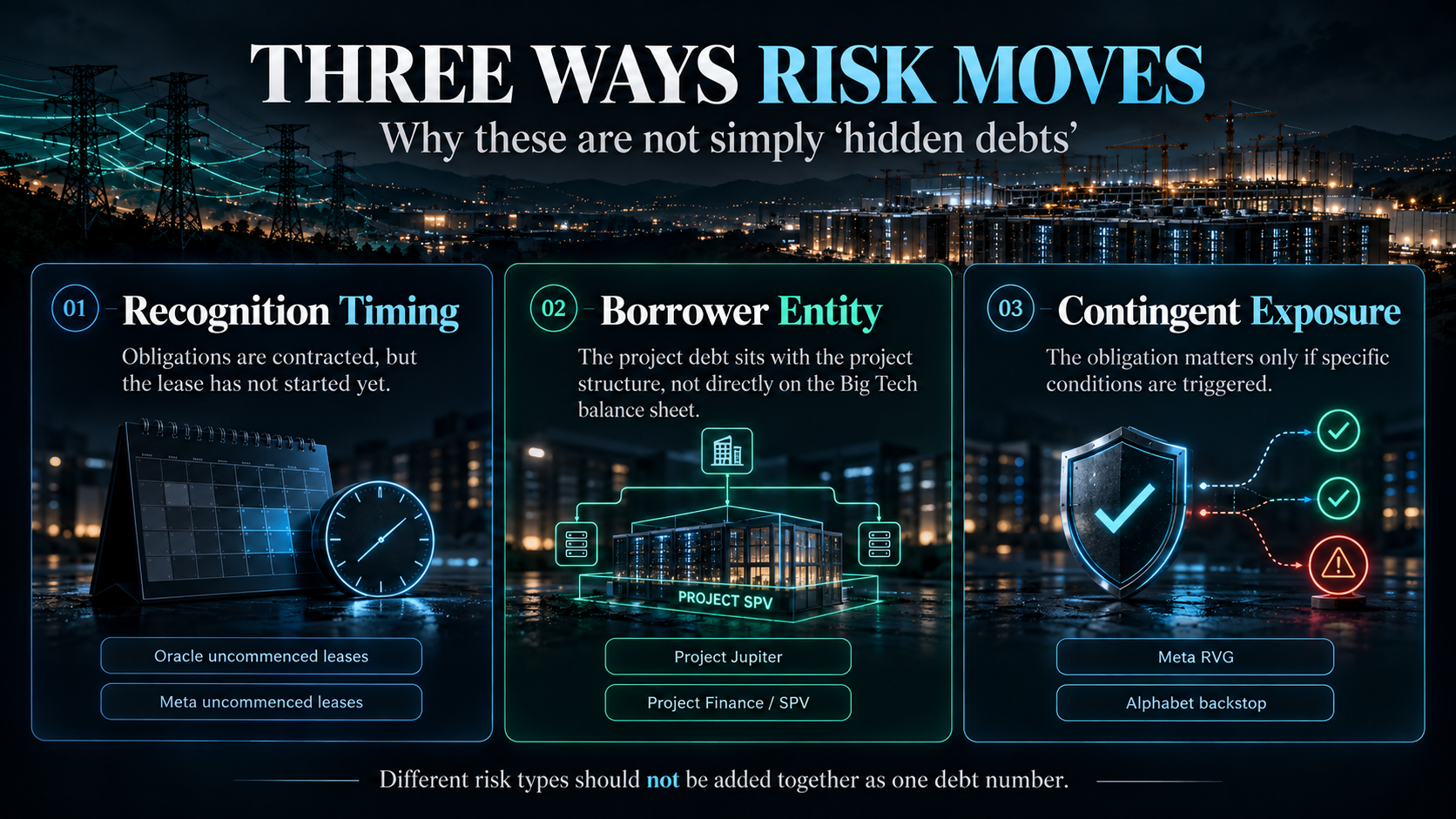
It is difficult to group all these items together as “hidden liabilities.” This is because uncommitted leases, project borrowings, and guarantees differ in their accounting recognition timing and the conditions under which actual obligations arise.
As the scale of AI investment grows, the term “hidden debt” appears frequently. Some of this is actually project finance that exists outside the financial statements. However, Oracle’s $288 billion, Meta’s residual value guarantees, and Alphabet’s credit derivatives are all listed in the footnotes to their disclosures. I believe it is more accurate to categorize them into three types based on their nature.
- Payment obligations not yet commenced (recognition point) : Agreements for which a contract has been entered into but the facility has not yet been completed and therefore has not been recognized as a lease liability. The uncommended leases between Oracle and Meta fall under this category.
- Borrowing on the project side (borrower) : Cases where debt exists on a separate project side rather than on the Big Tech company's financial statements. A prime example is Project Jupiter's $18 billion loan.
- Guarantees that materialize only when conditions are met (Conditional Exposure) : Agreements that normally have no payment obligation but activate when conditions such as default, a decline in asset value, or contract termination occur. Meta's Residual Value Guarantee and Alphabet's Credit Derivatives fall into this category.
Project Jupiter is a recent example demonstrating how contracts operate when the first two of these encounter actual schedule delays. Capex, which was compared in the previous post, shows money already spent. Long-term leases and purchase commitments show money promised for the future, project finance shows who pays first, and guarantees show where the burden falls if problems arise. We covered the first in Part 1, and in this post, we looked into the remaining three.
7Why Risk Allocation Has Become Important in AI Infrastructure Finance
Recently, in the AI-related loan and corporate bond markets, project-specific risk allocation and contract terms are being evaluated more importantly than computing demand. This is because the scale of funding required has exceeded the level that can be provided based solely on the creditworthiness of Big Tech companies.
In terms of scale, Moody's estimates, cited by Reuters, project that AI-related Capex by the top six U.S. tech companies will reach approximately $1 trillion by 2027. Morgan Stanley estimated the financing gap—the portion of global data center investment that cannot be covered by internal corporate cash—to be about $1.5 trillion by 2028. This shortfall must be filled by external funds, such as corporate bonds, bank loans, and private credit. Market sources interviewed by Reuters also reported that lenders are now scrutinizing how risk is distributed more closely than demand forecasts.
Similar changes are appearing in the corporate bond market. According to Goldman Sachs data reported by Reuters on September 22, the spread on corporate bonds issued by AI-related issuers was approximately 115 basis points (bp) , wider than the average of about 78 bp for U.S. investment-grade corporate bonds. The spread refers to the additional interest rate added to the government bond yield. The volume of debt issuance by hyperscalers is projected to reach approximately $420 billion by 2027. This difference does not necessarily imply a credit crisis. Given the surge in issuance volume over a short period, higher interest rates are largely required to absorb the supply. Nevertheless, the figures confirm that bond investors are demanding stricter conditions for AI-related issuances than before.
Why 8Project Jupiter is Difficult to Read Due to Slowing AI Demand
The issues directly observed in Project Jupiter are power securing, licensing, and contract fulfillment, rather than the slowdown in AI demand. During the same period, Oracle's order indicators actually increased.
Oracle announced that its Remaining Provisional Objectives (RPOs) increased to $664 billion in the first quarter of FY2027 (June–August). RPOs are amounts that have been contracted but have not yet been recognized as revenue. In the same quarter, Oracle supplied over 300,000 GPU units to customers. Meta and Alphabet are also continuing to expand their data center lease and supply contracts.
However, it is difficult to be reassured by relying solely on demand indicators. In the same quarter, Oracle's Capex was approximately $28.5 billion, and its free cash flow was in deficit. Even with demand, if data centers are completed late, revenue is received that much later, and financial costs continue to accrue during that time. Even after completion, if the cash generated is less than the cost of capital, investment efficiency declines. Therefore, I believe it is becoming increasingly difficult to judge AI investment based solely on the quantity of GPUs or the total amount of Capex.
96 Things to Check in Future Data Center Contracts
When looking at news regarding data center investments, it is difficult to assess the project's risk based solely on who borrowed the money. Going forward, we intend to check the following six factors together.
- Who invested their own money in the project?
- Who borrowed the money?
- Who promised a long-term lease?
- If construction is delayed, who pays the costs?
- Who guarantees it if asset values fall?
- If power cannot be secured, who is responsible?
In addition, we must also consider who needs to generate the cash to cover all these costs. In the case of Project Jupiter, the force majeure clause was triggered when the possibility of schedule delays arose, and changes occurred in the market price of the related loans.
You just need to look for "leases that have not yet commenced" in the Leases notes of Big Tech 10-Q and 10-K statements, and expressions such as "residual value guarantee," "guarantee," and "maximum potential exposure" in the Commitments and Contingencies notes. These numbers are not in the body of the balance sheet but are listed in the notes. By simply tracking how much these amounts have increased each quarter, you can gauge the pace of AI infrastructure commitments.
10Frequently Asked Questions
| question | answer |
|---|---|
| Does a force majeure notice mean contract termination? | It is different from contract termination. It is a contractual clause that allows for the adjustment of liability or payment timing when the fulfillment of obligations is delayed due to reasons beyond one's control. Oracle stated that Project Jupiter is proceeding as planned, and Blue Owl also said that there are no changes to the financial agreements. |
| Is the $18 billion from Project Jupiter Oracle's debt? | This is project financing that is not recorded as direct borrowing by Oracle. However, according to a Reuters source, since Oracle bears the project's debt costs as a long-term tenant, it is difficult to separate this from Oracle's contractual payment obligations. |
| What does it mean that loans were quoted at 89 to 91 cents per dollar? | This means that loan bonds were quoted at a level of approximately 89 to 91 cents per dollar of face value. While this does not imply default, the fact that investors demanded a price discounted from face value can be seen as a signal that they view the project risk as higher than before. |
| Is Oracle's $288 billion in unstarted leases debt? | It is not currently included in lease liabilities on the balance sheet because the use of the facility has not yet begun. When the lease begins sequentially starting in the second quarter of FY2027, it will result in a payment obligation to pay rent for 15 to 19 years. |
| Is this incident a sign of the AI bubble collapsing? | It is difficult to make such a judgment based on current data. Oracle's RPO has increased to $664 billion, and Big Tech's lease agreements continue to grow. The issues revealed in this incident lie not in demand, but in the execution phase, such as power and licensing, and in the structure of financial contracts. |
Conclusion — How much should AI data centers earn?
In Part 1, we looked at who can afford AI investment costs, and in this article, we traced who bears the costs when investment falls through. Financial structures can change the timing of fund inflows and who bears the risk. However, they cannot replace the economic viability of the project itself.
The initial financial burden can be shared by having the project side borrow directly and Big Tech enter into long-term lease agreements. There are also methods such as receiving advance payments from customers or sharing the risk of asset depreciation with investors. However, for this structure to be sustainable, the data center must actually be operational, customers must use computing capacity, and there must be cash remaining from the revenue even after paying investment costs, interest, and rent.
In Part 3, I intend to take this a step further. In "How Much Does an AI Data Center Need to Earn to Break Even?", I will calculate how much the currently promised AI infrastructure needs to earn to exceed its capital costs by incorporating utilization rates, GPU investment costs, power costs, lease costs, and financing costs, in addition to RPO and cloud revenue growth rates.
To be honest, I am not yet sure whether Project Jupiter will end up with a delay of about a year or if it will serve as a catalyst to re-evaluate the terms of other data center contracts. Nevertheless, from now on, whenever I see news about AI data centers, I intend to ask two questions: If this facility shuts down, who bears the costs? And if it operates properly , how much revenue should it generate ?
This article is intended for informational purposes only to analyze market structure and corporate disclosures and does not constitute a recommendation to buy or sell any specific stock. The amounts for uncommended leases, warranties, and credit derivatives mentioned in this text represent commitments, warranty baselines, and maximum potential exposures as defined in each company's SEC disclosures, and do not equate to currently recognized liabilities or estimated losses. The schedule and terms of Project Jupiter are as of the date of this report and are subject to change. Investment decisions and liabilities are the responsibility of the individual.
📌 Was this analysis helpful?
In the next post, we plan to cover Part 3 of the AI Capital Cycle , "How Much Does an AI Data Center Need to Earn to Break Even?"
We continuously track AI investment flows from a capital perspective. If you receive notifications, you won't miss out.
Subscribe and get notifications →How this content was produced
Aleph's research AI agent assisted with collecting and analyzing public data, creating charts and visuals, and structuring the draft. Davar personally reviewed and edited the sources, figures, reasoning, and final conclusions.
This content is for informational purposes only and is not personalized investment advice or an individual stock recommendation. Read the full disclaimer

Davar
Davar builds and operates Aleph's research AI agent and writes and reviews analysis on macroeconomic developments and AI industry trends.
© Aleph. All rights reserved.