
How much does an AI data center need to earn to break even? We will easily explain these two calculations, which differ by a factor of 12, by drawing an analogy to starting a cafe.
In the previous two installments of the AI Capital Cycle series, we examined how efficiently Big Tech companies are utilizing their massive investments in AI , and who suffers losses if AI data centers shut down . This naturally leads to the simplest question: "Given the huge sums poured in, how much revenue must be generated from AI just to break even?"
I plan to directly calculate this question in Part 3 by inputting utilization rates, GPU investment costs, power costs, lease costs, and financing costs. Before that, however, in this article, I intend to establish a standard for breaking even based on two recent external calculations. Goldman Sachs estimated that five major U.S. cloud companies (hyperscalers), including Amazon and Google, would need annual AI revenue of approximately $300 billion to avoid losses from their AI investments. In a paper published by the National Economic Research Institute (NBER), Professor Stijn Van Nieuwerburgh of Columbia Business School calculated that to achieve a 10% annual return on total U.S. AI data center investments, annual revenue would need to reach approximately $3.55 trillion by around 2032. While the two figures differ by nearly 12 times, neither can be deemed incorrect. To properly interpret these figures, we must first examine what "breaking even" means.
Break-even should be calculated based on profit, not revenue.
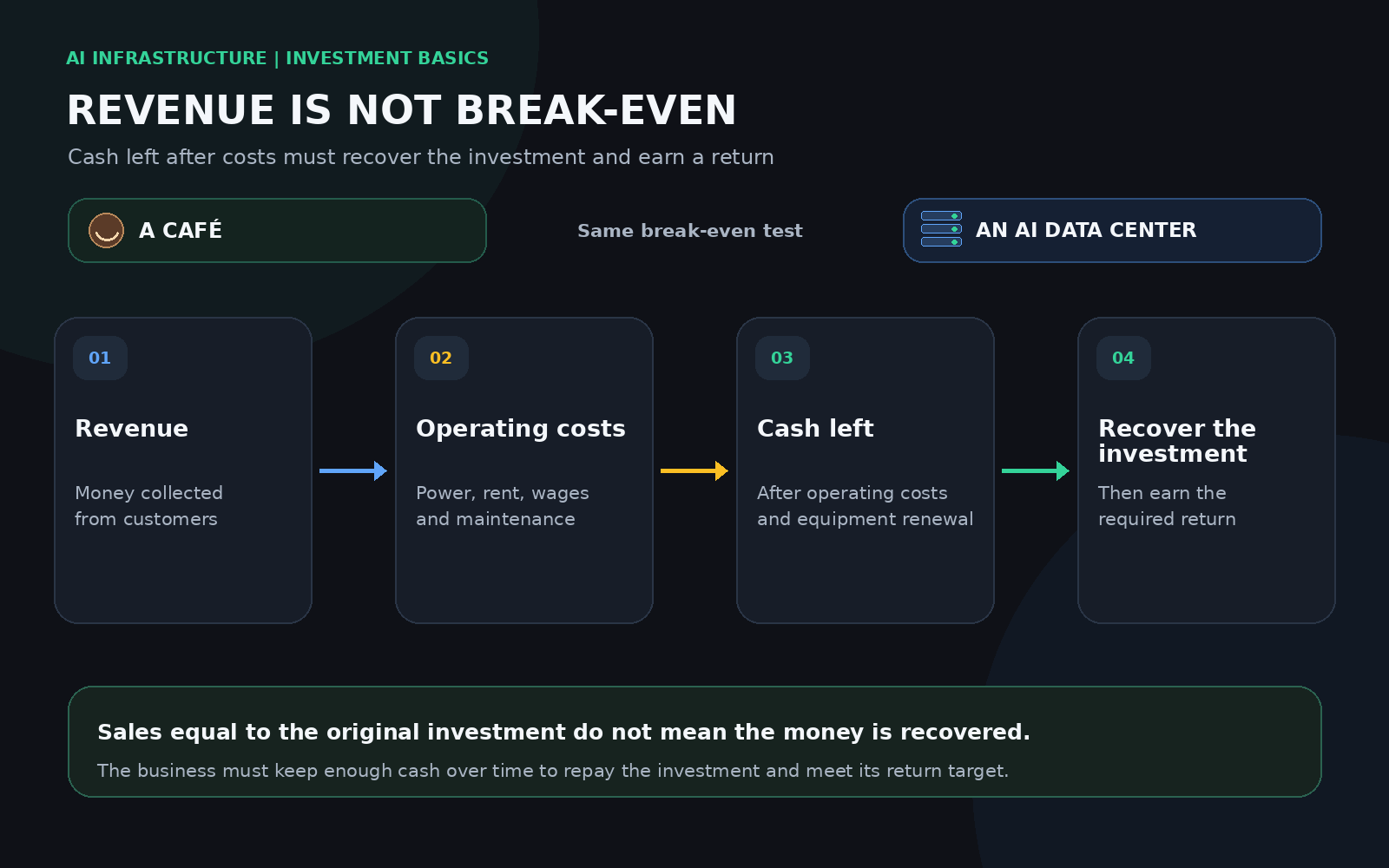
Let's imagine opening a cafe. It cost 100 million won to install coffee machines and do the interior design. If sales in the first year reached 100 million won, have you broken even? Not necessarily. After paying for coffee beans, rent, part-time wages, and electricity bills from the revenue, the actual profit is significantly reduced. You must recoup the initial 100 million won investment with the money remaining after paying these expenses.
Therefore, the break-even point must be calculated in two stages. The first stage is covering operating expenses, such as the cost of coffee beans, rent, and labor, with revenue. The second stage is recovering the initial investment of 100 million won with the money remaining after paying operating expenses. Furthermore, you must earn more than the interest you would have received if you had put that 100 million won in a bank to make opening a cafe worthwhile.
Let's look at the second step in numbers. Assuming the coffee machine is used for six years, to recoup the entire 100 million won and achieve an annual return of 10% on the investment over that period, approximately 23 million won must remain each year after paying operating expenses. The revenue required to generate this 23 million won depends on the profit margin remaining after deducting operating costs from revenue. For a cafe with a 50% profit margin, 46 million won in annual revenue is sufficient, but for one with only a 30% margin, 77 million won is required. The required revenue differs by nearly 1.7 times depending on whether the profit margin is 50% or 30%.
※ This is a hypothetical calculation for illustrative purposes. It is assumed that there are no taxes or money received from reselling the equipment.
The return on investment in an AI data center must also be calculated in the same two stages. The first stage is covering electricity and operating costs through an influx of customers, and the second stage is recouping the massive investment in the building and GPUs.
2 The reason the two figures differ by as much as 12 times
Goldman Sachs and the NBER paper differ in their subjects and objectives. Goldman Sachs calculated based on only five large companies, whereas the NBER paper covered the entire United States. Furthermore, Goldman Sachs considered a level that avoids losses, whereas the NBER paper considered a level that generates an annual return of 10%.
| division | What was calculated? |
|---|---|
| Goldman Sachs: Approximately $300 billion annually | The study targeted five companies: Amazon, Alphabet (Google), Microsoft, Oracle, and Meta. According to a Bloomberg report, Goldman Sachs projected that their investment in AI infrastructure could increase to approximately $800 billion by 2026 and $1.2 trillion by 2027. The calculation suggests that annual AI revenue would need to reach approximately $300 billion to break even within the next few years based on this investment. The specific calculation method was not disclosed. |
| NBER Paper: Approximately $3.55 trillion annually by 2032 | The study covered the entire United States. Assuming that building 188 GW (in terms of power capacity) of AI data centers by 2032 would cost nearly $9 trillion, the study worked backwards to calculate how much revenue is required to invest this money without debt and generate an annual return of 10%. This is not a prediction of future revenue, but a calculation of what *must* be generated. |
The calculation method used in the NBER paper is the same as the previous cafe example. Just as the cafe example examined the case where a coffee machine is used for 6 years and 50% of the revenue remains, the paper assumed that the investment in IT equipment such as servers and GPUs is recouped over 6 years, while other assets like buildings take 20 years, with 50% of the revenue remaining as operating cash flow. Here, 6 years is merely a period chosen for the calculation and does not mean that equipment is actually replaced every 6 years. If the retention rate is assumed to be low, the required revenue increases, while if the assumption is that the equipment can be used for a longer period, it decreases.
As such, the required revenue varies significantly depending on the assumptions made. Therefore, for investors, it is more important whether the invested money is actually returning as revenue and cash than which of the two figures is correct.
Where do we stand now? In the same report, Goldman Sachs analyzed that hyperscalers' cloud revenue is projected to be approximately $70 billion annually higher than the growth trend prior to the AI boom, as of the second quarter of 2026 ( reported by Investing.com ). While this entire amount cannot be viewed as AI revenue, a simple comparison based on this figure as the revenue generated by AI demand falls slightly short of a quarter of the $300 billion break-even point. The same applies to the United States as a whole. Reuters , citing Professor Van Nieuwerburgh’s estimate of $3.55 trillion, pointed out that the money currently being earned by the U.S. AI industry is merely a fraction of that total. Instead, the backlog of contracts set to become future revenue exceeds $1.5 trillion. Ultimately, the key factor is how quickly and to what extent these contracts convert into profitable revenue. Let’s examine this process in Oracle’s recent quarterly earnings.
3Oracle, Business is good, but cash is short
Oracle's performance for June to August 2026 is similar to a cafe that is expanding its store due to a rush of customers, but the cost of expansion is greater than the revenue coming in.
First of all, business is going well. Revenue from cloud infrastructure, which involves renting and receiving data center servers and GPUs, reached $7.4 billion , an increase of 121% from a year ago and more than double.
There are also many pending bookings. The amount of revenue that Oracle has not yet recognized—for which it has signed contracts with customers but has not yet provided services—reaches $664 billion . This is known as RPO (Remaining Performance Obligation), which is analogous to a group reservation taken in advance at a cafe. However, it is difficult to interpret this amount directly as AI revenue. This figure includes contracts unrelated to AI, and it takes time for bookings to turn into revenue. The company expects to recognize approximately 13% ($86 billion) of this amount as revenue within 12 months, 37% between 13 and 36 months, and 34% between 37 and 60 months. The remainder will be recognized later.
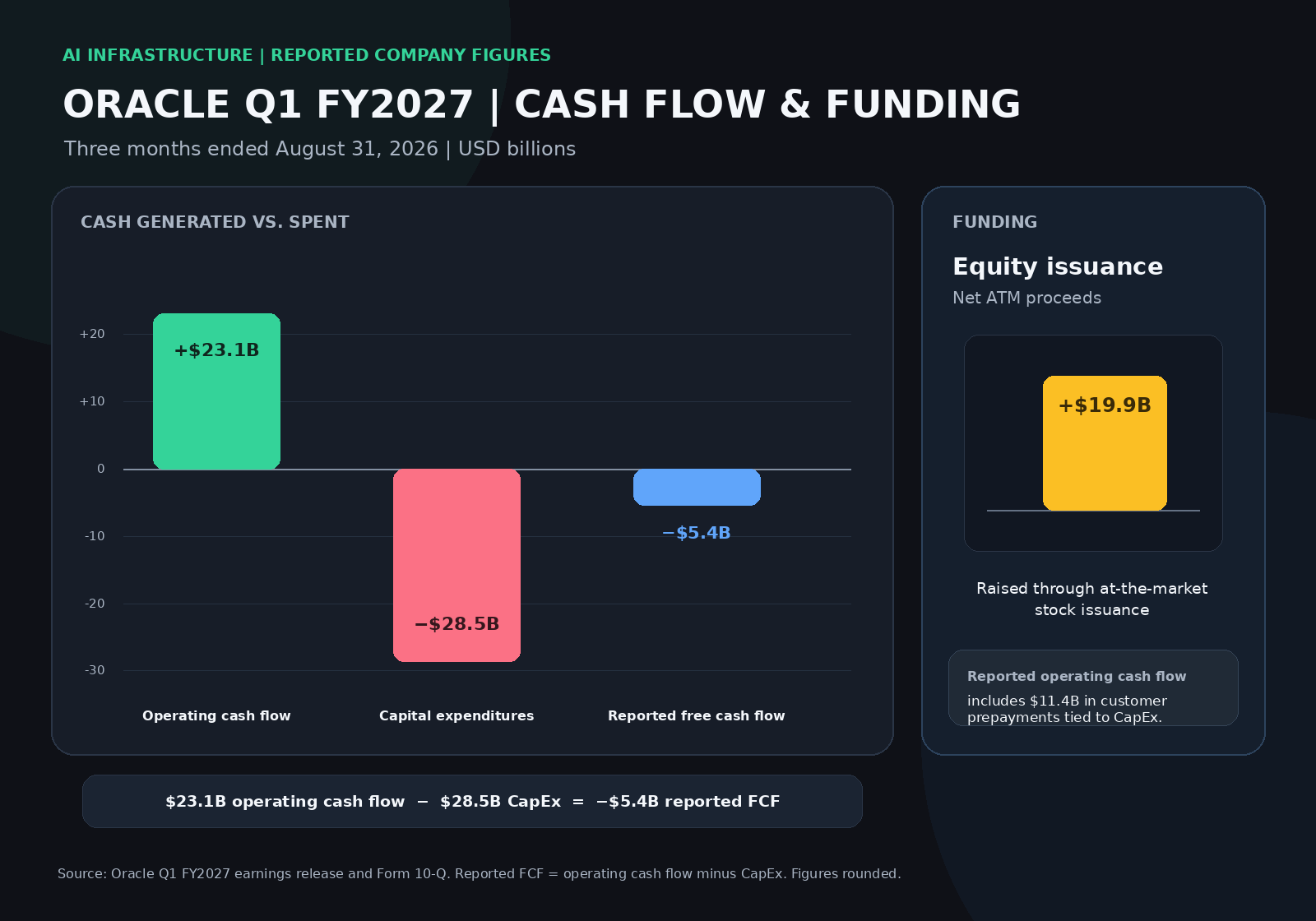
The problem is cash. Cash inflow from operations this quarter was $23.1 billion , while total capital expenditure was $28.5 billion . The company explained that capital expenditure is increasing as it expands the capacity of existing data centers and builds data centers in new regions. As outflows exceeded inflows, the company's reported free cash flow (cash inflow from operations minus investment costs) was negative at approximately -$5.4 billion .
The $23.1 billion received was not entirely earned from business operations this quarter. Of this amount, approximately $11.4 billion consists of advance payments made by customers in relation to capital expenditures. Just as a cafe receives money upfront by selling season tickets, Oracle received cash in advance by collecting service fees, and according to the contract, services must be provided later. If we simply subtract these advance payments, the operating cash flow comes out to approximately $11.7 billion. This is a reference figure I calculated separately, not an indicator disclosed by the company. In the same quarter, Oracle raised approximately $19.9 billion by issuing new shares. This increased the company's funds available for investment or debt repayment.
Of course, one cannot conclude that Oracle’s AI business has failed based solely on these figures. Since data centers are built first and profits are generated later, a cash shortage in the initial stages is somewhat natural. However, that does not mean one should be complacent just by seeing the news that revenue has doubled. We need to monitor for several quarters to see if the increased contracts translate into actual revenue and if there is still cash remaining after covering expenses.
Recalculating the free cash flow after deducting the $11.4 billion in prepayments yields approximately -$16.8 billion. This is also a reference figure I calculated separately. Oracle separately announced 'net cash outflows from capital expenditures,' reflecting prepayments and other factors, at approximately $18 billion; however, the calculation basis for this figure differs from the total capital expenditure of $28.5 billion. The quarterly report (10-Q) also lists approximately $288 billion in data center leases that have not yet commenced. Since the leases have not yet started, they are not yet recorded as liabilities, but once they begin, rent payments must be made for 15 to 19 years (this agreement was discussed in detail in the previous post, "Who Loses Money If AI Data Centers Stop?"). Oracle accounts for computer and network equipment costs spread over 1 to 6 years, applying a 6-year period to servers and network equipment, which account for the majority of these costs. While the number matches the 6-year figure from the previously mentioned NBER paper, one is based on the company's accounting standards, while the other is based on the paper's calculation assumptions.
4 Three Things to Check When Reading Earnings Articles, Where to Find Them?
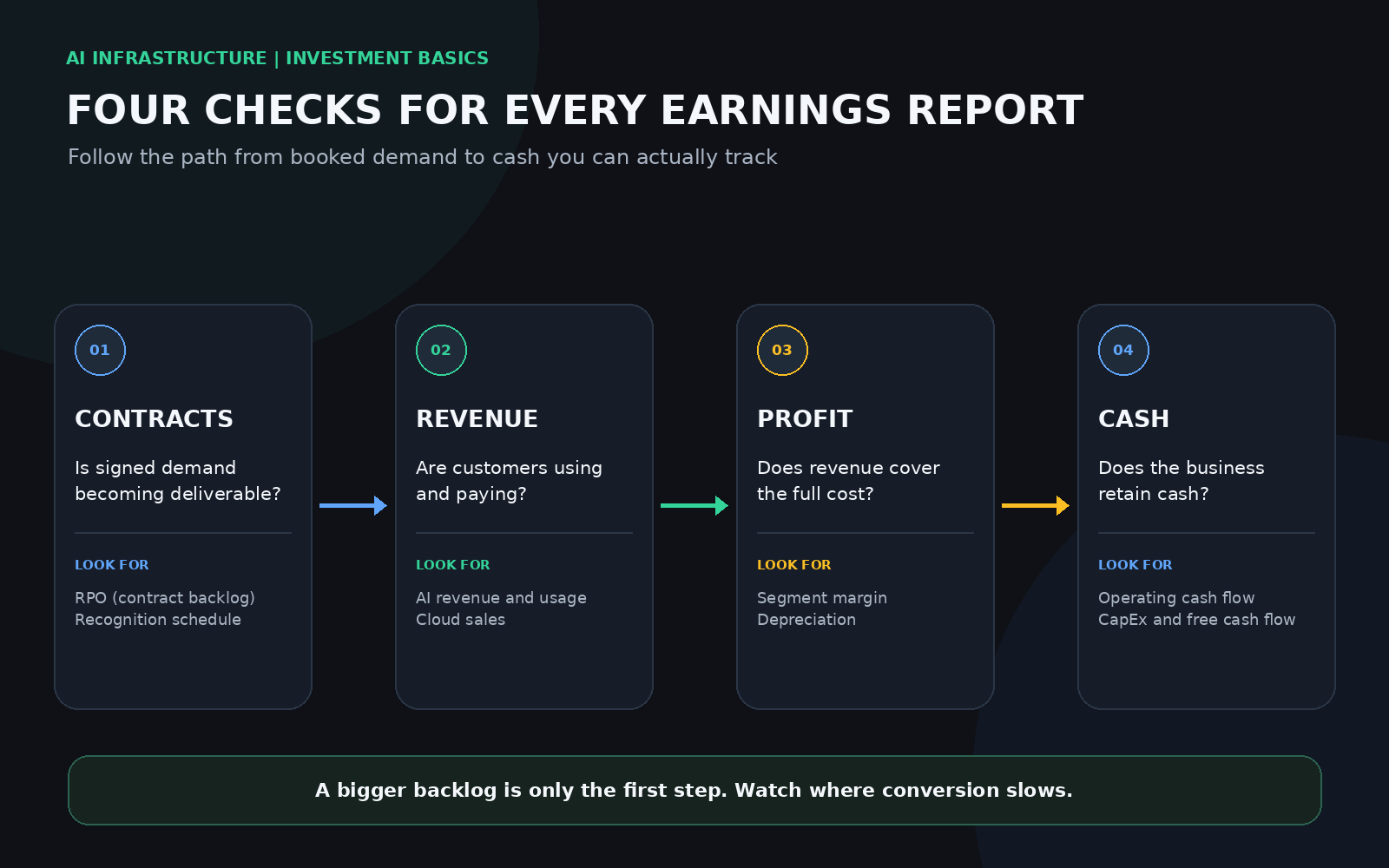
When reading earnings reports for AI companies, do not just look at the percentage increase in revenue; if you check the following three points in order, you can gauge whether your investment is returning properly.
- Have the contracts led to actual revenue? Article headlines like "Surge in Order Backlog" merely indicate that a large number of reservations have accumulated. You must verify the proportion of these that will convert into revenue within a year. Since revenue is generated only when the data center is actually operating, you must also check whether power has been supplied and operations have begun. Applying for grid connection or starting construction does not mean the facility is yet in the operational stage.
- Did revenue lead to profit? Depreciation is an amount recorded as an annual expense by spreading the cost of expensive equipment over its usage period. Even if revenue increases, if this depreciation increases faster, profit actually decreases. Oracle's depreciation for this quarter was $3.2 billion, more than double that of a year ago ($1.4 billion).
- Did the profit remain as cash? If investment costs exceed the cash generated from operations, check how the difference was covered. The risk assumed varies depending on whether one relies on customer prepayments, stock issuance, loans, or leases.
If a quarter continues to see any of the three factors worsen, projected earnings must be re-evaluated. Conversely, if all three improve in succession, grounds are built to determine whether the investment can be recovered.
Regarding the third question, the NBER paper points out a noteworthy aspect. It suggests that as data center investment funds are raised through various means—such as leases, joint ventures, project loans, and private placements—the debt burden increases, and commitments that are not easily visible on the balance sheet alone may also grow. This is the very structure examined through Oracle's Project Jupiter in the previous article , "Who Loses Money When AI Data Centers Stop?" This data center was built with approximately $18 billion in bank loans and long-term lease agreements; however, when securing power was delayed, Oracle issued a force majeure notice, and the loan was even quoted at a price below its face value.
Professor Van Nieuwerburgh specifically warned of the risks of this structure in a paper revised and presented at a conference in October. He noted that because a significant portion of the funding for AI infrastructure is based on debt, even a slight decrease in demand, construction delays, or a minor drop in asset values could cause losses to balloon far more significantly (reported by Reuters). The same could happen if equipment becomes obsolete faster than expected due to technological advancements. The burden ultimately falls on the investors who provided the funds.
The figures needed to verify the three points mentioned above can all be found in publicly available materials. Quarterly (10-Q) and annual (10-K) reports of U.S. companies can be found by searching the SEC EDGAR website using the company name or ticker symbol (ORCL for Oracle), while earnings announcements and conference call transcripts are available under the 'Investor Relations' menu on the company's website. Since the reports are written at length in English, it is faster to use the search function (Ctrl+F) with the keywords below.
- Contracts → Revenue: 'Remaining performance obligations' (the point at which they turn into revenue). Data center capacity (MW/GW) and operational schedules are confirmed in earnings statements and conference call transcripts, while regional grid conditions are verified in PJM (US East) and ERCOT (Texas) data.
- Revenue → Profit: 'Depreciation', 'Segment Information'. The years over which equipment costs are spread are found in the notes to tangible assets.
- Profit → Cash: 'Net cash provided by operating activities' (operating cash flow), 'Capital expenditures' (capital expenditures), 'Proceeds from issuances of common stock' (proceeds from issuance of common stock), 'customer prepayments' (customer prepayments), 'lease commitments' (leases not yet started)
5Frequently Asked Questions
| question | answer |
|---|---|
| How much does an AI data center need to earn to break even? | It varies depending on which companies are targeted and what criteria are used for calculation. Goldman Sachs calculated that the five major companies need approximately $300 billion annually to avoid losses, while an NBER paper calculated that the entire U.S. needs approximately $3.55 trillion in annual revenue by 2032 to generate a 10% annual return. |
| If the revenue equals the investment, isn't it breaking even? | No. You must use the remaining money after covering operating expenses with revenue to recoup your investment and expected returns just to break even. |
| Does having a large Request for Proposal (RPO) mean success? | It is still difficult to view it that way. They have merely taken reservations; no revenue or cash has come in. Oracle also expects that about 13% of the $664 billion will be recognized as revenue within 12 months. |
| If free cash flow is negative, is it considered an investment failure? | It is difficult to make a judgment based on just one quarter. Since data centers are a business where you build first and generate revenue later, you need to observe whether revenue and cash follow over several quarters. |
Conclusion — We must look at the process of how the money returns, rather than just a single figure.
The $300 billion and $3.55 trillion figures are calculations derived from different assumptions. Honestly, I do not yet know which side the actual result will be closer to. We will have to wait and see whether data centers will be built as planned, as assumed in the NBER paper, and whether they can generate 50% of revenue as operating cash flow after construction.
Therefore, starting with the next earnings report, instead of just looking at the news that AI sales have increased, I intend to meticulously record the three points outlined earlier every quarter.
The remaining question is the time lag. While the money to build data centers is being spent now, 71% of the contracts Oracle has secured will be recognized as revenue within 13 to 60 months. The question of how much and where to raise the necessary funds during this period—whether through customer advances, stock issuance, or loans—is not merely a problem for the company alone.
At last month's FOMC press conference, Fed Chair Kevin Warsh cited the strengthening economy, geopolitical tensions, and "capital competition" as reasons for the rise in long-term interest rates this year. He suggested that hyperscalers are attracting capital from the market, and that this partially explains the increase in interest rates ( Original press conference text , "Interest Rates Risen, But AI Stocks Risen" ). From here on, this is my interpretation. I believe that as more companies cover their funding shortfalls with bonds and loans, there is an additional reason why long-term interest rates will not easily fall.
In Part 3, I will calculate this gap directly by inputting the operating rate, electricity costs, lease costs, and financing costs.
This article is an analysis for informational purposes only and does not constitute an investment recommendation. The figures from Goldman Sachs and NBER are calculated based on different assumptions and do not represent actual revenue forecasts. Oracle's figures are based on the Q1 2027 fiscal year results announced on September 10, 2026, and the corresponding Q1 2027 results. Investment decisions and liabilities rest solely with the investor.
📌 Was this analysis helpful?
I will explain in an easy-to-understand way every quarter how contracts lead to revenue, and revenue leads to cash. Please subscribe if you would like to be notified of new posts.
Subscribe and get notifications →How this content was produced
Aleph's research AI agent assisted with collecting and analyzing public data, creating charts and visuals, and structuring the draft. Davar personally reviewed and edited the sources, figures, reasoning, and final conclusions.
This content is for informational purposes only and is not personalized investment advice or an individual stock recommendation. Read the full disclaimer

Davar
Davar builds and operates Aleph's research AI agent and writes and reviews analysis on macroeconomic developments and AI industry trends.
© Aleph. All rights reserved.