
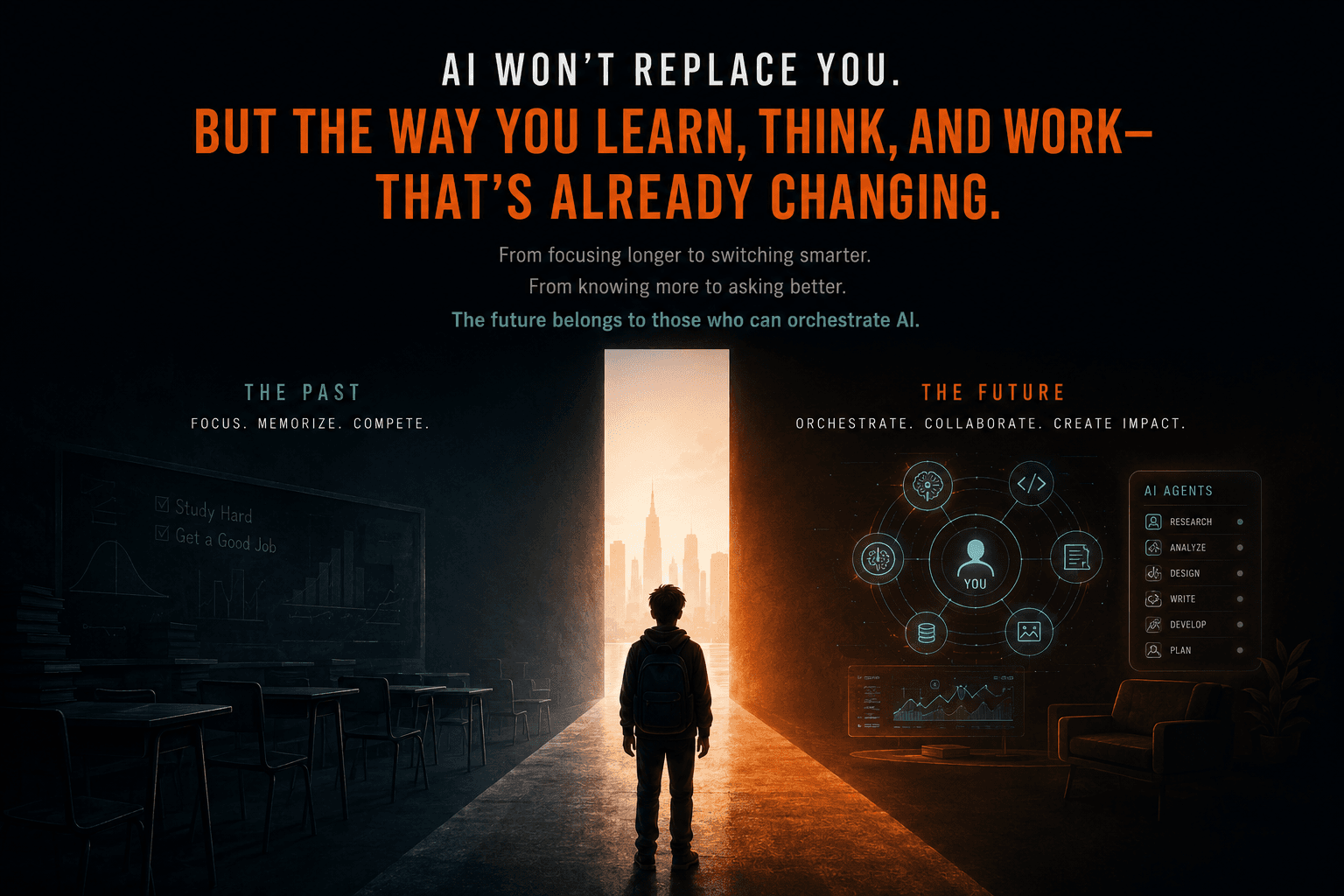
Is the attitude of unconditionally fearing new media still appropriate in the age of AI?
Future Education
AI Agent
Shorts generation
The future of education
Educational Paradigm
2026.05.24
Today, I would like to write a story unrelated to investment.
As I work on developing and operating AI agents, I frequently receive requests for consultations from parents. When I speak with them, almost everyone shares similar concerns: a resistance to social media and YouTube, and a vague fear of AI. Seeing media outlets and so-called experts exploit these fears to boost viewership, I wanted to offer a slightly different perspective as someone working in the field.

Whenever new media came out, adults said the same thing.
Back when comic books were popular, adults worried, saying, "If you only read comic books, you won't be able to read." When television became widespread, they worried again, saying, "Addiction to TV lowers your thinking ability." The situation was even more serious when video games appeared, with people saying, "Violence increases and you lose your sense of reality." As the internet spread, people claimed that "concentration disappears."
However, that comic book generation grew up to write novels and make movies. The TV generation grew up to build the content industry. The game generation grew up to establish Silicon Valley. The adults' fears repeated themselves in exactly the same pattern every time, and were wrong every time.
Now Shorts and Reels stand in that spot. The same fear has returned. “Concentration disappears. The brain is ruined. Deep thinking becomes impossible.”
However, this time it is difficult to simply overlook. It is not a matter of whether new media is good or bad, but rather because the very standards of "good competence" seem to be shifting as a new work environment—specifically AI agents—is actually being established. The point that keeps bothering me these days is whether the things we tried to instill in our children will continue to hold the same value in the future.
Strange things discovered while operating the 2AI agent
I actually develop and operate AI agents. In the process, I had an experience that I initially did not anticipate.
It wasn't the agent who was slow. It was me who was getting stuck.
The agent completes the assigned task and waits for the next instruction. However, a bottleneck occurs because I cannot quickly decide what to assign next. Although the AI processes tasks much faster, I am the one who has to determine the next direction. This problem becomes more pronounced when running multiple agents simultaneously. Agent A has finished, so I need to give the next instruction; Agent B's output needs to be reviewed and passed to C; and D is running through yet another flow—how quickly a person can switch between and manage these flows determines overall productivity.
After this experience, I had this thought. We have been taught that the ability to concentrate for a long time is a valuable competency. Deeply immersing oneself in a single task and maintaining focus so that the flow is not interrupted—that was the standard for an outstanding person. However, in an environment where multiple flows are managed simultaneously with AI agents, the ability to quickly switch contexts can become much more important than before.
If so, is the characteristic of the generation that grew up watching Shorts—quickly consuming dozens of videos and moving on to the next stimulus—actually a problem? Or is it a pattern that is actually well-suited to the era of AI agents?

3 Let's reconsider the premise that fast switching is a weakness.
Underlying adults' concerns about the Shorts generation is a premise: the longer one's attention span, the better talent one becomes.
However, it is worth examining whether that premise remains valid in the era of AI agents.
Rapid transitions are not always the answer. The counterargument that moving quickly without properly setting a direction will only lead to rushing off in the wrong direction is valid. However, this raises another important question: Must the strategic judgment required to set that direction ultimately also be made by humans?
The areas in which AI can provide assistance are rapidly expanding. An era is approaching where AI excels at a significant portion of rational and logical strategy formulation—analyzing data, formulating scenarios, and organizing options. If so, what remains for humans is not rational strategy itself, but rather the ability to perceive and judge what meaning that strategy holds for people—that is, the emotional and ethical realm.
And there is no evidence anywhere that such empathy or ethical sensitivity diminishes from watching a lot of Shorts.
One more point. If you follow the argument that rapid switching diminishes deep thinking ability to the end, you arrive at a strange conclusion. We now live amidst a much faster rhythm and more information than humanity did 2,000 years ago. By that logic, modern humans should be intellectually inferior to the ancient Greeks. Can you agree with such a conclusion?
Will the education system that tells you to stick to one path continue to work?
Education up until now has been geared toward creating masters. It emphasized quick career decisions, intensive training, and a ban on distractions. Any child attempting to get distracted was considered a problem child lacking concentration, while those who delved deeply into a single field were recognized as having the highest value. Underlying this is the premise that a person with unrivaled ability in a specific field wins in competition.
In an era where AI agents assist with execution, this calculation may change. Tasks that were previously handled by separate teams—such as marketing, planning, development, and finance—can now be managed simultaneously by a single person who knows how to utilize agents. This is work that previously required the entire team.
Elon Musk is a prime example. He is simultaneously running Tesla, SpaceX, X, Neuralink, The Boring Company, and xAI —managing everything from electric vehicles to space, brain engineering, social media, and tunnels. While he may not be the top expert in each individual field, he accomplishes more than anyone else by connecting various disciplines and setting the direction. In the era of AI agents, this approach becomes possible for a single individual.
An orchestra conductor is not the best violinist.
Of course, being merely broad without any depth has its limits. To guide an AI agent in the right direction, one must at least be able to read the language of that field. To judge whether the results produced by a marketing agent are right or wrong, one must understand marketing, and to review a development agent's code, one must not be unfamiliar with it. Possessing a depth somewhere between expert and novice across various fields—such capabilities may become even more important in the future.
You Learn Nothing When Talking to 5AI? – This Article Is a Counterexample
As AI becomes more widespread, there is a growing concern that delegating tasks to AI will cause humans to become increasingly weak. The same warning was given when search engines and calculators were first introduced: “If you don’t think for yourself, your brain rusts.”
The experience of those who have actually used AI extensively is different. Through conversations with AI, they learn things they didn't know before and discover perspectives they hadn't considered. Counterarguments raised by the AI sharpen their thinking, and the frames presented by the AI open up unseen spaces.
In fact, this article itself is the result of that experience. It emerged from an actual debate I had with an AI. I presented the AI with three arguments: that shorts-type talent can be stronger, that the craftsman model is faltering, and that the significance of academic qualifications is changing. The AI countered my claims, and I refuted those counterarguments; the AI admitted partial defeat and restructured its points. In that process, new thoughts emerged that were not present at the beginning. Both for me and for the AI.
If this isn't learning, then what is?
This is exactly what Socrates did 2,500 years ago. He taught nothing, only asked questions. He kept asking questions from the side until the other person arrived at the answer on their own. When a conversation with AI works well, it resembles that structure. A person asks a question, the AI raises a counter-argument, the person reconsiders, and a perspective that was not there initially emerges.
What needs to be prioritized in education in the future may change. Rather than how much one knows, it may be about how well one can ask questions in conversations with AI. It is worth asking how much such skills are currently being addressed in schools.
6The signal of educational background is changing
This is what one's educational background originally did: proving to an employer that they could handle difficult tasks. Graduating from a good university meant having a lot of knowledge, but at the same time, it was a signal guaranteeing self-directed learning ability, the capacity to endure ambiguity, and the execution skills to survive fierce competition.
However, as AI significantly lowers the cost of accessing knowledge, some of the things previously verified by academic credentials are beginning to take on a different meaning. If a person with a Ph.D. and one without use the same AI, the gap in simple knowledge retrieval narrows. Companies like Palantir have long hired based on actual problem-solving skills rather than degrees, and now, such companies are becoming the trend rather than the exception.
This does not mean that universities themselves will become useless. Collaboration learned through team conflicts, life role models received from seniors and professors, and the experience of wrestling with unsolved problems—these are things that AI cannot easily replace. The question is whether the current four years of time and tens of millions of won in costs will continue to be necessary for these things in the future. If universities fail to provide a convincing answer to this question, the current system will change significantly.

7What Remains for Humans – Not Reason, but Empathy and Ethics
As AI takes on increasingly more responsibility for strategy and execution, what will become more important to humans?
A significant portion of rational and logical judgment is already rapidly moving into an area where AI excels over humans. Analyzing data, comparing options, and deriving optimal strategies—this is where AI is faster and more accurate.
AI can calculate which strategy is optimal, but it cannot truly feel the pain that strategy inflicts on others. Ethical judgments that cannot be explained by data, the choice of priorities in situations without a right answer, and the sensitivity to resonate with the suffering of others—these remain outside the realm of AI.
If there is one thing education should focus on in the AI era, it is not memorizing more knowledge, but rather cultivating the ability to feel and understand people, and the power to judge right from wrong on one's own. However, this ability cannot be measured by college entrance exam scores. Nor is it fostered by simply listening to lectures. It grows through actual experiences of conflict, forming relationships, failing, and making choices again.
8 The Illusion of Purpose – Curiosity Comes First
When you listen to the stories of successful people, they seem to have something in common. They succeeded because they knew why they had to do their work from a young age and that sense of purpose never wavered.
I think this is mostly a story reconstructed after the fact.
In reality, there are far more instances where one simply followed what was interesting, only to look back at some point and realize that meaning had emerged. I started simply because it was fun, and as I got better at it, it deepened; and as it deepened, it became the direction of my life. It wasn't that purpose came first and experience followed; rather, experience accumulated first and meaning attached later. Looking back after success, everything seems inevitable, but the actual process was mostly not like that.
In a sense, isn't the fact that education forces the idea of "what you must become" from a young age also rooted in this misconception?
9Frequently Asked Questions
| question | answer |
|---|---|
| Does watching a lot of shorts really cause a drop in concentration? | Studies yield varying conclusions, and there is no consensus on the evidence. The same fear has existed whenever comic books, TV shows, or games were released, and society has adapted each time. A more fundamental question may be whether the standard of “how long attention spans should be” remains valid in the era of AI agents. |
| What skills will become more important in the era of AI agents? | Formulating rational strategies is increasingly becoming an area where AI excels. On the other hand, the ability to empathize with others, ethical judgment in situations without definitive answers, and the capacity to ask good questions are likely to remain the domain of humans. |
| Is it right to decide on a career path early? | In an era where AI assists in execution, it becomes easier for a single person to handle multiple fields simultaneously. It is possible that the process of finding one's direction by trying out various fields firsthand is more effective than making a quick career decision. Curiosity may come first, and the career path may follow. |
| Doesn't talking to AI lower a child's thinking skills? | In reality, the experiences of those who have used it extensively often tell the opposite story. Counterarguments raised by AI sharpen one's thinking, and unexpected perspectives open up new questions. Ultimately, it is the difference between using AI as a machine to bring answers or as a conversational partner. |
| Will a college degree still be meaningful in the age of AI? | The function of "quantity of knowledge" guaranteed by degrees is rapidly being replaced by AI. While the value of experiences such as team collaboration, mentoring, and grappling with unanswerable problems remains, it is a question that universities themselves must answer: whether the current costs and time are still necessary for these activities. |
Conclusion – Things We Must Ask Again
To be honest, I still don't know the answer either.
No one can be certain right now what impact Shorts will have on children, or which skills will become more important in the era of AI agents. Perhaps in a few years, all current ideas could turn out to be wrong.
However, looking at what we have examined so far, it seems that we need to question some of the things we have taken for granted.
Will long-term concentration continue to be the most important ability in the future?
Is rapid context switching really a bad habit?
Will the method of deciding one's career path early remain valid?
Is knowing a lot of knowledge still the most important competitive advantage?
Will educational background continue to hold meaning in the same way in the future?
There is no answer yet. However, shouldn't we at least be cautious about the attitude of hastily labeling the new generation as "broken"? If humans are meant to find meaning by following what is interesting, we should also consider whether it is truly right to narrow those interests to a single point at such an early age.
Curiosity comes first, and meaning comes later.
Isn't the job of education, at the very least, not to crush that curiosity too quickly?
📌 Did this article give you something to think about?
This article is derived from actual discussions with AI. We continue to track changes in education, talent, and industry in the era of AI agents.
In the next post, we plan to cover “The Era of AI Agents: Which Universities and Curricula Will Survive.”
How this content was produced
Aleph's research AI agent assisted with collecting and analyzing public data, creating charts and visuals, and structuring the draft. Davar personally reviewed and edited the sources, figures, reasoning, and final conclusions.
This content is for informational purposes only and is not personalized investment advice or an individual stock recommendation. Read the full disclaimer

Davar
Davar builds and operates Aleph's research AI agent and writes and reviews analysis on macroeconomic developments and AI industry trends.
© Aleph. All rights reserved.