
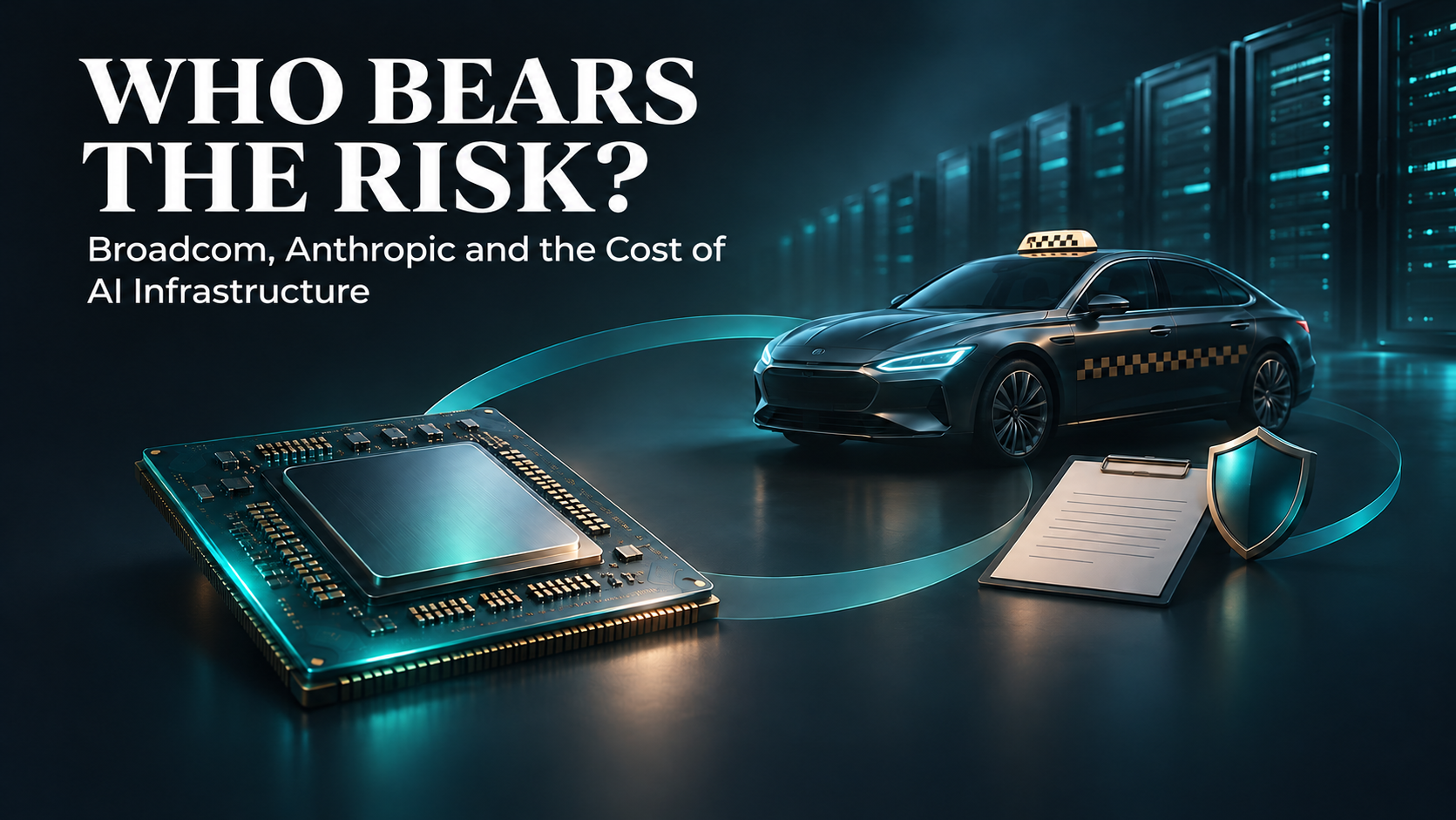
The $63 Billion Deal Analyzed Through Taxi Company Vehicle Leases: What Risks Did the Company That Sold the AI Equipment Take on?
What if an AI semiconductor manufacturer went a step further by guaranteeing a customer's equipment payments while selling its products? The $63 billion deal between Broadcom and Antropic, announced on October 26, includes such a condition. A separate entity funded by financial institutions purchases Broadcom's equipment and leases it to Antropic, while Broadcom supports the residual value of that equipment. The maximum potential burden disclosed by Broadcom is approximately $43 billion . 1 · 3
Later in the week the deal was announced, semiconductor stocks in the U.S. and Korea were shaken significantly amid concerns over the exit of AI investments. On October 30, the KOSPI closed at 5,730.74, down 3.48% , and the Philadelphia Semiconductor Index fell 7.2% that night. After rebounding on November 2, the KOSPI closed again on the 3rd at 5,648.79, down 3.59% .² There is no evidence to suggest that this deal caused the stock price decline. The market cited the earnings of Alphabet, Amazon, and Intel, as well as the financing plans of Big Tech companies, as the background factors.
Nevertheless, it is a good case study to examine where the money and risks required to expand AI facilities flow. In the previous article on Coreweave, we looked at whether a company that borrows money to purchase AI facilities and leases them to customers can handle the debt. In this article, we will examine what risks the company sharing takes on when it also acts as a guarantee, and what investors should look for going forward.
The taxi company, seeing an increase in passengers, decided to lease cars instead of buying them.
This transaction is similar to a structure where a taxi company acquires vehicles through leasing rather than purchasing them. Let’s assume there is a taxi company that needs to acquire 1,000 additional vehicles due to a surge in customers. If the cost of the vehicles were paid for all at once, the company’s bank account would be depleted. Therefore, a capital company borrows money from a bank to purchase the vehicles from a car manufacturer, and the taxi company drives those vehicles while paying monthly lease payments. The lease payments go to the capital company, which then uses that money to repay the loan to the bank.
On October 26, Bank of America, Blackstone, Citi, and Morgan Stanley announced a $63 billion financing deal for AI computing facilities to be used by Antropic. A newly established Special Purpose Vehicle (SPV) will use funds from the financial institutions to purchase Broadcom's custom AI accelerators (XPUs) and network equipment, which will then be leased to Antropic. The rent paid by Antropic will go to the SPV, which will repay the financial institutions the interest and principal according to the financing terms. Equipment deliveries are scheduled to begin in 2027. 1
Antropic is the company that develops the AI service 'Claude'. By analogy, Antropic is a taxi company, the SPV is a capital firm, the four financial institutions are banks, and Broadcom is a car company. The funding side is also divided into two tiers. Bank of America, Citi, and Morgan Stanley arrange senior loans to ensure repayment first in the event of a problem, while Blackstone alone provides the committed portion of the subordinated funds, which are repaid later.
Up to this point, it is not much different from a common equipment lease. The noteworthy point is that the car company, Broadcom, did not stop its role at selling cars.
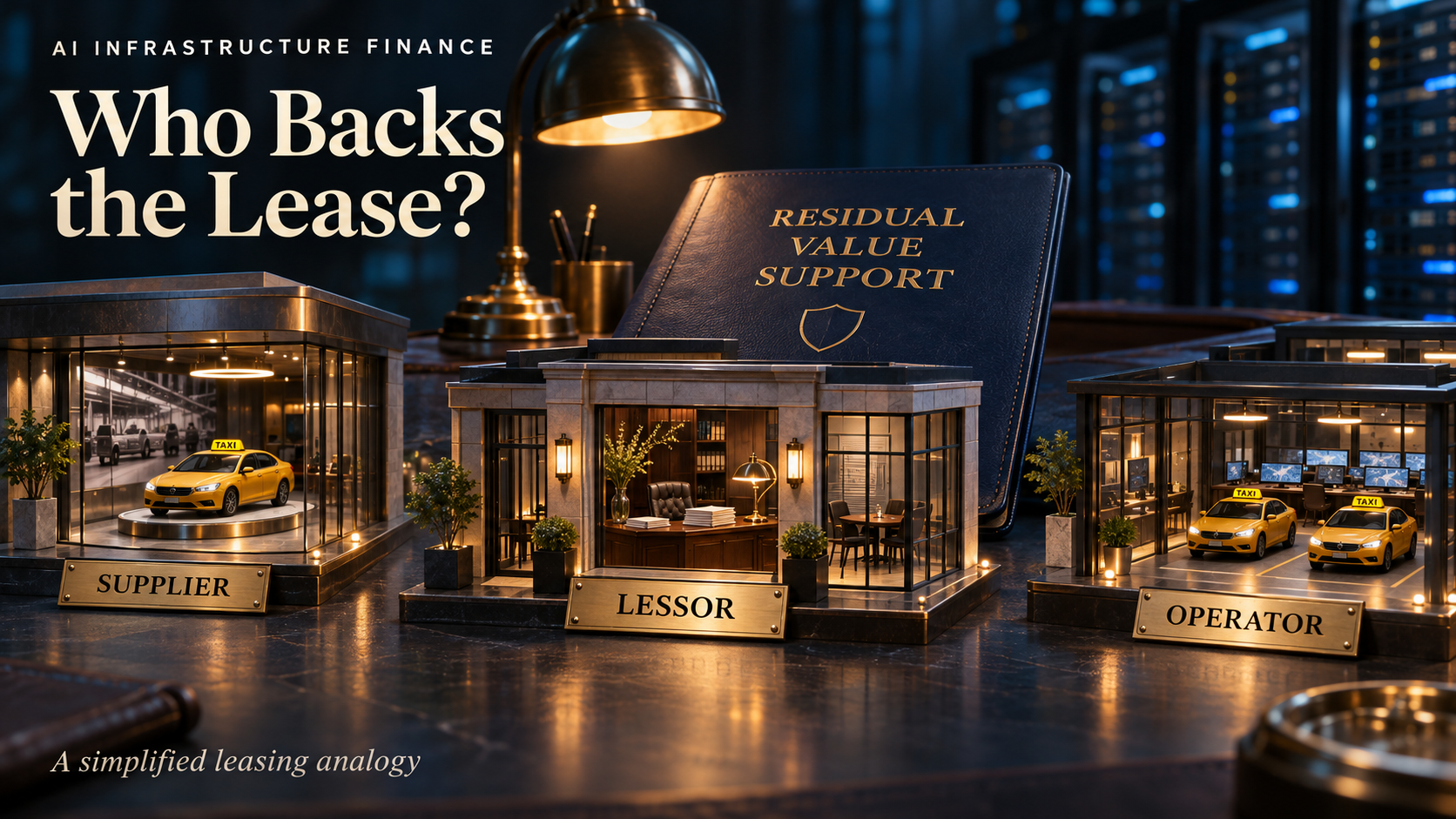
The 2car company agreed to take responsibility for the used car value when selling the car.
To use an analogy, Broadcom’s role is equivalent to a car company taking responsibility for the resale value of a used car. Let’s assume a car company made the following promise to a finance company: “If a taxi company fails to pay its lease and we reclaim and sell the car, and the proceeds fall short of 72.5% of the remaining lease payments, we will cover the difference.” The value a car can receive when it is disposed of after being driven for several years is called residual value. You can think of it as the resale value of a used car. It is a structure where, if the proceeds from selling the car are insufficient to cover the repayment amount, the car company covers the shortfall within the agreed-upon range.
If we follow how this formula works with simple numbers, it works like this. If a taxi company has 100 million won in outstanding lease payments and the payments are cut off, the amount of money the car company has to cover depends on how much the used car is sold for.
| The price of the recovered car | 72.5% of the remaining lease payments | The money the car company will cover |
|---|---|---|
| 80 million won | 72.5 million won | 0 won |
| 50 million won | 72.5 million won | 22.5 million won |
| 0 won | 72.5 million won | 72.5 million won |
※ This is a simple calculation to help understand the disclosed formula and does not represent the actual transaction amount or recovery result.
In the table, when the selling price of the car is 0 won, the amount the car company has to cover becomes the largest under this assumption. The actual burden on Broadcom depends on how much equipment has been deployed, how much rent has been paid up to that point, and how much is recovered by disposing of the equipment.
A disclosure (8-K) filed by Broadcom on October 27 contains this commitment. If the value of the equipment falls below the agreed-upon standard due to the customer's failure to fulfill the lease agreement, Broadcom may cover the difference. The disclosure explains this difference as the gap between 72.5% of the remaining payment obligations under the lease agreement and the proceeds from the disposal of the equipment. The maximum potential burden upon deployment is approximately $43 billion at undiscounted prices. The burden increases as the equipment is delivered and deployed, and decreases as the customer pays rent. 3
In its transaction explanatory materials, Broadcom presented an example where, assuming equipment deliveries and lease payments proceed as assumed, the potential burden would reach approximately $43 billion before decreasing to zero. A footnote in the document clarifies that this is an example based on assumed delivery schedules and lease payment plans, and that actual amounts and timing may differ. While the promise of residual value support does not mean the amount will be paid out in cash immediately, it could become a real burden if agreed-upon conditions are met. 4
Therefore, the two numbers must be read separately. The $63 billion represents the size of the financial transaction involved in purchasing the equipment. The $43 billion is the conditional maximum potential burden disclosed by Broadcom. This is not money that Broadcom has already lost, nor does it mean that it will necessarily have to pay this amount even if a problem arises.
Broadcom also outlined in its disclosure methods to mitigate the burden in the event that a customer fails to fulfill the contract. These methods include taking over the lease agreement, reselling the equipment at a predetermined price under certain conditions, or selling it to another party. The company assessed the likelihood of actual financial burden as low, citing expectations that customer profitability would significantly improve and the value of the equipment would be maintained.
This is not the first time Broadcom has made such a commitment. It used a similar structure in the $35 billion Apollo-led deal in June, listing the maximum potential burden of that deal at approximately $29 billion in its quarterly report. 5 The maximum potential burden disclosed in this deal is greater than that of the previous one. Since the actual burden of each transaction depends on equipment deployment and lease payments, the sum of the two figures does not represent the current loss or the actual exposure at that point in time.
From this point on, it is difficult to explain using the car analogy. The used car market is extensive, and the market value of a car a few years old can be roughly estimated. AI equipment improves at a much faster rate, and it is difficult to assume there are as many buyers for billions of dollars worth of equipment at once as there are for cars. Based solely on public disclosures, it is difficult to determine how much the equipment can be sold for in the event of a problem, or how much the participants will ultimately bear.
It is not possible to conclude the reason why Broadcom accepted these terms based solely on publicly available data. What can be confirmed is that , in the process of securing large orders, equipment suppliers also agreed to share some of the customer's financing risks .
3AI Equipment investment costs go out first, and revenue comes in later.
In AI infrastructure investment, there is a gap between when money goes out and when it comes in. Data centers and servers must be built first, and the revenue generated from those facilities comes in over several years. Depending on how this gap is filled, the person bearing the risk changes.
When investing with one's own cash, unlike borrowing money from external sources, there is no obligation to repay interest or principal. Nevertheless, if investment performance is poor, the company and its shareholders are affected. Issuing new shares lowers the ownership stake of existing shareholders. If corporate bonds are issued or money is borrowed, interest must be paid and the principal repaid. When equipment is brought in through a lease, the lessor, the financial institution, and the supplier providing the guarantee share the risk. The Broadcom deal is the last of these methods.
Oracle chose to raise funds directly through stocks and bonds. At its Investor Day event on October 28, Oracle announced that it would limit additional capital raising to $20 billion during fiscal years 2027–2030. The plan is to split this into $10 billion in stocks and $10 billion in bonds, and refinancing to pay off existing debt is not included in this limit. This limit is separate from the $20 billion stock sale completed in the first quarter (June–August) of fiscal year 2027. The company projected that its free cash flow would turn positive in the second half of fiscal year 2028 and exceed $ 30 billion in fiscal year 2029. Free cash flow is the money remaining after deducting capital expenditures from cash generated from operations. Since Oracle's fiscal year ends in May, the second half of fiscal year 2028 is from December 2027 to May 2028.
Oracle's stock price rose by approximately 11% on Investor Day. However, on November 2, the stock price fell by 8.8% after Oracle disclosed plans to raise a total of $20 billion, consisting of $10 billion in new shares and $10 billion in corporate bonds. On Investor Day, the scale of future fundraising and cash flow plans were presented, and as the actual new share issuance plan was subsequently announced, the possibility that the number of shares would increase and the stake of existing shareholders would decrease became more concrete. However, since U.S. semiconductor stocks also fell sharply on the same day, the stock price fluctuations on the two days cannot be explained solely by these factors. The company's stated turnaround to a cash flow surplus is a future plan, not an achievement already accomplished .
Oracle raised funds directly through stocks and bonds, whereas the Broadcom deal is structured so that a separate entity purchases the equipment and leases it. Although the methods differ, the two cases raise the same question: Who provides the funds needed to expand AI facilities, under what conditions, and who bears the losses if predictions go awry?

If the financial situation of NUM3 AI companies changes, the demand outlook for memory companies may also change.
The link between this deal and Samsung Electronics and SK Hynix is the expectation of investment in AI facilities. Neither the publicly disclosed deal announcement nor Broadcom’s filing contains any mention of Samsung Electronics or SK Hynix providing guarantees for the transaction. Nor has it been confirmed that the recent decline in the two companies' stock prices was caused by this deal.
As AI and cloud companies expand their computing facilities, the demand for memory, including High Bandwidth Memory (HBM) used in AI accelerators, is likely to increase. Based on this expectation, investors calculate the future earnings of memory companies. For example, KB Securities recently raised its forecast for Samsung Electronics' operating profit in 2027 from 555 trillion won to 640 trillion won. This is an estimate by a single securities firm, and actual performance may vary depending on memory prices and demand.
However, for capital investment to continue, AI companies must be able to raise funds, and those facilities must generate revenue and cash. If borrowing becomes difficult or expectations for investment recovery decline, the pace of capital investment may be adjusted. This, in turn , alters the outlook for memory demand and the assessment of corporate value. MTN cited the dampening of investor sentiment caused by Big Tech's large-scale fundraising plans as the background for the decline in the domestic stock market on November 3.
This is a possible path that could unfold in the future . It does not mean that AI investment has decreased or that memory demand has declined. Stock prices are not determined solely by last quarter's earnings. If expectations for significant future growth are already heavily reflected in the stock price, the price will fall the moment investors begin to doubt how long those profits will last, even while earnings are increasing. This is one of the reasons why stock prices sometimes fall even on days when brokerage firms raise their earnings forecasts.
5Whether the guarantee becomes an actual burden depends on whether the rent continues to come in.
The direct condition for reducing Broadcom's potential burden is the payment of rent for Antropic. Therefore, costs and cash flow must be examined along with Antropic's revenue growth.
According to the S-1 filing submitted by Antropic on October 26, revenue for the first half of 2026 was approximately $16.3 billion . The net loss for the same period was $80.7 billion, but a large portion of this was non-cash loss resulting from changes in the fair value of convertible securities and related financial instruments. Since excluding non -cash losses does not immediately imply strong cash flow, operating profit and loss and cash flow must be viewed separately.
The amended filing submitted on November 2 included third-quarter data. Third-quarter revenue was approximately $17 billion , an increase of about 47% from the second quarter. Computing and infrastructure expenses for the same quarter were approximately $9.9 billion , and their share of revenue rose from 48% in the second quarter to 58% in the third. These expenses included about $5 billion in computing costs purchased through short-term contracts, which the company explained were significantly more expensive than similar long-term contracts. On an accounting basis, operating profit/loss shifted from a surplus of $974 million in the second quarter to a deficit of $567 million in the third quarter. The company cited short-term computing costs and approximately $2 billion in non-cash donation matching costs as the primary reasons. 11
It is also necessary to look at cash flow. Antropic’s cumulative operating cash flow for January through September 2026 was an inflow of approximately $6.57 billion , a significant improvement from the outflow of approximately $2.02 billion during the same period last year. 11 However, this is a cumulative figure for nine months, not just the third quarter, and it remains to be seen in subsequent quarters whether the company can continue to cover rising computing costs and rent.
The scale of future expenditures has also been disclosed. According to the amended filing, Antropic's total expenditures on purchase and lease agreements entered into as of and after September 30, 2026, amount to approximately $895.4 billion . These are mostly computing and infrastructure-related contracts, and include leases that have not yet commenced. The company projected that approximately $447.5 billion of this amount would occur before the end of 2030, with the majority of the remainder occurring between 2031 and 2045. Payments due over the 12 months following September 30 amount to approximately $69.8 billion. Since these are multi-year commitments, the entire amount is not immediately repaid debt or already expensed; some contracts also include termination rights or conditions for initiation of transactions. As it has not been confirmed to what extent the Broadcom transaction is included within these agreements, the two figures cannot be added together.
While sales are growing rapidly, the costs and commitments that must be covered by those sales are also increasing. However, a rise in the cost ratio in a single quarter cannot definitively confirm a long-term deterioration in profitability. The cost ratio could fall again if the proportion of short-term contracts decreases.
The path through which risk escalates is as follows: If revenue from AI services grows slower than expected or computing costs rise faster, the financial burden on companies using the equipment increases. Furthermore, if the resale value of the equipment drops, the losses are passed on to financial institutions and equipment suppliers. Credit rating agency Moody's warned that Broadcom's financial risk could increase if it pursues multiple large-scale deals in a short period. Even if losses occur in the future, it is difficult to attribute them to a single cause, as they could be due to slowing AI demand, rising interest rates, or the generational shift of equipment.
6 Four Things to Watch Going Forward — Revenue and Costs, Potential Burdens, Cash Flow, Financing Conditions
To determine whether AI investment funds are being recouped, you need to check the following four points using publicly available data. Here is a summary of where to check each item and what precautions to take.
| Observation item | How to check | Points to note |
|---|---|---|
| Antropic Revenue and Costs | Compare revenue, computing and infrastructure costs, and operating cash flow for the same period in the registration statement and subsequently disclosed financial data. Also, examine how committed amounts are divided by year. Verify the extent to which revenue and expense items are provided in the quarterly reports following the listing. | The listing schedule and the scope of subsequent disclosures have not yet been finalized. |
| Broadcom's potential burden | Review the maximum potential burden of residual value support and related explanations in the quarterly report. Also, examine whether equipment is delivered as scheduled starting in 2027. | It has not been confirmed whether the increase resulting from equipment deployment and the decrease resulting from rent payments will be disclosed separately. |
| Big Tech funding situation | Compare operating cash flow, capital expenditure, and financing details via stocks, bonds, and leases by company. | Definitions vary from company to company, such as whether a lease is included. |
| Financial conditions | Check the interest rates, collateral, and guarantee conditions of newly issued bonds and loans. Also observe whether transactions in which the supplier provides a guarantee are increasing. | It is difficult to simply compare interest rates due to differences in maturity and credit rating. |

7Frequently Asked Questions
| question | answer |
|---|---|
| Is the $43 billion disclosed by Broadcom a confirmed loss? | No. It is a conditional burden that may arise if the customer fails to fulfill the lease agreement and the value of the equipment falls short of the agreed standards. The $43 billion represents the maximum potential burden when the equipment is deployed, and it decreases as the customer pays rent. |
| Why does Antropic rent equipment instead of buying it directly? | The reason is not stated in the public data. Generally, leasing is widely used by companies that need to rapidly expand their facilities because it allows for the payment of equipment costs over several years instead of paying the full amount at once. |
| Do Samsung Electronics and SK Hynix also share the risk of this deal? | Neither the publicly disclosed deal announcement nor Broadcom’s filing contains any mention of the two companies providing guarantees for the transaction. The connecting link is the expectation that investment in AI facilities will continue, and if that expectation changes, the outlook for memory demand and stock valuations could change along with it. |
| Why did Oracle's stock price rise on Investor Day but fall during the actual fundraising? | On Investor Day, future fundraising scale and cash flow plans were presented, and as the actual new share issuance plan was subsequently revealed, the possibility of a decrease in existing shareholders' stake became concrete. However, the stock price fluctuations on these two days cannot be explained solely by these factors. |
| Is it risky for equipment suppliers to help customers finance? | It cannot be concluded that it is inherently dangerous. Suppliers secure large orders through this. However, if multiple transactions with the same customer accumulate over a short period, the supplier shares the burden when that customer's business falters. |
Conclusion — If the company that sold the car also provided a warranty, you must first check if the lease payments are being received.
If a car company has agreed to cover the resale value of used cars, it is difficult to judge its performance based solely on the number of cars sold. The Broadcom deal demonstrates that companies selling AI equipment also share some of their customers' financing risks.
In the previous article , "How Much Does an AI Data Center Need to Break Even?", we examined how much an AI data center needs to earn to recoup its investment, and in "Can AI Companies Manage Debt Until Future Revenue Becomes Cash?", we looked at whether companies that borrow money to purchase AI equipment and lend it to customers can manage their debt. This article covers the structure in which some of that risk is transferred to equipment suppliers.
There is one more step between the judgment that AI will continue to grow and the judgment that the money spent to support that growth can be recouped. If Antropic continues to pay rent in accordance with the contract, Broadcom's potential burden is reduced. Whether revenue growth translates into the ability to make those payments can only be determined by looking at costs and cash flow together. Honestly, I don't know what the outcome of this deal will be a few years from now.
So, going forward, I intend to ask three questions. Is Antropic's revenue growing faster than computing costs? Who is providing the funds needed for capital investment, and under what conditions? Will the equipment to be delivered starting in 2027 actually generate rental income and cash? I plan to look for the answers to these questions one by one in the upcoming earnings announcements and quarterly reports.
📌 Was this analysis helpful?
I will continue to track the process of money invested in AI returning as actual profits and cash. Please subscribe below to receive new posts.
Subscribe and get notifications →Reference materials
- Broadcom IR, Bank of America, Blackstone, Citi and Morgan Stanley announce $63 billion transaction (2026.10.26)
- SBS Biz, 'Alphabet Shock' Hits KOSPI Hard… SK Hynix Plunges 7% (2026.10.30) · Reuters, Wall Street Closes Sharply Lower as AI Cash Burn Fear's Spark Tech Selloff (2026.10.30) · Aju Business Daily, KOSPI Closes at 5,648.79, Down 210.29p (3.59%) (2026.11.03)
- Broadcom, Form 8-K Item 2.03 (Submitted Oct. 27, 2026) — 1st Disclosure
- Broadcom IR, Transaction Structure Explanation Material (Oct. 2026) — The $43 billion reduction path is an example based on assumptions in the footnotes.
- Broadcom, Form 10-Q (Q1 2026.08.02) — 1st Disclosure · Nasdaq.com (The Motley Fool) Summary
- Oracle IR, Oracle Investor Day 2026: Accelerating Value Creation (2026.10.28) · investingLive, Stock Price Reaction to Investor Day (2026.10.28)
- Reuters (AOL), Oracle taps investors for $20 billion to finance AI expansion (2026.11.02) · Opening Bell Daily, November 2 closing price $119.22 (2026.11.02) · The Motley Fool, October 30 closing price $130.67 (2026.11.02) — Decline rate calculated based on two closing prices
- Aju Business Daily, Samsung Electronics and SK Hynix Plunge 5% in Early Trading... 'Cold Winds' Face Despite Earnings Optimism (2026.11.03)
- MTN, KOSPI falls 3% on plunge in US semiconductor stocks… Samsung Electronics down 4% (2026.11.03)
- Reuters (Virginia Business), Anthropic's IPO filing shows explosive growth, risks and staggering costs (2026.10.26)
- Anthropic, Form S-1/A (Filed Nov. 2, 2026) — First Disclosure · Fortune, Anthropic's growth slowed and costs jumped in the third quarter (Nov. 2, 2026) · Tech Times, Computing costs relative to revenue 48%→58% (Nov. 3, 2026) · Unite.AI, Annual breakdown of commitments and operating cash flow Jan-September (Nov. 2026)
- iNews24, Broadcom to Provide $63 Billion in Funding for Antropic AI Chip Purchase (Oct. 2026)
How this content was produced
Aleph's research AI agent assisted with collecting and analyzing public data, creating charts and visuals, and structuring the draft. Davar personally reviewed and edited the sources, figures, reasoning, and final conclusions.
This content is for informational purposes only and is not personalized investment advice or an individual stock recommendation. Read the full disclaimer

Davar
Davar builds and operates Aleph's research AI agent and writes and reviews analysis on macroeconomic developments and AI industry trends.

© Aleph. All rights reserved.