
NVIDIA NVHBM and Samsung Electronics, SK Hynix, and TSMC Examined Through the Lens of a Cafe Where Regular Customers Determine the Recipe
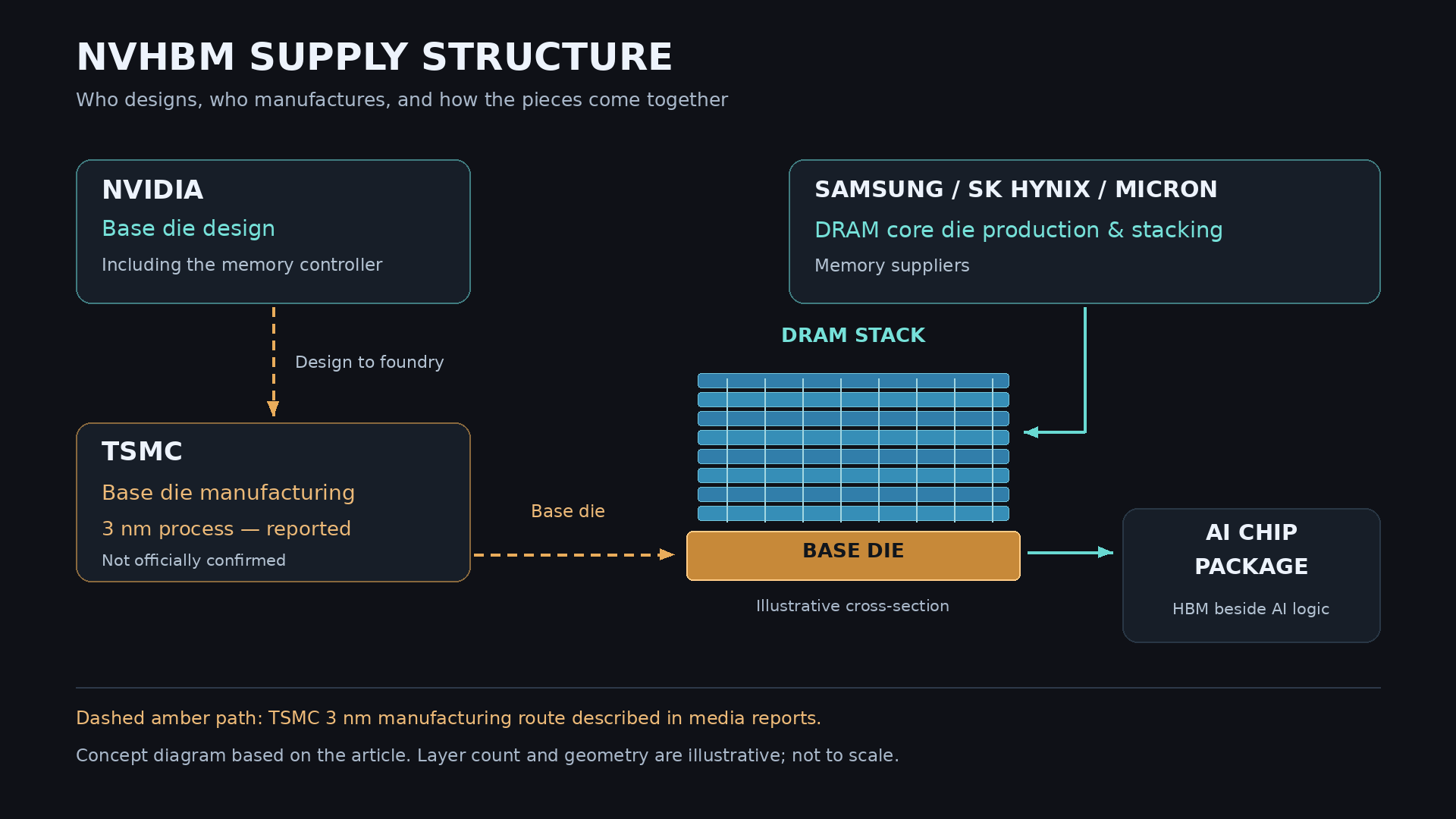
On October 18, Reuters reported, citing the Seoul Economic Daily, that Samsung Electronics has decided to manufacture the base die for Nvidia's custom high-bandwidth memory (HBM), NVHBM , using Taiwan's TSMC's 3-nanometer process . According to the same report, Nvidia requested that not only Samsung Electronics but also SK Hynix and Micron use the TSMC process.
As the number of AI servers increases, HBM sales rise, and memory companies see strong performance. Samsung Electronics’ preliminary operating profit for the third quarter (consolidated basis) reached 107.4 trillion won , surpassing the 100 trillion won mark for the first time. However, news has now emerged that Nvidia intends to decide not only the design of memory but also which factories will manufacture its core components. Will memory companies be able to maintain current profits in the future, or will Nvidia's share of the market grow?
In the previous article, "CXMT Shock," we examined whether existing cafes could maintain their prices when a new cafe opened on a cafe street. This time, we look at a major regular customer placing bulk orders at a cafe on the opposite side of the same street. If this regular customer starts deciding everything from the beverage recipes to the ingredient factories, who will retain the power to set prices as the HBM market expands? In this article, after briefly reviewing the structure of HBM, we intend to examine what Samsung Electronics, SK Hynix, TSMC, and Nvidia each gain and lose, and what investors should look for in their next earnings reports.
Customers design even the chips below the 1HBM themselves.
HBM is a memory that stacks data-storing DRAM chips in multiple layers and places them right next to the AI computing chip. No matter how fast the AI chip performs calculations, it must wait if the data arrives late. HBM is responsible for the task of rapidly delivering a large amount of data all at once.
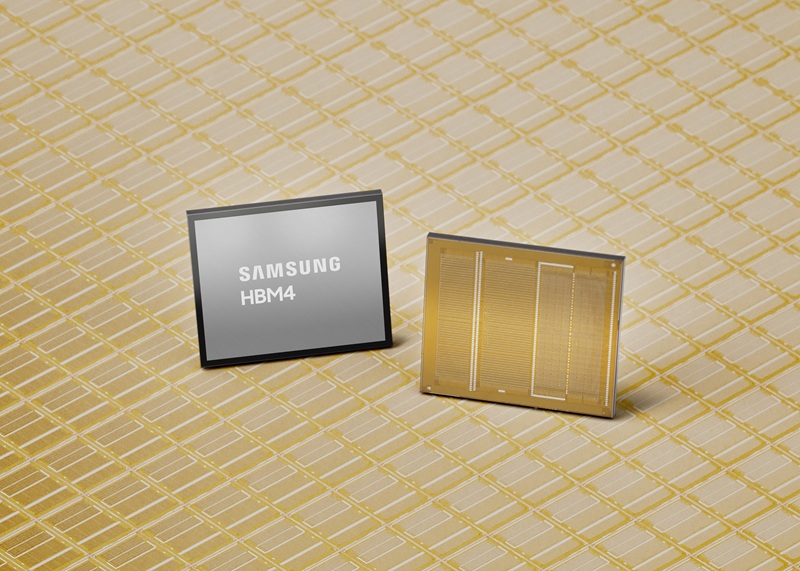
At the very bottom of the stacked DRAM is a chip called a base die. It serves as the pathway for data to travel between the upper layer of DRAM and the AI chip. While SK Hynix manufactured this chip using its own technology up to HBM3E, it decided to use TSMC's logic process starting with HBM4; meanwhile, when Samsung Electronics announced the mass production of HBM4 in February, it emphasized the base die produced using its own foundry's 4nm process .
NVHBM places the memory controller on this base die. The memory controller is a circuit that directs when and where data is sent, and it was originally located on the AI chip side. NVIDIA explains that this increases memory bandwidth by up to 30% compared to standard HBM4E, reduces HBM power consumption by 15% , and expands the area available for computational circuits on the AI chip by up to 25% .
That is all the technical structure investors need to know. What we will follow in this article is who designs and manufactures the base die, and consequently, who makes the money.

2A big regular customer decides the recipe and even intends to designate the ingredient factory.
NVHBM is a structure where NVIDIA directly handles the base die design, allowing multiple memory companies to use that same design. In an announcement on August 26, NVIDIA stated that it would establish a common NVHBM implementation supplied by various memory vendors. The explanation was that this would reduce the engineering burden associated with connecting and verifying memory separately for each supplier.
Returning to the cafe street from the previous post, the memory companies are the cafes, and NVIDIA is a major regular customer placing large orders every day. It is as if this regular customer personally created the recipe for the beverages to be supplied and distributed it equally to three cafes. NVIDIA is not the only place ordering with this recipe. NVHBM is provided to NVLink Fusion customers, who connect AI chips designed directly by Big Tech to NVIDIA's server systems, and the first partner is Annapurna Labs, Amazon's semiconductor design subsidiary.

A report on October 18 took this a step further. It stated that Nvidia had requested the three memory companies to manufacture their base dies using TSMC's 3nm process. This indicates an intention to designate the factories from which the materials will be received, in addition to the recipes. Overseas media cited the fact that if the three companies manufacture base dies using different processes, verification must be conducted separately for each supplier, even if the design is identical, as the underlying reason.
According to reports, Samsung Electronics accepted this request after an internal review. However, the Seoul Economic Daily reported that the company plans to maintain in-house production of general-purpose HBM and custom products for other customers as it does now, while also considering the use of its own foundry in preparation for a scenario where NVHBM demand exceeds TSMC's production capacity. During the Q&A session following the earnings announcement on September 30, Micron President Scott DeVore stated that unlike HBM4, the HBM4E, designed in collaboration with Nvidia, utilizes a foundry process rather than its own base die. Although he did not specify which foundry it was, Micron had previously announced that it would manufacture the HBM4E base die with TSMC during its earnings announcement in September 2025.
I believe this change could increase the bargaining chips for regular customers. If beverages are made with the same recipe, it becomes easier for regulars to compare multiple cafes side by side. Domestic media outlets have also been affected; Money Today Broadcasting interpreted NVHBM on September 7 as a move by Nvidia to seize the initiative in base die design. How much power that card carries in price negotiations will be revealed in upcoming contract prices and earnings.
Even if you receive the same recipe as 3, the profit margin varies from cafe to cafe.
Even with the same NVHBM order, Samsung Electronics, SK Hynix, TSMC, and Nvidia must analyze different profit and loss paths. This is because differences remain at each company even under a common design. These differences include DRAM chip performance, the technology for stacking and connecting multiple layers, heat management, and yield. Yield is the ratio of normal products to manufactured goods; even when producing the same quantity, a low defect rate ensures profitability.
Samsung Electronics is a company that also operates a materials factory. In February, it introduced HBM4, which combines the latest 6th-generation 10nm-class DRAM (1c) with its own 4nm base die. If, as reported, the company sources its NVHBM base dies from TSMC, Samsung investors must consider both the benefits of securing new NVHBM volumes and the costs associated with procuring base dies externally. The profit opportunities and production line utilization could also differ if the company's own foundry were to manufacture these chips. However, since transactions between the memory and foundry divisions are excluded from the company's overall consolidated results as internal transactions, changes in the foundry business unit's revenue do not directly translate into changes in the company's total revenue. It is difficult to calculate the net effect for Samsung as a whole based on current data.
SK Hynix is already a company that uses materials from TSMC's factories. In April 2024, it signed a business agreement with TSMC to use TSMC's logic process for HBM4 base dies. Collaboration with an external factory itself is not a new burden. What SK Hynix investors should observe is whether its superiority in DRAM quality and yield translates into sales prices and profitability even under a common design.
TSMC is a materials factory. According to reports, it will receive all NVHBM base die orders from the three companies. However, since it does not manufacture the DRAM chips themselves, not all HBM revenue will go to TSMC. As TSMC's 3nm production lines are also handling orders for smartphones and AI chips, an increase in base die orders could create a new bottleneck in production capacity. Reports that Samsung Electronics is considering its own foundry as an alternative are also aligned with this point.
Nvidia is a regular customer holding the recipe. It can reduce the design and verification burden associated with using multiple suppliers, and enables AI chips from other companies connected to its platform to be bundled into the same memory structure. However, one must make a separate judgment regarding whether technological leadership is growing and whether the current stock price is worth buying.
| Company (Cafe metaphor) | Points to examine in this change | Evidence to change the judgment |
|---|---|---|
| NVIDIA (the regular customer holding the recipe) | How much the number of customers using NVHBM is increasing | Actual customer adoption, related revenue, and profitability of NVLink Fusion |
| TSMC (designated materials factory) | How much the volume of base dies and advanced packaging is increasing | Whether orders lead to revenue and cash, 3nm production capacity and the burden of expansion |
| SK Hynix (a cafe that used TSMC materials) | Whether the superiority in DRAM quality, stacking, and yield is maintained | Confirmation of NVHBM supplier, maintaining sales price and profitability |
| Samsung Electronics (a cafe that also owns a materials factory) | How to mix in-house production and external procurement | Whether profitability improves after incurring total costs, including external financing costs |
※ The table summarizes the profit and loss paths for each company based on the same news, rather than a ranking of stock price increases, and is not an investment recommendation for any specific stock.
4If orders increase significantly, cafes following the recipe can also earn money.
Even if regular customers hold the recipe, if orders grow faster than the cafes' production capacity, the profits of memory companies can increase as well. If Big Tech finds it easier to manufacture their own AI chips thanks to common designs, overall HBM orders could expand. Furthermore, if only a few companies can meet those orders with the desired quality and delivery times, the cafes retain a significant amount of price negotiation power. Just because the recipe is the same does not mean the ability to mass-produce it becomes commonplace.
Some suppliers actually view customized products as having higher profit margins. Micron CEO Sanjay Mehrotra stated during the earnings announcement on September 23, 2025, that he expects HBM4E using custom base dies to generate higher gross profit margins than standard HBM4E. This serves as evidence that a supplier's profits do not necessarily decrease simply because the customer leads the design. It remains to be seen whether this expectation will translate into actual profitability in the case of NVHBM, for which Nvidia holds the recipe.
Current data indicates that orders still exceed supply. On October 15, TSMC announced that its third-quarter revenue, measured in US dollars, was $46.72 billion, a 16.2% increase from the previous quarter. During the earnings conference call, Chairman Wei Zhejia stated that demand related to AI significantly exceeds TSMC's supply capacity and projected an annual revenue growth rate of approximately 44% in dollar terms for this year. He also added that when planning production capacity, they take into account Big Tech's capital investment, data center construction, financing, power, and the supply of components such as HBM.
The future situation can be divided into three parts as follows.
- If orders grow faster than supply: the profits of Nvidia, which holds the recipe, TSMC, the materials factory, and the three memory companies could increase together.
- Cases where orders increase but regular customers cut prices more aggressively: If price drops cannot be offset by cost reductions, profit per unit decreases even if shipment volume increases. Memory companies must look at selling prices and profit margins before sales volume.
- When supply increases and data center investment is delayed: You must check whether prices, inventory, and cash flow are deteriorating all at once.
In the third case, even if memory prices fall, the cause cannot be entirely attributed to NVHBM. This is because slowing demand and increased production by other companies also have an impact. Which scenario leads to a particular situation is revealed not by the performance figures in the announcements, but by actual customer adoption, mass production schedules, sales prices, and the profit remaining after deducting costs.
5When you don't know which cafe will earn more, there is a way to distribute it across the entire street.
If you have decided to invest in the semiconductor industry but find it difficult to determine where the profits will accumulate—between the regular customers holding the recipe, the ingredient factories, or the cafes—it is worth first considering a strategy that encompasses multiple stages rather than a single company. If I were investing new capital into this shift, I would first review a non-leveraged semiconductor ETF that covers design, manufacturing, memory, and equipment together, rather than concentrating all my funds on a single memory company. It is akin to investing across the entire street instead of buying a stake in a single cafe. This choice aims to reduce the risk of being wrong in judging a single company, while the risk of the entire semiconductor sector declining together remains.
The starting point for comparison is the U.S.-listed VanEck Semiconductor ETF (SMH) . It tracks an index holding around 25 U.S.-listed semiconductor companies, with a total expense ratio of 0.35% per year. As of October 16, the holdings disclosed by the fund manager are Nvidia 20.46% , TSMC 9.42% , Micron 4.57% , and SK Hynix 3.67% . SK Hynix is included as a U.S.-listed American Depositary Receipt. It is like having regular customers, material factories, and two cafes in one basket, along with semiconductor equipment companies.
There is a point that Korean investors often overlook. Since SMH holds only U.S.-listed stocks, it does not include Samsung Electronics. Furthermore, it is not a product that exclusively holds HBM, and its weightings change daily. When choosing a domestically listed ETF, it is better to compare the actual holdings first—such as how heavily concentrated they are in Samsung Electronics and SK Hynix, whether they also include Nvidia and TSMC, and the proportion of equipment—rather than focusing on whether "AI" or "HBM" is in the name.
If you are selecting individual stocks, it is best to narrow down your investment choices in this way.
- SK Hynix: The investment is based on the assumption that the competitiveness of HBM mass production will continue to translate into sales prices and profits. It is difficult to make a judgment based solely on the news that shipments have increased.
- Samsung Electronics: The investment is based on the view that securing new customers and volume, combined with a combination of in-house production and external procurement, leads to improved overall company profitability. News alone about the addition of a new client is not enough.
- TSMC: The investment is based on the assumption that orders for advanced manufacturing and packaging will continue even amidst competition among memory companies. It also bears the burden of capital investment amounting to $60 billion to $64 billion this year, as well as risks related to Taiwan.
- Nvidia: It is an investment in the expansion of the platform's influence in addition to chip sales. We need to assess how much of that expectation has already been reflected in the stock price.
When evaluating pricing, do not rely solely on the assumption that this year's high profits will continue; you must also factor in scenarios where next year's profits increase or decrease. The criterion is whether you can afford the current cost even if profits decline. You cannot skip this calculation even when selecting an ETF. Even if you choose a good company, if you buy it at too high a price, the returns will fall short of expectations.
If you do not invest the newly decided funds for semiconductors all at once, there is a method to determine your next course of action based on earnings results whenever they are released, rather than waiting for news. Initially, you start small after weighing the price and overall weighting. Subsequently, you do not blindly increase your investment every time earnings are checked; instead, your actions vary depending on the results.
- If not only customers and volume but also profitability and cash flow have improved, and the stock price is at a manageable level: Consider additional investment.
- If earnings have improved but the stock price has risen faster, reducing expected future returns: Postpone additional purchases.
- If sales increase but prices, profit margins, and cash flow deteriorate: Do not invest the remaining money, and re-examine whether the reason for the initial investment is still correct.
If you already hold a significant amount of Samsung Electronics, SK Hynix, or semiconductor ETFs, the calculation changes. Simply adding SMH or Nvidia does not automatically diversify your portfolio. You must first assess how heavily your holdings are concentrated in the same companies and industries by combining the stocks you directly own with those in ETFs. For U.S.-listed products, you must also check exchange rates and the availability of trading per account.
※ The above content explains the criteria and order for investment decisions and is not a recommendation to invest in any specific stock or product. The weighting of ETF holdings is based on disclosures by fund managers as of October 16, 2026, and is subject to change thereafter.
6Three things to watch going forward — Customers, price and profitability, and leftover cash
There are three key factors to verify in the next earnings report that follow the statement about increased HBM sales. The third-quarter earnings announcements and conference calls by SK Hynix and Samsung Electronics, set for the end of this month, will provide an opportunity to assess the current profitability of their HBM businesses and their future product and customer plans. The profitability of NVHBM sales can only be evaluated once revenue and costs are confirmed following mass production. Prior to that, we will also observe whether Samsung Electronics officially announces its use of TSMC, which is currently in the press briefing stage, and how SK Hynix responds to the same request.
- Customers: Which companies are confirmed as NVHBM suppliers, and how many customers other than NVIDIA have increased. This item also includes whether the number of customers actually adopting NVHBM among the companies participating in NVLink Fusion is increasing.
- Price and Profitability: Whether customized HBM maintains higher prices and profit margins than general-purpose products. Since a high gross profit margin does not necessarily mean a high selling price, the price and cost explained by the company are considered together.
- Remaining cash: Whether there is cash left over after paying for facility investments. Even if shipments and sales increase, if expansion costs rise faster, the share returning to investors decreases.
A company may not disclose the price or profit margin of HBM separately. In such cases, it is advisable to review the company's explanation regarding the overall performance of the memory business, product mix, and pricing and costs, but to avoid interpreting the company's overall profit margin as the HBM profit margin.
7Frequently Asked Questions
| question | answer |
|---|---|
| What is NVHBM? | It is a custom HBM that incorporates a memory controller designed by NVIDIA into the bottom chip (base die). It was announced on August 26, 2026, and is available to NVLink Fusion customers who connect their own AI chips to NVIDIA systems. The first partner is Amazon Annapurna Labs. |
| Is it bad news for Samsung Electronics if it uses TSMC's process? | It is difficult to view this from a single perspective. There are benefits associated with securing custom orders for NVIDIA and the costs associated with sourcing base dies externally, and production opportunities at the in-house foundry also change. It is difficult to calculate the net effect based on publicly available data, and it has been reported that in-house production of general-purpose HBM will be maintained. |
| Will HBM prices go down due to NVHBM? | No results have been confirmed yet. If customers find it easier to compare suppliers, their bargaining power may increase. While supply shortages can help defend prices, contract terms and costs must also be considered. |
| Is Samsung Electronics also included in SMH? | It is not included. SMH holds only stocks listed in the United States. SK Hynix is included as a U.S.-listed American Depositary Receipt, and its weighting is 3.67% as of October 16, 2026. |
Conclusion — When HBM orders increase, choose a company that will protect those profits.
The most significant change in this NVHBM news is that Nvidia is expanding the scope of its involvement in memory design and procurement. To use a cafe analogy, it is like a major regular customer setting the recipe and even designating the ingredient factories. Now, memory companies must not only produce the increased orders but also demonstrate to Nvidia why they deserve good prices and profits from them.
However, there is no basis to conclude that the competitiveness of Samsung Electronics and SK Hynix has disappeared. Even when receiving the same design, the ability to meet desired performance and quality standards in large quantities varies from company to company. Companies that can maintain this difference can increase their profits as orders from major clients grow.
Therefore, if I were to invest in semiconductors for the first time, I would start by comparing ETFs that cover design, manufacturing, and memory together. If I were to invest in a single memory company, I would verify whether it is supported by pricing, costs, and profitability, in addition to growth in customers and shipments. If my portfolio already has a large weighting in semiconductors, I would calculate how much overlap I have with the same companies before adding a new product. In either case, I must also consider the expectations embedded in the current stock prices.
In my previous post , "CXMT Shock," I asked whether memory companies could maintain their prices even with the entry of new competitors. This time, I asked whether they could preserve their profits even when major clients finalize their designs. Going forward, whenever I see announcements of increased HBM orders, I intend to verify exactly how much profit the company receiving the order made after covering its costs. I will allocate additional investment funds when I confirm the ability to protect profits and determine that the stock price is not overpriced relative to those earnings.
📌 Was this analysis helpful?
I will continue to track where money flows into AI infrastructure and who benefits from it. Please subscribe below to receive new posts.
Subscribe and get notifications →How this content was produced
Aleph's research AI agent assisted with collecting and analyzing public data, creating charts and visuals, and structuring the draft. Davar personally reviewed and edited the sources, figures, reasoning, and final conclusions.
This content is for informational purposes only and is not personalized investment advice or an individual stock recommendation. Read the full disclaimer

Davar
Davar builds and operates Aleph's research AI agent and writes and reviews analysis on macroeconomic developments and AI industry trends.

© Aleph. All rights reserved.