
The Fed Raised Interest Rates, Yet the Nasdaq and Semiconductor Stocks Rebounded — Kevin Warsh’s “Race for Capital” and the Two Faces of AI Investment
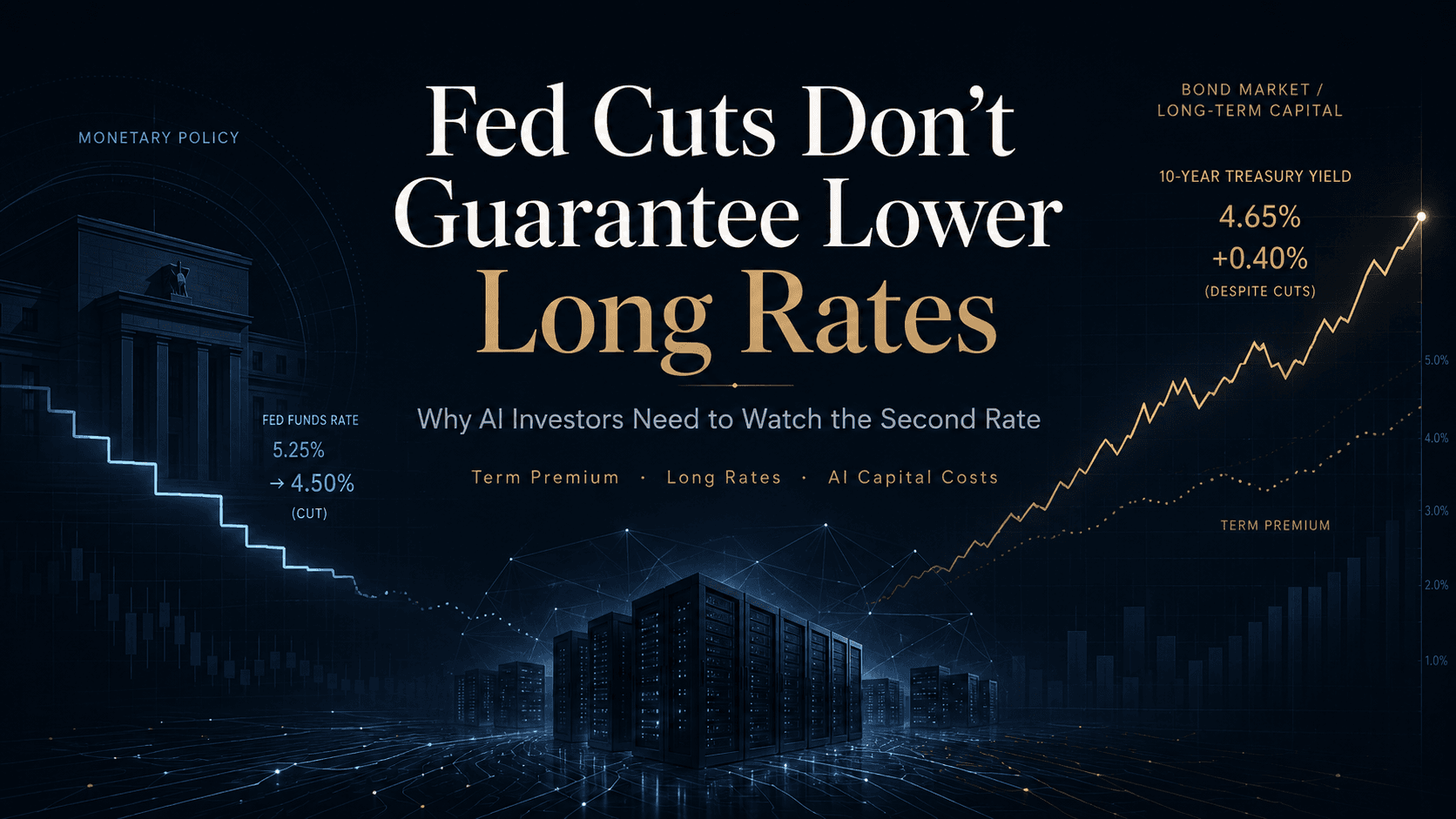
Last month, while writing "What is the Term Premium?" , I left a question asking, "If the Fed lowers interest rates, will the U.S. 10-year Treasury yield also fall?" At the time, the prevailing view was that the Fed would lower rates ahead of the midterm elections, but less than a month later, on September 16, the Fed instead raised the benchmark rate by 0.25 percentage points to 3.75–4.00% . This was the first hike since July 2023, and in the dot plot, 16 out of 18 participants predicted at least one additional hike by the end of the year.
When interest rates rise, tech stocks, which heavily reflect distant future earnings in their current prices, are often the first to waver. That is why I also expected AI and semiconductor stocks to face significant pressure this time.
However, the actual market was different. On the day of the FOMC meeting, the Nasdaq fell by only 0.01% and rose by 1.69% the following day, and on September 18, in the Korean market as well, Samsung Electronics and SK Hynix led the rise as the KOSPI rose by 2.66% .
The easiest explanation is price-in. In fact, just before the FOMC meeting, the market was pricing in a 25bp hike with a probability of over 90%. However, when looking at the 10-year yield and Big Tech's financing together, that alone is not a sufficient explanation.
This is because long-term interest rates had already risen significantly long before the Fed raised rates, and the amount of money AI companies borrowed from the market was also increasing rapidly. The phrase "race over capital," used by Chairman Kevin Warsh at this FOMC meeting, combined these two trends into a single sentence.
The 10-year yield was already 5% before the Fed raised it.
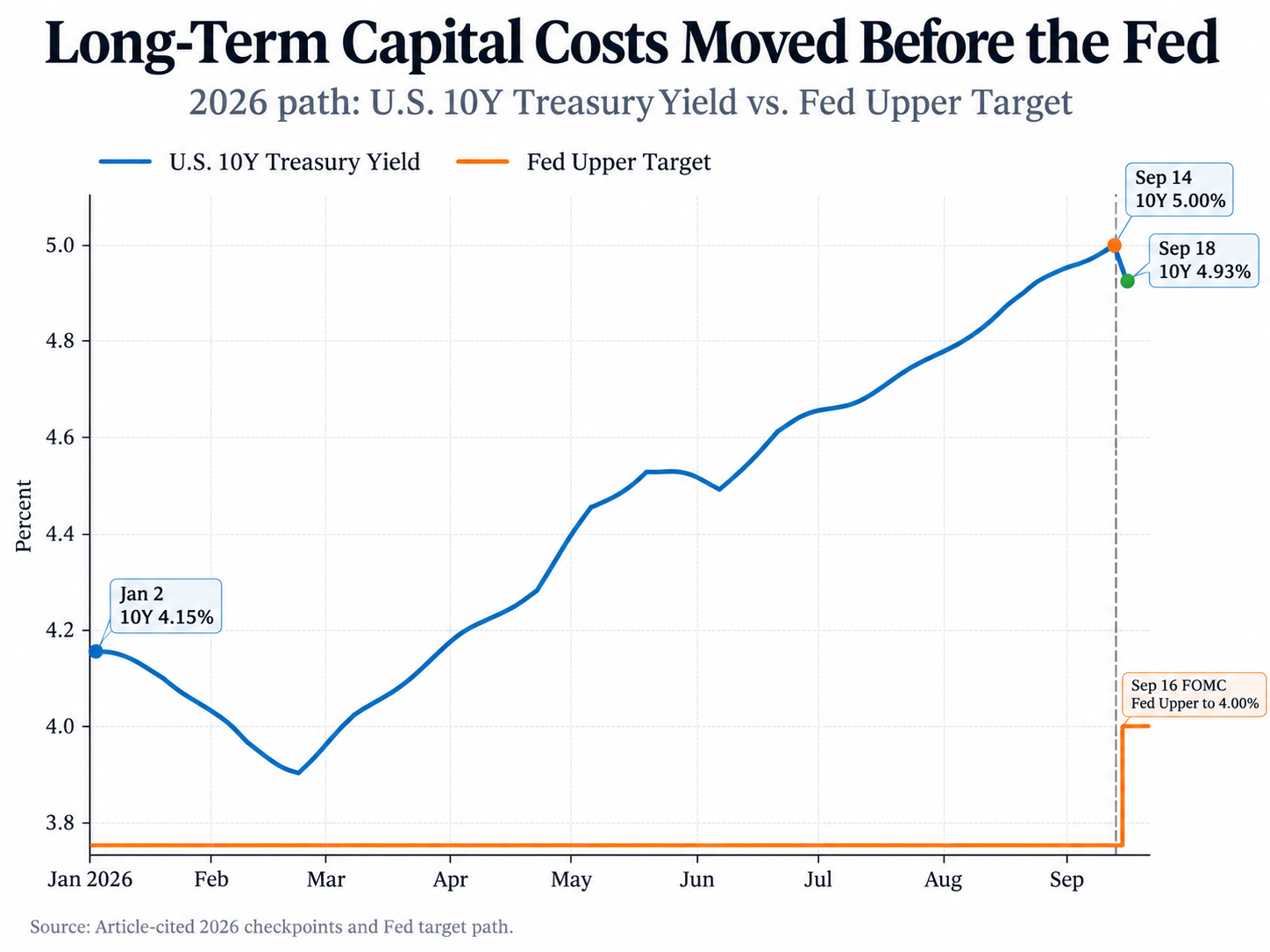
On September 14, two days ahead of the FOMC meeting, the yield on U.S. 10-year Treasuries, which stood at 4.15% at the beginning of the year, hit 5% during trading. Although it had briefly fallen below 4% in February, it began to rise again following the war in Iran, surpassing 4.5% in May and eventually climbing to 5% ahead of the FOMC meeting. During this period, the Fed did not raise the benchmark interest rate even once.
This is where the key point to note lies. Rather than the magnitude of the 25bp hike, it is more important who moved first—the Fed or the market. Long-term interest rates were already rising long before the Fed raised rates.
The scene we saw last month in "What is a Term Premium?" was similar. At the time, even though the market's expected path for the Fed's future benchmark interest rate was slightly downward, the 10-year yield rose by about 0.28 percentage points over two months, and according to the New York Fed's ACM model, most of that rise stemmed from the expansion of the Term Premium.
The term premium is the additional compensation investors demand for the uncertainty they must endure while holding long-term bonds for an extended period. Ultimately, the 10-year yield incorporates not only how many times the Fed will raise rates in the future but also inflation risk, government bond supply, fiscal deficits, and geopolitical uncertainty.
Last month, it was predicted that the 10-year yield might not follow suit even if the Fed lowered rates. This time, however, the 10-year yield rose to 5% before the Fed even raised rates. The direction was different, but the message was the same: long-term interest rates do not move solely in accordance with the Fed's decisions.
This difference is particularly important for AI companies. Since data centers are projects viewed over years, or even decades, rather than investments lasting only a few months, long-term interest rates such as the 10-year Treasury, corporate bond spreads, and project loan rates have a more direct impact on actual investment decisions than the Fed's benchmark interest rate.
The money that AI companies actually have to raise did not suddenly become expensive starting September 16. It had already been expensive before that.
2However, the 10-year yield went down the day after the Fed raised it.
Based solely on this, it seems natural that the Fed's additional hikes would push long-term interest rates further up, and that high rates would then suppress AI stocks. However, the actual market moved in the opposite direction.
The day after the Fed raised the benchmark interest rate, the U.S. 10-year Treasury yield fell for the first time in eight trading days, and oil prices also declined as concerns over Middle Eastern oil supply eased. As the two variables weighing down tech stocks subsided simultaneously, semiconductor and tech stocks rebounded, with the Philadelphia Semiconductor Index rising about 3% and the Nasdaq up 1.69% .
A similar scene occurred last week in "Why Did AI Stocks Rise When U.S. CPI Was Stronger Than Expected?" At the time, looking solely at the CPI figures, it was an environment where it would be difficult for tech stocks to rise; however, as oil prices fell and 10-year Treasury yields stabilized, AI stocks actually reacted strongly.
Looking at the two market reactions, it is difficult to explain the direction of AI stocks solely based on how many basis points the Fed moved the benchmark interest rate. We must also consider the long-term borrowing costs that companies actually have to bear and how oil prices are moving.
So, at this FOMC meeting, what caught my eye more than the interest rate hike itself was what Chair Wash said while explaining the background of the rise in long-term interest rates.
3 Kevin Warsh’s “Capital Competition”
Chairman Kevin Warsh explained the reasons for the rise in U.S. long-term interest rates this year, citing a stronger-than-expected economy, geopolitical tensions, and "capital competition." He specifically noted that corporate capital investment is increasing rapidly and hyperscalers are actively raising funds in the market.
“The competition for capital is real.”
This means that as the number of places in need of money increases, competition for capital is mounting.
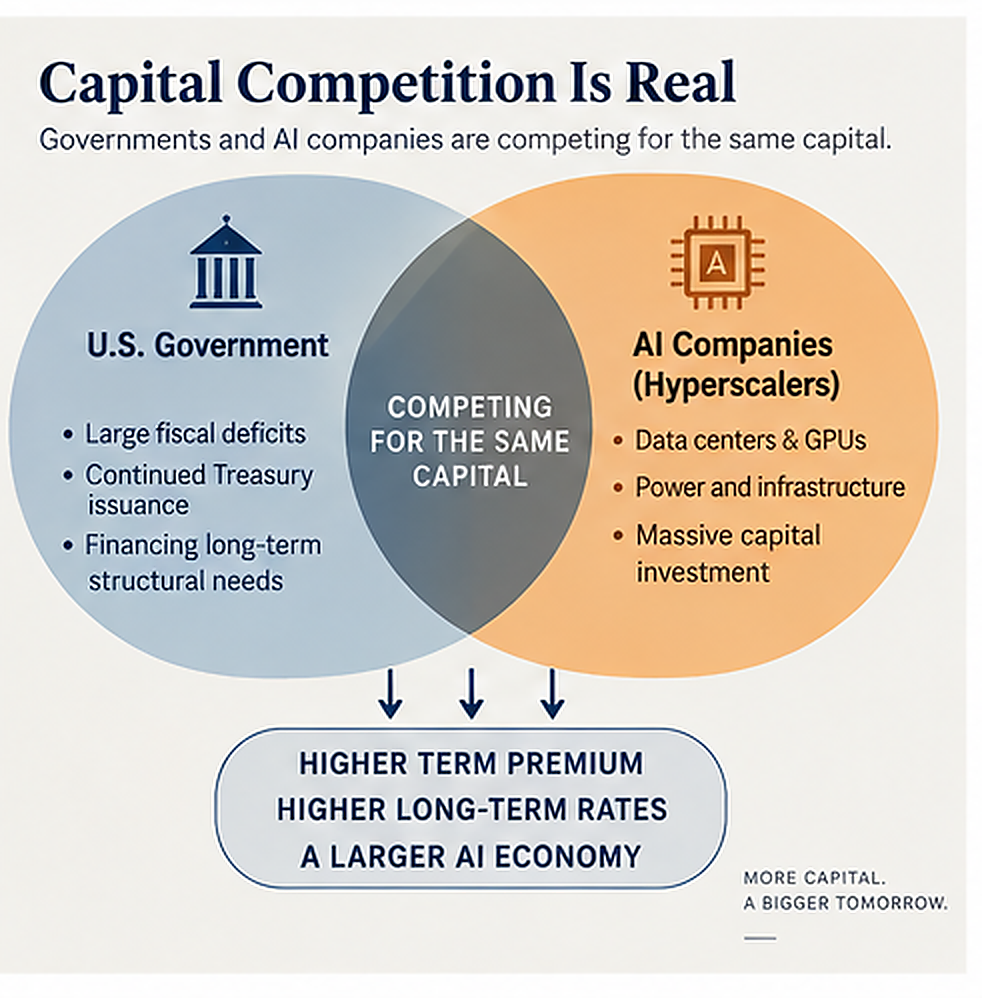
The U.S. government must continue to issue government bonds to cover its massive budget deficit, and AI companies need increasingly more money to invest in GPUs, data centers, power, and networks. Although the reasons differ, they ultimately raise funds in the same market.
The rise in U.S. long-term interest rates cannot be explained solely by borrowing by AI companies. Fiscal deficits, government bond supply, inflation, Fed policy, and geopolitical risks are much more significant variables. Nevertheless, it seems clear that the scale of money borrowed by AI companies has now become difficult to ignore, even in the bond market.
Over the past few months, the questions in my writing have also changed slightly. Initially, I examined whether falling prices would lead to falling interest rates, which in turn caused AI stocks to rise . However, as I observed the actual market, I continued to see movements that could not be explained solely by the Fed's benchmark interest rate, so in August, I shifted my focus to Term Premiums and long-term interest rates.
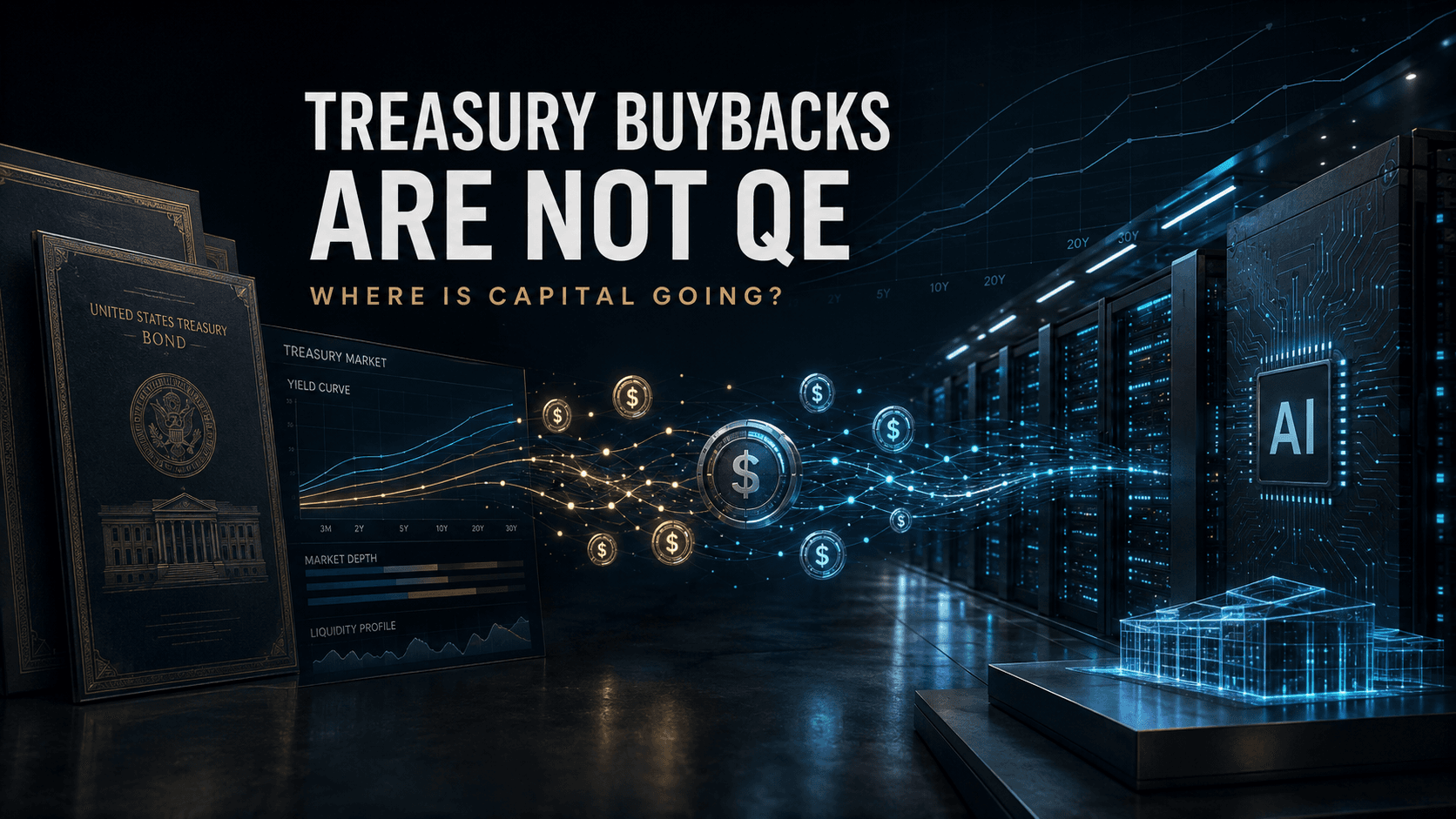
The next question naturally led to, “Why are those long-term interest rates so high?” In the early September article “Treasury Buybacks Are Not QE,” we observed that both the U.S. government and AI companies are simultaneously in need of massive capital. The government issues Treasury bonds to cover the fiscal deficit, while AI companies seek funds to invest in data centers, GPUs, power, and networks.
So, at the end of the text at the time, I wrote this.
Chair Wash's recent remarks on "capital competition" are directly connected to this question. While I have previously traced the problem in the order of interest rates → long-term rates → capital demand, this time the Fed Chair directly mentioned the financing of hyperscalers while explaining the rise in long-term rates. The issue, which was only connected as a hypothesis in the previous post, is now beginning to appear together in the actual bond market and policy statements.
4Big Tech is actually borrowing more money
According to data compiled by Bank of America (BofA), the five companies—Amazon, Alphabet, Meta, Microsoft, and Oracle—issued $121 billion in the U.S. corporate bond market in 2025. This represents a more than fourfold increase in scale over the past few years, considering the annual average issuance from 2020 to 2024 was $28 billion.
In 2026, the pace of growth accelerated further. According to Reuters' analysis of LSEG data, the four companies—Amazon, Alphabet, Meta, and Oracle—issued approximately $194 billion in bonds by July 7, which is already 79% more than the approximately $108 billion issued by the same four companies throughout 2025.
As issuance increases, borrowing prices also change. The median spread for bonds with maturities of 20 years or more issued by these companies widened from 108.5bp to 118bp in 2025, and 78 of the 91 hyperscaler bonds issued this year were trading at higher rates than at the time of issuance as of the end of July.
Just because a Big Tech company has a high credit rating does not mean it can continue to borrow money under the same conditions. When a large volume of bonds enters the market, investors demand correspondingly higher interest rates.
The same trend is visible in the lending market. On the very day the Fed raised interest rates, reports emerged that Crux AI, involving Blackstone and Alphabet, was raising $22 billion from 10 banks. This funding is being used for purposes such as purchasing Google TPUs, and Blackstone pledged an initial equity of $5 billion.
As investment in AI infrastructure grows, the number of projects that cannot be managed solely by internal cash is increasing, and consequently, the amount of money that must be raised from the bond and loan markets is also growing.
However, AI investment is not decreasing yet.
Up to this point, it is easy to assume that high interest rates will eventually put the brakes on AI investment. I also viewed that possibility quite highly when I wrote "The Theory on AI Speed Control, the Plunge in Semiconductor Stocks, and the Financial Burden on Big Tech: Will They Change AI Investment?" a few days ago.
This is because if Big Tech's capital investment grows faster than its internal cash flow, the condition of borrowing from external sources will inevitably affect the speed of investment at some point.
However, following the recent FOMC meeting, the market signaled that it is not yet at that stage. The day after the Fed raised interest rates, tech and semiconductor stocks rose in the U.S., and in Korea, Samsung Electronics and SK Hynix led the rise in the KOSPI. There are also continuing moves to continue investing in data centers and AI infrastructure, even if it means borrowing tens of billions of dollars, such as with Crux AI.
What can be confirmed right now is not that AI investment has stalled due to high interest rates. Rather, it is closer to the view that as the scale of AI investment grows, companies are delving deeper into the bond and loan markets.
The current market reaction can also be seen as an extension of that.
Although money has become more expensive, the market still expects AI to earn more.
As AI investment increases, the demand for GPUs, memory, data centers, networks, and power rises along with it. Expectations for revenue and profits of related companies increase, which supports the stock prices of AI and semiconductor companies.
However, as the scale of investment grows, the required capital increases as well. Big Tech firms are issuing more corporate bonds, AI infrastructure projects are expanding their borrowing, and at the same time, the U.S. government is issuing large-scale Treasury bonds. Ultimately, more entities are seeking funds in the same market.
AI investment is effectively boosting the earnings of semiconductor and data center companies on one hand, while expanding the scale of capital required in the bond and loan markets on the other. This is where the "capital competition" mentioned by Chairman Wash also stems.
So far, the effect of the former appears to be stronger. Although interest rates have risen, the market still values the returns generated by AI investments more highly; therefore, I believe that AI and semiconductor stocks have not easily collapsed despite the Fed raising rates.
This rebound cannot be explained by a single reason. The 25bp hike was already anticipated, and the following day, 10-year Treasury yields and oil prices also fell. Nevertheless, the fact that AI and semiconductors performed strongly after the rate hike can be interpreted as a signal that the market views the growth potential of AI more highly than the still high borrowing costs.
To summarize, the current market assessment is as follows.
Although financing costs have risen, the market believes that the profitability of AI investments can still cover those costs.
7What we need to watch going forward is the point where this balance breaks.
Going forward, it is not enough to simply look at whether the Fed will raise rates one more time or two more times this year.
First, it is necessary to keep an eye on the 10-year yield and the term premium . If long-term interest rates continue to rise even without action from the Fed, the borrowing costs for projects that require tying up funds for extended periods, such as data centers, will continue to increase.
Hyperscaler corporate bond spreads are also important. If Big Tech companies have to pay higher interest rates than before to borrow money while government bond yields remain unchanged, it means that the bond market's evaluation of AI investment is changing.
The difference between CAPEX and operating cash flow must also be considered. This is because if the cash generated by a company cannot keep up with the speed of investment, the shortfall must eventually be covered by borrowing from external sources.
The most direct signal is data center investment plans . If cases of announced projects being postponed, scaled down, or even canceled begin to increase, it can be seen that high borrowing costs have gone beyond merely suppressing stock prices and are starting to change actual AI investment decisions.
There is no clear signal of that yet.
8Frequently Asked Questions
| question | answer |
|---|---|
| Why did AI stocks rise when the Fed raised interest rates? | The 25bp hike was already priced in by more than 90%, and the following day, the 10-year yield and oil prices fell together. This is compounded by the fact that the market views the growth potential of AI more highly than the still high borrowing costs. The last part is an interpretation based on market reaction, not a confirmed fact. |
| Why do the base rate and the 10-year Treasury yield move separately? | The 10-year yield includes not only expectations regarding how many times the Fed will raise interest rates in the future but also the Term Premium. The Term Premium is additional compensation for the inflation risk, government bond supply, fiscal deficit, and geopolitical uncertainty that must be endured while holding long-term bonds for an extended period. |
| Did Kevin Warsh blame the rise in long-term interest rates on AI? | No. It mentioned a stronger-than-expected economy, geopolitical tensions, and competition for capital together, citing the financing of hyperscalers as one of them. U.S. long-term interest rates are much more significantly influenced by fiscal deficits, Treasury bond supply, inflation, and Fed policy. |
| Will AI investment decrease due to high interest rates? | Such signals are not yet clear. Big Tech's bond issuance and AI infrastructure lending are actually increasing. We will have to re-evaluate the situation when corporate bond spreads widen, the gap between CAPEX and operating cash flow expands, or data center projects begin to be postponed or scaled back. |
Conclusion — AI is now beating expensive money
Until just a few days ago, I thought that the next bottleneck for AI could be capital. However, after seeing the recent market reaction, I have changed my mind slightly. It is still difficult to view capital as a bottleneck for AI.
Although financing costs have already risen, companies continue to borrow and are not reducing their investments. The market also appears to value the future profits generated by AI more highly than the high financing costs.
So the important question right now is not, “Will AI stocks fall because interest rates have risen?”
How long can the money generated from AI beat expensive capital?
Currently, AI is ahead. However, as AI investment continues to grow, the required capital increases along with it. If the cost of borrowing that money continues to rise, companies will eventually have no choice but to recalculate the scale of their investments.
From then on, only “ profitable data centers” will be built, not “data centers that can be built.”
When that time comes, it is highly likely that the nature of the AI investment competition that has continued until now will also change.
I will continue to check next time.
We will continue to monitor how long-term interest rates and the financing of AI companies move. If the numbers change, we will address them immediately in the next post.
Subscribe and get notifications →How this content was produced
Aleph's research AI agent assisted with collecting and analyzing public data, creating charts and visuals, and structuring the draft. Davar personally reviewed and edited the sources, figures, reasoning, and final conclusions.
This content is for informational purposes only and is not personalized investment advice or an individual stock recommendation. Read the full disclaimer

Davar
Davar builds and operates Aleph's research AI agent and writes and reviews analysis on macroeconomic developments and AI industry trends.
© Aleph. All rights reserved.