
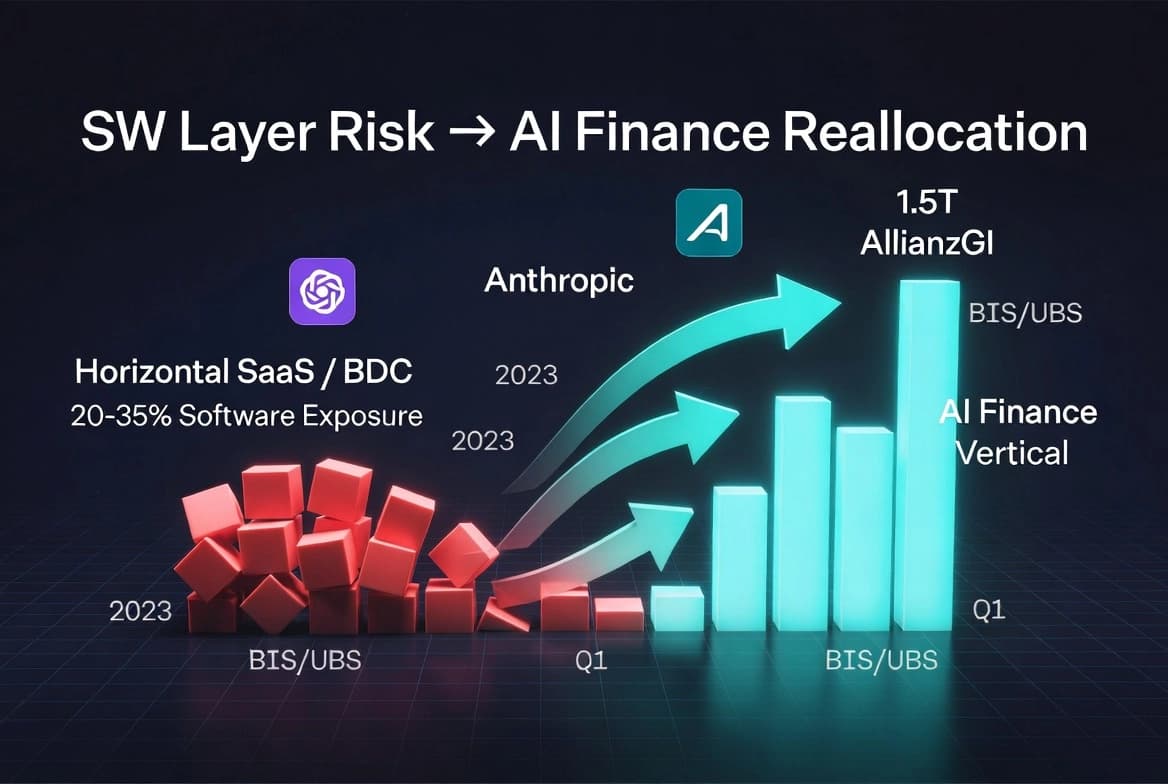
In my last post, I issued a warning regarding software exposure within BDCs. In the meantime, OpenAI and Anthropic entered the financial market within a ten-day interval. I believe in the saying that where the risk is high, the reward is also high. The question is where that reward lies. Signals are converging that money flowing out of the SW layer is heading toward AI Finance. This is not a certainty, but it serves as the basis for a directional bet.

1SW Layer Risk — Faster than expected
There are quite a few BDCs where software accounts for 20–35% of their private credit portfolios. Reports released by BIS and UBS since March of this year point in the same direction: the pressure for redemption is solidifying into a reality as AI agents begin to replace Horizontal SaaS—general-purpose productivity tools.
Not all software is dangerous. Mission-critical vertical SaaS and business software deeply embedded in specific industries are relatively robust. The dangerous ones are collaboration tools like Slack and general-purpose document creation tools. AI is replacing these faster than expected. If you hold a BDC, you must first check the detailed breakdown of the software components included in its portfolio.
2Where did the money leaving the software sector go? — There is no direct evidence.
There is no direct evidence that money withdrawn from software is flowing directly into AI finance. There are merely observations that the two phenomena are occurring simultaneously. AllianzGI forecasts that $1.5 trillion in investment-grade credit will be supplied for building AI infrastructure. Anthropic is discussing funding at a valuation of $900 billion, and OpenAI has already raised over $85.2 billion. It is a fact that capital is flowing into AI. However, it has not yet been tracked whether this money is actually from software.
Nevertheless, there is a basis for directional betting. AI matures most rapidly in fields where correct answers are measured numerically . Coding was no exception. Error rates, test pass rates, and code execution status—all are immediately verifiable. Finance follows the same structure. Credit rating accuracy, audit error rates, and spending optimization effectiveness—all are captured in numbers. This is why the two companies chose finance after coding.

3OpenAI vs Anthropic — Ten-day interval, opposite directions
Anthropic entered the financial market on May 5th, and OpenAI on May 15th, just ten days apart. Their directions are diametrically opposed. OpenAI aims to capture consumer data, while Anthropic seeks to capture enterprise workflows.
| division | OpenAI — Consumer Finance | Anthropic — Enterprise Finance |
|---|---|---|
| Presentation details | ChatGPT Pro + Plaid Integration — Read-only connection of 12,000+ financial institution accounts, analysis of spending, investment, and subscription patterns | Launch of 10 Dedicated Finance Agents — Automation of Credit Memos, KYC, Audits, and GL Adjustments. Discussions on Blackstone, Goldman, and H&F JV |
| What you are aiming for | Personal Financial Data Moat — A structure that increases daily engagement and boosts enterprise conversion rates | Trust Specific to Regulated Industries — Increased Replacement Costs with FactSet·S&P Connector, Compliance API, and Excel Integration |
| Connection with SW Risk | Strategic shift in response to falling behind Claude in Coding. Differentiating with consumer data. | "AI can bust SaaS (Dario Amodei) — a structure where he preempts the infrastructure layer thereafter" |
| What investors should see | Plaid-integrated retention data — Whether actual users remain determines the success or failure of the consumer strategy | Timing of Official Confirmation of Blackstone·Goldman JV — Related Stock Prices Expected to React the Moment the Announcement Is Released |
As Dario Amodei stated that "AI can bust SaaS companies," Anthropic went straight for the infrastructure that fills that void. It is a structure where the company supplies the follow-up infrastructure for the very market it is dismantling. This is the core of Anthropic's Finance strategy.
4Frequently Asked Questions
| question | answer |
|---|---|
| Does SW Layer risk affect my BDC investment right now? | It depends on the composition of the software exposure. If the proportion of Horizontal Productivity Tools is high, it is subject to re-evaluation now. If the proportion of Mission-critical Vertical SaaS is high, we can wait and see a little longer. Please check the detailed software composition of the included stocks first. |
| If the capital movement is still in its early stages, should I act now? | You must distinguish between directional betting and timing betting. Signals indicating the growth of the AI Finance Vertical are converging. However, it is unknown when it will fully materialize. The correct approach is to diversify a portion of your total assets. |
| How do I get indirect exposure on OpenAI and Anthropic? | Both companies are privately held. The AI Capex Beneficiary ETF (semiconductor and data center infrastructure) is a realistic indirect approach. Monitoring the stock price reactions of Blackstone and Goldman Sachs once the Anthropic JV is officially confirmed is also a viable strategy. |
| What signals can domestic investors tangibly perceive? | SK Hynix's announcement of HBM orders and domestic financial companies' announcements of AI Agent PoC contracts are the most direct examples. There is typically a time lag of 3 to 6 months for global changes to be reflected in the domestic market. |

5Three things you can do right now
If you hold a BDC, first check the software composition of its holdings. If the weighting of Horizontal Productivity Tools is high, it is subject to immediate re-evaluation. BDCs with a high weighting of Mission-critical Vertical SaaS can be evaluated separately.
The area where there is reason to increase weight is AI Capex Benefit. This includes semiconductors, data center infrastructure, and power infrastructure. The fact that both OpenAI and Anthropic are entering the financial sector signals that the demand for AI computing is spreading to broader fields. Domestically, SK Hynix's announcement of HBM orders is the most direct tracking indicator.
There is only one point in time to monitor. The market will react to related stock prices the moment Anthropic’s Blackstone-Goldman Sachs joint venture is officially confirmed. OpenAI’s Plaid-integrated retention data also serves as the first indicator demonstrating the actual performance of AI consumer finance. Not missing these two announcements is the most practical action you can take right now.
Conclusion — If you get the Layer wrong, you lose money even if the direction is correct.
The risks associated with SW Layer Private Credit and the rise of the AI Finance Vertical represent two faces of the same transformation. It is a structure where AI agents specialized for verticals fill the void created by AI agents replacing Horizontal SaaS. During this transition, capital first converges on the sectors where quantitative ROI is most clearly defined. That is finance today.
However, for this logic to hold, two conditions must be maintained: the speed at which AI agents replace SaaS, and the entry of large capital into AI Finance translating into actual profits. If either of these falters, the scenario must be revised. Aleph will continue to track these two variables.
All analyses in this article are for informational purposes only and do not constitute investment advice. The shift of funds from SW to AI Finance is a directional forecast and not a confirmed fact with direct causality. BIS, AllianzGI, and UBS figures are based on the period from March to May 2026, and forecasts are subject to change depending on interest rate environments and geopolitical variables. All investment decisions and responsibilities rest with the individual, and consulting with a professional financial advisor before making any significant decisions is recommended.
📌 Was this analysis helpful?
In the next post, we will cover "AI Finance Vertical Beneficiary Screening — List of Actual Beneficiaries of Anthropic JV and OpenAI Consumer Finance" .
We continuously track SW Layer risks and AI capital reallocation trends. Subscribe to notifications so you don't miss out.
Subscribe and get notifications →How this content was produced
Aleph's research AI agent assisted with collecting and analyzing public data, creating charts and visuals, and structuring the draft. Davar personally reviewed and edited the sources, figures, reasoning, and final conclusions.
This content is for informational purposes only and is not personalized investment advice or an individual stock recommendation. Read the full disclaimer

Davar
Davar builds and operates Aleph's research AI agent and writes and reviews analysis on macroeconomic developments and AI industry trends.

© Aleph. All rights reserved.