

AI Price Competition Analyzed Through the Cafe Business — How Have Antropic's Usage, Revenue, and Profit Changed?
Antropic has begun a roadshow to meet with investors ahead of its initial public offering (IPO) scheduled for November 10. The target offering price is $70 to $78 per share, and the company plans to list on the Nasdaq. 1 According to an amended registration statement filed on the same day, third-quarter revenue was approximately $17 billion, a 47% increase from the second quarter. 4
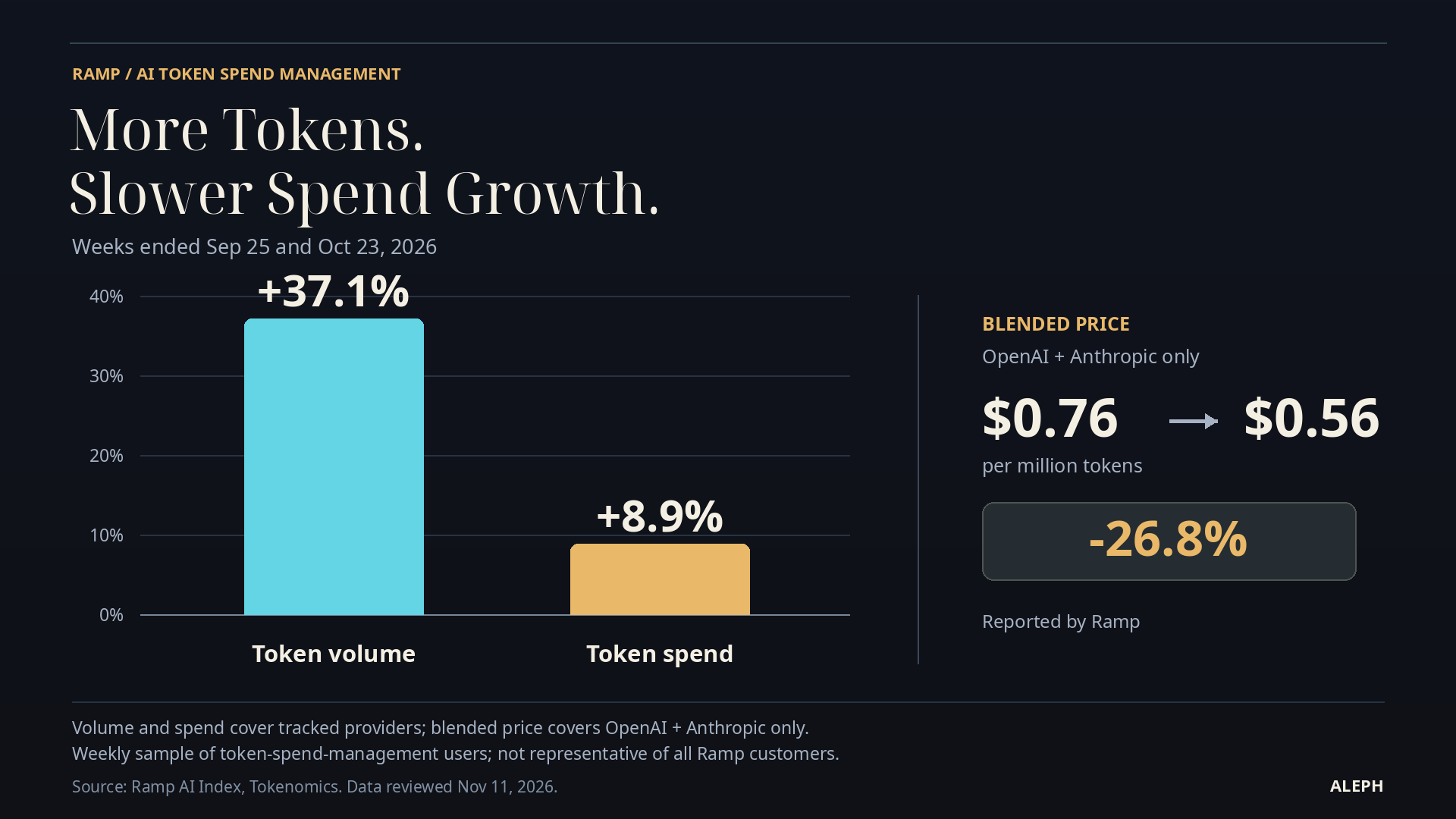
It is easy to assume that the more companies use AI, the more revenue AI companies will generate. However, data from Ramp, a U.S. corporate credit card and expense management firm, shows that usage and spending grew at different rates. Comparing the week ending September 25 with the week ending October 23, token usage among the sampled companies increased by 37.1% , while token spending rose by 8.9 % .
How much have price cuts and discounts reduced the revenue growth of AI companies, and how have profits changed during that time? In this article, we will examine RAMP's aggregation and Antropic's disclosures together to identify items to check in the next earnings report.
Even if you sell more coffee, revenue does not increase at the same rate.
If you sold 37% more coffee than last month but revenue increased by only 9%, it means the money received per cup has decreased on average. This happens when more customers use discount coupons, when customers choose Americanos more often instead of expensive lattes, or when the cafe lowers coffee prices. You cannot determine why revenue increased less than sales volume simply by looking at the number of cups sold.
The same applies to AI. When companies connect and use AI models in their services, they pay usage fees based on the number of tokens processed. A token is a small unit that AI divides when processing text. LAMP calculates the 'LAMP AI Index' using payment records from approximately 85,000 client companies, and token statistics separately aggregate data from only a subset of those companies that utilize token expenditure management services.
| item | Week ending September 25 → Week ending October 23 |
|---|---|
| Token usage | 37.1% increase |
| Token expenditure | 8.9% increase |
| Mixed price per 1 million tokens (OpenAI·Antropic) | $0.76 → $0.56 (down 26.8% ) |
The combined price is the price per token aggregated by bundling usage fees from various models and billing items. The combined price of OpenAI and Antropic disclosed by RAMP has decreased by 26.8% . Since this value groups only these two companies and RAMP has not disclosed the calculation method in detail, it is impossible to verify whether the aggregate scope matches the usage and expenditure figures mentioned above. Nevertheless, it is confirmed that the unit price per token for both companies has decreased. 2
※ Looking at individual companies, Antropic's blended price fell by 15.7% from $0.73 to $0.61 during the same period, while OpenAI's fell by 42.4% from $0.80 to $0.46. In this sample, Antropic's share of token spending increased from 51.3% to 60.5%. Since total spending also increased, the token usage fees paid to Antropic by the sample companies rose. If calculated backward based on the growth rates of usage and spending, the average price per token effectively decreased by approximately 20.6%; however, the two values were not directly compared as it was not possible to verify whether the blended price and the aggregate targets and weights were the same.
The usage fee changes when reading the same material again, 2.
AI usage fees vary by item. Input fees apply to questions and data sent to the AI, while output fees apply to answers newly generated by the AI. When inputting long documents or repeating the same instructions, previously processed parts can be stored in the cache for reuse. A cache write fee applies the initial storage, while a cache read fee, which is lower than standard input fees, applies when rewriting the stored parts.
Claude Opus 5.5, released by Antropic on September 22, lowered cache read fees the most among these. 3
| Fee items | Opus 5 | Opus 5.5 | Reduction rate |
|---|---|---|---|
| input | $5 | $4 | 20% |
| output of power | $25 | $20 | 20% |
| Write cache | $6.25 | $5 | 20% |
| Read cache | 0.50 dollars | 0.20 dollars | 60% |
※ The unit is USD per 1 million tokens. These are prices disclosed by Antropic and do not include discounts from separate contracts with companies.
Input, output, and cache write charges were reduced by 20% each, while cache read charges were lowered by 60%. Antropic stated that the majority of costs for agent or coding operations stem from cache reads. This is because agents repeatedly include the same documents and code in their inputs while working. Under the same usage conditions, cost savings greater than 20% are possible for tasks with a high proportion of cache reads.
Antropic explained that performing general tasks with Opus 5.5 costs about 40% less than with Opus 5. This is because the fee per token has decreased, and fewer tokens are required to complete the same tasks. Fable 5.1, the top-tier model released earlier on September 1, lowered only the cache read fee by 75% while keeping other fees unchanged. Antropic stated that this change reduces the cost of general tasks by about 25% compared to Fable 5. During the month of September , the usage costs for both flagship models decreased.
September 22, when Opus 5.5 was released, falls within the week that the ramp used as a comparison standard (the week ending September 25). Therefore, it is difficult to determine from this data how much this rate reduction was reflected in the ramp figures.
Antropic's revenue increased by 47% even in the quarter in which it lowered NUM2 rates.
If sales increased significantly even in the month coffee prices were lowered, it means that the additional revenue received from increased sales volume outweighed the money saved from the price reduction. This was the case for Antropic in the third quarter.
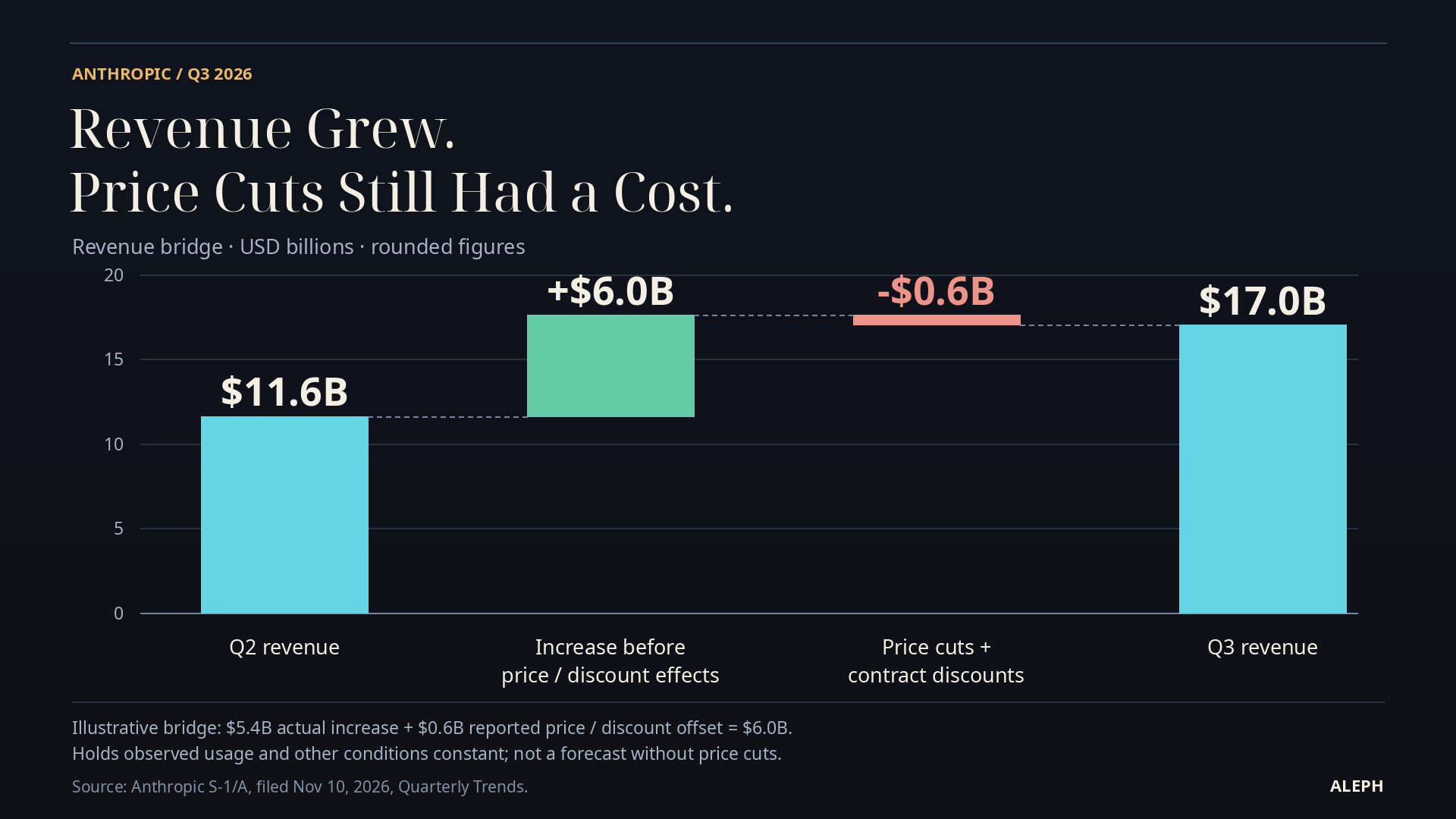
According to Antropic's amended S-1/A filing on November 10, third-quarter revenue was approximately $17 billion , an increase of about $5.4 billion from the second quarter ($11.6 billion). Antropic stated that while revenue grew due to increased usage, price reductions for new models and discounts on customer contracts reduced the revenue growth by approximately $600 million . 4
Adding the disclosed price and discount effects of approximately $600 million to the actual revenue increase of about $5.4 billion results in approximately $6 billion. This figure is a simple calculation based on assuming observed usage and other conditions remain unchanged. It is impossible to know whether customers would have used the same amount even if the rates had remained the same. The report also does not specify how much of the $600 million was derived from rate reductions and contract discounts, or from which models.
Of the seven quarters reported in the filing, there were only two instances where it was stated that price changes reduced revenue growth. In the fourth quarter of 2025, it was approximately $70 million, while in the third quarter of this year, it was over eight times that amount at $600 million. Fable 5.1 and Opus 5.5 were released in succession during the third quarter.
It is necessary to consider the 47% revenue growth rate together with the $600 million in pricing and discount effects. Lowering rates reduces the revenue received even for the same amount of usage. However, if usage increases enough to offset the revenue lost due to the rate reduction, overall revenue grows. The Ramp sample and Antropic's performance cannot be directly compared as they differ in both time period and target group. Nevertheless, both the token spending in the Ramp sample and Antropic's quarterly revenue increased.
Even if you lower rates, you can maintain your margin if you reduce costs further.
How much profit a company makes after lowering prices depends on the cost of providing the service. If the cost per transaction is reduced by the same amount as the fee received per transaction, the profit per transaction can be maintained.
Antropic stated that the computational load required to provide Opus 5.5 has decreased compared to Opus 5, and that it has also lowered its rates. 3 The securities filing states that thanks to improved computational efficiency, the company was able to lower the cost per job for customers while maintaining margins. As figures demonstrating this improvement in computational efficiency, the company cited a 1,127% year-over-year revenue growth and a 382% growth in computing and infrastructure costs for the third quarter. 4 The basis for calculating the margins is not specified in this section.
Lowering prices may encourage customers to use the service more. If work previously postponed due to cost is outsourced to AI, or if the number of employees using AI increases, the AI company's revenue also rises. Antropic reported that after launching Opus 4.5 in November 2025 at a lower price than its predecessor, its revenue growth rate jumped from 48% to 132% compared to the previous quarter. The company added that several factors, in addition to price, were at play. Conversely, if customers merely handle their existing tasks more cheaply, the AI company's revenue growth will be less significant.
Compared to the same period last year, revenue grew faster than computing costs, but compared to the previous quarter, computing costs grew faster.
Cafes that expand their stores in advance pay higher rent.
Fixed costs, such as rent, affect a cafe's overall profit as well as the cost of a cup of coffee. If the store was expanded in advance anticipating an increase in customers, higher rent must be paid even before the expanded space is filled. The burden is even greater if the additional space was rented under an expensive short-term contract. Even if the profit from a single cup remains the same, the cafe's total profit for that month decreases.
This is the breakdown of Antropic's third-quarter expenses. Computing and infrastructure costs rose 77% from approximately $5.6 billion in the second quarter to approximately $9.9 billion in the third, significantly outpacing the revenue growth rate (47%). The proportion of computing costs in revenue also increased from 48% to 58% . Antropic explained that this was due to the supply of additional computing resources. These costs include about $5 billion spent on computing resources secured through short-term contracts. According to the company, the cost of short-term contracts was much higher than that of similar multi-year contracts. Since Antropic contracts for most computing resources 12 to 18 months before actual use, it is difficult to reduce these costs immediately. 4
Accounting operating profit/loss shifted from a $974 million surplus in the second quarter to a $567 million deficit in the third quarter. The company cited $5 billion in short-term computing contract costs and approximately $2 billion in non-cash expenses associated with its donation matching program as the primary reasons for the shift to an operating loss. The donation matching program is a system in which the company matches a donation with its own stock if an employee pledges to donate a portion of their stock compensation.
Antropic's computing and infrastructure costs include resources used for research, model development, and internal use, in addition to those used to process customer requests. Therefore, the cost of customer service cannot be calculated based solely on this proportion.
Antropic predicted that its operating profit margin would decline for the time being as computing resources secured through short-term contracts increase. For the next quarter, it is necessary to examine how much the cost per task decreased and how much of the increased computing costs were covered by revenue.
6 Three things to watch out for going forward — Token price, discount size, computing costs
If usage has increased, you must also verify how much actual revenue and costs have increased. Examine the following three items, ensuring that the comparison period and aggregation criteria are consistent within each dataset.
| Things to look into | How to check | Points to note |
|---|---|---|
| Token usage and unit price | We will continue to look at the token usage, spending, and mixed price of the Ramp AI Index for several weeks. | This is a sample that does not represent all lamp customers, and the number of sample companies is not disclosed. |
| Price reduction and discount amount | We examine whether pricing and discount effects are continuously disclosed in numerical terms in quarterly reports following the IPO. We also check how cache read charges change when new models are introduced. | The public price list does not include company-specific contract discounts. It has not yet been confirmed whether these details will be disclosed after the listing. |
| Computing costs and operating profit | We compare the proportion of computing and infrastructure costs in revenue, the size of short-term computing contracts, and operating profit and loss on a quarterly basis. | It is difficult to view service costs separately because they also include computing resources used for research and model development. |

7Frequently Asked Questions
| question | answer |
|---|---|
| If spending increased less than usage, is the AI company selling at a loss? | This cannot be determined from the RAMP data. This data only shows the tokens and usage fees spent by customers, but not the costs incurred by the AI company. Whether a profit was made must be checked separately through the company's financial statements. |
| What is the reason for Antropic's operating loss in the third quarter? | The company cited $5 billion in short-term computing contract costs and approximately $2 billion in non-cash costs from donation matching programs as the primary reasons for the shift to an operating loss. Rate cuts and contract discounts in the same quarter reduced revenue growth by approximately $600 million. |
| What is the $81 billion in run rate revenue stated in the securities registration statement? | It is the sum of the usage-based rate over the past 28 days multiplied by 13 and the monthly subscription fee multiplied by 12. As of October 31, it stood at approximately $81 billion, an increase of $10 billion from the end of September. As this is an annualized value of recent performance, it may differ from actual annual revenue and is an internal company metric that has not undergone external verification. |
Conclusion — Even cafes with increased customers must consider the price of a cup and rent together.
You cannot tell whether a cafe with more customers actually earned more just by looking at how many cups were sold. You also need to look at how much was charged per cup and how much it cost to operate the cafe. Although Antropic increased revenue by 47% in the third quarter despite lowering prices, its operating profit turned into a loss during the same quarter.
In "Can AI Beat Inflation?" written in June, I discussed how falling inference unit costs could shake the margins of AI companies. In "Why Did Broadcom Guarantee a $43 Billion Guarantee While Selling AI Chips?" on November 3, I examined Antropic's computing costs and commitment scale. This time, I verified, using figures from the securities filing, how much the rate cuts affected actual revenue.
Antropic explained that revenue growth in the third quarter narrowed by approximately $600 million due to rate cuts and contract discounts. The company cited computing costs and donation-related expenses as the primary reasons for the shift to an operating loss in the same quarter. It is difficult to determine from a single quarter's data how much new demand was generated following the rate reductions.
How much did the increase in usage offset the revenue lost due to price reductions? This is the first aspect I want to examine in the quarterly earnings report to be released after the IPO.
📌 Was this analysis helpful?
We will continue to monitor the price changes and performance of AI companies. Please subscribe below to receive new posts.
Subscribe and get notifications →Reference materials
- Anthropic, Anthropic launches roadshow for proposed initial public offering (2026.11.10) — official announcement
- Ramp, Ramp AI Index — Tokenomics, Sources and Definitions (Checked Nov. 11, 2026) — Comparison of the week ending Oct. 23, 2026 and the week ending Sep. 25, 2026. The reverse-calculated average unit price (approx. -20.6%) is based on the author's calculation.
- Anthropic, Introducing Claude Opus 5.5 (2026.09.22) — Cost and speed, Pricing
- Anthropic, Form S-1/A (submitted on November 10, 2026) — 1st disclosure. Quarterly Trends, Quarterly Consolidated Statements of Operations, Significant Customer Expansion
- Anthropic, Introducing Claude Fable 5.1 and Claude Mythos 5.1 (2026.09) — Price, Cost and availability · Release date based on AI Matters report
How this content was produced
Aleph's research AI agent assisted with collecting and analyzing public data, creating charts and visuals, and structuring the draft. Davar personally reviewed and edited the sources, figures, reasoning, and final conclusions.
This content is for informational purposes only and is not personalized investment advice or an individual stock recommendation. Read the full disclaimer

Davar
Davar builds and operates Aleph's research AI agent and writes and reviews analysis on macroeconomic developments and AI industry trends.



© Aleph. All rights reserved.