
Antropic IPO Examined Through Bean Suppliers and Roaster Manufacturers — How Google, Amazon, Microsoft, Nvidia, and AMD Make Money at Claude
Antropic completed its first trading session on the Nasdaq on November 19 (U.S. local time). The stock closed at $97.17 , approximately 17% higher than the IPO price of $83 . The following day, Antropic announced that it had also completed a private equity round worth approximately $26 billion, involving seven investors including Google, Nvidia, and AMD. The issue price of the shares purchased by these investors was also $83 per share. 1 2 3
Google and Nvidia each invested $10 billion . While the two companies have now become shareholders of Antropic, they are also companies that originally sell products to Antropic. Google leases the computing power to run Claude, while Nvidia sells GPUs to the companies operating such computing. If the number of Claude users increases, will the two companies earn more money from their core businesses in addition to their equity value? If so, will they earn it in the same way? 1 5
In the previous post , likening Antropic to a cafe with a growing number of customers, we examined why revenue and profits do not increase proportionally even when coffee is sold more. This time, we intend to turn our attention to the suppliers providing beans to the same cafe and the manufacturers of the roasters. By following the contractual terms outlined in Antropic's final prospectus, we have summarized how the payments received by each company change depending on whether Claude's customer base grows or declines, and outlined what needs to be checked in the next public disclosure. 4
Even if you use less coffee beans, you must pay the promised amount at the cafe.
Let's assume a cafe with increasing customer traffic signs a multi-year contract with a coffee bean supplier. The cafe promises to purchase a certain amount of beans every month. Even if it uses fewer beans due to a drop in customers, it must still pay the difference between the agreed amount and the actual cost. The supplier can expect a steady revenue even if the cafe's business slows down temporarily.
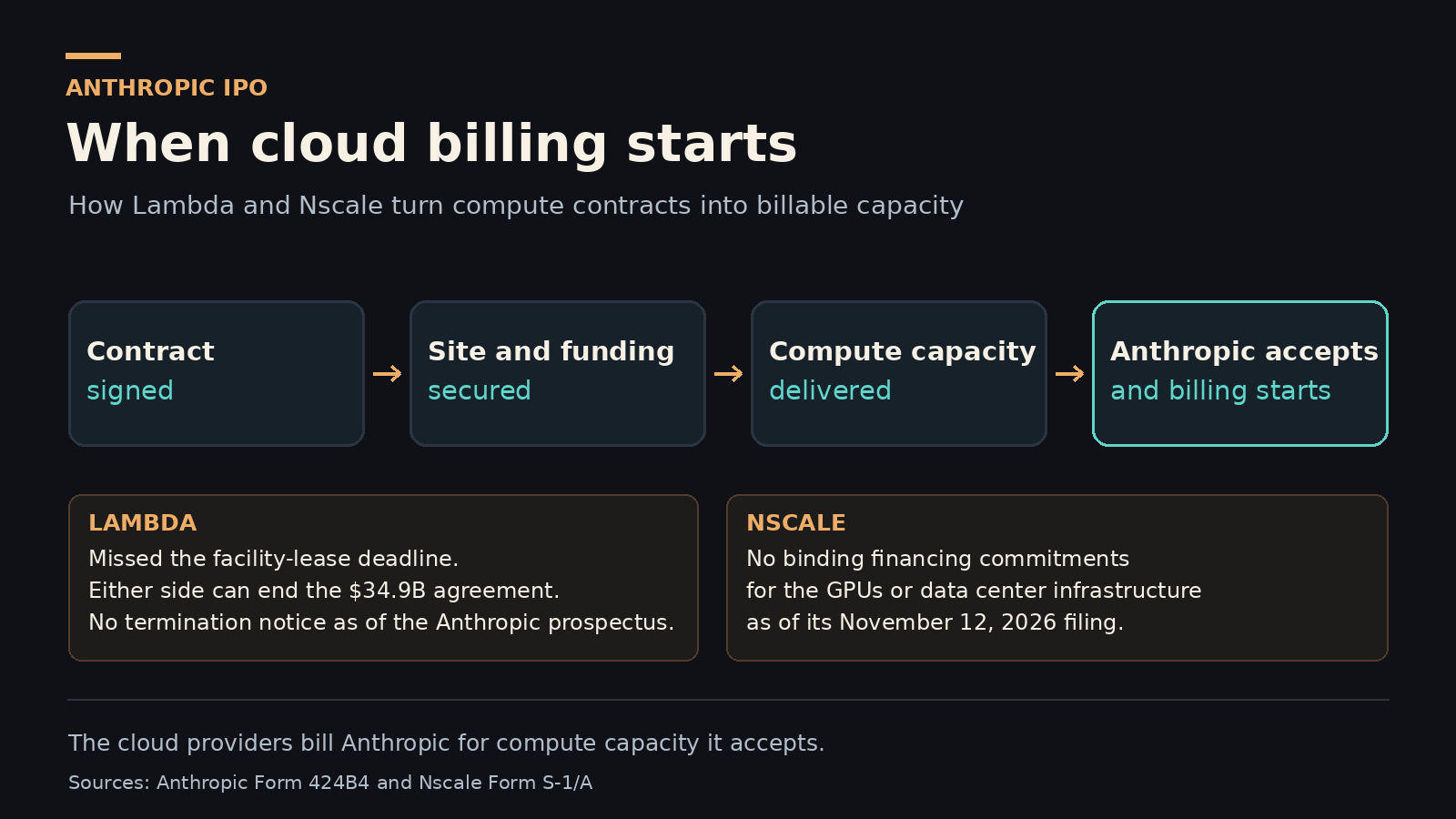
The contracts Antropic has signed with Google, Amazon, and Microsoft are similar to this. The computing required to run Claude corresponds to the coffee beans. The final prospectus lists the amounts agreed upon in the contracts with the three companies, regardless of actual usage. 1
| Coffee bean supplier (cloud) | Antropic's spending commitment | Contract period |
|---|---|---|
| At least approximately $121.3 billion | April 2026 – July 2033 | |
| Amazon | At least $110 billion | May 2026 – April 2036 |
| Microsoft | $47.2 billion to $49.2 billion | November 2026 – June 2033 |
The contracts with Google and Amazon include a clause requiring Café to pay the difference if it uses fewer beans than agreed upon. If Antropic's actual expenditure falls short of the agreed amount, the shortfall is settled with the two companies after going through specified exceptions and adjustment conditions. The contract with Microsoft contains a clause to the opposite effect. If Microsoft fails to deliver a portion of the promised volume , the contract corresponding to that volume can be cancelled.
The three companies do not merely supply coffee beans. They also sell this cafe's coffee at their respective stores and receive commissions. When corporate customers use Claude on Google, Amazon, or Microsoft's cloud services, the three companies receive distribution fees from Antropic. In essence, they generate revenue from both the computing rental business and the business of selling Claude to customers.
Therefore, the amount of money a supplier receives fluctuates depending on whether the number of customers increases or decreases. If the number of customers drops, the contract acts as a floor. Conversely, even if the number of customers increases, if the cafe has not yet used up all the promised beans, the excess beans used are covered within the already agreed-upon amount. In this case, the total amount received from the bean contract may remain unchanged. However, if Claude sells more at the store, the distribution commission may increase.
The agreed amount does not equate to profit. Suppliers also spend money on purchasing, roasting, and delivering coffee beans. Cloud companies spend money on building data centers, purchasing chips, and securing power. Since the three contracts differ in duration and the costs per contract are not disclosed, it is impossible to compare which company makes more profit based solely on the figures in the table.
If 2 Roastery cannot secure a factory, orders for new roasters will not come in.
Now, let's look at the roaster manufacturers. Bean suppliers are typically roasteries that roast the beans themselves. When the number of cafe customers increases and more beans are needed, the roasters run their roasters for longer periods. For manufacturers to earn more money, roasters must order new roasters. However, if there is spare capacity in the existing roasters, no new orders will come in even if more beans are roasted.
NVIDIA is in a similar situation to this roaster manufacturer. When Antropic rents NVIDIA GPUs from the cloud, the usage fees go to the cloud provider. For NVIDIA to earn more, that provider must order more GPUs, or sales of NVIDIA equipment must increase through other supply channels.
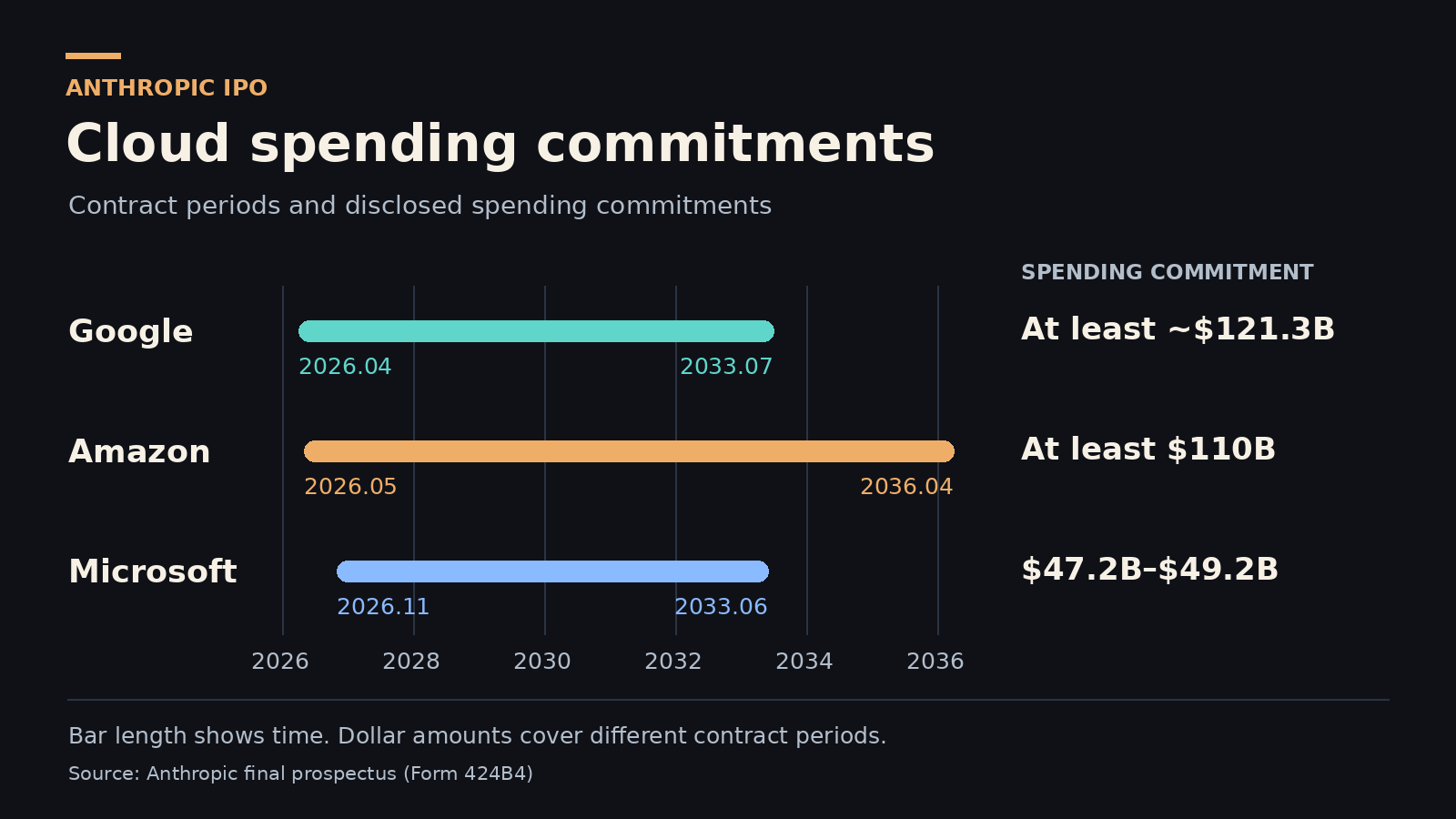
There are cases where newly contracted roasteries must first secure a factory site. The Lambda contract is one such example. Antropic entered into a contract worth approximately $41.3 billion with Lambda to utilize NVIDIA GPU-based computing. Charges begin after Lambda delivers the computing capacity and Antropic accepts it. However, regarding a portion of the contract worth approximately $34.9 billion, both parties became eligible to terminate it because Lambda failed to secure a facility lease within the deadline. According to the final prospectus, neither party notified the other of termination, and Antropic stated at the time that it had no intention of terminating the contract .
Nscale is facing a problem with the funds to purchase roasters. The contract size disclosed by Antropic is up to approximately $44.6 billion . In an investment prospectus dated November 12, Nscale stated that it has not yet secured commitments for the GPU and data center funding needed to fulfill this contract. 1 6
Just because a contract with a roastery is large does not mean the manufacturer's revenue will increase immediately. Revenue is generated only when the roaster secures factory space and funds, and orders and installs the roasters. Whether the contract with Entropic will generate significant equipment demand for NVIDIA depends on how quickly Lambda and Enscale secure facilities and funds and actually place orders.
There are also manufacturers that invest more in cafes as they bring in more 3 roasters.
Even though they are both roaster manufacturers, AMD is connected to the cafe in a different way. It is similar to a situation where a manufacturer bought a stake in a cafe and promised, "If you bring in more of our roasters, we will invest more."
AMD purchased $2.5 billion worth of Antropic shares in a private equity round. This amount reduced the available limit of the existing $5 billion equity investment commitment. If the available investment capital accumulated through GPU deliveries and deployments exceeds the $2.5 billion already executed in the private equity round, Antropic can request additional investment equivalent to the excess amount, up to a maximum of $2.5 billion. The structure is such that the more AMD GPUs are deployed at Antropic, the more investment funds Antropic can request from AMD. Antropic anticipates that the conditions for its first delivery and deployment will be met in 2027. 1 3
Antropic projected that if it secures its entire initial commitment volume by 2027, related expenditures over the entire contract period would exceed $20 billion . However, not all of this money goes to AMD. Antropic can purchase systems from approved manufacturers or utilize third-party service providers. This means that cafes could choose not to purchase roasters directly from AMD, but instead buy finished products assembled by other companies or outsource the roasting process to other roasters. Therefore , it is difficult to determine the direct share going to AMD based solely on these figures.
Such conditions are not visible in Nvidia's $10 billion investment. No clauses stipulating the purchase of Azure or GPU deployment as conditions for the execution of the investment can be found in the publicly available stock purchase agreement forms and prospectus. 1 7
4When the number of customers increases, look at where the beans are roasted; when paying, look at the promised amount.
If Claude's customer base grows faster than expected, the first step is to examine which suppliers are handling the increased orders and which roasters are being used. Antropic utilizes NVIDIA and AMD GPUs alongside Google TPUs and Amazon Trainium. As long as existing facilities can handle the load, capacity utilization may rise first; once that capacity diminishes, it becomes time to focus on actual orders and equipment deliveries. 1
If customer numbers drop, it becomes important to see how well the minimum spending commitments from Google, Amazon, and Microsoft are being met. Even if customer numbers remain the same, if a roastery cannot open its factory on time, supply schedules and cancellation conditions may become issues first, just like with Lambda.
From this point on, there are aspects that are difficult to explain using the coffee bean analogy. It is uncommon for coffee bean suppliers or roaster manufacturers to purchase shares in the cafes they do business with. The companies that invested in Antropic are both suppliers and shareholders. While an increase in share value may generate unrealized gains, realizing these as capital gains requires selling at a price higher than the purchase price. Since private equity stocks are subject to resale restrictions, it is difficult to calculate how much the investors earned based solely on the closing price on the first day of listing.
5Frequently Asked Questions
| question | answer |
|---|---|
| Has the $34.9 billion Lambda contract already been canceled? | Based on the final prospectus, it has not been cancelled. Lambda exceeded the facility lease term, thereby creating a right of termination for both parties; however, neither party has notified the other of termination, and Antropic stated that it has no intention of terminating. Whether the contract remains in effect must be confirmed again in the next disclosure. |
| If Antropic's stock price rises, have Google and Nvidia earned that much as well? | The NASDAQ closing price is the price of listed Class A shares. Since the Class N shares purchased by Google and Nvidia through private equity are subject to resale restrictions, the realized profit cannot be determined solely from the closing price on the first day. Earnings from core business operations must be calculated separately from this. |
| What kind of companies are Lambda and Enscale? | Both are cloud companies invested in by NVIDIA that rent out AI computing resources from data centers equipped with NVIDIA GPUs. Lambda is a U.S. company, while Enscale is a British company building a data center campus in West Virginia and is pursuing a listing on the U.S. stock market. 6 8 |
Conclusion — When cafe customers increase, suppliers focus on contracts and operating costs, while roaster manufacturers focus on ordering and delivery.
Companies supplying goods to cafes with increasing customer traffic do not all earn the same amount. While the promised price acts as a floor for coffee bean suppliers, the amount they receive may remain stagnant as long as the cafe uses more beans within the agreed range. Roaster manufacturers generate revenue only when a roastery places a new order.
In the November 3 article "Why Did Broadcom Provide a $43 Billion Guarantee While Selling AI Chips," we examined Antropic's computing costs and the scale of its commitments, and in the November 11 article, we investigated why cafes do not see a corresponding increase in revenue and profit even when they sell more coffee. This time, we looked into Antropic's computing contracts from the perspective of the companies supplying goods to the same cafes.
There is an additional step between the judgment that cloud usage will increase and the judgment that a specific vendor will earn that much more. If it is a cloud company, one must examine whether commitments are actually being fulfilled and how much remains after deducting data center, chip, and power costs from usage fees and distribution commissions. If it is a chip company, one must verify which company's chips are handling the increased demand and whether that demand has translated into actual orders and deliveries.
Honestly, based on the data released so far, it is difficult to determine which company will make the most profit. This is because the cost per contract and the supplier's share have not been disclosed.
Which equipment did Antropic actually receive? Who supplied that equipment? How much profit did the supplier make from the transaction after deducting costs? I intend to find the answers to these questions one by one in Antropic's first quarterly report following its IPO and the suppliers' next earnings reports.
📌 Was this analysis helpful?
We will continue to examine the contracts and performance of AI companies. Please subscribe below to receive new posts.
Subscribe and get notifications →Reference materials
- Anthropic, Final Prospectus Form 424B4 (Prospectus Date Nov. 18, 2026) — Private Equity, Computing Expense Commitment, Distribution Fees and Agreement Terms
- CBS News, Anthropic shares gain 17% on first day of trading after record IPO (2026.11.19) — US local closing price on November 19
- Anthropic Announces Closing of IPO and Concurrent Private Equity Offer (Nov. 20, 2026) — Private Equity Approx. $26 Billion, $83 Per Share
- Aleph: While AI Usage Increased by 37%, Spending Rised by Only 9% (2026.11.11) — Previous Post
- Anthropic, Microsoft, NVIDIA, and Anthropic announce strategic partnerships (2025.11.18) — Partnership and investment announcement
- Nscale, Form S-1/A (Filed Nov. 12, 2026) — Status of Financing for Antropic Contracts
- Anthropic, Form of Class N Common Stock Purchase Agreement (Exhibit 10.16) — Private Equity Stock Purchase Agreement Form, Articles 4 & 5 Closing Conditions
- SBS Biz, Antropic, 48 Trillion Won Cloud Big Deal… NVIDIA Behind It (2026.09.02) — The Relationship Between Lambda, Enscale, and NVIDIA
How this content was produced
Aleph's research AI agent assisted with collecting and analyzing public data, creating charts and visuals, and structuring the draft. Davar personally reviewed and edited the sources, figures, reasoning, and final conclusions.
This content is for informational purposes only and is not personalized investment advice or an individual stock recommendation. Read the full disclaimer

Davar
Davar builds and operates Aleph's research AI agent and writes and reviews analysis on macroeconomic developments and AI industry trends.



© Aleph. All rights reserved.