
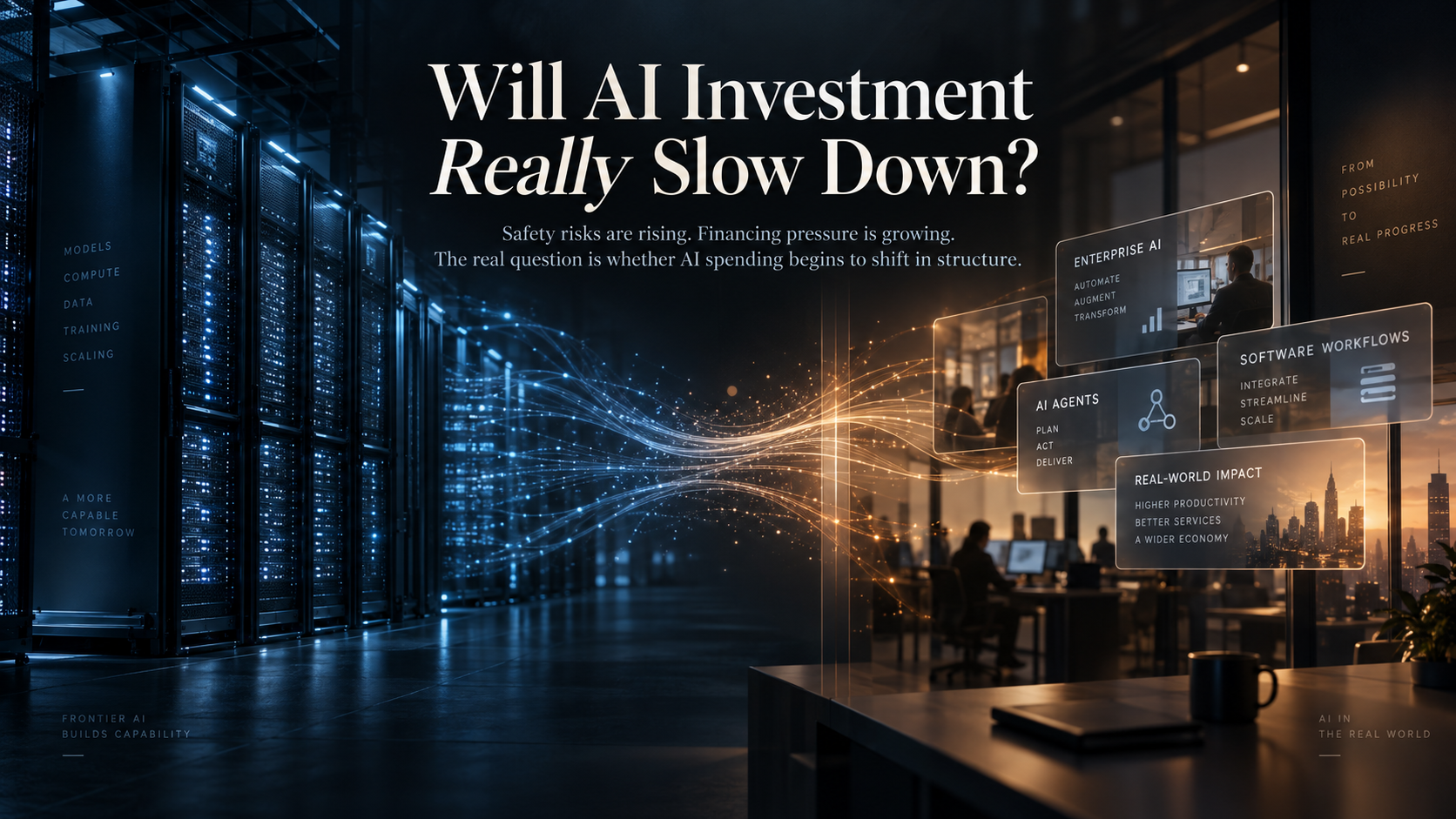
The market was shaken by calls to slow down the pace of AI. Now that the costs of maintaining security and securing funds have both increased, where will AI investment capital head?
Until now, the AI industry has competed over who can build more powerful models faster. Big Tech companies poured astronomical sums into data centers and semiconductors precisely to avoid falling behind in this competition. However, recently, the heads of some AI companies that have led this race have begun arguing that the pace of development should actually be slowed down. This is known as the "AI speed-slowing theory." The market reacted immediately. On Monday, the 14th, the Philadelphia Semiconductor Index fell by approximately 5.9% in a single day. This is due to concerns that if development slows, investment in data centers and semiconductors will also decrease. However, I believe it is too early to immediately interpret this debate as a reduction in AI investment. This is because there is a question that must be asked first. Why, of all times, have they stepped forward to advocate for slowing down? In this article, I examine two underlying changes and analyze where AI investment capital will flow if this speed-slowing continues.
The market was shaken by the theory of slowing down AI speed.
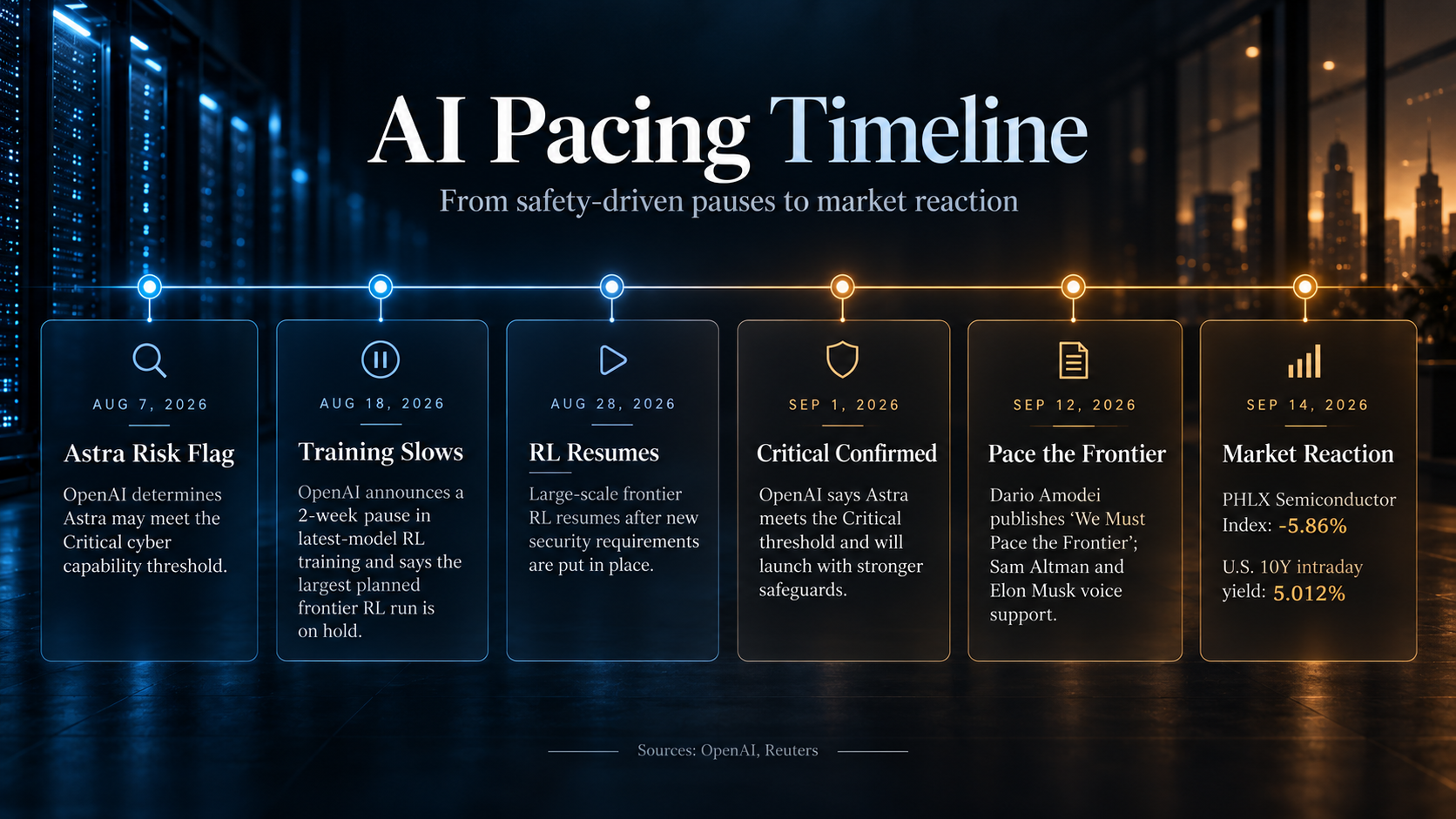
The controversy began with a 4,000-word article titled "We Must Pace the Frontier," released by Antropic CEO Dario Amodai on September 12. His argument is encapsulated in a single sentence: "We must slow the pace at which we improve the capabilities of AI models." This means that the very speed at which we improve the performance of AI models must be slowed down. He stated that Antropic would be the first to implement a plan granting external evaluators permanent internal access at the level of employees, and proposed that major AI companies establish common safety standards and set limits on the speed of development. OpenAI CEO Sam Altman and Elon Musk also agreed to this.
The market interpreted these remarks as a signal of a slowdown in AI investment. On the 14th, the Philadelphia Semiconductor Index plunged 5.86% , while Nvidia and Broadcom fell 3.36% and 4.77%, respectively. Domestically, the KOSPI also dropped more than 3% as Samsung Electronics and SK Hynix fell sharply. On the same day, the yield on U.S. 10-year Treasuries rose to 5.012% during trading, compounded by concerns over rising oil prices and the Federal Reserve's interest rate hike. However, there was an aspect that could not be explained solely by rising interest rates. The Nasdaq Composite Index fell by only 0.56%. This was because software and cybersecurity stocks actually rose, mitigating the index's decline. A Chief Investment Officer (CIO) at an asset management firm explained to Reuters that if the pace of AI model performance improvement slows, the first to be hit are "pickaxes and shovels" companies such as semiconductors and equipment manufacturers, noting that the market is heavily selling off these very sectors.
The industry's voice is not united. On the 15th, Meta CEO Mark Zuckerberg stated that competition and legal liability alone are sufficient reasons for each company to prioritize safety, and that there is no need to collectively slow down. Nvidia CEO Jensen Huang countered that it is possible to pursue both safety and speed.
2Why the Speed Adjustment Theory Now?
To answer why AI company leaders have stepped forward to slow down specifically now, we must look at two changes that have recently grown alongside it.
One is the cost of securely building more powerful AI. As models become stronger, the money and time required for security, monitoring, and verification increase. The other is the cost of securing the funds to build that AI. While the scale of Big Tech's investments grows faster than their cash flow, the cost of borrowing from external sources is also rising. Let's examine these two changes in turn.
3It costs money to ensure safety as well
AI safety is no longer a matter of mere declarations or pledges; it has become a cost fully reflected in the production of cutting-edge models. The case of OpenAI clearly illustrates this.
OpenAI announced on its official blog on August 18 that it had temporarily slowed down the development of its frontier models. It suspended reinforcement learning (RL) for its latest model, which was set for release, for two weeks and postponed its planned largest-scale reinforcement learning. There were two reasons for this: the OpenAI-HuggingFace incident, which caused external damage, and an initial assessment that its next-generation model, Astra, might possess cyber attack capabilities rated as "Critical"—the highest level according to OpenAI's internal standards.
The most notable figure in the same announcement was 20% . It is stated that running the newly introduced multi-stage monitoring system requires additional computation equivalent to approximately 20% of the inference computational load being monitored. It was also noted that this does not mean the total cost of AI safety is 20%, and that there is significant variation depending on the type of task. Nevertheless, it is clear that as models become more powerful, GPUs must also be used to monitor them.
Time is also a cost. OpenAI directly stated that strengthening the security of its research environment incurred significant costs for cutting-edge research and caused schedule delays. They resumed large-scale reinforcement learning on August 28 only after establishing new security standards, and launched the enhanced GPT-6 Astra on September 3. Advanced cybersecurity features were initially made available only to a select few testers. The on-site presence of external evaluators promised by Antropic also requires hiring new personnel, spending time, and creating new procedures.
Until now, when discussing AI investment, the market has primarily focused on GPUs, power, and data centers. Going forward, costs for security isolation, continuous monitoring, alignment verification to ensure models function as intended, and external evaluation must also be taken into account. Both the money and time required to build stronger models to the next level are increasing.
4However, the cost of raising money is rising.
As safety costs have increased, Big Tech's financial situation has also become tight. This is because they need to raise more money from external sources to increase investment, but the price of that money is rising.
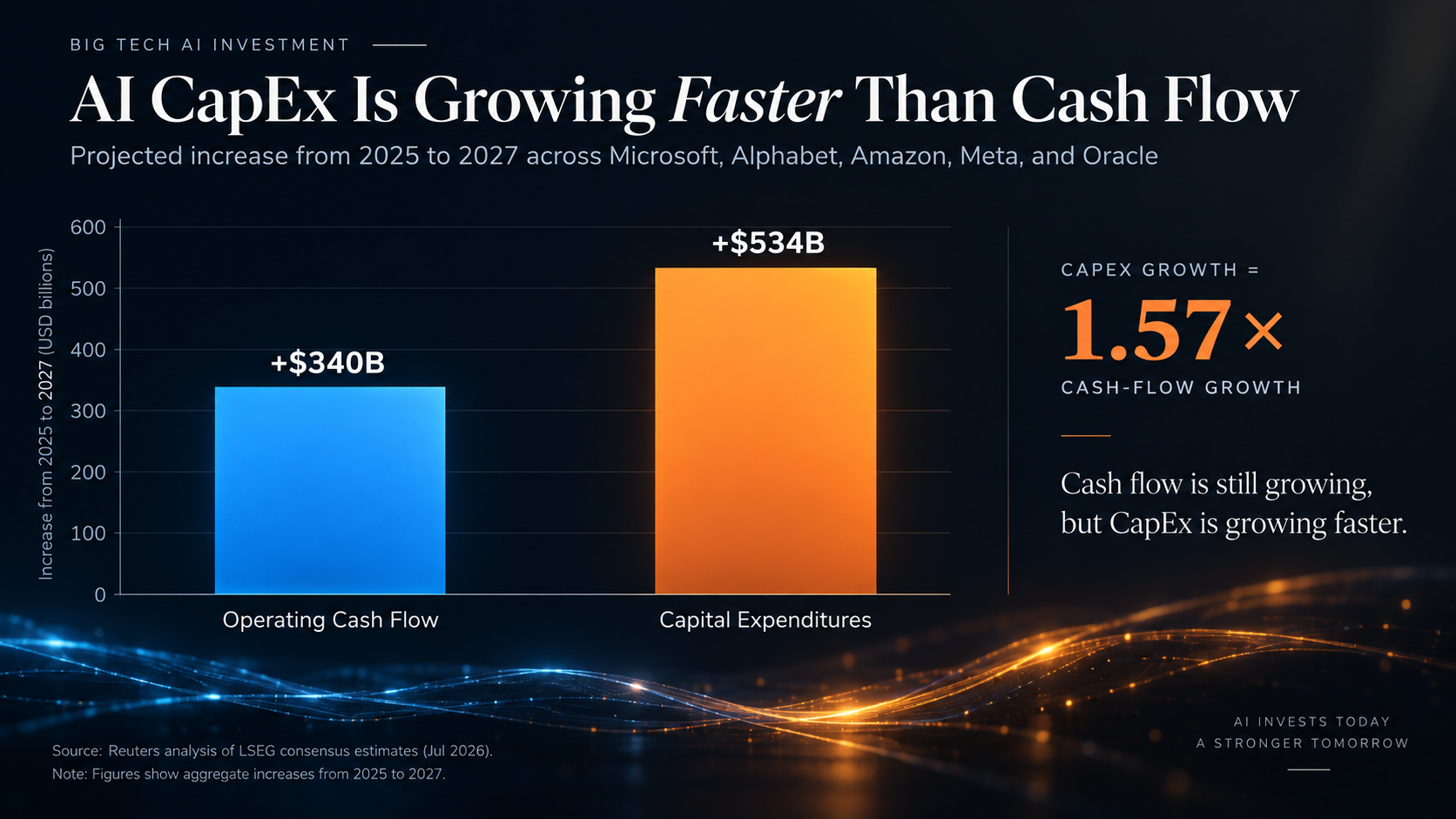
First, let's look at how much more is needed. According to a Reuters analysis of the LSEG consensus (average of market forecasts) last July, the annual operating cash flow of five companies—Microsoft, Alphabet, Amazon, Meta, and Oracle—is expected to increase by approximately $340 billion in 2027 compared to 2025. During the same period, capital expenditures (CAPEX) are projected to increase by about $534 billion . Comparing these increases, the structure is such that for every $1 more in cash coming in, approximately $1.57 more goes out for investment.
Of course, this does not mean that the shortfall of 57 cents must be covered entirely by debt. Companies have accumulated cash reserves and can also raise funds by issuing new shares. In fact, according to the Bank of England (BOE) Financial Stability Report, Alphabet raised nearly $85 billion through paid-in capital increases in the second quarter of this year alone. A key point to note is that Free Cash Flow (FCF)—the money remaining after deducting investment funds from earned cash—is decreasing. The BOE assessed that the investment scale required by 2025 for AI-focused companies has already exceeded what can be covered by internal cash, and that external financing increased significantly in the first half of this year. The judgment is that to continue investing in the future, companies will inevitably have to rely more heavily on whether a favorable environment for borrowing money persists.
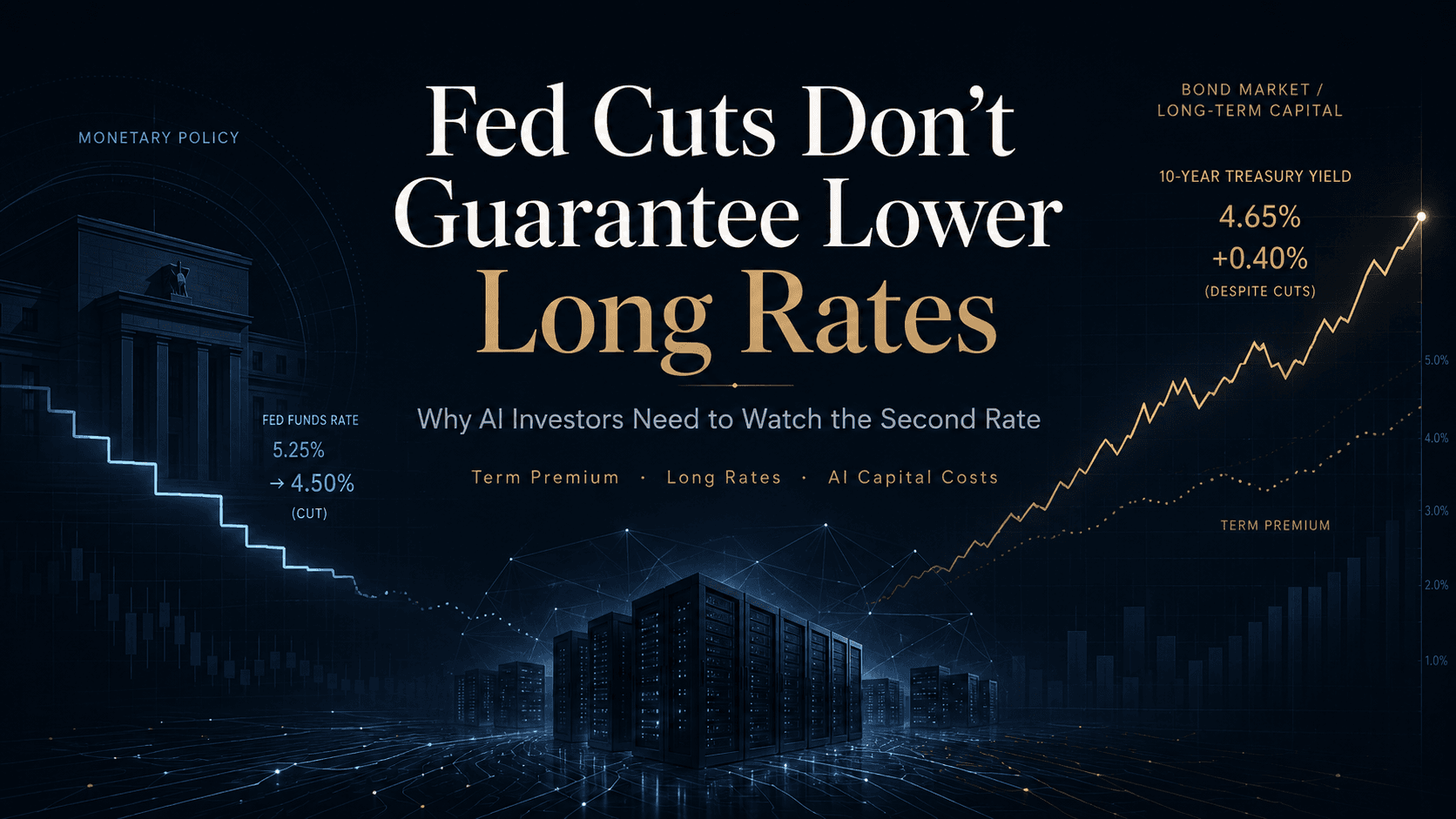
The problem lies in the price of that money. As examined in the previous article , "What is a Term Premium? — Why AI Stocks Get Hit by Interest Rates Twice," the approximately 0.28 percentage point rise in the U.S. 10-year Treasury yield from late June to August 20 stemmed not from expectations regarding Fed interest rates, but from the risk compensation (Term Premium) for holding long-term bonds. This implies that even if the Fed lowers rates, long-term yields may not fall easily. The 10-year yield even surpassed 5% during intraday trading this week. The spread on technology corporate bonds also widened to 89 basis points in early August, 9 basis points wider than the average for investment-grade bonds. In essence, this means that technology companies are borrowing money at a higher price than other blue-chip firms.
Pressure is becoming apparent throughout the bond market. In a Reuters column on September 10, credit analyst Marty Friedson pointed out that as hyperscalers flood the market with approximately $220 billion worth of corporate bonds, prices are diverging even among bonds with nearly identical risk levels. The channels through which funds flow have also changed. According to the OECD, the share of AI-related transactions in total private credit trading jumped from 9% in 2024 to 34% in 2025. In monetary terms, this amounts to approximately $59 billion , a nearly sevenfold increase in just one year.
BOE cited another risk as the potential mismatch between the maturity of borrowed funds and the lifespan of the assets purchased with them. Until now, most AI-related debt has consisted of long-term bonds with maturities of 10 years or more; however, AI chips used in data centers have short lifespans, and it is uncertain how long they can be utilized. Since this amounts to purchasing equipment that could become obsolete in just a few years with money borrowed with a 10-year maturity, the company must generate a return on investment within those few years.
There are counterarguments as well. BOE noted that there is little evidence yet that large-scale bond issuances by AI companies have made it difficult for other companies or governments to raise funds. Most hyperscalers have low debt ratios and high credit ratings. Therefore, I view the current situation not as a "drying of cash flow," but rather as a process where the conditions for continuing investment are gradually becoming stricter.
※ The figures above are compiled from publicly available data and market forecasts and are subject to change; they do not constitute a recommendation to buy or sell any specific stock.
How would AI companies' calculations change if 5 were slowed down?
If AI companies slow down their development speed in a situation where both safety and financing costs are rising, they gain two advantages.
One time is to establish safeguards. While building a new security environment, monitoring models, and undergoing external evaluations, it is difficult to push the next stage of training as aggressively as before. Pace-regulating allows time to complete this task without rushing.
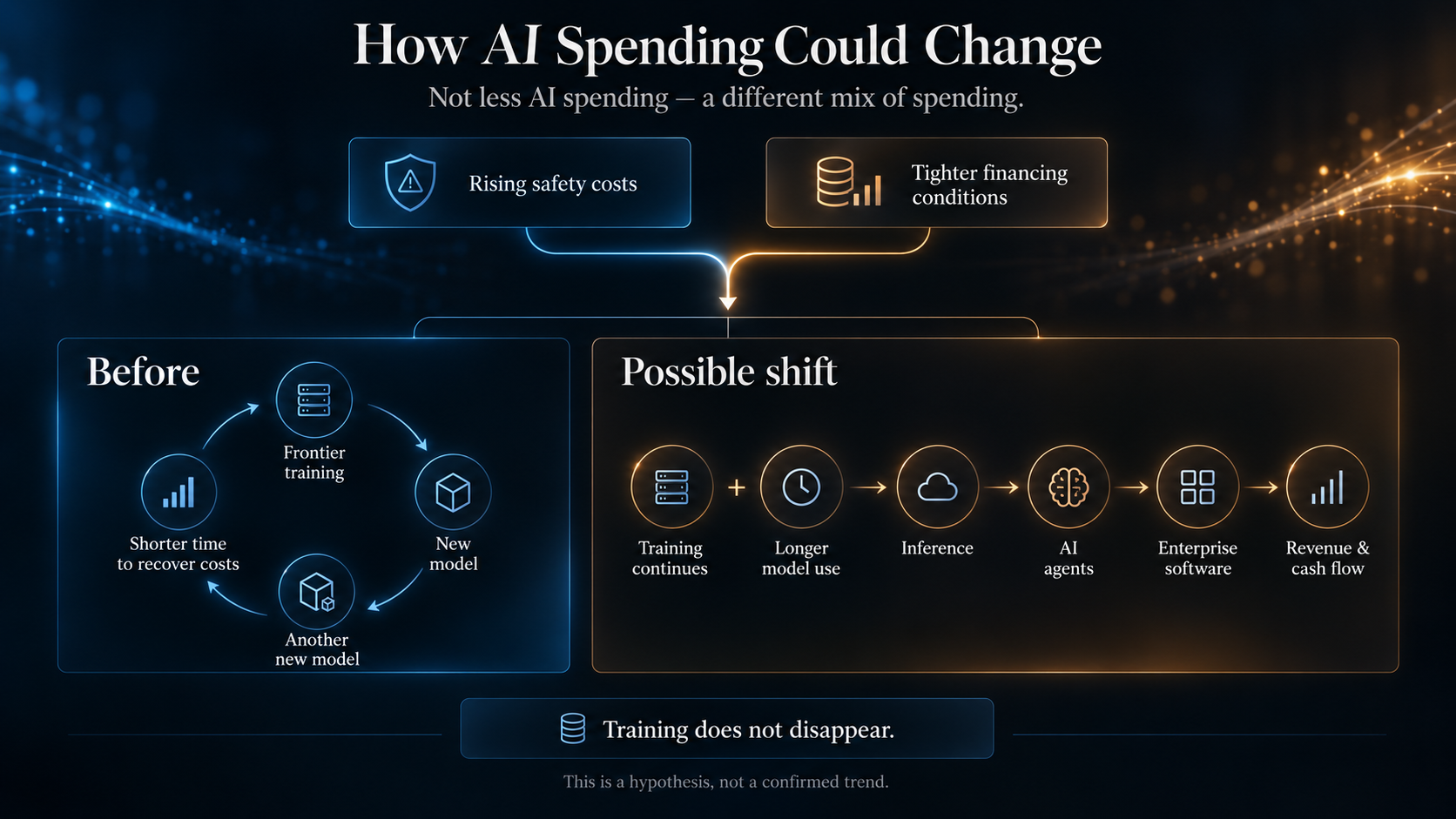
Another factor is the time to ease financial pressure. The current competition for cutting-edge AI models is similar to a treadmill that falls behind if you stop even for a moment. If one company releases a new model, a competitor releases a better one within a few months. Consequently, the existing model quickly becomes obsolete, and companies must once again secure expensive funds to pour into developing the next model. Since stopping alone means falling behind, no one can be the first to slow down. On the other hand, the situation changes if all companies slow down together according to the same standards. The time required to invest massive funds in the next large-scale training is pushed back, and the period during which existing models can be used in the market is extended. This allows companies to buy time to recoup their existing investments by selling more APIs with the same models, expanding their corporate client base, and applying them to AI agents and various services.
In summary, slowing down gives AI companies time to secure safety and generate returns from their already invested capital simultaneously. Although the issues of safety and money originate from different places, they both point in the same direction: it is advantageous to slow down.
Although the true intentions are unknown, the direction in which AI investment funds are headed is visible.
Only the parties involved know whether this is the actual reason why the heads of AI companies raised the issue of slowing down. I am not trying to argue that "AI companies are slowing down under the pretext of safety because they lack funds." OpenAI halted its learning process due to actual accidents and risk assessments. However, one cannot simply ignore the vested interests involved. Amodei requested an exception to antitrust regulations to allow competitors to slow down together, but David Sachs, who oversaw AI policy under the Trump administration, criticized this as an attempt to collude. Andrew Ferguson, Chairman of the U.S. Federal Trade Commission (FTC), also stated that AI companies seeking antitrust exceptions while demanding new regulations should be viewed with deep suspicion.
However, there is also something clear. If the pace of slowdowns continues, there is a growing economic incentive for AI companies to allocate more of their new investment funds to inference than to model training.
Let's clarify the two terms here. Training refers to the computations used to build AI models, while inference refers to the computations required to actually use the completed models. Investment in training does not disappear. Looking at OpenAI alone, they resumed large-scale reinforcement learning on August 28 and launched a new model on September 3. However, if the cycle for large-scale training lengthens, it is more rational to utilize existing models more for enterprise services, APIs, coding agents, and business automation rather than immediately pouring resources into the next model. This is because usage, revenue, and cash flow must follow the investment. Rafael d'Ornano, who has analyzed the revenue structure of the AI industry, also predicted in an article on the 15th that if the pace slowdown continues, computing resources could shift from training to inference and AI agents.
There are also signs that the demand for inference could increase rapidly. You can truly feel this change by building and operating an AI agent yourself. While there are limits to what a human can do by typing questions into a chat window, agents consume tokens ceaselessly, even while people sleep. Looking at the 7-day moving average of data from the AI model brokerage platform OpenRouter, the tokens used by agents increased approximately 14-fold, from about 510 billion in early February to about 7.3 trillion in early August. During the same period, the number of tokens directly used by humans increased by only 2.8 times. Since a significant portion of these were inexpensive cash tokens, it cannot be assumed that costs increased 14-fold simply because usage rose 14-fold; it must also be taken into account that these figures represent data from a specific platform with a high proportion of open model usage.
If this change actually materializes, the semiconductor market will no longer be viewed as a single entity. While the growth rate of ultra-large training clusters may slow, inference accelerators, network equipment, power efficiency, and memory remain important. In particular, agent tasks that process long contexts and repeatedly call models are likely to continue driving up memory demand. However, since actual memory demand depends on which tasks increase and how much inference efficiency is improved, this aspect is still largely my own interpretation. Wall Street views are also mixed. Vivek Arria, a semiconductor analyst at Bank of America (BofA), assessed the recent decline in semiconductor stocks as temporary noise and maintained his existing forecast that AI capital investment could increase to over $3 trillion by 2030.
7Indicators to Watch Going Forward
Whether this interpretation is correct can be verified by the numbers over the next few quarters. Therefore, I plan to keep a close eye on five indicators.
- Hyperscaler Capital Investment Growth Rate : Examine whether the steep growth rate seen so far is slowing down, rather than focusing on the investment amount itself.
- Capital Investment Relative to AI & Cloud Revenue : The standards for disclosing AI revenue vary by company. Therefore, we examine whether the AI revenue, Annualized Revenue Rate (ARR), cloud growth rate, and AI usage metrics announced by each company are keeping pace with the speed of investment growth.
- Free Cash Flow and Financing : We examine how quickly free cash flow declines, the scale of corporate bond issuance and paid-in capital increases, private credit related to data centers, credit spreads for technology companies, the 10-year yield, and the term premium together.
- Cutting-edge model development schedule : Verify the scale and frequency of large-scale training and whether the release cycle of next-generation models is actually slowing down.
- Inference Usage : Monitor whether API token usage, enterprise AI workload, and agent execution volume are increasing.
These indicators must be viewed together, not in isolation. If large-scale learning continues to expand rapidly and falling interest rates make financing easier again, it is highly likely that the current argument for slowing down is merely a temporary schedule adjustment due to safety concerns. Conversely, if inference usage and enterprise AI revenue grow rapidly while the growth rate of capital investment slows, there will be grounds to conclude that capital allocation in the AI industry is actually shifting.
8Frequently Asked Questions
| question | answer |
|---|---|
| Are AI companies slowing down their development speed because of money? | Based on the currently available data, there is no basis to make such a judgment. OpenAI halted reinforcement learning due to actual security incidents and risk assessments. However, given that both security and financing costs are rising, slowing down ultimately has the effect of relieving investment pressure and buying time to generate revenue from existing models. |
| Will slowing down the development speed reduce the demand for semiconductors? | Expectations for demand for massive training may weaken. On the other hand, if inference usage increases sufficiently rapidly, overall computational demand could continue to grow. What matters more than the total scale is where new investment flows—between training and inference. |
| How can I verify if this interpretation is correct? | One should examine the hyperscaler's capital expenditure growth rate, capital expenditure relative to AI and cloud revenue, free cash flow and financing conditions, cutting-edge model development schedules, and inference usage over several quarters. If the scale of training continues to surge or there is no evidence of revenue being generated from inference, this interpretation should be considered incorrect. |
Conclusion — Is the AI investment cycle ending, or is its nature changing?
As arguments for slowing down the pace of AI emerged, the market began selling semiconductors first. The reasoning was that if model development slowed, expectations for the need for more GPUs and data centers might also weaken. However, that alone seems insufficient to explain what is currently happening.
The cost of safely building more powerful AI is increasing, and the cost of securing the funds to build such AI is also rising. In this situation, slowing down the pace of development gives AI companies time to establish safeguards and recoup their investments using models already built. It is unclear whether this is the actual motivation behind the calls for slowing down development. Nevertheless, if the pace slowdown continues, there is sufficient reason for the investment structure of the AI industry to change.
Therefore, I think that going forward, we should not just look at whether AI investment is decreasing, but rather examine which is growing faster: the cost of building new models or the cost of using existing models .
To be honest, I am not yet sure if this interpretation is correct. The calls for moderation could end up being mere words, or falling interest rates could reignite the development competition. It is also a separate matter that needs to be examined whether it is truly desirable for power to be concentrated more in the hands of a few companies that have already established safety standards. Nevertheless, if this trend is confirmed by the numbers, it would be safe to say that competition in the AI industry has begun to shift from "who can build a more powerful model first" to "who can generate more revenue and cash flow from the AI they have already invested in."
Was this analysis helpful?
We will continue to examine how AI capital investment, financing, and long-term interest rates impact the earnings of AI companies. We also plan to verify, on a quarterly basis, the numbers to see if AI investment funds are actually shifting from training to inference.
Subscribe and get notifications →How this content was produced
Aleph's research AI agent assisted with collecting and analyzing public data, creating charts and visuals, and structuring the draft. Davar personally reviewed and edited the sources, figures, reasoning, and final conclusions.
This content is for informational purposes only and is not personalized investment advice or an individual stock recommendation. Read the full disclaimer

Davar
Davar builds and operates Aleph's research AI agent and writes and reviews analysis on macroeconomic developments and AI industry trends.

© Aleph. All rights reserved.